
The best way to allocate a marketing budget is to triangulate three inputs: what your revenue can realistically support, what your growth goals require, and what your business can actually afford to spend.
TL;DR:
- Marketing budgets should be based on a realistic overlap of revenue support, growth goals, and cash flow capacity, not a fixed percentage.
- Regularly revisiting the budget weekly and monthly helps identify variances exceeding 15 percent, allowing timely adjustments aligned with operational and market shifts.
- Aligning marketing spend with operational capacity ensures lead volume does not surpass service ability, preventing missed callbacks and customer dissatisfaction.
- Distributing budget according to the business stage involves higher experimentation and content focus at startups, shifting to proven channels and infrastructure at scale.
- Establishing predefined reallocation rules and a strategic reserve helps prevent political fights and ensures flexibility during market or economic changes.
Table of Contents
- Marketing Budget Allocation Benchmarks You Need to Know
- Common Mistakes in Marketing Budget Allocation
- How To Create a Marketing Budget Step by Step
- Percent-of-Revenue vs. Objective-Based vs. Affordability
- Sample Marketing Budget Allocation by Growth Stage
- Monitoring, Reallocation Triggers, and Review Cadence
- Governance Rules That Prevent Political Budget Fights
- Marketing Budget Allocation in the Trades: A Practical Example
- External Factors That Shift Marketing Budget Allocation
- What I’d Prioritize Going Into 2026
- When Budget Alignment Needs Operational Backup
- Sources
- FAQ
Marketing Budget Allocation Benchmarks You Need to Know
Before you build anything, anchor your plan to real numbers. Marketing budgets averaged around 7.7% of company revenue in recent Gartner CMO Spend Survey data, though that figure swings hard by industry and by how fast a company is trying to grow. A company chasing aggressive market share gains often needs double that, sometimes more, just to keep pace with acquisition targets.
Here’s what to bookmark before your next budget meeting:
- Overall benchmark: Marketing budgets average around 7.7% of revenue, per Gartner’s most recent CMO spend data, but treat this as an anchor, not a target.
- Stage-based ranges: Early-stage and high-growth companies often run a higher percentage of revenue on marketing; mature, steady-state businesses often run a lower percentage.
- Three budgeting methods to triangulate: percent-of-revenue (what’s affordable at scale), objective-based build-up (what your goals require), and affordability (what current cash flow supports). Where all three roughly agree, you have your approved number, as Semrush’s budgeting framework recommends.
- The 70/20/10 rule: Put 70% into channels with proven performance, 20% into scaling bets that have shown early promise, and 10% into pure experiments you haven’t tried before.
- Pacing threshold: Flag any channel or campaign that drifts more than 15% off its planned spend or performance target for the month. That variance line is your trigger to investigate, not panic.
- Strategic reserve: Hold back 5 to 20% of total budget, unallocated, so you can respond to a strong signal or a market shift without cannibalizing what’s already working.
Keep these six numbers in front of you and most budget conversations get a lot shorter.
Common Mistakes in Marketing Budget Allocation
Most marketing budgets don’t fail because the math was wrong. They fail because the process around the math was broken. Here are the four mistakes that show up most often, in order of how much damage they do.
- Treating the budget as a static, annual document. A budget approved in January and left untouched until December ignores everything that happens in between: a channel that stops converting, a competitor that doubles down on your keywords, a product launch that changes your customer acquisition math entirely. Practitioners increasingly warn against the “annual habit” in favor of a living process with weekly pacing checks and monthly reallocations tied to real drivers like lead volume and cost per acquisition.
- Over-indexing on one channel and calling it permanent. A channel that worked brilliantly last year can quietly decay as auction costs rise or algorithm changes shift reach. Teams that never question a channel’s continued performance end up defending a habit, not a strategy.
- Misclassifying fixed versus variable costs. Software subscriptions, agency retainers, and platform tools often get bundled in with media spend, which hides how much flexibility you actually have. Fixed costs commonly make up a significant portion of a fully loaded marketing budget; when fixed costs become too high, flexibility to react diminishes.
- Modeling growth on aspirational CAC instead of measured CAC. It’s tempting to plan next quarter’s budget around the customer acquisition cost you’re hoping to hit rather than the one your last six months of data actually produced. That gap between hope and reality is where budgets quietly blow up.
Pro Tip: *Before you finalize next quarter’s numbers, pull your actual blended CAC by channel for the last 90 days and compare it against what your budget model assumes.
How To Create a Marketing Budget Step by Step
Building a defensible marketing budget isn’t about picking a number that feels right. It’s a five-step process that starts with data and ends with a governance plan for changing your mind later.
Step 1: Collect your inputs first
You can’t triangulate anything without real numbers on the table. Before you touch a spreadsheet, gather:
- Revenue targets for the period, broken out by quarter if possible
- Historical customer acquisition cost (CAC) by channel, not blended
- Blended customer lifetime value (LTV), so you know what you can actually afford to spend to acquire a customer
- Fixed costs already committed (tools, retainers, salaries tied to marketing operations)
- Seasonality patterns from at least the last two cycles, since most trades and consumer businesses see meaningful swings by month
Harvard Online’s guidance on digital marketing budgets points to four core factors driving this stage: goals, historical performance, team capacity, and market context. Skipping any one of those means you’re building on guesswork.
Step 2: Run all three budgeting methods
Calculate a percent-of-revenue number using your industry benchmark. Then build an objective-based number from the ground up: how many leads do you need, what does each lead cost to generate at current conversion rates, and what does that total to? Finally, run an affordability check against current cash flow and margin. Semrush’s approach frames the overlap between these three numbers as the range you should actually approve, since it accounts for what’s aspirational, what’s necessary, and what’s sustainable all at once.
Step 3: Map goals to funnel stages and channel roles
Every dollar should have a job. Break your funnel into three functional stages, capture (top-of-funnel awareness and lead generation), create (mid-funnel nurture and conversion), and retain (post-sale expansion and loyalty), then assign each channel a primary role. Paid search might sit almost entirely in capture. Email and retargeting usually live in create. Referral programs and loyalty offers belong in retain. When a channel doesn’t map cleanly to a stage, that’s usually a sign it’s being funded out of habit rather than strategy.
Step 4: Set pacing, reserve, and ownership
Divide your approved annual number into monthly pacing targets, adjusted for known seasonality. That reserve guidance comes directly from budget governance practitioners who’ve watched teams strip working channels to fund new opportunities instead of drawing from a reserve built for exactly that purpose.
Finally, decide who owns the reallocation decision before you need to make one. Is it the head of marketing alone, or does anything over a certain dollar threshold need CFO or CEO sign-off? Answering that question now, while nobody’s under pressure, saves weeks of political back-and-forth later.
Step 5: Document and revisit
Write the budget down in a shared, living document (not a slide deck that gets forgotten after the kickoff meeting), and set a recurring calendar hold to revisit it. A simple marketing budget spreadsheet with planned, actual, and variance columns by channel and month does more work than any elaborate dashboard if nobody actually opens the dashboard.
Percent-of-Revenue vs. Objective-Based vs. Affordability
Each of the three budgeting methods answers a different question, and none of them is right on its own.
- Percent-of-revenue answers: “What do comparable companies spend, and what can we sustain as we scale?” It’s fast, benchmarked, and easy to communicate to a board, but it says nothing about whether this specific year’s goals are realistic.
- Objective-based build-up answers: “What does it actually cost to hit our targets?” You start from the goal (say, 500 new qualified leads a month) and work backward through your funnel conversion rates and channel costs to a required number. It’s the most rigorous method, but it can produce numbers wildly disconnected from what the business can pay for.
- Affordability answers: “What can we spend without damaging cash flow or margin?” It’s the reality check that keeps ambitious objective-based numbers honest.
Here’s how the disagreement plays out with simple, generic numbers. Imagine a company with $10 million in revenue. The objective-based build-up, calculated from a lead target and current channel CAC, comes out to $950,000. Affordability, based on current margin and cash reserves, caps spend at $800,000.
None of those three numbers is “correct” on its own. The overlap zone, roughly $700,000 to $800,000, is where a defensible budget lives. The $150,000 gap between the objective-based number and the affordability ceiling is the important signal: it tells you that hitting your lead target as currently modeled isn’t affordable this year.
That gap is diagnostic, not just a budgeting inconvenience. If the objective-based number is far above affordability, you’re looking at one of two problems. Either your unit economics need work (your CAC is too high relative to LTV, and no amount of extra spend fixes a broken conversion funnel), or you have a resourcing and prioritization problem (the economics work fine, you just don’t have enough dollars allocated to fund the plan you want). Confusing the two leads teams to throw more budget at a channel that actually needs a landing page fix, or to cut a channel’s spend when what it really needed was patience and a slightly bigger check.
Sample Marketing Budget Allocation by Growth Stage
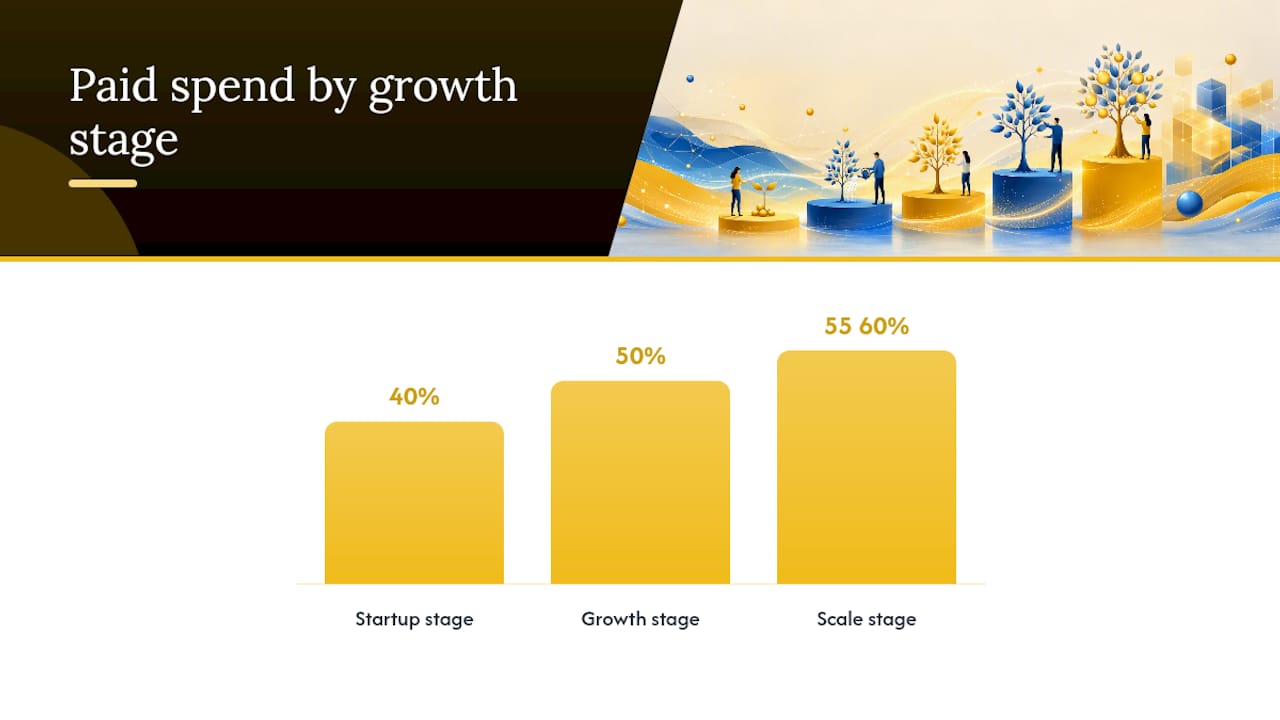
How you split spend across channels should shift as your business matures. A startup chasing its first hundred customers has almost nothing to be conservative about protecting. A scale-stage company has a lot to protect and a narrower window for experimentation as a share of total spend.
Startup stage (validating product-market fit, low brand recognition):
- 40% paid acquisition (search and social, testing multiple channels quickly)
- 25% content and organic (building owned assets that compound)
- 20% product-led or referral mechanics
- 15% experimentation and brand testing
Growth stage (proven channels, scaling what works):
- 50% proven paid channels with established CAC
- 20% scaling bets, channels showing early promise but not yet fully proven
- 15% content, SEO, and organic growth
- 10% experimentation
- 5% brand and awareness
Scale stage (mature channels, protecting margin, diversifying risk):
- 55% to 60% core proven channels
- 20% martech, tools, and marketing operations infrastructure
- 10% to 15% new channel diversification
- 10% experimentation, held disciplined even at scale
Creative spend deserves its own line item, and most budgets underfund it. For paid social and video specifically, industry guidance on marketing budget allocation recommends putting 15 to 25% of total paid social spend into creative production. Media spend without fresh creative just accelerates ad fatigue. If you’re pouring money into targeting and bidding while running the same three video assets for six months, you’re not optimizing a budget, you’re funding diminishing returns.
Three guardrails apply no matter what stage you’re in. First, separate martech and tooling costs from media spend in your reporting, they behave differently and get evaluated on different timelines. Second, always keep a testing reserve, even when a channel is performing well. Comfort is exactly when experimentation budgets get quietly zeroed out, right before you need the next channel already tested and ready.
If your paid social spend has been sliding without a clear cause, common paid social execution mistakes are worth reviewing before you assume the channel itself is the problem.
Monitoring, Reallocation Triggers, and Review Cadence
A budget that isn’t tracked against actuals is a forecast, not a plan. The fix is a simple tracking template and a fixed cadence for acting on what it shows.
That explanation column matters more than it looks. It forces whoever owns the number to articulate why a channel drifted, rather than just noting that it did.
Layer three review rhythms on top of that sheet, a structure recommended in practitioner guidance on building a marketing budget:
- Weekly: Light pacing checks. Is spend tracking to plan for the month? Are any campaigns burning budget faster than expected? This is a 15 minute check, not a full review.
- Monthly: Decision-grade reviews. This is where the 15% variance threshold gets applied and real reallocation decisions get made, not just noted.
- Quarterly: Strategic reallocation. Zoom out from individual channel performance and ask whether the overall mix, startup-style aggressive testing versus scale-style protection, still matches where the business actually is.
Specific triggers should prompt action outside the normal cadence, not wait for the next scheduled review:
- Cost per acquisition running 30% above target for four consecutive weeks
- Marketing efficiency ratio (MER) eroding below your established floor
- A strong early signal from a 10% experimentation bucket test, one worth pulling forward into the 20% scaling tier immediately rather than waiting for quarter-end
Pro Tip: Set your monthly review meeting for the same week every month, before month-end close, not after. Reviewing October’s numbers in mid-November means you’ve already lost three weeks of November to a problem you could have caught.
Governance Rules That Prevent Political Budget Fights
The single biggest predictor of budget chaos isn’t a bad forecast. It’s the absence of decision rules written down before anyone’s emotionally attached to a number.
Predefine your “if X then Y” rules at the start of the budgeting cycle, not in the middle of a heated Tuesday meeting. Writing these rules in advance turns reallocation into a process instead of a negotiation, a shift model practitioners increasingly point to as the fix for treating budgets as political rather than logical.
The strategic reserve exists specifically for the moments those rules trigger. Rather than stripping budget from a channel that’s already working to fund a new opportunity, the reserve gives you dry powder to deploy without disrupting anything else. Deploy it when a trigger condition is met, not on a whim, and refill it at the next quarterly review if it’s been drawn down.
Finally, tie every reallocation above a set dollar threshold to a required sign-off and a short written record of why the change happened. This doesn’t need to be bureaucratic. It just needs to exist. A one-paragraph note in a shared document, dated and attributed, is enough to keep the next budget cycle from relitigating decisions that were already made for good reasons.
Marketing Budget Allocation in the Trades: A Practical Example
Trade businesses face a version of this problem that most marketing budget guides ignore entirely: spend that generates more leads than your crews can actually service doesn’t create growth. It creates missed callbacks, frustrated customers, and technicians stretched past capacity. Specialized consulting firms often work with HVAC, plumbing, electrical, and remodeling businesses to align marketing investment with dispatch capacity, technician bandwidth, and job margin instead of treating lead volume as the only metric that matters.
Consider a general pattern that shows up across trade businesses making this shift: a company generating steady lead flow but with technicians running at or near full capacity often needs to redirect marketing dollars away from pure top-of-funnel volume and toward retention and maintenance agreement programs, work that fills the same crew hours with higher-margin, more predictable revenue. That’s driver-based allocation in practice: connecting the budget line item to the operational number (available technician hours) rather than to a vanity metric (raw lead count).

The Spartan case study and Elmers case study both walk through how this alignment between marketing spend and operational capacity played out for real trade businesses. Trades owners weighing whether their own lead generation matches what their team can actually deliver can find more detail in Rebuildingthetrades’ FAQ resource.
External Factors That Shift Marketing Budget Allocation
No budget survives contact with a changing market unchanged, and pretending otherwise is how six-month-old plans become irrelevant. Economic tightening typically pushes budgets toward lower-funnel, faster-payback channels, since a CFO under pressure wants to see revenue attribution sooner rather than trust a longer brand-building arc. That’s a defensible shift, but it comes with a cost: starving upper-funnel and brand investment for too long erodes the pipeline that lower-funnel channels depend on eighteen months out.
Rising platform costs are another constant pressure.
Interest rate shifts matter disproportionately for trade businesses, where big-ticket purchases (a new HVAC system, a full electrical panel upgrade) are sensitive to financing costs and consumer confidence. A budget built during a low-rate environment often needs its channel mix revisited when financing gets more expensive, since the customer’s buying calculus has genuinely changed, not just the marketing team’s targeting.
This is exactly why a quarterly strategic review matters more than an annual one. Gartner’s framing of the current environment as “do more with less” reflects real pressure across marketing organizations to justify every dollar against measurable outcomes, and that pressure only intensifies when the broader economy tightens. A budget that can’t flex to a market shift within a quarter isn’t a plan. It’s a bet you made once and stopped thinking about.
What I’d Prioritize Going Into 2026
Gartner’s framing of “do more with less” isn’t a slogan. It’s a mandate to stop funding channels out of habit and start funding outcomes, and most marketing organizations still aren’t set up to do that well. The teams that will separate themselves this year aren’t the ones with the biggest budgets. They’re the ones with the clearest decision rules.
I’d put governance and unit economics ahead of almost everything else on the priority list. A beautifully built channel mix means nothing if nobody’s agreed in advance on what triggers a reallocation, and a budget that ignores measured CAC in favor of hopeful CAC is a budget built on fiction. Creative investment for paid social and video is the other underweighted line item I’d fix first. Most teams cut creative production the moment budgets tighten, which is backward. Fatigued creative is often the actual reason a “declining channel” is declining.
If you take one thing from this: adopt the triage framework, run all three budgeting methods, and put a monthly review on the calendar before your next fiscal quarter starts. Everything else compounds from that decision.
— Dan
When Budget Alignment Needs Operational Backup
Everything above assumes your marketing spend is landing on a business that can absorb the leads it generates. For a lot of trade businesses, that’s the actual bottleneck, not the budget itself. Some consulting firms focus on HVAC, plumbing, electrical, roofing, remodeling, and siding companies where marketing produces calls and jobs the current operation can’t dispatch, staff, or price profitably yet.

This isn’t a marketing agency pitch. It’s operational consulting built around making the budget you’ve already approved actually convert into scheduled, profitable work: fixing dispatch bottlenecks, tightening the sales process that turns leads into signed jobs, and building the reporting systems that tell you which channel is actually paying for itself. If your lead volume already outpaces what your crews can service, more marketing spend won’t fix that. A clearer operational process might. The Elmers case study shows what that alignment looked like in practice for one trade business.
If you’re an owner or operator wondering whether your marketing budget is being wasted on a capacity problem rather than a lead-generation problem, start with Rebuildingthetrades’ business process mapping guide to see where the gap actually sits, or review engagement pricing to see what a hands-on operational audit looks like for a business your size.
FAQ
What Is the 70/20/10 Rule for Marketing Budget?
The structure protects core performance while still forcing continuous testing.
What Is Budget Allocation in Marketing?
Marketing budget allocation is the process of dividing total marketing spend across channels, campaigns, and initiatives based on goals, historical performance, and what the business can afford. The strongest approach triangulates percent-of-revenue benchmarks, objective-based goal calculations, and affordability rather than relying on any single method alone.
What Is the Ideal Marketing Budget Percentage?
The right figure for your business comes from where percent-of-revenue, objective-based needs, and affordability actually overlap.
How Often Should You Review a Marketing Budget?
Static, once-a-year budgets are one of the most common reasons marketing spend drifts away from actual performance.
How Much Should Trade Businesses Spend on Marketing Relative to Capacity?
Trade businesses should size marketing spend against dispatch and technician capacity, not lead volume alone, since generating more leads than crews can service creates missed callbacks rather than growth. Rebuildingthetrades works directly with HVAC, plumbing, electrical, and remodeling companies on this alignment between marketing investment and operational capacity.
0 Comments