
The roofing off season is the stretch when weather, not demand alone, throttles your production: winter in the northern states, peak summer heat or hurricane and rainy months in parts of the South. For a roofing owner, the question is not how to wait it out. It is how to enter that stretch with cash, a trained crew and a pipeline already built, so the slow months become your planning window. This guide covers when the off season hits, what it does to a roofing business, and the 90-day operating plan we would hand a roofing owner.
TL;DR
- Off season depends on region: the Bureau of Labor Statistics notes roofing work may be limited in northern states during winter months, while Southern markets slow for different reasons.
- The damage is rarely the lost revenue alone. It is fixed payroll, idle crews, thin cash and technicians who leave for steadier work.
- Start the plan in the shoulder season, eight to ten weeks before production slows: forecast cash weekly, close out jobs, collect receivables and lock in winter work.
- Use slow weeks for training, systems and pricing, the work you cannot do in June.
- Owners who want a trade-specific partner for this can look at our Rebuild program.
Table of Contents
- When is the roofing off season?
- What the off season actually does to a roofing company
- The 90-day off-season plan
- A worked example: a 12-person roofing company
- The mistakes that make the off season worse
- Our perspective
- How we help roofing owners prepare
- FAQ
- Sources
When is the roofing off season?
There is no single calendar. It depends on where your crews work.
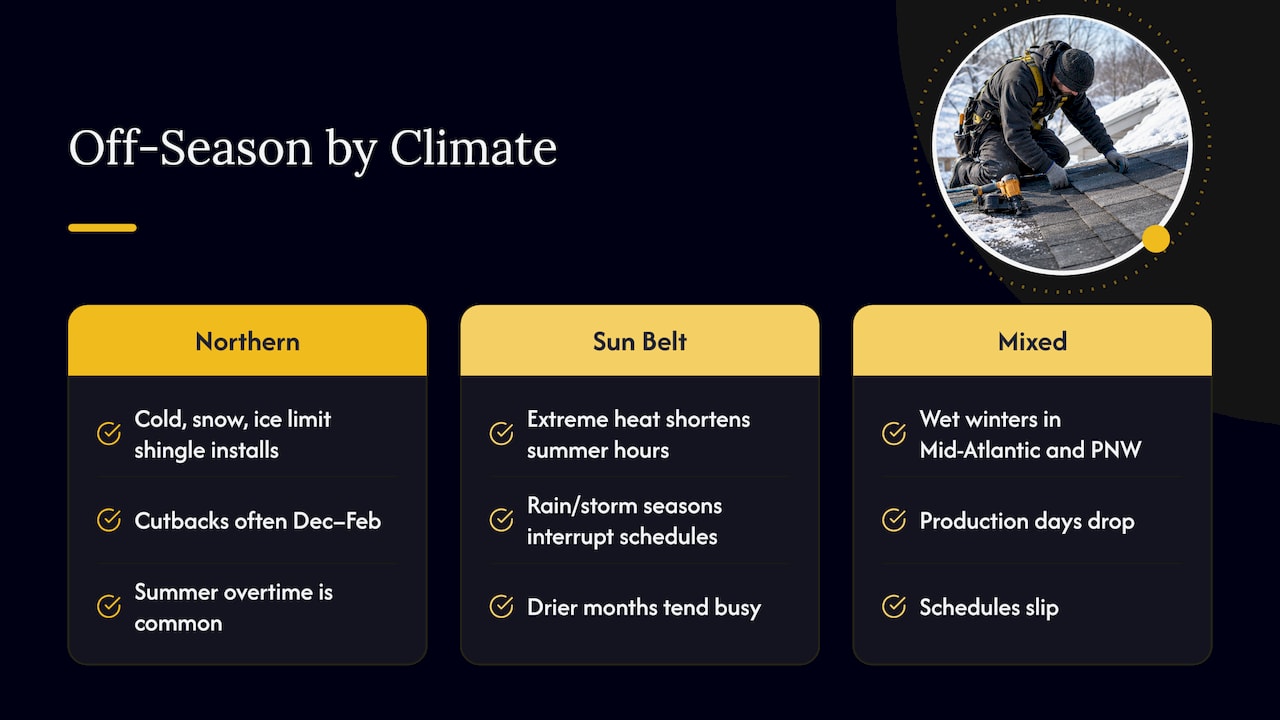
Northern and snow states. Cold temperatures, snow and ice limit shingle installs, so many crews cut back in the coldest weeks of the year, roughly December through February in many markets. The BLS says roofing work may be limited during winter in northern states, and that roofers often work overtime in the busy summer months, which is the other half of the problem: you earn a year of margin in about seven months.
Southern and Sun Belt states. The pattern flips or blurs. Extreme summer heat slows crews and shortens working hours, and rainy or storm seasons interrupt schedules. In those markets the drier months tend to be the busy window and the wet summer the slow one.
Mixed climates. The Mid-Atlantic and Pacific Northwest see wet winters. Work continues, but production days drop and schedules slip.
Homeowners searching this topic usually want to know whether winter is cheaper. That is a customer question. You are asking a different one: what does the slow stretch do to your company, and what do you do about it?
What the off season actually does to a roofing company
Most owners feel the off season as a revenue dip. The deeper problems show up in operations.
Fixed costs keep running
Trucks, insurance, software, office staff, loan payments and your best foreman’s salary do not pause because the roofs are frozen. A company that books revenue unevenly but spends evenly will run a cash gap every winter, even in a year of record sales.
Profit fades before you see it
Roofing jobs span weeks between contract, materials, install and final payment. Work in progress can look profitable on a sales report while labor overruns quietly erode the margin. Winter is when those overruns hit cash. Our guide to WIP accounting for contractors explains how to catch profit fade months before it lands in your bank balance.
Crews drift
Skilled installers and foremen who are laid off or cut to part-time often do not come back in spring. Rehiring and retraining costs more than most owners track. The labor burden on every hire, including payroll taxes, workers’ comp, insurance and tools, is easy to underestimate, which we cover in labor burden for contractors.
Spring becomes a scramble
Without a plan, March and April bring a flood of calls, an untrained seasonal crew, rushed estimates and discounted jobs sold in January out of fear. The off season sets the quality of your peak season.
The 90-day off-season plan
Think in three phases: shoulder, trough and ramp. Each has a different job.
Phase 1: The shoulder season (8 to 10 weeks before slowdown)
This is where the off season is won or lost. The aim is to enter the slow months with cash in the bank and clean books.
- Build a rolling cash forecast. Look at the last two or three years of revenue by month. Find your lowest months and your fixed cost per month. Then forecast the next 13 weeks and update it every week. Our walkthrough of the 13-week rolling forecast and the weekly cash flow rhythm show the layout.
- Close out work in progress. Finish punch lists, send final invoices and collect holdbacks. Every open job in December is cash you are financing yourself.
- Review the aging receivables. Call every account past terms. Do it personally or assign it to one accountable person.
- Forecast labor. Decide now who you keep full time, who moves to part-time and who you cannot afford to lose. A simple labor plan beats a layoff made in a panic. See our labor forecasting guide for contractors.
- Check material commitments. Avoid carrying stock you will not install until spring.
The same logic drives our shoulder season plan for HVAC contractors, and it translates directly to roofing: use the weeks before the slowdown to tighten operations, not to coast.
Phase 2: The trough (the slowest weeks)
Now the objective shifts from production to preparation. These are the weeks you cannot get back in July.
Fill the schedule with work that suits the weather. Depending on your market, that can mean repairs, leak calls, emergency tarping, ice dam work, flat or low-slope roof work in dry windows, gutters, siding or interior-adjacent scopes you already offer. Do this only where your crews are licensed and insured, and price it to cover real labor cost, not to keep trucks busy.

Sell next season’s work now. Estimates written in winter for spring installs convert to a booked backlog. Follow up on every unsold estimate from the previous year. Use a consistent process, with the same stages, follow-up timing and ownership for each lead. This is where sales training pays off: the slow weeks are the cheapest time to train your estimators.
Train the people you intend to keep. A foreman who can run a clean install, a project manager who protects margin, and a CSR who books the right jobs are worth more than another truck. Training you schedule in January is training that has no competing production pressure. Look at how we approach field supervisor training and service manager training.
Fix the call path. Winter calls are fewer, so every missed call costs more. Review how calls are answered, how leads are logged and how quickly an estimator responds. Our CSR training approach is written for HVAC, and the same call-to-KPI discipline applies to a roofing office.
Review your pricing. Knowing your true cost per labor hour and per square lets you quote winter work without giving margin away. Our piece on service pricing strategy lays out the numbers to know.
Phase 3: The ramp (4 to 6 weeks before the season returns)
- Confirm the crew roster and offer returning installers a start date, not a vague promise.
- Hold a preconstruction meeting standard for every job to cut rework. Our preconstruction meeting agenda gives nine items worth covering.
- Set your marketing budget by channel based on last year’s cost per booked job. See the marketing budget allocation approach.
- Stage materials and equipment, and inspect safety gear.
- Set weekly KPIs for the first month: booked jobs, install days completed, gross margin per job and cash collected.
A worked example: a 12-person roofing company
Take an illustrative company with $120,000 in monthly fixed costs (not a client case, just arithmetic). In a three-month slow stretch, the fixed cost is $360,000. If winter revenue covers only half, the company is short $180,000 before any surprises.
Now compare two approaches:
| No plan | With a 90-day plan | |
|---|---|---|
| Cash at start of slow season | Whatever is left after peak | Targeted reserve built during shoulder season |
| Open jobs in December | Several unbilled | Closed out and collected |
| Crew | Laid off, partly lost | Core kept, returning crew confirmed |
| Winter revenue | Panic discounts | Repairs, backlog and priced estimates |
| Spring start | Scramble | Staged and scheduled |
The figures are an example to show the mechanics. Your own numbers come from your own books, which is why the forecast comes first.
The mistakes that make the off season worse
- Discounting to keep crews busy. Jobs sold below cost lose money twice: once on the job, and once because the customer expects that price next year.
- Treating layoffs as the only lever. Hours, cross-training and scope mix are options you need time to plan.
- Watching only the bank balance. Cash is a lagging number. Weekly forecasts and job-level margin show trouble weeks early.
- Skipping training because “we’re too busy.” In peak season you are. In winter you are not.
- Having no owner for each task. Collections, estimate follow-up and training need a named person and a weekly check-in.
Our perspective
Many roofing owners describe the off season as a revenue problem. We treat it as a systems problem that revenue exposes. If cash is not forecast weekly, if no one owns follow-up and if foremen have never been trained to lead, a slow winter shows every gap at once.
That is why we focus only on the trades. A roofing company’s seasonality, job cost structure and crew dynamics are not the same as a software firm’s, and generic templates do not fit them. Our approach combines onsite work, data-driven systems and leadership development so the structure holds when the weather does not cooperate.
If you take one thing from this article, build the 13-week forecast and name an owner for every task in the plan above. Everything else gets easier once you can see the weeks ahead.
Dan
How we help roofing owners prepare
Rebuild is our hands-on program for trade businesses, covering sales training, management and leadership training, install and project management training, call management and dispatch training, financial operations and compliance assistance, and marketing analysis and strategy. For a roofing company heading into the slow months, that means working through the cash, the people and the pipeline together, with an operator focused on the trades.

If you want to plan your next off season with a team that works only with trade businesses, start on the Rebuild page. You can also read how other owners approached it in our case studies and in the Trade Intel blog.
FAQ
What is the off season for roofers?
It depends on region. In northern states it is generally winter, when cold, snow and ice limit shingle installs; the BLS notes work may be limited in winter there. In hot or storm-prone southern markets, the slow period can fall in summer.
How do roofing companies make money in the off season?
They shift the mix toward repairs, leak and emergency work, and any other scopes they are licensed for. They also sell and schedule spring installs early and collect outstanding receivables. The companies that fare best prepare in the shoulder season, not after production stops.
Should I lay off my roofing crew in winter?
Layoffs are one option, but they carry rehiring and retraining costs. A labor forecast lets you compare cutting hours, cross-training and keeping a core crew against the cost of rebuilding in spring. Decide on the numbers well before the slowdown begins.
When should I start planning for the slow season?
Eight to ten weeks before production usually slows. That is early enough to collect receivables, build cash and book work, and it leaves time to train people while crews are still on the payroll.
0 Comments