
Effective service manager training combines trade-specific leadership coaching with hands-on operational systems work, delivered through a workshop or cohort that forces the manager to apply what they learn on the job, not just in a classroom. That combination produces faster gains in dispatch accountability, technician retention, and P&L visibility than generic management courses ever will. Programs from industry groups like the Service Managers Leadership Lab run by ACCA, MSCA’s intensive workshops, and hands-on consulting from firms like Rebuildingthetrades all share this DNA: real scenarios, real numbers, real accountability.
Here’s how to think about your next move:
- Need a quick fix for a newly promoted manager who’s drowning? A short intensive workshop covers the basics fast.
- Need to rebuild dispatch, KPIs, or accountability systems from the ground up? A cohort or onsite consulting engagement fits better.
- Not sure which you need? Start with a business assessment before committing to either.
Key Takeaways
Hands-on, trade-specific training paired with a measured 90-day implementation plan produces faster, more durable gains in accountability and profitability than generic leadership courses alone.
| Point | Details |
|---|---|
| Match format to urgency | Choose a short intensive for immediate skill gaps and a multi-month cohort or onsite work for deeper system rebuilds. |
| Require five curriculum areas | Any program should cover financials, leadership coaching, dispatch, KPIs, and customer communication. |
| Protect the first 90 days | Structured overlap, coaching time, and weekly scorecards prevent a promoted technician from reverting to old habits. |
| Demand proof before buying | Ask vendors for case studies, sample sessions, and a measurement plan, not just a curriculum outline. |
| Rebuildingthetrades pairs training with systems | Its engagements combine onsite audits, coaching, and accountability systems, with case studies showing measurable operational outcomes. |
Table of Contents
- What Training Formats Actually Work for Service Managers?
- What Should the Curriculum Actually Cover?
- How Do You Choose the Right Training Program?
- How Do You Onboard a New Service Manager Without Breaking Operations?
- Do These Training Approaches Actually Produce Results?
- What Most Owners Get Wrong About Manager Training
- How Rebuildingthetrades Approaches Service Manager Training
- Frequently Asked Questions
- Sources
What Training Formats Actually Work for Service Managers?
Trade businesses don’t need a one-size-fits-all leadership course. They need a format that matches how urgently they need change and how much system rebuilding is required.
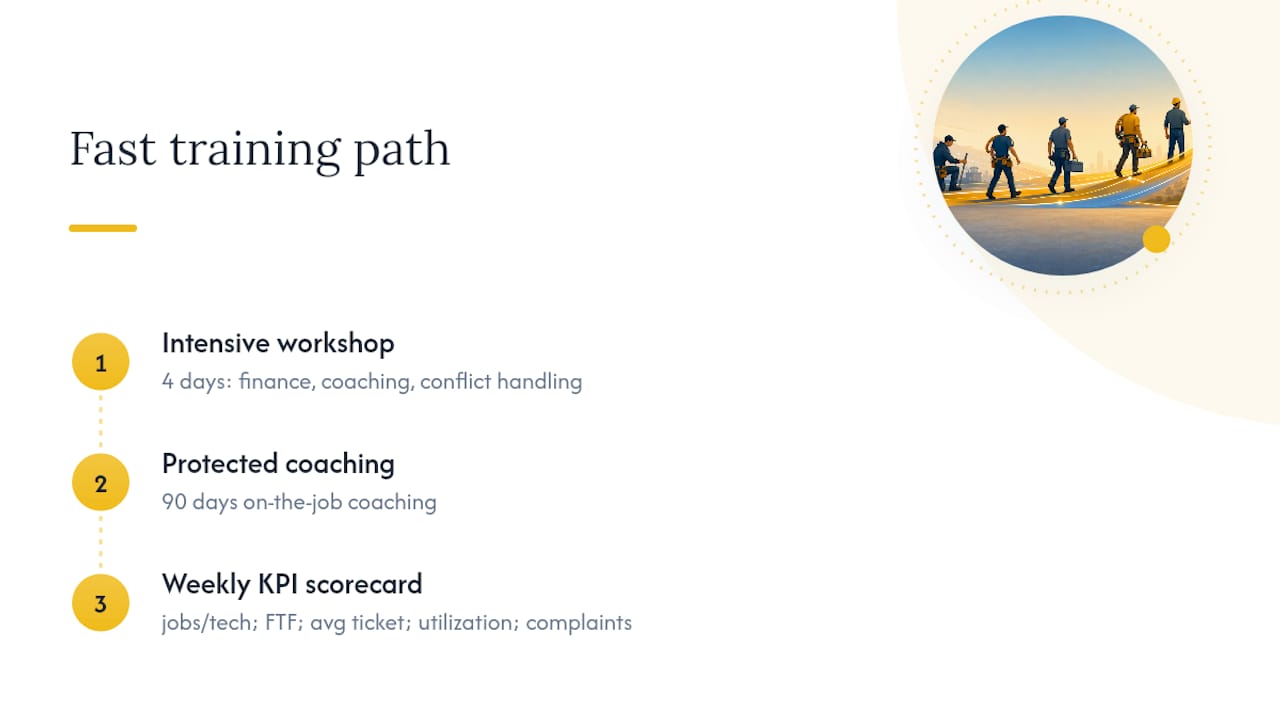
Short intensives solve immediate skill gaps. MSCA’s four-day Service Managers Training Program packs financial management, communications, coaching, and conflict management into a compressed schedule built around applied exercises rather than lectures. It’s the right call when a technician just got promoted and needs a leadership foundation this month, not next quarter.
Multi-month cohorts work when the manager needs paced accountability. ACCA’s Service Managers Leadership Lab stretches across roughly seven months, layering operations, safety, and financial fundamentals month by month so managers practice each skill on real jobs before the next module lands.

Self-paced courses offer flexibility but demand discipline. ACCA’s New HVAC Manager Essentials runs about 11 hours with 180 days of access, which works for a manager who learns well independently but needs someone checking that lessons actually get applied.
Onsite coaching or blended engagements matter most when the real problem isn’t the manager’s skill set. It’s the dispatch system, the KPI tracking, or the absence of accountability structure around them.
Pro Tip: Don’t pick a format based on price or convenience alone. Match it to how much operational rebuilding your business needs, not just how much leadership polish your manager needs.
What Should the Curriculum Actually Cover?
Ask any vendor pitching “service manager training” to show you their module list. If it doesn’t include these five areas, keep looking.
- Financial fundamentals. Reading a P&L statement, understanding job costing, spotting margin erosion before it becomes a crisis, and running quick budget controls for the department.
- Leadership and coaching. Structured one-on-ones, a feedback framework that isn’t just “good job” or “fix this,” conflict coaching, and a plan for retention and succession. One of the most persistent training mistakes in the trades is treating leadership and task management as the same skill. Task management gets the truck to the job site; leadership gets the technician to stay five years and coach the next hire, and that distinction requires its own communication framework, not an assumption that good technicians naturally become good coaches.
- Dispatch and operations. Scheduling rules, capacity planning, triage protocols, and routing that actually accounts for technician skill level and drive time.
- KPI tracking and reporting. Jobs per technician per day, first-time-fix rate, average ticket size, technician utilization, and complaint rate, all visible on a scorecard the manager reviews weekly, not quarterly.
- Documentation and customer communication. Field professionalism standards, clear escalation rules for when a job goes sideways, and scripts for customer updates that don’t leave the office guessing what happened on-site.
Programs like MSCA’s four-day workshop and ACCA’s leadership lab and manager essentials course all build around this same core, with curricula centered on financial fundamentals, leadership, dispatch, and KPI systems. The consistency across independent industry programs is itself a signal: these five areas aren’t optional extras, they’re the job.
How Do You Choose the Right Training Program?
Before signing up for anything, run the decision through a short checklist that filters out generic content dressed up as trade training.
- Business fit: Does the format match your urgency? A cohort makes no sense if you need a manager functional in three weeks.
- Hands-on application: Does the program include role-specific exercises, or is it lecture-and-slides?
- Evidence: Ask for case studies, sample session plans, and measurable KPI targets before you commit. Customized programs that apply directly to daily dispatch and financial problems consistently outperform generic content.
- Follow-up coaching: Training that ends the day the workshop ends rarely sticks. Ask what happens in week two.
Red flags worth walking away from: generic management content with no trade-specific scenarios, no role-based exercises, no way to measure whether the training worked, and no onsite or implementation support once the session ends.
Budget and timing vary widely. A four-day workshop runs a few thousand dollars per manager. A seven-month cohort costs more but spreads the investment over time. Onsite consulting engagements, which rebuild systems alongside training, typically run as multi-month contracts and cost more upfront but address the operational gaps a classroom never touches.
Pro Tip: Ask any vendor one blunt question: “What does my manager measurably do differently 90 days after this ends?” If they can’t answer specifically, they’re selling a seminar, not a transformation.
How Do You Onboard a New Service Manager Without Breaking Operations?
Promoting your best technician into a manager role and walking away is the single most reliable way to waste a good technician and get a bad manager. A structured overlap and protected coaching time matter more than the training content itself in those first 90 days.
- Weeks 1 to 2: Set expectations in writing. Define what success looks like at 30, 60, and 90 days. Overlap with the outgoing lead if one exists.
- Weeks 3 to 6: Shadow real dispatch decisions and one-on-ones. Protect at least a few hours of admin time weekly so the new manager isn’t just running calls.
- Weeks 7 to 10: Hand over scripted coaching conversations and an escalation matrix so the manager knows exactly when to loop in ownership.
- Weeks 11 to 13: Full ownership of weekly scorecards, dispatch audits, and one-on-one agendas, with ownership still reviewing results, not just activity.
| Milestone | What to Measure |
|---|---|
| Week 2 baseline | Current jobs per tech, first-time-fix rate, complaint volume |
| Week 6 checkpoint | Change in scheduling errors, technician feedback on communication |
| Week 10 checkpoint | Scorecard consistency, escalation response time |
| Week 13 review | Movement on baseline KPIs, retention signals, P&L visibility |
Structured one-on-ones and documented coaching conversations remain the most reliable tools for building accountability without micromanaging. Early warning signs of a failing transition: scorecards stop getting updated, the manager reverts to running jobs instead of running people, or complaint volume creeps up without anyone noticing for weeks.
Do These Training Approaches Actually Produce Results?
Case studies beat theory here, and the trades have real ones. Rebuildingthetrades’ work with the Tri-Trade organization focused on rebuilding dispatch workflows, scheduling discipline, and productivity tracking, the exact systems most manager training programs mention but rarely implement alongside the coaching.
The pattern across these engagements and the industry programs cited throughout this piece stays consistent:
- Training content maps to ACCA and MSCA’s own curricula: financial fundamentals, leadership, dispatch, KPIs.
- Outcomes get measured, not assumed. One client engagement is associated with a $21 million run-rate outcome tied to improved operational clarity.
- The training locks in only when it’s paired with system changes: scorecards, audits, escalation rules, not a workshop certificate alone.
That combination, hands-on coaching plus data-driven operational systems, is what separates a training program that produces a plaque from one that produces a P&L improvement.
What Most Owners Get Wrong About Manager Training
The conventional advice treats service manager training like a single event: send your best tech to a workshop, hand them a title, move on. That’s backwards. The research and the case studies both point to the same conclusion: training only works when it’s followed by 90 days of protected, coached, measured implementation. A four-day MSCA workshop or an ACCA cohort gives a manager the vocabulary and the framework. It doesn’t give them the muscle memory to run a scorecard review under pressure or have a hard conversation with a technician who’s coasting.
What’s overrated is the assumption that leadership skill transfers automatically from technical skill. Your best technician got there by being excellent at the trade, not by being excellent at coaching people through conflict. Training has to teach that separately, deliberately.
What owners should prioritize first isn’t the curriculum. It’s the onboarding sequence around it: overlap time, protected coaching hours, and a measurement plan that catches drift before it becomes a crisis three months in.
How Rebuildingthetrades Approaches Service Manager Training
Rebuildingthetrades doesn’t sell a standalone workshop and walk away. The engagement pairs onsite audits and tailored training cohorts with the KPI scorecards, leadership coaching, and accountability systems the training actually needs to stick once the session ends.

That’s the gap most training programs leave open: solid curriculum, no system to reinforce it once the manager’s back on the floor. Case studies like the Tri-Trade engagement and the Champion case study show what happens when training gets paired with dispatch rebuilds and financial visibility work instead of standing alone. If your business needs a manager who can run dispatch, read a P&L, and coach a crew without losing a step operationally, start with a business assessment on the pricing page to see what a tailored engagement looks like for your specific team size and trade.
Frequently Asked Questions
What is the fastest way to train a new HVAC or plumbing service manager?
A four-day intensive workshop, like MSCA’s Service Managers Training Program, delivers foundational skills in financial management, coaching, and conflict handling fastest. Pair it with 90 days of protected coaching time on the job to make it stick.
How long does service manager certification typically take?
It ranges widely. Self-paced courses like ACCA’s New HVAC Manager Essentials run about 11 hours with extended access, while leadership cohorts like the Service Managers Leadership Lab span roughly seven months.
Can a technician become an effective manager without formal training?
Rarely, and not sustainably. Technicians promoted without transition coaching, communication frameworks, and protected implementation time tend to revert to doing the technical work instead of leading the team.
What KPIs should a new service manager track first?
Start with jobs per technician, first-time-fix rate, average ticket size, technician utilization, and complaint rate. Review them weekly on a scorecard rather than waiting for a quarterly report.
Does onsite coaching matter more than classroom training?
For businesses with broken dispatch systems or unclear KPIs, yes. Classroom training teaches the concepts, but onsite coaching applies them to your actual scheduling, financial, and accountability problems.
0 Comments