
On-site, practice-first leadership training built for plumbing businesses, not generic management courses, is the fastest route from owner-operator chaos to a scalable company. Owners who run structured programs like a 90 Day Pilot report clearer KPIs, tighter estimating and pricing, and higher ticket averages within a quarter. The sections below cover the curriculum, how to pick a program, and a 30 to 90 day roadmap you can start this month.
TL;DR:
- A 2026 workforce study found 41% of plumbing and heating contractors struggle with estimating and 33% with pricing, the leading reported skill gaps.
- After training, track estimate to close ratios after estimating, average ticket value after pricing, and callback rates after install management.
- Choose providers whose examples come from plumbing, who train on site, document results, align with tracked KPIs, and offer follow up coaching.
- A pilot establishes baselines in the first month, delivers on site training and coaching in the second, and sets weekly KPI reviews by day 90.
Table of Contents
- Why leadership training matters for plumbing business owners
- Core curriculum and delivery: modules, design elements, and measurement
- How to evaluate and select a plumbing leadership training program
- 30 to 90 day implementation roadmap (example 90 Day Pilot)
- Realistic outcomes and sustaining change
- How Rebuilding the Trades can help you train your team
- FAQ
- Sources
Why leadership training matters for plumbing business owners
Most plumbing owners built their companies on technical skill, not management systems. A 2026 workforce study found that plumbing and heating contractors rank growing revenue as their top business priority, yet many report gaps in estimating, pricing, scheduling, and bookkeeping, the exact skills that determine whether revenue turns into profit. The same reporting found 41% struggle with estimating and 33% with pricing, numbers that explain why so many busy shops still run on thin margins.
Research on small businesses backs this up directly. Owners who complete formal management training see measurable gains in profitability, staff productivity, and retention compared with owners who never formalize their management approach. The lesson for plumbing owners: technical mastery gets you a full schedule, but management skill is what keeps the money.
KPIs sit at the center of this shift. MIT Sloan Management Review argues that KPIs are strategic tools, not reporting afterthoughts, and that leaders who align daily decisions to a short list of metrics outperform those who review numbers only at month end.
Owners who adopt this mindset typically see movement in a few concrete areas:
- Estimate accuracy improves once techs and estimators work from a shared pricing method.
- Average ticket size climbs when price books and scripts are trained, not just handed out.
- Dispatch efficiency rises as supervisors learn to triage calls instead of reacting to them one at a time.
Many plumbing owners report estimating and pricing as their biggest non-technical skill gap, and that gap is exactly what structured leadership training targets first.
Core curriculum and delivery: modules, design elements, and measurement
Effective plumbing leadership programs cover a consistent set of modules, delivered in a specific order so each one builds on the last.
- Leadership and accountability basics, including how supervisors hold techs to standards without becoming the bottleneck.
- KPIs and flash reports, teaching owners which five or six numbers actually drive decisions.
- Estimating and pricing, standardizing how a job gets quoted so margin stops depending on who answered the phone.
- Dispatch and call management, training dispatchers to route calls by value and urgency, not just by order received.
- Project and install management, covering scheduling, material staging, and crew communication on larger jobs.
- Succession planning, building a second-in-command who can run the shop when the owner cannot.
- Apprenticeship basics, giving new hires a structured path instead of informal shadowing.
The delivery method matters as much as the content. A meta-analysis of leadership training design found that programs built around needs analysis, participant feedback, active practice, and spaced on-site sessions produce stronger transfer than one-off lectures or fully remote courses. For plumbing crews, that translates into on-site modules with hands-on practice, followed by short virtual check-ins to keep the material active between sessions.
Measuring whether a module worked does not require a complicated dashboard. Track estimate-to-close ratio weekly after the estimating module, average ticket value monthly after the pricing module, and callback rate after the install management module. These are the same metric types covered in our breakdown of field service KPIs and formulas.
Pro Tip: Run one module at a time and hold the next session until the prior month’s KPI shows movement, rushing the curriculum is the fastest way to lose the team’s attention.
How to evaluate and select a plumbing leadership training program
Not every management course built for general small businesses will translate to a plumbing shop’s daily reality. A few criteria separate programs that stick from ones that get forgotten after the invoice clears.
- Trade specialization: the curriculum should reference plumbing-specific scenarios, not generic retail or office examples.
- On-site delivery: look for in-field practice, not just slide decks and webinars.
- Documented outcomes: ask for case studies with real financial or operational results, not just testimonials.
- KPI alignment: the program should connect directly to the metrics you already track or help you build them.
- Implementation support: coaching after the sessions end matters more than the sessions themselves.
When you interview a provider, ask direct questions:
- What does a typical 30, 60, and 90 day engagement look like, and what changes by each checkpoint.
- Can you walk through a case study with specific before-and-after numbers.
- Who delivers the training, and do they have hands-on trade experience.
- What happens if the KPIs do not move after the pilot.
A reasonable expectation is early, visible movement in one or two KPIs within 60 days, with fuller operational change by 90. Treat vague timelines or a refusal to show a sample case study as a red flag. Before committing to a multi-month engagement, ask whether the provider offers a pilot or proof-of-concept period, a shorter commitment that lets you test fit and see early numbers before scaling the relationship.
30 to 90 day implementation roadmap (example 90 Day Pilot)
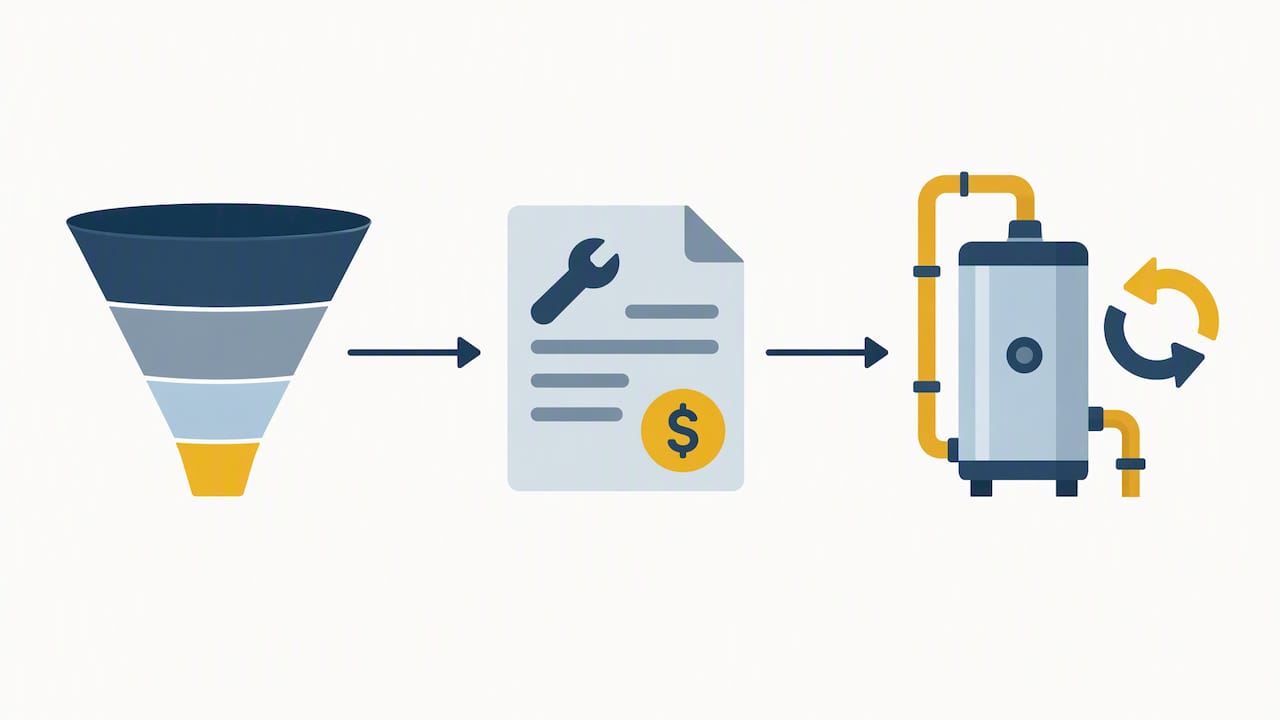
A focused pilot gives owners a way to test leadership training without betting the whole year on it. A structured 90 Day Pilot model typically breaks into three phases.
- Days 1 to 30: run an operational audit, establish baseline KPIs, and brief supervisors and key staff on what is changing and why.
- Days 31 to 60: deliver on-site modules covering supervisor training and a price book and script rollout, with coaching sessions starting and initial KPI checks against baseline.
- Days 61 to 90: lock in a weekly KPI review cadence, confirm supervisor accountability routines, document the new processes, and report early ROI against the baseline.
Supervisors, dispatchers, and the owner should attend the core sessions, since training that only reaches the owner rarely survives contact with the daily schedule. Expect a few hours a week from each attendee during the active training weeks, tapering to a short weekly check-in once the KPI cadence is established.
Field-delivered price book and script rollouts, paired with supervisor coaching, commonly raise average ticket size for trained plumbing shops, which is why that module sits early in most 90 day structures rather than being left for later.
Sample 30/60/90 metrics to track include estimate-to-close ratio at day 30, average ticket value at day 60, and callback or rework rate at day 90. For a deeper breakdown of supervisor-specific training structure, see our piece on field supervisor training with 30 to 90 day results.
Realistic outcomes and sustaining change
Leadership training works when owners treat it as a system, not a seminar. Case studies from trade-focused consulting work show shops reaching measurable run-rate improvements after combining training with accountability systems and financial visibility, but the numbers hold only when KPIs get checked weekly, not quarterly.
Embedding a short daily or weekly KPI review into the existing rhythm matters more than any single training day. Building a second-in-command who owns that review when the owner cannot is what turns a training program into a lasting operational habit, a point covered in more depth in our succession planning guide for contractors. Expect the full arc, training, new systems, and a shifted culture, to take a full quarter at minimum, and expect it to stall without the owner’s visible participation.
— Dan
How Rebuilding the Trades can help you train your team
We built our approach around the gap most plumbing owners hit: strong technical skill, weak management systems. Our Management & Leadership Training runs on-site, alongside a Price Book and script rollout, call management and dispatch training, and apprenticeship groundwork, all delivered by people who have worked inside trade businesses, not generic business coaches.

A pilot engagement typically follows the same 30/60/90 structure covered above: an audit and baseline in the first month, on-site modules and coaching in the second, and a documented KPI cadence with early results reporting by day 90.
| Service | What it covers |
|---|---|
| Rebuild | Full operational turnaround across leadership, KPIs, and systems |
| Management & Leadership Training | Supervisor and owner leadership development, accountability routines |
| Call Management & Dispatch Training | Dispatch triage, call handling, routing by value |
| Install and Project Management Training | Scheduling, crew coordination, job staging |
If you want to coordinate field data and dispatch routines alongside this kind of training, a platform like Won2Build’s field-to-office tools can help keep supervisors and the office on the same numbers between sessions.
Ready to see where your team stands? Check our pricing and request a pilot audit to get a clear starting point before committing to a full engagement.
FAQ
What is plumbing leadership training?
Plumbing leadership training is hands-on, on-site instruction that teaches plumbing business owners, GMs, and supervisors how to run operations: KPIs, estimating and pricing, dispatch, and team accountability. It differs from technical trade training because it focuses on running the business, not performing the trade work itself.
How long does leadership training take to show results?
Most structured programs use a 30 to 90 day pilot format, with early KPI movement, such as estimate-to-close ratio, visible by day 30 and fuller operational change by day 90. Full culture and systems change typically takes a full quarter or longer, backed by training design research showing spaced, on-site practice produces stronger results than one-off sessions.
What topics should a plumbing leadership program cover?
A solid curriculum covers leadership and accountability, KPIs and flash reporting, estimating and pricing, dispatch and call management, project and install management, succession planning, and apprenticeship basics. These modules map directly to the skill gaps, especially estimating and pricing, that plumbing contractors report most often.
How much does Rebuilding the Trades’ leadership training cost?
Pricing for our Management & Leadership Training and related services is available on request, since engagements are scoped to each shop’s size and needs. You can check current pricing details or request a pilot audit to get a specific quote.
What is a 90 Day Pilot program?
A 90 Day Pilot is a short, structured engagement that runs an operational audit in the first month, delivers on-site training modules and coaching in the second, and establishes a KPI review cadence with early results reporting by the third. It gives owners a lower-risk way to test a training provider before committing to a longer transformation engagement.
Sources
- What Contractors Say They Need for Tomorrow’s Plumbing Business | phcppros
- Leadership training design, delivery, and implementation: A meta-analysis.
- Strategic Alignment With AI and Smart KPIs | MIT Sloan Management Review
- Exploring the link between management training and organizational performance in the small business context
0 Comments