
An effective employer-run apprenticeship for trades combines structured on-the-job learning, a qualified mentor, related instruction, and documented competency checks tied to wage progression. Start by running a quick job-task needs assessment on your critical roles, then write a one-page training plan before you touch anything else.
TL;DR:
- Most trade apprenticeships should include at least 2,000 hours of on-the-job training, with competency checks replacing or supplementing hours for faster progress.
- A hybrid training model, combining minimum hours with competency-based assessments, is recommended to prevent rushing unqualified workers and reward fast learners.
- Related instruction should cover around 144 hours annually, focused on clear learning objectives for specific tasks, delivered via classes, trade schools, or in-house sessions.
- Mentors must be screened for teaching ability, maintain supervision ratios of one or two apprentices initially, and undergo training in providing constructive feedback.
- Documentation, including logs, agreements, and competency scores, must be consistent and stored centrally to ensure compliance and support evaluation during audits.
Table of Contents
- A 6-step checklist to launch your program in 30 to 90 days
- How to build the work-process schedule and on-the-job training structure
- Turning your best techs into mentors who can actually teach
- Records, agreements, and when formal registration matters
- Competency checks and the KPIs that prove the program is working
- Piloting the program before you scale it across the company
- Why this has to be an operations decision, not an HR checkbox
- How Rebuilding the Trades helps you build and run the program
- Where to check official standards and registration rules
- Sources
- FAQ
A 6-step checklist to launch your program in 30 to 90 days
Building a program from scratch feels bigger than it is when you break it into a sequence. Most owners can move from idea to a running pilot inside a quarter if they work through these steps in order.
- Map the critical occupations in your business (HVAC install tech, plumbing service tech, electrical apprentice) and list the specific tasks each one must master.
- Choose a training approach: time-based, competency-based, or a hybrid, then set the progression rules that will govern advancement.
- Define who can mentor, how many apprentices each mentor can supervise, and what accountability looks like for that role.
- Draft a written training plan and an apprenticeship agreement that spells out expectations, pay, and duration for both parties.
- Set up a simple recordkeeping system that tracks on-the-job learning hours, assessment results, and wage changes without adding a full-time admin job.
- Pick three KPIs that tie apprentice progress directly to business outcomes, such as first-time fix rate or time-to-proficiency.
Getting these six steps on paper before you recruit your first apprentice saves you from rebuilding the program mid-stream once problems surface.
How to build the work-process schedule and on-the-job training structure
Start with a job-task analysis: sit down with your best techs and list every task a fully competent tech performs, then group those tasks into a work-process schedule with rough hour allocations. This schedule becomes the backbone of your curriculum and the reference mentors use to know what to teach next.
You have three structural choices. A time-based model advances apprentices after a set number of on-the-job learning hours, which is simple to run but can hold back a fast learner or pass along someone who hit the hours without mastering the work. A competency-based model advances apprentices only when they demonstrate mastery of specific tasks, which shortens time-to-productivity but demands more disciplined assessment. A hybrid model blends both, using hour minimums as a floor and competency checks as the real gate, and it tends to fit trade businesses best because it protects against rushing while still rewarding fast learners.
Registered apprenticeship guidance permits time-based, competency-based, or hybrid approaches and recommends a baseline of at least 2,000 hours of on-the-job learning for apprenticeable occupations.
For related instruction, plan around these building blocks:
- Assign each task cluster a clear learning objective the apprentice must demonstrate, not just attend a class on.
- Deliver related instruction through night classes, a trade school partnership, or structured in-house sessions, whichever fits your crew’s schedule.
- Sample HVAC modules might cover refrigerant handling, airflow diagnostics, and electrical troubleshooting; plumbing modules might cover drain-waste-vent systems, backflow prevention, and code compliance; electrical modules might cover load calculations, panel work, and NEC fundamentals.
State standards commonly set related instruction at around 144 hours per year, with a common pass threshold near 70% on assessments. That figure gives you a planning target even if you never formally register.
Turning your best techs into mentors who can actually teach
A journeyworker with fifteen years on the tools isn’t automatically a good mentor. Screen for teaching aptitude, patience under pressure, and willingness to slow down, not just tenure or technical skill.
- Match mentors to apprentices based on schedule overlap and learning style, not seniority alone.
- Require every mentor to keep a simple observation record after each significant task, noting what the apprentice did well and what needs repeating.
- Set a supervision ratio that keeps mentors accountable, typically one mentor to one or two apprentices during the first several months, loosening as competency checks clear.
- Train mentors specifically in giving structured feedback, since demonstrating a skill and coaching someone through it are different abilities.
Mentoring pairs technical demonstration with modeling of professional habits like time management and decision-making, and it rarely works without deliberate mentor screening and coaching. Our service manager training breakdown covers how to build evaluation criteria that mentors can use consistently.
Pro Tip: Have new mentors shadow an experienced one for two weeks before assigning their first apprentice, so they see the observation and feedback routine in action before they own it.
Records, agreements, and when formal registration matters
Documentation is what turns a training habit into an audit-ready program, and it protects you if a dispute ever comes up over pay or advancement.
- Keep applicant qualifications, on-the-job learning hour logs, related instruction results, competency assessment scores, and wage progression records in one place, even a shared spreadsheet works at small scale.
- Use written selection procedures that apply the same criteria to every applicant, since sponsors with five or more apprentices typically must adopt an affirmative action plan and are subject to program reviews.
- Draft an apprenticeship agreement covering duration, wage steps, and the specific competencies required for each advancement, and set a review date to keep it current.
- If you choose to register formally, Apprenticeship.gov outlines the five building blocks a registered program needs: industry-vetted standards, paid work, structured on-the-job learning with mentorship, supplemental education, and a recognized credential.
- Build a monthly reporting cadence, even fifteen minutes reviewing the log, so nothing falls through the cracks until a program review forces the issue.
None of this needs to be complicated. It needs to exist, and it needs to be consistent every time you use it.
Competency checks and the KPIs that prove the program is working
Assessment should combine a written or knowledge test with a hands-on demonstration, and both need a pass threshold before you sign off on advancement. A tech who can describe a procedure but can’t execute it under normal shop pressure hasn’t actually mastered the task yet.
- Track first-time fix rate for apprentices against your journeyworker average to see the gap closing over time.
- Watch rework rate and callback frequency as a direct signal of skill retention, not just knowledge recall.
- Measure time-to-proficiency for each competency cluster so you know how long training actually takes in your shop.
- Track billable hours per apprentice and retention past the first year, since a program that trains people who then leave isn’t paying for itself.
- Run a quarterly program review where you look at these numbers together and adjust the curriculum or mentor assignments if something isn’t moving.
Tying wage progression to documented competency rather than hours alone keeps pay increases honest and keeps apprentices motivated to demonstrate skill, not just show up. OSHA’s training guidance similarly recommends pairing supervisor observation with practical demonstration and outcome monitoring rather than relying on a single test format. Owners who want sharper estimating skills baked into the curriculum can look at tools like BidBlock, which some contractors use to connect field accuracy with the bidding process. For the management side of these reviews, our piece on running a performance review process covers how to structure the conversation so it changes behavior instead of just documenting it.
Piloting the program before you scale it across the company
Don’t launch company-wide on day one. Run a pilot with one or two apprentices and one mentor first, and use it to find the gaps in your paperwork and your assumptions.
- Set a 3 to 6 month pilot window with checkpoints every 30 days to review progress against your training plan.
- Build an onboarding checklist covering safety orientation, tool issuance, schedule expectations, and who the apprentice reports to.
- Set wage progression steps tied to competency milestones, with a probationary period in the first 60 to 90 days to catch a poor fit early.
- Once the pilot clears its checkpoints, standardize the documentation, add mentor capacity gradually, and consider partnering with a registration sponsor only once the internal system runs smoothly on its own.
Our 30-60-90 onboarding playbook walks through the same checkpoint structure for new hires generally, and it adapts directly to apprentice onboarding.
Why this has to be an operations decision, not an HR checkbox
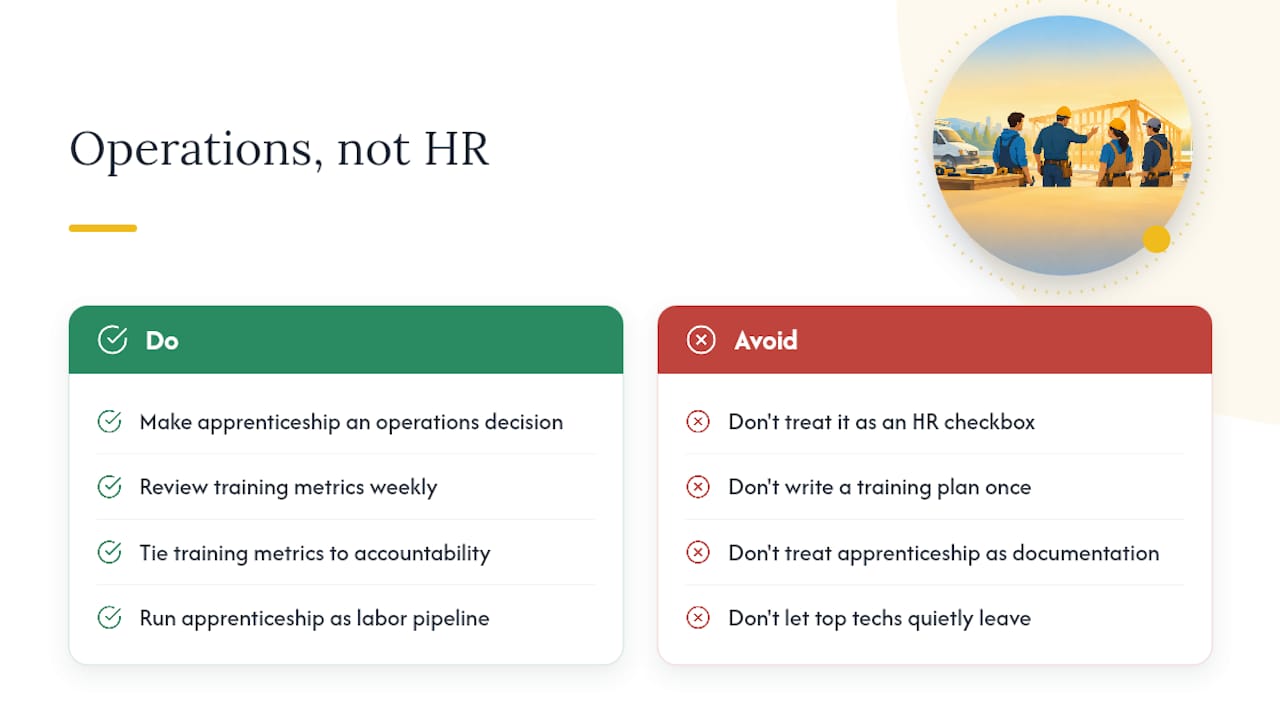
Owners tend to file apprenticeship under recruiting or compliance, and that’s the mistake. A structured program is an operations lever: it sets your labor pipeline, controls your callback rate, and determines whether your best techs are training the next generation or quietly planning to leave because nobody invested in them.
The businesses that get this right treat training metrics the same way they treat dispatch numbers, reviewed weekly, tied to real accountability. The ones that get it wrong write a training plan once, file it, and wonder a year later why turnover hasn’t moved. Apprenticeship only pays off when someone owns it operationally the same way they own scheduling or cash flow.
Apprenticeship is not a documentation exercise, it is a labor pipeline you either run on purpose or absorb the cost of not running.
— Dan
How Rebuilding the Trades helps you build and run the program
You don’t have to build this system by trial and error while running the rest of your business. Rebuilding the Trades works hands-on inside trade companies, matching specific services to the exact gaps most owners hit when standing up an in-house apprenticeship.

- Management & Leadership Training helps you turn journeyworkers into mentors who actually coach instead of just demonstrate.
- Install and Project Management Training builds the task-level standards your work-process schedule needs.
- Financial Operations and Compliance Assistance helps you build the recordkeeping and wage progression systems that keep the program audit-ready.
- Call Management & Dispatch Training connects apprentice scheduling to your existing dispatch operation instead of running it as a separate system.
One client’s three-tier maintenance agreement strategy shows the kind of operational clarity that comes from building structured systems inside a trade business, the same approach behind the $21 million run rates Rebuilding the Trades has documented in its case studies. If you’re ready to stop guessing at your training structure and build one that ties directly to your KPIs, visit the Rebuild service page to see which service fits your current gap, or start with a conversation through Rebuilding the Trades.
Where to check official standards and registration rules
For registration basics, work-process schedule templates, and OSHA-aligned safety training standards, consult Apprenticeship.gov and your State Apprenticeship Agency before finalizing your training plan.
Sources
- 2026-01 Registered Apprenticeship Training Approaches
- OSHA training guidelines
- Oregon apprenticeship standards (sample)
FAQ
What are the core elements every apprenticeship program needs?
A solid employer-run program needs structured on-the-job learning under a mentor, related instruction, documented competency assessments, and wage progression tied to that documented competency. These four building blocks come directly from how registered apprenticeship programs are structured, and they work whether or not you formally register.
How many hours of related instruction should an apprentice complete each year?
State standards commonly set related instruction at around 144 hours per year, delivered through classes, trade school partnerships, or structured in-house sessions.
Should I use a time-based or competency-based training model?
A hybrid model tends to work best for trade businesses because it sets an hour floor while gating real advancement on demonstrated skill. Pure time-based models can pass someone through without true mastery, while pure competency-based models demand more assessment discipline than most shops can sustain alone.
What supervision ratio should I set between mentors and apprentices?
A ratio of one mentor to one or two apprentices during the first several months gives mentors enough bandwidth to observe, document, and give real feedback. That ratio can loosen once an apprentice clears their initial competency checks.
When does my program need to formally register or adopt an affirmative action plan?
Formal registration is optional, but sponsors with five or more apprentices typically must adopt an affirmative action plan and written selection procedures. Check with your Registration Agency or State Apprenticeship Agency before you cross that threshold.
0 Comments