
Use a continuous performance management cycle, regular check-ins plus a mid-year and annual formal review, to improve outcomes and cut down on surprises. The OPM’s own model breaks this into four stages: plan, monitor, review, reward. If you manage technicians or field crews, this loop matters even more, because most of the evidence that actually proves someone did good work lives in work orders and call logs, not in your memory from three months ago.
Three things to do this week:
- Set or align each employee’s goals against their actual role, not a generic template.
- Put the first short check-in on the calendar. Don’t wait for a formal review window.
- Pull two concrete pieces of evidence per employee. A completed work order, a customer comment, a callback rate. Anything real.
Pro Tip: If you can’t find two pieces of evidence for someone right now, that’s your first sign the monitoring stage of your cycle is broken, not the employee.
Key Takeaways
A performance review process built on continuous check-ins, evidence-based ratings, and a scheduled formal review cycle produces more accurate ratings and fewer disputes than an annual-only system.
| Point | Details |
|---|---|
| Run the four-stage cycle | Plan, monitor, review, and reward in sequence, not as a once-a-year event. |
| Pair check-ins with formal reviews | Short regular check-ins plus a mid-year and annual review outperform annual-only systems. |
| Require evidence for every rating | Tie scores outside the middle of the scale to specific work orders, tickets, or metrics. |
| Never let the review introduce surprises | Issues should surface in check-ins first; the formal review should just document them. |
| Build the process into your operations | Rebuildingthetrades embeds this cycle into KPI systems and leadership training for trade businesses. |
Table of Contents
- What Is the Performance Management Cycle, and Why Annual Reviews Alone Fail
- How Do You Set Up a Performance Review Process Step by Step?
- Annual, Quarterly, or Continuous: Which Review Cadence Fits Your Team?
- How Do You Build a Fair Rating Scale and Avoid Inconsistent Ratings?
- How Should You Prepare for and Run the Review Conversation?
- What Happens After the Review: Plans, Follow-Ups, and Templates
- How Does Rebuilding the Trades Apply This Process With Trade Teams?
- Where to Read More on Performance Review Best Practices
- Why Most Review Advice Gets the Priority Order Backward
- Get Hands-On Help Building a Review Process That Sticks
- Sources
What Is the Performance Management Cycle, and Why Annual Reviews Alone Fail
The performance management cycle has four stages, and skipping any one of them is why most annual review systems produce dread instead of results. Planning means setting measurable expectations before the work starts, not after. Monitoring is the ongoing feedback and evidence-gathering that happens between formal meetings. Reviewing is the formal conversation and rating. Rewarding ties outcomes to recognition, pay, or promotion. Run all four in sequence and you get a loop, not a once-a-year event.
Research reviews on the topic are fairly blunt about this: frequent short check-ins combined with a mid-year and annual review consistently beat annual-only systems, largely because the quality of the manager-employee conversation itself drives most of the performance gain, not the rating scale or the software behind it.
Frequent, short check-ins paired with formal mid-year and annual reviews outperform annual-only systems, and manager-employee conversation quality is the primary driver of performance improvement, not the paperwork around it.
One more clarification worth making early: a performance appraisal is a single event. Performance management is the whole system that event sits inside. Confusing the two is why so many “review processes” are really just one meeting a year with nothing feeding into it.
How Do You Set Up a Performance Review Process Step by Step?
Building the actual review cycle takes more upfront work than most managers budget for, but it pays off within one review period.
- Define role-specific expectations first. Pull the job description apart and rewrite it as outcomes. A plumbing technician’s expectations aren’t “do quality work.” They’re callback rate under a target percentage, safety incidents at zero, and completed work orders logged the same day.
- Co-create SMART goals with each employee. Sit down together and agree on two or three goals with a measurable target and a deadline. Goals imposed top-down get ignored. Goals built together get chased.
- Decide what counts as evidence up front. Work orders, service tickets, quality inspection scores, and customer feedback are all fair game. Agree on the sources before the review period starts, so nobody argues about what counts later.
- Schedule the cadence now. Short check-ins every one to two weeks, a mid-year formal review, and an annual formal review. Put all of them on the calendar today, not “sometime in Q2.”
- Require a self-assessment before the manager assessment. Employees who self-assess before hearing your rating tend to converge faster on an accurate picture of their own performance and get less defensive when the numbers don’t match their expectations.
- Combine both assessments into one evidence-backed conversation. This isn’t you presenting a verdict. Culture Amp’s guidance for managers is direct on this: the review should be a two-way conversation that builds a full picture of contributions and development needs, not a one-way rating delivery.
- Document outcomes and decide next steps. Development plan, recognition, or a performance improvement plan. Whatever you decide, write it down and give the employee a timeline for when they’ll hear more.
The step people skip most often is step three. Managers agree on goals, then argue about evidence during the actual review because nobody defined what “good” looks like in measurable terms.
Pro Tip: For technician roles specifically, separate technical competency from behavioral competency on the same form. A tech can be excellent at diagnosing HVAC systems and still be bad at showing up on time. Blending both into one score hides which problem you’re actually trying to fix.
Annual, Quarterly, or Continuous: Which Review Cadence Fits Your Team?
There’s no single right cadence. There’s a right cadence for your situation.
- Annual formal reviews still make sense when you’re documenting for compliance, pay decisions, or promotion files, and you need one clean record per year that HR and legal can point to.
- Continuous check-ins outperform annual-only when priorities shift fast or the work is knowledge-heavy and hard to measure in a single snapshot.
- The hybrid most trade businesses should run: short check-ins every one or two weeks, a mid-year formal review, and one annual review that mainly documents what already happened in the check-ins.
- For technicians and field staff, keep check-ins short and practical. Pull evidence straight from work orders and dispatch records instead of asking for a written self-report nobody has time to write.
If your team is in trucks all day, a 10 minute check-in tied to that week’s tickets beats a 45 minute sit-down conversation nobody prepared for.
How Do You Build a Fair Rating Scale and Avoid Inconsistent Ratings?
Rating scales fall apart when managers use them inconsistently, and that inconsistency is what turns a review into a legal liability instead of a management tool.
A simple 1 to 5 scale works well for technical and trade roles, with Level 3 representing “meets expectations” and the bulk of your team landing there in a given cycle. If most of your team is scoring 4s and 5s, that’s usually a sign the bar isn’t calibrated, not that you’ve built an unusually strong crew.
- Require concrete evidence for every rating outside the middle. A Level 1 or Level 5 without a specific event or metric attached isn’t defensible.
- Tie every comment to something that actually happened. “Needs improvement” means nothing. “Missed three scheduled maintenance windows in Q2” does.
- Run calibration sessions with structure: agreed criteria, evidence on the table, and a facilitator keeping the conversation from turning into who argues loudest. Calibration that isn’t evidence-based tends to become a personality contest instead of a rating exercise.
- Keep records. A Level 1 rating in particular needs airtight documentation, since it often precedes disciplinary action, and thin paperwork is the first thing questioned if that action gets challenged later.
How Should You Prepare for and Run the Review Conversation?
Most bad reviews aren’t bad because of the rating. They’re bad because the manager walked in unprepared and the employee walked in blindsided.
Before the meeting:
- Build an evidence folder for each employee. Pull work orders, tickets, and any customer feedback ahead of time.
- Ask for the self-assessment at least a few days before the meeting, not the morning of.
- Share a rough agenda in advance so nobody is surprised by the topics.
- Book a private space with no interruptions and enough time. Twenty minutes is rarely enough for a real conversation.
During the meeting:
Open with something collaborative, not a verdict. “Let’s walk through how the last six months went and compare notes” lands very differently than “Here’s your rating.” Start with wins. Walk through specific examples for each rating point, not vague impressions. Co-create the development actions together instead of assigning them.
If the employee disagrees with a rating, don’t argue it out in the room. Note the disagreement, agree to revisit specific evidence, and set a follow-up date. Get both signatures or a digital acknowledgment on file when you’re done, not as a formality, but because it confirms both sides walked out with the same understanding.

Pro Tip: If anything discussed in the formal review is genuinely new information to the employee, that’s a sign your check-ins failed, not that the review did its job. Nothing in a formal review should be a surprise.
What Happens After the Review: Plans, Follow-Ups, and Templates
A rating without a follow-up plan is just a number nobody acts on.
A real development plan needs four things: the specific action, who owns it, a timeline, and how you’ll measure whether it worked. “Improve communication” isn’t a plan. “Complete two customer-facing calls per week with dispatch listening in, reviewed at the 30-day mark” is.
- Set a 30/60/90 day follow-up cadence and decide who’s responsible for tracking it, usually the direct manager, sometimes HR for compliance-sensitive cases.
- Adopt a one-page review form if you don’t have an HRIS. Goal progress, competency notes, development actions, and a signature line covers most of what a small trade business actually needs.
- For technician-specific templates, tie ratings to operational metrics like work-order completion rate, callback rate, and safety incidents, and keep those separate from behavioral scoring.
- Match your tools to your size. Simple field forms for small crews, a check-in tracker for mid-size teams, a full HRIS once you’re managing dozens of people across multiple review cycles.
| Tool category | Best fit |
|---|---|
| One-page paper or digital form | Small crews, no dedicated HR staff |
| Check-in tracker or shared spreadsheet | Growing teams running weekly check-ins |
| Full HRIS platform | Multi-location businesses with formal HR functions |
How Does Rebuilding the Trades Apply This Process With Trade Teams?
Rebuildingthetrades builds this same four-stage cycle directly into the operational systems it sets up for HVAC, plumbing, electrical, and other trade businesses, because a review process that isn’t backed by real dispatch and financial data just produces guesses dressed up as ratings.
- Planning and monitoring get anchored to KPI and reporting systems already tracking dispatch, sales, and technician performance.
- Case-study engagements have shown measurable operational clarity and revenue improvement, including one client reaching a $21 million run rate after tightening accountability systems.
- Technician-specific adjustments favor short, ticket-based check-ins over long written self-assessments field crews rarely have time for.
- Templates and leadership training are built into the broader engagement, not sold as a standalone download.
Where to Read More on Performance Review Best Practices
The OPM performance management cycle explains the four-stage federal model in plain terms. Culture Amp’s manager guide covers running two-way conversations well. The Human Capital Hub’s process guide summarizes the evidence on cadence and conversation quality. MIT HR’s review pages offer practical supervisor checklists worth adapting.
Why Most Review Advice Gets the Priority Order Backward
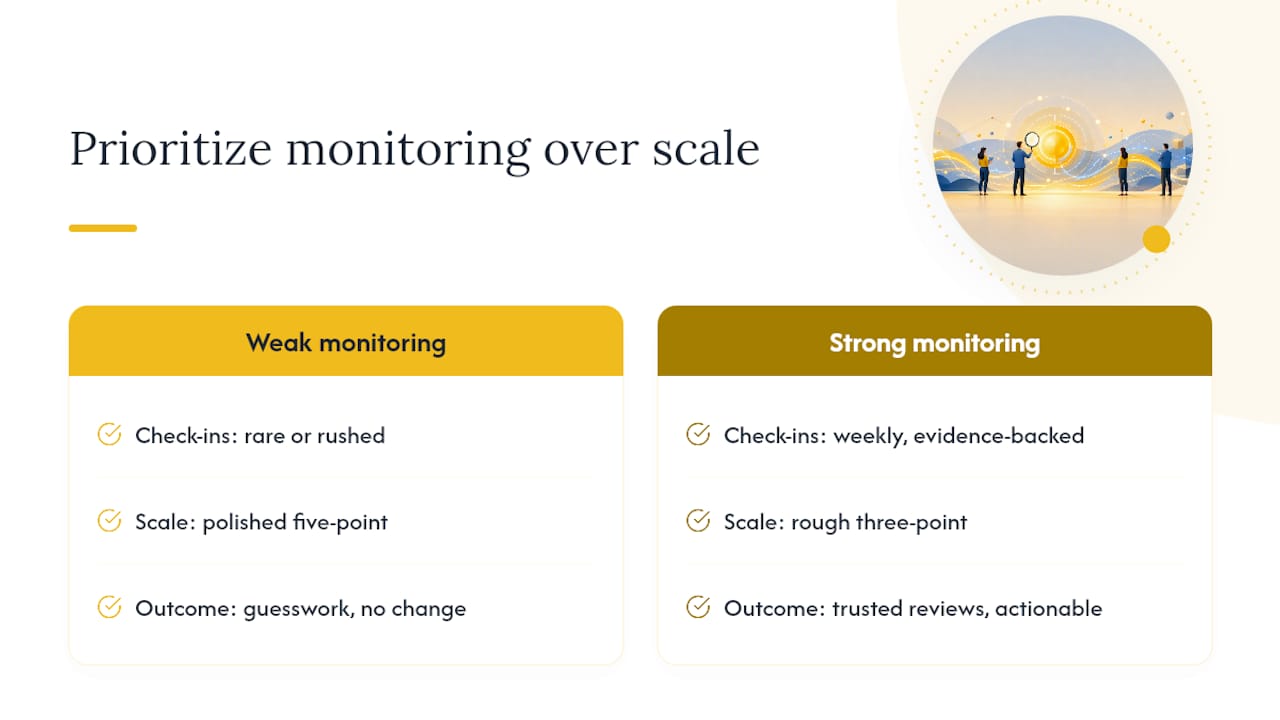
Most performance review guidance obsesses over the rating scale: five points or three, forced distribution or not, calibrated or manager’s discretion. That’s the wrong place to spend your energy. The evidence points somewhere else entirely: the conversation itself, and whether it’s backed by real evidence gathered continuously, is what actually moves performance. A perfect scale delivered through a rushed, evidence-free ten-minute meeting once a year will change nothing.
The conventional advice also treats “annual vs. continuous” as a binary choice, when the honest answer for most trade businesses is both, run together. Skip the check-ins and your annual review becomes a memory test. Skip the formal review and you lose the documentation you need for raises, promotions, or a defensible file if someone needs to be let go.
If you take one thing from this: fix your monitoring stage before you touch your rating scale. A team with weak check-ins and a great five-point scale will still produce reviews built on guesswork. A team with strong weekly check-ins and a rough three-point scale will produce reviews everyone actually trusts.
— Dan
Get Hands-On Help Building a Review Process That Sticks
A review template only works if the systems feeding it, dispatch records, KPI tracking, technician accountability, actually produce usable evidence. That’s the gap Rebuildingthetrades fills for HVAC, plumbing, electrical, and other trade businesses: instead of handing you a form and wishing you luck, the engagement builds the operational reporting and leadership training underneath the review process, so managers walk into every conversation with real numbers instead of impressions.

That’s the difference between a review cycle that produces defensible ratings and one that produces annual arguments. Rebuildingthetrades works directly with trade business owners on multi-month engagements covering KPI systems, leadership training, and accountability structures, the same foundation this article’s four-stage cycle depends on. If your review process keeps stalling because the underlying data doesn’t exist yet, check the pricing for a consulting engagement and see what a structured operational build looks like for a business your size.
Sources
- Performance management cycle — OPM
- The definitive guide to the performance management process — The Human Capital Hub
- Manager’s guide to employee performance reviews — Culture Amp
- Performance evaluation rating scale — Purdue HR
0 Comments