
Electrical leadership training is leadership and management training tailored to electrical contracting operations, not technical electrician certification. The first move is a focused training needs analysis on your frontline supervisors, because that single step, grounded in guidance from CIPD and OSHA, tells you exactly where to spend your training budget instead of guessing.
TL;DR:
- Training should focus on less-experienced supervisors to maximize safety, schedule adherence, and crew retention improvements over time.
- A quick needs analysis involves supervisor surveys, jobsite observations, incident reports, and team feedback to set targeted, measurable goals.
- Effective delivery includes short workshops, weekly micro-practice tied to real jobs, peer groups, and monthly coaching over three months or more.
- Embedding safety and code compliance into daily routines ensures leadership habits transfer beyond the training event, supported by simple scorecards.
- Measuring success involves tracking key KPIs like schedule adherence, callbacks, near-miss reports, and turnover at 30, 60, and 90 days to evaluate progress.
Table of Contents
- Who to train first and what results to expect
- How to run a training needs analysis and set learning goals
- Delivery formats that actually transfer to the field
- Embedding the habits so they outlast the training
- Measuring results with a 90-day pilot checklist
- Folding electrical codes and safety standards into leadership training
- Why trade-specific training beats generic leadership courses
- How Rebuilding the Trades can help you build this program
- FAQ
- Sources
Who to train first and what results to expect
The highest return comes from training the supervisors and newly promoted managers who are still figuring out their role, not your most seasoned lead electricians. CIPD’s evidence review finds that leadership training works best when it targets less-experienced or less-capable leaders, and that the effects hold steady or grow over time when the training is targeted and reinforced afterward.
For electrical contractors, that translates into a few concrete outcomes once training takes hold:
- Fewer safety incidents and stronger hazard reporting from crews
- Better schedule adherence and fewer missed callbacks
- Lower turnover among journeymen and apprentices who feel managed, not just dispatched
Electrical contractors rank safety and leadership among their top training priorities, with 64% citing safety and 51% citing personnel or leadership topics as the courses they want most. That interest signals real appetite, but appetite alone does not produce results.
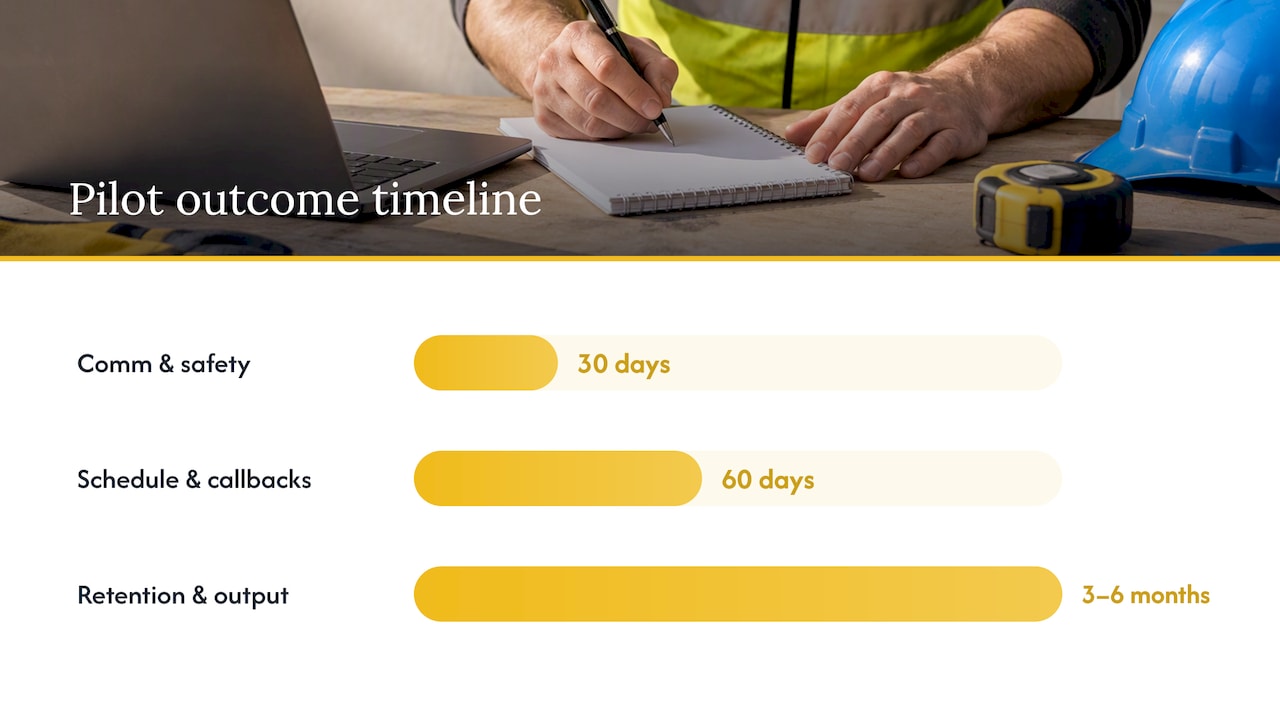
Expect early, visible shifts in communication and safety habits by day 30, measurable movement in schedule adherence and callback rates by day 60, and clearer gains in retention and crew output by the three to six month mark.
How to run a training needs analysis and set learning goals
A training needs analysis does not need to be a drawn-out HR project. It needs to be fast, specific, and tied to the jobs your supervisors actually do.
- Survey your supervisors with five to ten direct questions about where they feel least confident, from toolbox talks to handling a late crew.
- Spend two half-days observing jobsites, watching how supervisors brief crews, handle delays, and respond to problems in real time.
- Pull the last 12 months of incident reports and customer callback logs to see where leadership gaps show up as operational cost.
- Run a short crew focus group, 20 to 30 minutes, to hear how the team experiences their supervisor’s communication and follow-through.
- Map what you find to three role-specific skill gaps per supervisor and turn each into a measurable goal.
Once you have the gaps, set two or three SMART goals per participant. A supervisor weak on delegation might get: “Run three toolbox talks per week led by a crew member, tracked in a log, for the next eight weeks.” A supervisor struggling with callbacks might get: “Reduce repeat service calls on assigned jobs by reviewing punch lists with crews before sign-off, every job, for 60 days.”
This kind of upfront analysis matters beyond accuracy. CIPD’s review notes that training built on a real needs analysis increases motivation to learn and makes the skills more likely to transfer back into daily work, rather than fading once the workshop ends.
Delivery formats that actually transfer to the field
Classroom-only leadership training rarely survives contact with a dispatch board. The formats that stick combine short bursts of instruction with repeated, low-stakes practice on real tasks.
A workable blend for a busy electrical contractor looks like this:
- A one to two day kick-off workshop covering core management skills: goal-setting, feedback, and basic scheduling discipline
- Weekly on-site micro-practice sessions, 15 to 20 minutes, tied to that week’s actual jobs
- Small peer learning groups where two or three supervisors compare notes on real problems
- Monthly one-on-one coaching to review progress against the SMART goals set during the needs analysis
Exercises should mirror what supervisors actually face: running a job safety analysis under time pressure, role-playing a dispatch conflict, or handling a disagreement between two crew members on site. Guidance on coaching versus managing is a useful reference when designing these exercises, since the goal is building judgment, not scripting answers.
Plan delivery across three months or more, with sessions spaced out rather than compressed into one week. CCNECA’s 2024 industry profile found that a large share of electrical contractors already use hybrid training formats, and most expect to keep using them, which fits a spaced, blended schedule better than a single off-site retreat.
Pro Tip: Keep micro-practice sessions tied to a job already on the board that week. Supervisors retain more when the exercise maps to a decision they will make again within days.
Embedding the habits so they outlast the training
Training that ends when the workshop ends rarely changes anything. The habits need a home in your daily routines, or they get crowded out by the next busy week.
Build safety leadership directly into the supervisor’s weekly rhythm:
- Scheduled safety walks led by the supervisor, not just a safety officer
- Supervisor-led toolbox talks rotated among crew members to build ownership
- A near-miss reporting incentive that rewards reporting rather than punishing it
OSHA’s guidance on safety management recommends training managers and supervisors specifically on their role in hazard recognition, incident investigation, and building a culture where workers report problems instead of hiding them. That is not a separate initiative from leadership training. It is part of the job description for anyone supervising crews.
A non-punitive feedback culture is one of the conditions CIPD names as necessary for leadership skills to actually stick, alongside mentorship and organizational support, rather than relying on classroom time alone.
Keep the accountability simple: a one-page scorecard per supervisor, updated monthly, with a short coaching note attached. That visibility alone tends to keep new habits from quietly disappearing.
Measuring results with a 90-day pilot checklist
You do not need a dashboard full of metrics to know if training is working. A handful of numbers, tracked consistently, will tell you.
Track these on a simple recurring basis:
- Crew productivity, measured in completed jobs or billed hours per crew per week
- Schedule adherence, the percentage of jobs starting and finishing on time
- Customer callbacks per completed job
- Near-miss reports filed per month
- Supervisor and crew turnover
Set a baseline before training starts, then check again at 30, 60, and 90 days. At 30 days, look for early behavior change: are toolbox talks happening, are safety walks logged. At 60 days, look for movement in schedule adherence and callback numbers. At 90 days, compare turnover and productivity against your baseline.
A practical 90-day pilot follows this sequence:
- Run the training needs analysis across your supervisor group.
- Select two or three pilot supervisors based on where the biggest gaps and the biggest upside sit.
- Deliver the kick-off workshop and set SMART goals for each pilot participant.
- Assign an on-site coach, internal or external, to run weekly check-ins.
- Record baseline KPIs before the first coaching session.
- Run weekly micro-practice and monthly one-on-one coaching for the full 90 days.
- Review the scorecards and KPI movement at day 90 before deciding whether to expand the program.
A pilot built around two supervisors, one dedicated coach, and weekly micro-practice tends to show measurable movement in schedule adherence and near-miss reporting once it is tied to explicit coaching notes and a simple scorecard rather than left informal, as advised in Subcontractor Growth Requires Smart Leadership Hiring.
Folding electrical codes and safety standards into leadership training
Leadership training for electrical contractors cannot sit apart from the regulatory environment supervisors work in every day. A supervisor who runs a strong toolbox talk but cannot connect it to the specific hazards on a panel upgrade or a service change has only learned half the job.
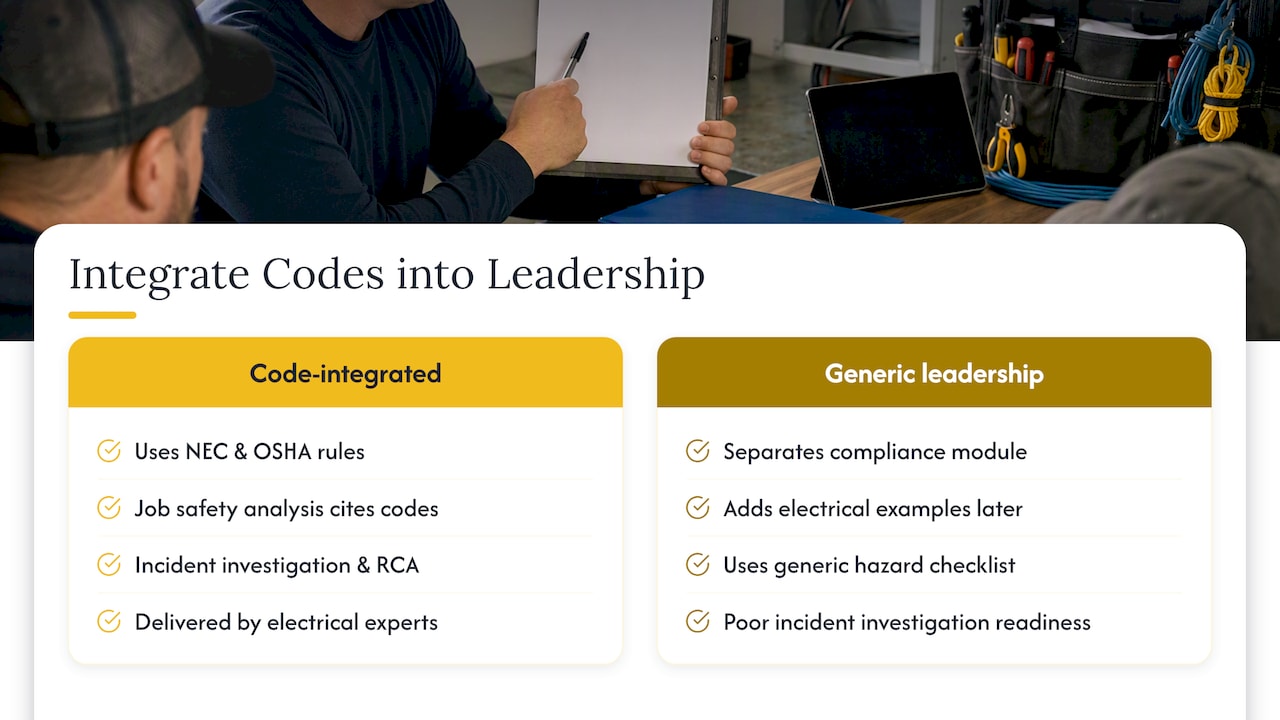
The most effective approach treats code compliance and safety standards as the content of leadership practice, not a separate compliance module bolted on afterward. When a supervisor runs a job safety analysis, it should reference the actual NEC requirements and OSHA electrical safety provisions relevant to that job, not a generic hazard checklist. OSHA’s guidance on safety management specifically calls out incident investigation and root cause analysis as management responsibilities, which means supervisors need enough regulatory grounding to investigate an incident properly, not just report it upward.
This also shapes who should deliver training. A program built around generic leadership theory, with electrical examples added as an afterthought, will miss the regulatory texture that makes a toolbox talk credible to a crew of licensed electricians. Training that threads code awareness and safety standards through every management exercise, from delegation to performance reviews, builds supervisors who can defend a decision on both operational and regulatory grounds. That credibility is part of what makes a crew actually follow a supervisor’s call in the field, rather than treating the role as a title without authority.
Why trade-specific training beats generic leadership courses
Generic leadership courses teach communication frameworks in a conference room. Electrical contracting does not run on conference rooms. It runs on scheduling pressure, crew composition that shifts job to job, and safety stakes that a retail manager never faces.
Programs that work are the ones built around those constraints: scenarios drawn from real dispatch conflicts, coaching that happens on the jobsite rather than in a slide deck, and goals tied to numbers an owner already tracks. Owners should be skeptical of any provider who cannot point to measurable KPI movement from a real engagement, and should favor those who embed coaching into daily operations rather than treating training as an event.
— Dan
How Rebuilding the Trades can help you build this program
We built our training around the same constraints electrical contractors face every day: tight schedules, safety stakes, and crews who notice fast whether a program is real or just a slide deck. Our Management & Leadership Training works alongside our sales and service manager coaching to cover the full range of roles that touch your operation, from the supervisor running crews to the manager handling the phones and the close.

If you want to skip the guesswork on where your gaps actually are, we run a short training needs analysis as the starting point for every engagement, the same method outlined above, applied to your crews and your numbers. From there we can:
- Build a 90-day pilot around your highest-impact supervisors
- Pair your team with on-site coaching instead of one-off workshops
- Track the same KPIs your business already runs on, with a simple scorecard
Pricing depends on scope, and our pricing page is the fastest way to get a sense of what a pilot engagement looks like for your size of operation. Request a training needs analysis and we will tell you plainly whether a pilot makes sense before you commit to anything.
FAQ
What is electrical leadership training exactly?
Electrical leadership training is management and leadership development built for people who run electrical contracting crews and operations, covering goal-setting, performance reviews, scheduling discipline, and safety leadership. It is distinct from technical electrician training or code certification, which teaches wiring and installation skills rather than how to run a crew or a business unit.
Who should go through leadership training first?
Newly promoted supervisors and less-experienced managers see the biggest gains, since CIPD’s evidence review finds training effects are strongest when targeted at leaders who are still building core management skills. Veteran crew leads benefit more from refresher coaching than from a full program.
How long does it take to see results from leadership training?
Early behavioral changes, like consistent toolbox talks or safety walks, typically show up within the first 30 days. Measurable shifts in schedule adherence, callbacks, and turnover usually become clear between 60 and 90 days, with stronger gains by the three to six month mark.
Does safety training count as leadership training?
Safety leadership is a core part of management training for electrical contractors, not a separate track. OSHA’s guidance treats training managers and supervisors on hazard recognition and incident response as a management responsibility, and electrical contractors rank safety as their top training priority at 64%.
What does a Rebuilding the Trades engagement include?
A typical engagement starts with a training needs analysis, then builds a pilot program using Management & Leadership Training alongside role-specific coaching for sales or service managers where relevant. Pricing depends on scope and is available through our pricing page.
Sources
- Leadership development: An evidence review (CIPD)
- Safety Management – Education and Training | Occupational Safety and Health Administration
- 2024 Profile of the Electrical Contractor (CCNECA)
0 Comments