
Sales manager coaching is the ongoing, manager-led practice of building a rep’s specific skills through structured 1:1 conversations anchored to real deals, calls, or CRM records, not general pep talks or pipeline reviews. Do three things this week and you’ll already be ahead of most managers: schedule a recurring 30-minute weekly 1:1 with every rep, pick exactly one skill to coach per rep per session, and require an artifact (a call recording, a deal page, an email thread) as the anchor for every conversation.
Each of those moves solves a specific failure mode. Recurring weekly time protects coaching from getting bumped by whatever fire is burning that day. One skill per session stops coaching from turning into a scattershot list of everything a rep did wrong. And an artifact keeps the conversation tied to what actually happened on a call instead of a vague memory of it, which is where most manager feedback falls apart.
- Book the recurring slot now. Put it on the calendar before the week gets away from you; a 1:1 that “we’ll find time for” rarely happens twice.
- Choose one skill per rep, in advance. Discovery questions, objection handling, or closing language, not all three at once.
- Bring an artifact to every session. A recorded call or a live deal page turns opinion into evidence.
Pro Tip: Write the skill you’re coaching at the top of your 1:1 notes before the call starts. If you can’t name it in five words, you’re not ready to coach that session yet.
The rest of this playbook builds out the framework, the agendas, the scripts, and the metrics behind those three moves, adapted for sales teams that spend more time in trucks than in office chairs.
Key Takeaways
Weekly, deal-anchored coaching sessions built around a single skill and a real artifact are the single highest-leverage habit a sales manager can build.
| Point | Details |
|---|---|
| Coaching frequency drives wins | Reps coached weekly win 19% more deals than uncoached reps, per Gong’s analysis. |
| Separate managing from coaching | Protect roughly 30% of weekly hours for skill-focused 1:1s, not pipeline review. |
| Anchor every session to an artifact | Use a call recording, deal page, or on-site estimate photo to ground feedback in fact. |
| One skill per session | Coaching five things at once dilutes all of them; pick one and go deep. |
| Adapt format for field teams | Shorten agendas, add mid-week micro-checks, and use ride-alongs for reps who sell on-site. |
| Rebuildingthetrades builds the system | Onsite audits, leadership training, and KPI setups help trade businesses turn this playbook into a repeatable habit. |
Table of Contents
- Why Sales Manager Coaching Moves the Quota Needle
- Manager vs. Coach: Where Your Time Actually Belongs
- Types of Sales Coaching and When to Use Each
- A Step-by-Step Coaching Framework You Can Copy This Week
- Coaching Techniques That Actually Change Rep Behavior
- How Often Should You Coach, and What Should You Measure?
- Coaching Mistakes That Turn Into Wasted Time
- Choosing a Sales Coaching Training Program That Fits Your Team
- Ready-to-Use Coaching Templates and Scripts
- Coaching Sales Reps in the Field: HVAC, Plumbing, and Electrical Teams
- How Rebuildingthetrades Helps You Put This Playbook to Work
- Frequently Asked Questions
- Sources
Why Sales Manager Coaching Moves the Quota Needle
The business case for coaching isn’t theoretical anymore. Reps who get one structured coaching conversation per week win 19% more deals than reps who get none, according to Gong’s revenue intelligence analysis. That’s not a marginal bump from a nice-to-have management habit. It’s a double-digit swing in outcomes tied to a single, repeatable behavior: showing up weekly with a real conversation instead of a status check.
The mechanism behind that number is straightforward. Sales Assembly’s coaching playbook recommends structured, deal-anchored 1:1s of 30 to 45 minutes that end in a written commitment from the rep, with one targeted skill worked per session and a real artifact, like a recording or CRM deal, driving the conversation. That structure is what separates coaching from a friendly chat about the pipeline.
The numbers that matter for your next budget conversation: Reps coached weekly with structured, deal-anchored 1:1s win 19% more deals than uncoached reps. If you’re asking leadership for protected coaching time, that’s the number to lead with.
Here’s a small but telling example. Within six weeks, her close rate climbed into the mid-50s, and her manager traced the shift directly to how she opened calls, not to any change in territory or lead quality.
- Weekly cadence beats monthly “check-ins” for skill transfer.
- Deal-anchored conversations outperform generic coaching talks.
- One tracked skill per session produces cleaner, measurable improvement than broad feedback.
Manager vs. Coach: Where Your Time Actually Belongs
A sales manager and a sales coach are not the same job, even when one person does both. Management is about pipeline accuracy, forecasting, hiring, territory decisions, and making sure the machine runs. Coaching is about developing a specific human being’s specific skill so they close more deals. Most managers default to the former because it’s urgent and measurable in the short term, and let the latter slide because its payoff shows up weeks later.
- Manager work: forecast reviews, deal desk approvals, hiring and firing decisions, territory and comp questions, cross-functional escalations.
- Coach work: skill-specific 1:1s, call reviews, role-play rehearsal, individual development planning, real-time deal strategy on specific opportunities.
If you’re carrying your own quota on top of managing, protect coaching time first and let administrative reporting slide to a lower-frequency cadence. Harvard Business Review’s research on coaching found that most managers were never taught to coach at all. They learned to manage, not to develop people, which is exactly why this time reallocation feels unnatural at first.
Pro Tip: Block your coaching hours on the calendar as “meetings,” not “coaching,” if your culture treats coaching time as optional. Protect it the same way you’d protect a client call.
Types of Sales Coaching and When to Use Each
Not every coaching problem needs the same format, and mixing formats without intention dilutes all of them. Five distinct types cover almost every situation a sales manager will face.
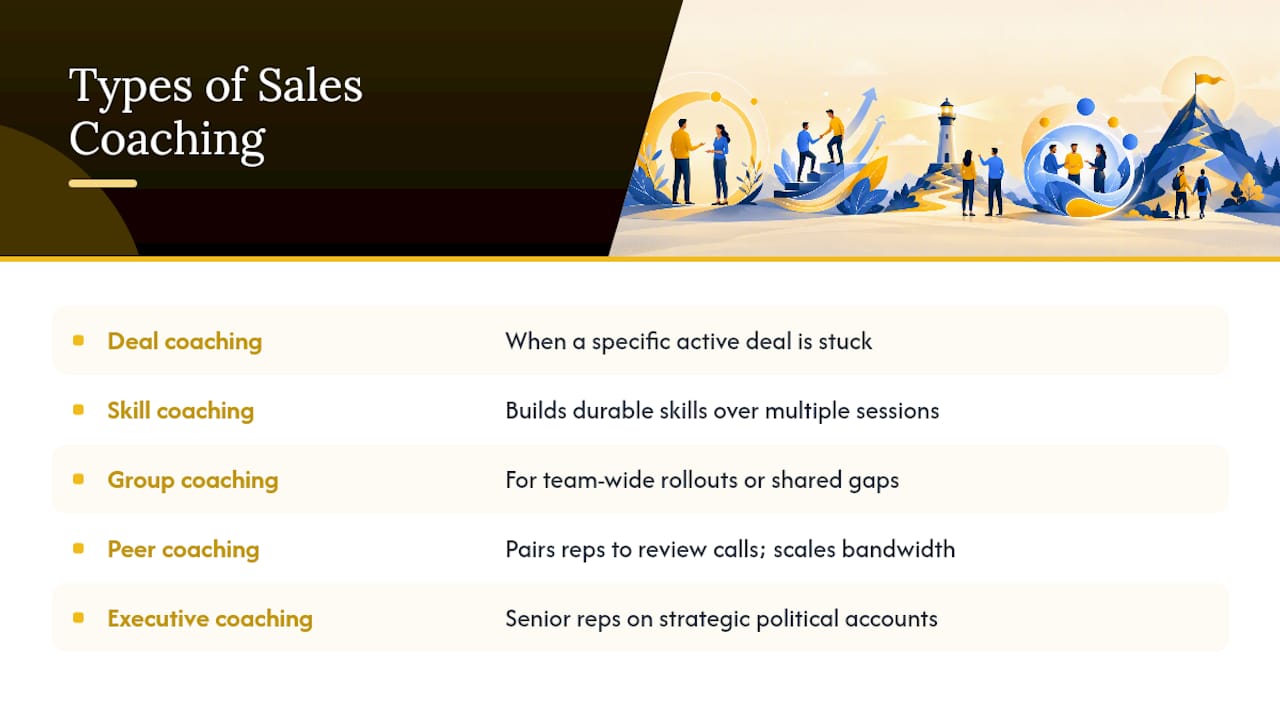
Deal coaching targets a specific opportunity in motion, walking through strategy, stakeholders, and next steps on one active deal. Use it when a rep is stuck on a specific account, especially a large or complex one where losing would hurt the quarter.
Skill or capability coaching builds a durable competency over multiple sessions, like discovery questioning or negotiation. This is the weekly 1:1 workhorse, best for reps who are otherwise performing fine but have one identifiable gap holding them back.
Group coaching develops a shared skill or standard across the whole team at once, often through recorded-call reviews or shared role-play. It works well for rolling out a new methodology or fixing a competency gap that shows up across multiple reps.
Peer coaching pairs reps to review each other’s calls or role-play together, and it scales manager bandwidth on larger teams where 1:1 time per rep is limited.
Executive coaching applies to senior reps handling strategic accounts or navigating complex stakeholder politics, often requiring the manager to coach on influence and internal alignment rather than tactical selling skills.
A quick way to choose: if the problem is one deal, coach the deal. If it’s one rep’s recurring pattern, coach the skill. If it’s the whole team, coach the group. If bandwidth is the constraint, add peer coaching. If the account is strategic and political, step into executive coaching mode yourself.
A Step-by-Step Coaching Framework You Can Copy This Week
Every effective weekly 1:1 follows the same five-step arc, regardless of rep tenure or deal size. Skipping steps is how coaching degrades into a status update.
- Pulse check (2 minutes). Ask how the week is going before jumping into business. This isn’t small talk. It surfaces morale or bandwidth issues that explain performance dips.
- Rep-driven agenda (5 minutes). Let the rep name what they want help with first. Ownership here increases follow-through later.
- Artifact review (15 minutes). Pull up the call recording or deal page and walk through what actually happened, not what the rep remembers happening.
- One skill, worked deeply (10 minutes). Zero in on the single skill you identified in advance. Resist the urge to comment on everything else you noticed.
- Experiment and commitment (3 minutes). End with a specific, written commitment the rep will try before the next session.
This mirrors the structure Battlecard’s coaching framework recommends: a small number of fixed pillars, applied consistently, beats an ever-shifting list of things to fix.
30-minute weekly agenda:
| Time | Activity | Who leads |
|---|---|---|
| — | Pulse check + rep agenda | Rep |
| 5-10 min | Deal/pipeline review (quick) | Manager |
| 10-15 minutes | Coaching moment on one skill | Manager, using artifact |
| 25 minutes | Commitment + next step | Rep states it aloud |
That 10 minutes deal review, 15 minutes coaching moment, 5 minutes career check split reflects what Gangly’s manager playbook identifies as the operational sweet spot for balancing depth against frequency in weekly B2B rep 1:1s.
60-minute biweekly or monthly deep session:
| Time | Activity | Who leads |
|---|---|---|
| 0-2 minutes | Pulse check + open agenda | Rep |
| 10-30 min | Full call or deal review with detailed notes | Manager |
| 30-45 min | Role-play or rehearsal on the target skill | Both |
| 30-45 minutes | Development plan check-in | Manager |
| 30-45 minutes | Commitment + accountability for next cycle | Rep |
Feedback script for the coaching moment: “In this call, at the 4-minute mark, you asked a closed question where an open one would have surfaced more. Here’s why that matters: you lost a chance to hear the real objection. For next week, try opening with ‘walk me through how this decision typically gets made’ before you pitch anything.”
Pro Tip: Rehearse your own feedback delivery once before the session, out loud, alone. Managers who script the first sentence of tough feedback deliver it far more calmly than those who wing it.
Coaching Techniques That Actually Change Rep Behavior
Four coaching skills separate managers who develop reps from managers who just critique them: diagnostic listening, question-led debriefs, pattern recognition across calls, and motivating feedback delivery, according to research from QUOTA Training. All four are trainable, not innate, which is good news if coaching doesn’t come naturally to you yet.
A question bank for debriefs that surface root causes:
- “What was the buyer actually trying to figure out on that call?”
- “Where did you feel the energy of the conversation shift, and what caused it?”
- “If you replayed that moment, what would you say differently?”
- “What did you decide not to say, and why?”
Role-play that transfers to real calls needs to be short and specific, not a full mock call. Pick one 5 to 10 minute segment, like the opening 60 seconds of a discovery call or a single objection response, and run it three times with quick feedback between reps. Longer role-plays feel more realistic but rarely get repeated often enough to build muscle memory.
Feedback formula: name the specific behavior, explain why it matters to the outcome, and assign one next-step experiment. “You interrupted the buyer twice in the first five minutes. That signals you’re not listening, which erodes trust early. Next call, wait a full three seconds after they finish speaking before you respond.”
A simple scoring rubric, rating a rep 1 to 5 on discovery, objection handling, and closing language, on both a practice role-play and their next live call, tells you fast whether the skill actually transferred or just looked good in rehearsal.
Pro Tip: If a rep scores a 4 in role-play but a 2 on the real call, the gap isn’t the rep’s fault. It usually means your practice scenario wasn’t realistic enough.
How Often Should You Coach, and What Should You Measure?
Weekly 30 to 45 minute sessions per rep is the baseline cadence backed by evidence, not a guideline to skip when things get busy. Adjust the depth by segment: top performers often need less time but more strategic, deal-level coaching; middle performers benefit most from consistent skill-building; reps at risk of missing quota need shorter, more frequent check-ins, sometimes twice weekly, focused on one urgent behavior.
Three metrics tell you whether coaching is working, and none of them require complicated dashboards.
- Skill-level win-rate movement. Track win rate specifically on deals where you coached a targeted skill (like discovery) versus deals where you didn’t.
- Ramp time to quota. Measure how many weeks it takes a new rep to hit full quota, and compare cohorts before and after you implemented structured coaching.
- Forecast accuracy. Coached reps tend to call their own deals more accurately because coaching conversations surface risk earlier.
Gartner’s research on coaching technology points out that organizations scaling coaching effectively pair a clear framework with technology that tracks these metrics automatically, rather than relying on a manager’s memory or spreadsheet.
A basic KPI dashboard needs just four columns per rep: sessions held this month, skill currently being coached, last artifact reviewed, and win rate trend over the last 30 days. Anything more elaborate tends to go unused.
Coaching Mistakes That Turn Into Wasted Time
The single most common mistake is calling a pipeline review “coaching.” Reviewing deal stages and close dates is management, not coaching. If the conversation doesn’t touch a specific rep behavior, it isn’t coaching, no matter how long it runs.
- Mistake: Manager talks 80% of the session. Fix: cap yourself at 40% talk time; ask more, tell less.
- Mistake: Coaching five skills in one session. Fix: pick one skill and hold the line, even when other issues surface.
- Mistake: Coaching the loudest rep, not the neediest one. Fix: rotate depth of coaching based on who’s furthest from quota, not who asks for the most attention.
- Mistake: Cadence slips during busy weeks. Fix: treat the recurring 1:1 like a client meeting that can’t be moved.
Some situations aren’t coaching problems at all. If a rep understands what to do but consistently won’t do it, that’s a performance management conversation, not a coaching gap. If the skill gap is so wide that months of coaching haven’t moved it, that may point to a hiring mismatch rather than a training failure. Coaching fixes skill and habit; it doesn’t fix will or fit.
Choosing a Sales Coaching Training Program That Fits Your Team
Picking a training program or certification comes down to five comparison points: format, who it’s built for, duration and cadence, the specific skills it teaches, and what it costs against how fast you’ll see results.
| Format | Best for | Duration & cadence | Learning objectives | Cost & time-to-impact |
|---|---|---|---|---|
| Self-paced online course | New or frontline managers | Single course, self-paced | Coaching fundamentals, scalable process | Lower cost, impact in weeks |
| Cohort-based executive program | Senior leaders, VPs | Multi-week program | Strategy, structure, measurement, leadership | Higher cost, impact over months |
| Internal certification/workshop | Whole management team | One-time workshop plus follow-up | Team-wide consistency, shared vocabulary | Moderate cost, fast rollout |
HubSpot Academy’s Sales Manager Training is a solid entry point for smaller teams needing a fast ramp. It’s built around a scalable sales process, onboarding tactics, and building a coaching culture, and it’s accessible without a major budget commitment. For senior leaders responsible for aligning sales strategy across a whole organization, Cranfield’s Strategic Sales Leadership Programme goes deeper into strategy, structure, and measurement, suited to VPs and directors rather than frontline managers. Programs from providers like RAIN Group and Korn Ferry tend to sit in between, offering structured skill-building and leadership development aimed at mid-level sales managers, while Salesforce’s own training resources lean toward CRM-integrated coaching workflows for teams already standardized on that platform.
Before you commit, run a short pilot:
- Define one measurable objective (e.g., raise discovery scores by one point on the rubric).
- Set a success threshold before you start, not after.
- Pick 2 to 3 managers to pilot for 6 to 8 weeks.
- Check trainer credentials and ask for a case study with a measurable outcome, not just a testimonial.
- Compare pre- and post-pilot metrics against the KPIs you’re already tracking.
Ready-to-Use Coaching Templates and Scripts
Drop these directly into your calendar invites or coaching docs. A reusable template is what turns coaching from a personal habit into a team-wide system.
30-minute agenda template fields: rep name, date, artifact reviewed (link), skill focus, three coaching notes, one committed action, and a follow-up date.
Coaching scorecard example:
| Competency | Week 1 score (1-5) | Week 4 score (1-5) | Notes |
|---|---|---|---|
| Discovery questioning | 2 | 4 | Clear improvement after role-play practice |
| Objection handling | 3 | 3 | Needs a different coaching approach next cycle |
| Closing language | 3 | 4 | More confident direct asks |
One-page development plan fields: current skill gap, target skill level, two practice activities per week, manager support commitment, and a 30-day review date.
Feedback snippet you can use verbatim: “I noticed you paused before answering the pricing objection today, that’s new, and it worked. The buyer felt heard instead of rushed. Keep doing that.”
Tools that automatically surface call recordings and deal-page changes make this system easier to run consistently, especially for managers juggling coaching across a distributed team; automation platforms like Cursor Cat Digital’s AI workflow tools can help route the right artifact to the right coaching session without manual digging.
Coaching Sales Reps in the Field: HVAC, Plumbing, and Electrical Teams
Trade sales teams don’t sit at desks between calls, which means the standard weekly 1:1 format needs real adjustments. Reps are driving between job sites, quoting on-site, and often unreachable during business hours, so coaching has to fit into their actual day, not an office calendar.
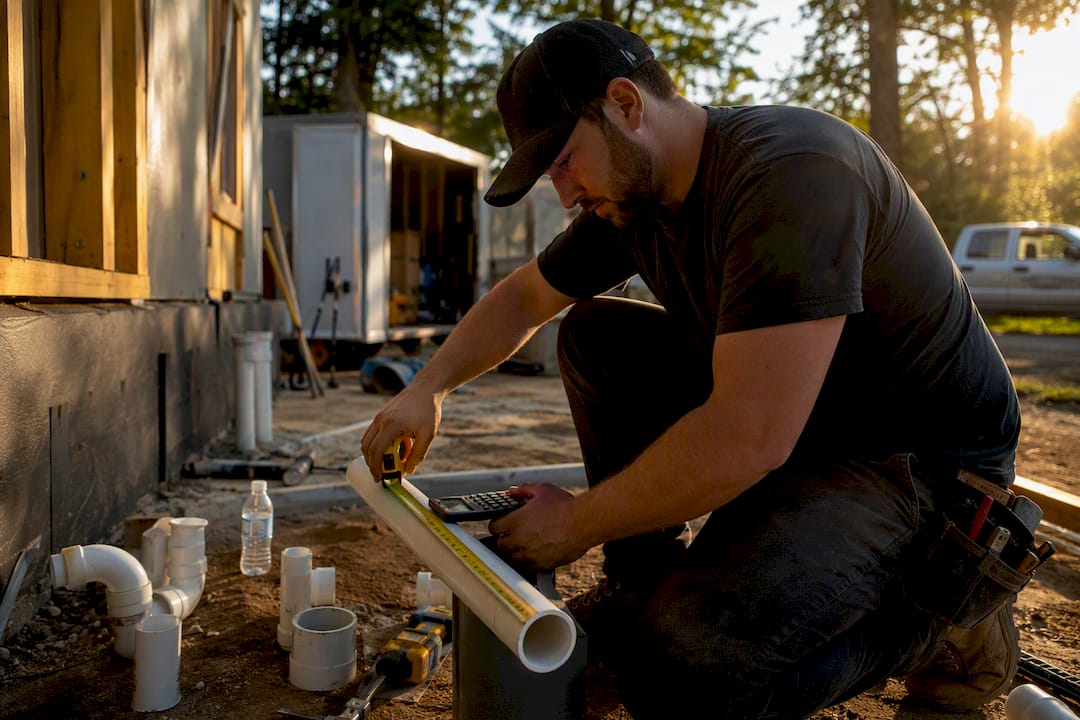
Shorten the agenda to 15 to 20 minutes and make it mobile-first: a recorded phone quote or a photo of a signed estimate works as an artifact just as well as a CRM deal page. Add a mid-week micro-check, five minutes by phone or text, to catch a stalled deal before Friday instead of after. Field ride-alongs, where the manager joins a rep on an actual site visit, replace call recordings entirely for reps who quote in person.
Field coaching checklist for site visits:
- Watch how the rep handles the homeowner’s first question about price.
- Note whether they explain the “why” behind a recommendation or just state it.
- Check if they ask about timeline and urgency before pitching the full job scope.
- Review the written estimate together immediately after, while it’s fresh.
Rebuildingthetrades has seen this kind of structured hands-on coaching shift outcomes directly. One client tracked in the Spartan case study moved toward a $21 million run rate after tightening leadership routines and accountability systems, including how sales conversations were coached and tracked.
Pro Tip: Keep a simple photo log of estimates reviewed on-site. It becomes your artifact library for coaching conversations later that week.
An Editorial Note on Building a Coaching Culture That Lasts
Most coaching systems die within a month, not because the framework was wrong, but because the manager let the calendar win. The habit that actually sticks is treating your coaching day as immovable, the same way you’d treat a signed client meeting. Announce it publicly to your team, and you’ve created a small accountability trap for yourself.
I’d also push back on the instinct to coach everyone the same amount. Uneven coaching, more time for the rep closest to a breakthrough, isn’t unfair. It’s just where the leverage actually is.
How Rebuildingthetrades Helps You Put This Playbook to Work
Reading a coaching framework and running it consistently across a field sales team are two different problems, and the gap between them is usually operational, not motivational. Rebuildingthetrades works directly inside HVAC, plumbing, electrical, and roofing companies to build the systems that make coaching stick: onsite audits that show exactly where sales conversations break down, hands-on leadership training for managers who’ve never been taught to coach, and KPI and reporting setups that track the same metrics this playbook recommends, win-rate movement, ramp time, and forecast accuracy, without a spreadsheet nobody updates.

Clients working with Rebuildingthetrades have reported improved operational clarity and measurable financial gains, including the Tri-Trade case study outcomes tied to tighter accountability systems and sales process improvements. If you’re ready to move from reading about weekly, deal-anchored coaching to actually running it across your team, the fastest next step is a discovery conversation about a pilot engagement. Check the Rebuildingthetrades pricing page to see what a coaching and operations pilot could look like for your business.
Frequently Asked Questions
What is sales manager coaching, exactly?
It’s the ongoing, structured practice of a sales manager developing a specific rep skill through recurring 1:1 conversations anchored to real deals or call artifacts, distinct from general management activities like pipeline reviews.
How is sales coaching different from sales management?
Management covers forecasting, hiring, and administrative oversight. Coaching focuses specifically on developing an individual rep’s skill through targeted feedback and practice, ideally in a protected weekly time block.
How often should a sales manager coach each rep?
Weekly sessions of 30 to 45 minutes are the evidence-backed baseline, with cadence adjusted by rep segment: more frequent, shorter check-ins for reps at risk, and deeper strategic sessions for top performers.
What’s the biggest mistake sales managers make when coaching?
Confusing a pipeline review with coaching. If the conversation doesn’t focus on a specific rep behavior tied to an artifact, it isn’t coaching, no matter how useful the discussion feels.
How do I measure if my sales coaching is actually working?
Track three things: win-rate movement on the specific skill you coached, ramp time for new reps to hit quota, and forecast accuracy, which tends to improve as reps get better at assessing their own deals.
Sources
- How to Coach Sales Reps in 2026: A Manager’s Playbook
- Gong — Win rates and coaching impact
- The evolution of sales training and coaching technology — Gartner
- Most managers don’t know how to coach people — HBR
0 Comments