
A plumbing price book is the master list of flat-rate prices your technicians quote from on every job, built from your true labor and parts costs instead of gut feel. The immediate payoff is consistency: every tech quotes the same job the same way, discounting drops, and average ticket size climbs. The rest of this guide covers whether to buy a ready-made template or build your own, and how to set it up correctly either way.
TL;DR:
- A well-calculated loaded labor rate, typically between $90 and $160 per hour, is crucial for setting accurate flat-rate prices.
- Parts markup should be tiered: four to five times for parts under $25, 2.5 to 4 times for $25 to $500, and 1.8 to 2.5 times for parts over $500.
- Price books must be regularly updated, at least twice a year, to reflect material cost changes and prevent outdated quotes from eroding margins.
- Using a price book during customer interactions, with consistent scripts and documentation, helps prevent discounts and maintains profit margins.
- Integrating the price book into your job management system ensures quotes and invoices are accurate and eliminates errors from manual re-entry or outdated sheets.
Table of Contents
- What Is a Plumbing Price Book, and When Should You Use Flat-Rate Pricing?
- What’s Inside a Ready-Made Plumbing Price Book
- How to Build or Customize Your Own Plumbing Price Book
- The Flat-Rate Formula and Baseline Price Ranges
- Presenting the Price Book Without Losing Deals to Discounting
- Who Owns the Price Book, and How Often Should It Change?
- Legal and Regulatory Considerations Affecting Pricing in Plumbing Services
- Integrating Your Price Book With Job Management or Invoicing Software
- Training Your Team to Actually Use the Price Book
- Common Pitfalls in Building and Maintaining a Price Book
- Why a Working Price Book Beats a Perfect One
- Sources
What Is a Plumbing Price Book, and When Should You Use Flat-Rate Pricing?
A plumbing price book is a structured list of jobs, tied to fixed prices, that your technicians reference in the field instead of calculating an estimate on the spot. Most shops keep it as a spreadsheet in Excel or Google Sheets, a printed and laminated binder for the truck, a PDF, or a module inside field service software. The format matters less than the discipline of using it every time.
Flat-rate pricing works best for repeatable jobs where scope is predictable: toilet repairs, faucet swaps, water heater replacements, drain clearing. The customer sees one number before work starts, and your tech isn’t negotiating on the spot. Hourly or hybrid pricing still makes sense for diagnostics with unknown causes, commercial work with variable access and code requirements, or anything where scope could shift once walls open up.
The upside of flat-rate is real: flat-rate systems tend to raise average ticket size by roughly 20 to 30 percent compared to hourly billing on standard jobs, mostly because customers accept a firm number and techs can present upgrade options without haggling. The risk is quoting a flat rate on a job with hidden complexity and eating the loss. That’s why good price books include modifiers for access, age of the home, and site conditions, not just a single number per task.
What’s Inside a Ready-Made Plumbing Price Book
Buying a plumbing pricing manual instead of building one from scratch saves weeks of work, but not every template is built the same. Before you pay for one, check what’s actually included.
- A task list covering common repairs and installs, each with estimated labor hours and parts cost
- Markup bands by parts cost tier, so a $15 washer and a $600 water heater aren’t marked up the same way
- A built-in calculator so you can plug in your own loaded labor rate and see prices recalculate automatically
- Standard operating procedures for dispatch, diagnosis, and close
- Talk tracks technicians can use word for word when presenting options or handling pushback on price
- A truck stock list tied to the most-quoted repairs
Delivery varies. Some products are downloadable spreadsheets and PDFs you print or load onto a tablet. Others integrate directly into field service software. One example worth studying is a flat-rate plumbing price book built by a licensed master plumber, which bundles an estimate calculator with SOPs and scripts rather than shipping a bare price list. Before buying anything, confirm the formulas are editable, ask for sample pages, check the refund policy, and find out whether any training or onboarding is included.
How to Build or Customize Your Own Plumbing Price Book
Copying a competitor’s rate sheet is the fastest way to lose money quietly. Your price book has to come from your actual costs, not the number a rival posted on their website.
- Calculate your loaded labor rate. Start with wages, then add payroll taxes, benefits, and an allowance for non-billable time like training, travel, and admin work. Fold in truck costs, insurance, and overhead allocation, then divide by your actual billable hours. Most shops land somewhere in the $90 to $160 per hour range, though $75 to $150 per hour shows up frequently in marketplace data too, depending on region and role.
- Set parts markup by cost tier. Small parts under $25 often need a 4 to 5x markup just to cover the trip and truck stock. Mid-range parts between $25 and $500 typically run 2.5x to 4x, while anything over $500 usually drops to 1.8x to 2.5x to stay competitive on big-ticket items.
- Validate labor hours against real job history. If your book says a toilet swap takes 45 minutes but your techs consistently take 75, the book is wrong, not the tech.
- Decide flat-rate versus hourly per job type, and build in modifiers for after-hours work, excavation, or permit pulls.
- Pilot before rolling out company-wide. Run the new book with 2 to 3 technicians and track variance between quoted and actual hours for 30 to 60 days before you commit the whole team to it.
Pro Tip: Run your pilot group’s actual hours against the book weekly, not monthly. A 60-day silent drift in labor time is much harder to unwind than a two-week correction.
The Flat-Rate Formula and Baseline Price Ranges
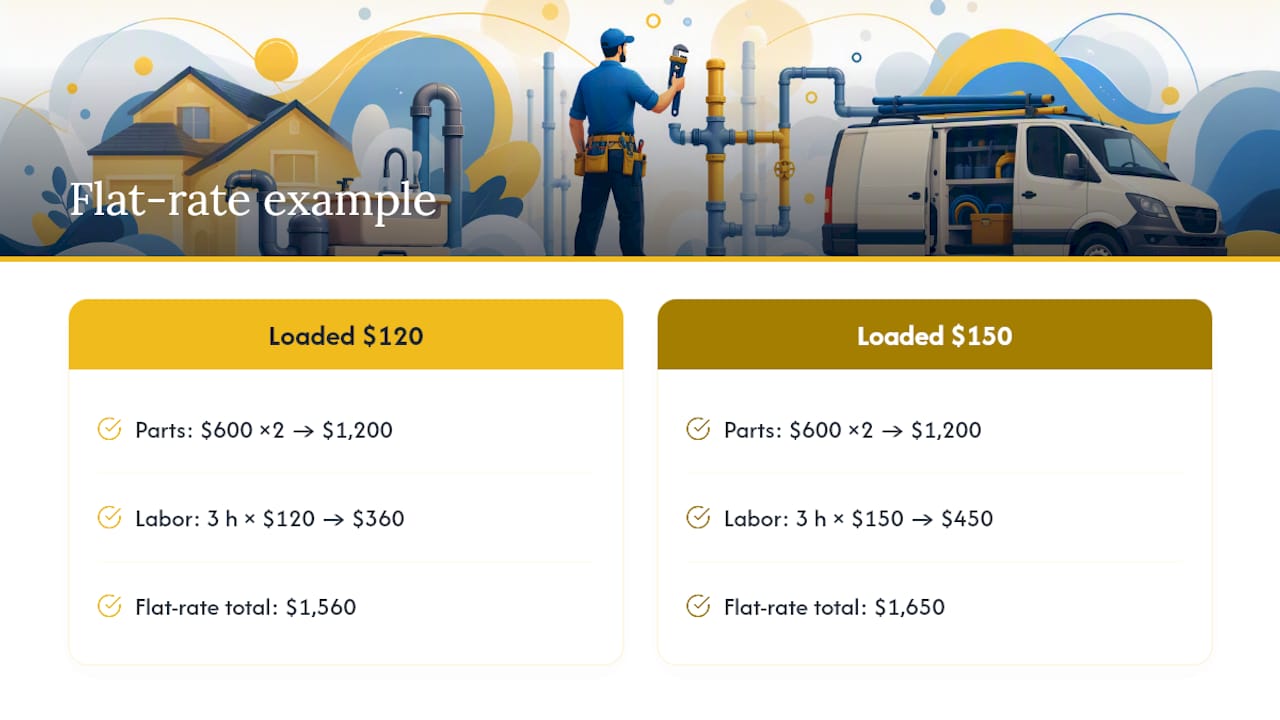
The math behind flat-rate pricing isn’t complicated once you have your inputs. The formula is: Flat Rate = (Parts Cost × Markup) + (Labor Hours × Loaded Rate).
Say a water heater swap uses a $600 tank, marked up at 2x, plus 3 hours of labor at a $120 loaded rate. That’s $1,200 in parts plus $360 in labor, for a $1,560 flat-rate quote. Change the loaded rate to $150 and the same job jumps to $1,650. That gap is exactly why copying someone else’s price sheet is risky: your loaded rate is not their loaded rate.
For seeding your own book, industry data offers a reasonable starting point.
These baseline ranges come from aggregated 2026 contractor cost guides, and they’re wide for a reason: regional labor costs, permit requirements, and equipment access all push a job toward the low or high end. Treat these as a sanity check on your own math, not as the final answer. If your calculated flat rate for a standard toilet repair comes out at $400, something in your loaded rate or hours estimate is off, and it’s worth rechecking before that price hits a customer’s invoice.
Presenting the Price Book Without Losing Deals to Discounting
A price book that lives in a drawer doesn’t protect your margins. Technicians need to quote from it in front of the customer, every time, with language that’s been practiced.
A basic good/better/best script sounds like this: “I can fix just the leaking valve today for $180, or replace the whole assembly with a 5 year warranty for $340, or do the full fixture upgrade for $520.” When a customer pushes back on price, the response isn’t to discount on the spot. It’s closer to: “That price covers the parts, the labor, and the warranty. I can check if there’s a smaller version of this fix that fits your budget, but I can’t change what this repair costs.”
- Techs quote only from the tablet app or laminated sheet, never from memory
- Every scope change gets documented before the price changes
- The standard flow runs dispatch, arrival, diagnosis, present options, close, with a clear escalation path when scope shifts mid-job
Quoting from a single source-of-truth cuts down on inconsistency far more than any amount of verbal coaching. Memory drifts. A laminated page or tablet screen doesn’t.
Pro Tip: Have new hires shadow a veteran tech for one full week specifically watching how they handle price objections, not just how they fix pipes. The script matters as much as the wrench work.
Who Owns the Price Book, and How Often Should It Change?
Prices go stale the moment copper or PVC costs move, so someone in your shop needs to own the update calendar. A workable cadence is a full refresh every January, a mid-year check every July, and a quarterly glance at anything tied to volatile materials. BuildFolio’s contractor guidance recommends at least twice-yearly reviews as the floor, not the ceiling, for shops with exposure to swinging material costs.
Assign one owner, usually an operations manager, who has final sign-off on any price change alongside finance. Keep a change log. When margins move in the monthly P&L, you want to know whether it was a parts price spike or a labor-hour miscalculation, not guess.
Three numbers to track monthly: average ticket size, margin by task type, and the gap between quoted and actual labor hours. If that gap keeps widening on the same job category, the price book has a hole in it, not the technician.
Legal and Regulatory Considerations Affecting Pricing in Plumbing Services
Pricing isn’t purely a math exercise. Several jurisdictions regulate how contractors present and charge for plumbing work, and the rules vary enough that a price book built for one state or province can create compliance problems in another.
Licensing boards in many regions require that quoted prices reflect a licensed contractor’s actual rate structure, not a bait-and-switch low estimate followed by a much higher final bill. Some jurisdictions require written estimates above a certain dollar threshold before work begins, and a few require the customer’s signature on that estimate before any diagnostic or repair work starts. If your price book generates a verbal quote only, check whether your local consumer protection statutes require it in writing.
Advertising a flat rate also carries obligations. If your marketing quotes a starting price like “drain clearing from $125,” most consumer protection frameworks expect that price to be genuinely available for the described scope, not a number designed purely to generate calls. Bait pricing complaints are a common source of licensing board disputes.
Sales tax treatment of labor versus parts differs by state and by municipality, and some places tax materials but exempt labor, or the reverse. Your price book’s markup structure should be built with your bookkeeper or accountant checking that tax is applied correctly on the parts and labor split, not folded into one number that makes tax reporting a guessing game later.
None of this replaces legal advice specific to your market. But building a price book without a conversation with your licensing board or a local attorney about disclosure and estimate requirements is a gap worth closing before you roll pricing out company-wide.
Integrating Your Price Book With Job Management or Invoicing Software
A price book that lives separately from your dispatch and invoicing system creates a gap where errors slip through. Techs quote one number in the field, then the invoice gets typed up differently back at the office, and nobody notices until a customer calls to dispute the bill.
The cleanest setup pulls your price book directly into whatever field service or invoicing platform you already run. Most modern platforms support a service catalog or price list module where you load your flat-rate line items once, and every quote, invoice, and job ticket pulls from that same catalog. When you update a price, it updates everywhere instantly, instead of requiring you to reprint laminated sheets or push a new spreadsheet to every tablet.
If your current software doesn’t support a native price catalog, a workaround many shops use is a synced spreadsheet that feeds into invoicing through an integration or a simple import process. It’s not as clean as native integration, but it beats technicians manually retyping numbers from memory.
Whatever system you use, the goal is the same: one source of truth, updated in one place, visible identically to the technician in the field and the office generating the invoice. Estimator and cost-manual subscriptions, like the National Plumbing & HVAC Estimator, can feed updated labor and material benchmarks into that catalog periodically so your numbers don’t quietly drift out of date between your annual refreshes.
Training Your Team to Actually Use the Price Book
The best price book in the world fails if your customer service staff and technicians don’t trust it or don’t know how to use it under pressure. Training has to cover more than “here’s the spreadsheet.”
Start with why the numbers are what they are. Techs who understand that a $340 repair covers loaded labor, parts markup, and warranty coverage defend that price with more confidence than techs who were just handed a number to recite. Walk new hires through the actual formula once, using a real job from last month, so the pricing feels earned rather than arbitrary.
Customer service staff booking calls need a simplified version of the same training. They’re often quoting rough ranges over the phone before a technician even arrives, and if those ranges don’t match what the tech eventually presents in person, customers feel misled before the job even starts. Give phone staff a short reference sheet with the most commonly booked services and their typical ranges, tied to the same source-of-truth numbers the field team uses.
Role-play the price objection scenarios specifically. Most training programs spend all their time on the technical repair and almost none on what happens when a customer says the price is too high. That’s backwards, since the pricing conversation is where deals are actually won or lost. Record a few common objections and rehearse responses until they sound natural, not scripted.
Refresh this training every time the price book updates. A team trained once on old numbers will keep quoting from memory long after the book has changed, which quietly reintroduces the exact inconsistency the price book was built to eliminate.
Common Pitfalls in Building and Maintaining a Price Book
Most price books fail for the same handful of reasons, and nearly all of them are avoidable with a little discipline up front.
The most common mistake is copying a competitor’s rate card instead of calculating true costs. A price that works for a shop with lower overhead or cheaper labor markets can quietly bankrupt your margins if you adopt it without adjustment. Build every number from your own loaded labor rate and parts markup, never from what you saw on someone else’s website.
A close second is letting the book go stale. Material costs shift, especially copper and PVC, and a price book that hasn’t been touched in eighteen months is quoting yesterday’s costs at today’s job. Assign an owner and stick to the review cadence, even when business is busy and updating a spreadsheet feels like a low priority.
Skipping the pilot phase causes damage that’s hard to see until the P&L reflects it. Rolling a new price book out to the entire team at once, without tracking quoted-versus-actual hours on a small group first, means any error in your labor estimates gets multiplied across every job before anyone catches it.
Finally, many shops build a solid price book and then never train technicians on the reasoning behind it or the scripts for defending it. The book becomes a suggestion instead of a standard, and discounting creeps back in exactly where flat-rate pricing was supposed to eliminate it. A price book only works when it’s paired with enforcement, not just distribution.
Why a Working Price Book Beats a Perfect One
Most advice on plumbing pricing focuses on getting the number exactly right, and that’s the wrong obsession. A price book with a slightly imperfect formula that every technician actually uses beats a meticulously researched spreadsheet that sits in a drawer because nobody trained the team on it. The math matters, but the rollout matters more.
Where conventional advice falls short is treating price books as a one-time setup task. They’re a governance problem disguised as a spreadsheet problem. Without an owner, a review calendar, and a pilot process to catch bad labor-hour assumptions, even a well-built book drifts out of alignment with reality within a year.
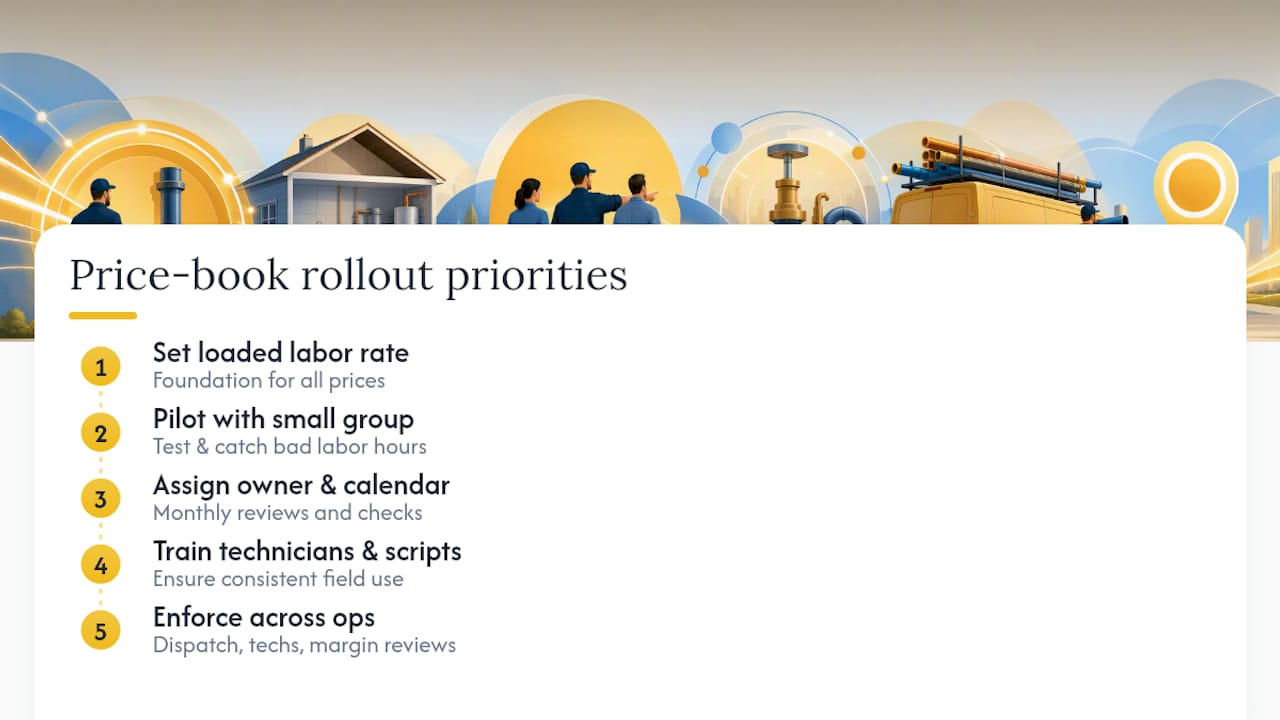
If you’re starting from zero, prioritize in this order: get your loaded labor rate right first, since every other number in the book depends on it. Then pilot with a small group before rolling out company-wide. Training and scripts come last, but they’re not optional. A shop that skips the operational discipline around its price book, and treats the spreadsheet as the whole solution, tends to see the same discounting problems resurface within a few months.
— Dan
Building your price book is only half the job. Enforcing it across dispatch, technician training, and monthly margin reviews is where most trade businesses lose the thread, and it’s exactly the operational gap some consulting services work with plumbing, HVAC, and electrical companies to close. If your team has a price book that isn’t translating into consistent average tickets, the governance and rollout playbook covered in Rebuildingthetrades’ operations-first roadmap for plumbing businesses is worth reviewing before you invest in another template. For shops ready for hands-on help standardizing pricing, dispatch, and technician accountability, check out Rebuildingthetrades’ pricing and service overview to see what an engagement actually involves.
Sources
- Plumbing Flat Rate Pricing Template (2026)
- 2026 Plumbing Price Guide: Average Rates & How to Estimate
- Plumbing Cost Estimator – Fixture, Labor & Material Pricing (2026) | EstimationPro AI
- Flat-Rate Plumbing Price Book + Estimate Calculator + SOPs — by a Licensed Master Plumber
0 Comments