
An operational turnaround in a trade business means fixing how the company runs: cash, job costing, dispatch, sales and the people who manage them. It does not mean working harder or cutting staff. The pattern that works is the same in HVAC, plumbing, electrical and construction. Diagnose against your own history, find the one constraint holding everything else back, stabilize cash first, then build the reporting and leadership that stop the slide from coming back. Doing that alone is hard, because the owner is usually the person inside the problem. We built our work at Rebuilding the Trades around trade companies only, with onsite audits, leadership training and accountability systems, so the plan below is the one we would hand a friend.
TL;DR
- Score eight lines of the business (revenue trend, gross margin, months of cash, debt payments, owner hours, crew, customer mix, current books) against your own past, not against a number you heard at the supply house.
- Name the single constraint and fix one thing at a time. Five simultaneous fixes tend to stall halfway.
- Stabilize cash first: in construction, most cash comes from work in progress, so project managers, change orders and invoicing speed decide whether you survive.
- Build a short monthly and weekly reporting rhythm so problems show up months earlier.
- Make the change stick through operations-level leaders who are accountable for it, with the owner visibly committed.
Table of Contents
- Signs the business needs a turnaround, not just a better month
- Diagnose before you prescribe
- Stabilize cash in the first 30 days
- Build visibility that lasts
- Fix the leadership and accountability gap
- Turnarounds in family and second-generation companies
- A realistic 90-day sequence
- Where we come in
- Our perspective
- FAQ
- Sources
Signs the business needs a turnaround, not just a better month
Every trade business has bad months. A turnaround is for a pattern: margins thinning on jobs that look busy, the owner working 70 hours and still unsure where the money went, techs or project managers leaving, books weeks behind, and a bank balance that surprises you.
A simple way to test it is the owner’s checkup from NPMCA. It has you score eight lines green, yellow or red: revenue trend, gross margin, months of cash, debt payments, owner hours, crew, customer mix and whether the books are current. The scoring is against your own history. A gross margin that was 38% two years ago and is 31% now is a red line, whatever the average shop supposedly earns.
Two reds that connect to each other, say thin cash and stale books, usually mean you cannot see the real cause yet. That is the signal to stop treating symptoms.
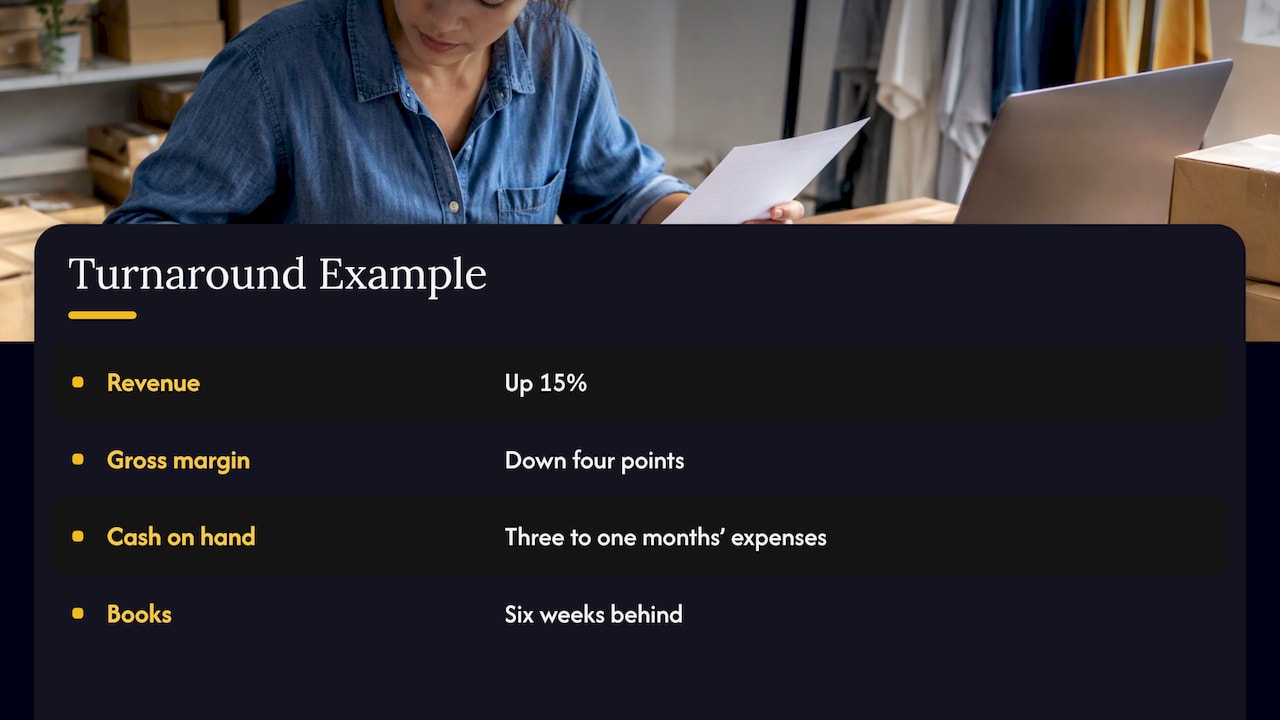
A worked example: a plumbing company grows revenue 15% but its gross margin slides four points, cash on hand drops from three months of expenses to one, and the bookkeeper is six weeks behind. Revenue is green, margin and cash are red, books are red. The books are the constraint, because without current numbers nobody can tell whether the margin slide comes from pricing, labor or callbacks. Fix that first.
Diagnose before you prescribe
The most common turnaround mistake is picking a fix from a podcast. The NPMCA checkup advises naming the constraint that holds the other lines back and working on that alone, because the owner’s attention is the scarcest resource in the business.
To find the constraint, you need cost data you can trust. NECA’s guide for electrical contractors, Driving Through Business Growth Roadblocks, separates two kinds of cost:
- Direct job costs: labor, materials, equipment rental, bonding premiums, fuel and permits.
- Overhead: support staff payroll, insurance, office, debt payments and the owner’s salary.
The guide’s point is that estimators need accurate overhead numbers to bid profitably. If overhead is guessed, every bid carries the error. It also recommends a postmortem after each project that compares estimated and actual profit. That habit turns every job into a diagnostic. After ten jobs you can see whether the leak is in estimating, in field labor, in material markup or in change orders nobody billed.
Labor is a frequent culprit because the true cost of an hour is higher than the wage. Our piece on labor burden for contractors shows how a 2,000-hour job can lose $29,060 when burden is left out of the bid.
A useful diagnostic sequence:
- Bring the books current so you are looking at this quarter, not last year.
- Pull the last 10 to 20 completed jobs and compare estimated and actual margin.
- Sort the misses by cause: estimate, labor hours, materials, scope change, callbacks.
- Pick the cause that costs the most dollars. That is your constraint.
Stabilize cash in the first 30 days
A business can be profitable on paper and still run out of cash. NECA’s guide notes that in construction 85% of cash comes from project work in progress, so cash performance depends heavily on the project manager. Its recommendations are concrete:
- Train project managers on cash flow, with incentives tied to performance.
- Process change orders immediately instead of at the end of the job.
- Send invoices early, ideally automated.
- Set a goal of cutting the typical 60 to 90 day collection period to 50 days.
The arithmetic matters. A company billing $200,000 a month that moves collections from 75 days to 50 days frees up roughly 25 days of billings, around $165,000 of cash, without winning a single new job. That calculation is ours, using the guide’s collection figures, and your own number depends on your billing.
Next, forecast. A 13-week rolling forecast gives you a weekly view of cash in and out so a shortfall is visible two months ahead. We lay out the routine in our guide to a weekly cash flow rhythm. For jobs that run several months, WIP accounting shows profit fade while there is still time to act on it.
One piece of crisis advice from a contractor playbook is worth repeating: tracking money in and out in close to real time beats the comfort of not knowing. The first month of a turnaround is mostly about replacing hope with numbers.
Build visibility that lasts
Once cash is under control, the goal is to make sure you never lose sight of it again. ELECTRI International’s Built to Sell report, published in July 2026, says clean, timely financials build trust with buyers, lenders and bonding partners, and that monthly statements, WIP reviews and cash flow visibility are critical to understanding a company’s true health. Even if you never plan to sell, your bonding agent and banker read the same signals.
A practical reporting stack for a small or midsize trade firm:
| Rhythm | What to review | Why it matters |
|---|---|---|
| Weekly | Cash position, 13-week forecast, collections, open change orders | Prevents cash surprises |
| Weekly | One-page flash report with a cash trigger | Gives the owner a five-minute health check |
| Monthly | Financial statements, WIP schedule, job margin versus estimate | Catches profit fade early |
| Quarterly | Overhead rate, labor burden, pricing review | Keeps bids honest |
We cover the weekly page in our one-page flash report guide and the full set in contractor financial reporting.
What good looks like
Benchmarks help you set a target, as long as you remember the NPMCA advice to judge progress mainly against yourself. The CFMA’s 2026 Construction Financial Benchmarker, built on FY2025 data from 1,359 companies, reports a median sales growth of 4.8%, an average net income before tax margin of 6.8% and median days of cash of 29.
The gap between average and best firms is the useful part. In the same report, the top 25% earned a 12.5% net income before tax margin, gross profit of 21.0% of revenue versus 17.6% overall, and SG&A of 9.2% versus 11.2%. Those firms did not just sell more. They kept more of each dollar and spent less to run the company. These are construction-wide figures, so a service-heavy HVAC or plumbing shop will see different ratios, but the direction is the same: margin discipline and overhead control separate the top quartile.
Fix the leadership and accountability gap
Systems fail when nobody owns them. Most trade turnarounds that stall do so here: the owner builds a new process, and the team goes back to the old habits within six weeks.
A NECA study of best practices for electrical contractors, published through NYECA, found that change agents work best when they are operations-level leaders who are respected by their peers, passionate about the change, and accountable for implementation as a core part of their job. It also stresses that senior leadership must be visibly committed: providing resources, walking the talk and keeping the company focused on the overall objectives so individual departments do not bog the effort down.
Translate that to a shop of 15 to 50 people:
- Pick the right change agent. Often it is a respected service manager, field supervisor or lead installer, not the newest office hire.
- Give the role time. If implementation is on top of a full route, it will lose every week.
- Set a scheduled update. A PSMJ excerpt in the same NECA study describes why this works: a project manager who misses a committed update must either do the work or admit it and do better next time.
- Show up yourself. If the owner skips the weekly review, the team learns the review is optional.
Promoting a good technician or project manager into management does not by itself create a manager. A SMACNA white paper on becoming a construction CEO notes that promoted project managers need explicit coaching to move from building the project to running the company. The same applies one level down for foremen and service managers.
We go deeper on role-specific training in our guides to field supervisor training, service manager training, and 90-day pilots for plumbing and electrical leadership. If dispatch is where jobs go wrong, see audit-first dispatcher training.
Turnarounds in family and second-generation companies
Family businesses carry an extra layer: the turnaround is also a transition. SMACNA’s transition-planning paper for the HVAC and sheet metal industry reports that only 30% of surveyed contractors had qualified successors, while 50% had potential successors who needed further development. Owners who developed successors most often involved them in business development (78%), internal leadership programs (66%), budget preparation (60%) and reviewing financial information (58%).

That list is a practical curriculum for a second-generation owner. Put the next generation in front of the numbers and the sales process, not just the trucks. The SMACNA CEO white paper adds that in family firms the right last name often decides who leads, but the next generation still has to earn the trust of peers, and that ultimately there must be one boss who makes final decisions.
A turnaround gives that handover a shared project. When the founder and the successor work through the cash forecast and the leadership plan together, authority is earned in front of the team. Our article on succession planning for contractors explains how this protects bonding and margins.
A realistic 90-day sequence
| Days | Focus | Output |
|---|---|---|
| 1 to 30 | Current books, eight-line checkup, job postmortems, 13-week forecast | One named constraint and a cash picture |
| 31 to 60 | Fix the constraint: pricing, change orders, invoicing speed, dispatch or sales process | Measured change in the constraint metric |
| 61 to 90 | Weekly flash report, monthly WIP review, named change agent with scheduled updates | A routine that runs without the owner pushing it |
The sequence follows the one-constraint rule. If you finish day 90 with one problem truly solved and a reporting rhythm that exposes the next one, the turnaround is working.
Where we come in
Most owners can run this sequence on paper. The hard part is doing it while also running jobs, and being objective about your own company. We are consultants for trade businesses only: HVAC, plumbing, electrical, roofing, remodeling and siding. Our work is hands-on and includes onsite audits, leadership and management training, accountability systems, financial visibility, dispatch and scheduling, sales process improvement, and KPI and reporting systems.
The Rebuild program covers sales training, management and leadership training, install and project management training, call management and dispatch training, financial operations and compliance assistance, and marketing analysis and strategy. Our case studies report results such as $21 million run rates, and you can read the Tri-Trade Company story for how that looked in one business.

Our perspective
Most struggling trade companies are not short of effort. They are short of clarity. The owner is the dispatcher, the estimator and the banker, and nobody can say which of those jobs is quietly costing the company money.
We start with the numbers and with the people. The numbers tell us where the constraint is. The people decide whether the fix survives past week six. That is why we pair financial visibility with leadership training and accountability systems instead of handing over a template.
We work only in the trades because the problems are specific: WIP that hides profit fade, dispatch that burns drive time, service managers promoted without training, successors who never saw the books. Generic playbooks miss those. A turnaround built on the way trade companies actually run is faster to adopt and easier to keep.
If you see yourself in the red lines above, bring in hands-on help early, while you still have months of cash and a team that believes the business can change.
Dan
FAQ
How long does an operational turnaround take in a trade business?
The first stabilization, current books and a cash forecast, can take about 30 days. Visible change in the main constraint often shows within 60 to 90 days, and a durable reporting and leadership routine takes a few quarters to settle. Fixing one constraint at a time keeps the timeline realistic.
What should I fix first when cash is tight?
Start with collections and billing speed. Process change orders immediately, invoice early and aim to shorten the 60 to 90 day collection cycle NECA describes toward 50 days. Then build a 13-week forecast so you see shortfalls before they hit.
Do the same steps apply to construction and remodeling companies?
Yes. The core is the same: current books, estimate versus actual job margin, work-in-progress review, and accountable leaders. Longer jobs make WIP reporting even more important, and the CFMA benchmarks above come from construction firms.
Can a family business turn around while handing over to the next generation?
Yes, and the two work well together. Involve the successor in the financials, the sales process and the leadership plan, as SMACNA’s research on successor development suggests, and keep a single final decision-maker so the team knows who decides.
Sources
- NPMCA: The owner’s checkup, where you are and what to fix first
- NECA: Electrical Contractors, Driving Through Business Growth Roadblocks
- ELECTRI International: Built to Sell
- CFMA: 2026 Construction Financial Benchmarker, Executive Summary
- NECA: Best Practices for Electrical Contractors
- SMACNA: So You Want to Be a CEO
- SMACNA: Providing Vision and Leadership for the Future of the HVAC Industry
0 Comments