
Run this: a short employee survey, three operational KPIs, and a facilitated leadership debrief to convert the results into action. That combination is the fastest, most reliable path to a usable org health assessment. Frameworks like McKinsey’s Organizational Health Index and the academically validated Organizational Health Behavior Index both produce a score plus a ranked list of levers to pull.
- Next 14 days: Define what “healthy” means for your business, pick one KPI (turnover, first-time fix rate, or job margin), and get a baseline number before you do anything else.
Key Takeaways
An org health assessment works when a short survey, a handful of operational KPIs, and a facilitated leadership debrief convert findings into owned, time-bound action.
| Point | Details |
|---|---|
| Start with one metric | Benchmark a single operational KPI, like first-time fix rate or job margin, within 14 days. |
| Combine numbers with narrative | Pair a short survey with six to eight interviews to capture both the “what” and the “why.” |
| Build an accountability chart | Map every function to one named owner before assuming an engagement problem is the real issue. |
| Run pulses quarterly, deep dives annually | Frequent light checks catch drift before it shows up in the financials. |
| Rebuildingthetrades pairs diagnosis with implementation | Their onsite audits, accountability chart builds, and coaching produced documented outcomes including a $21 million client run rate. |
Table of Contents
- What an Org Health Assessment Actually Covers
- Core Dimensions and Metrics Worth Tracking
- Which Assessment Tools and Methods Work Best?
- How Do You Run an Org Health Assessment Step by Step?
- Turning Assessment Findings Into a Real Redesign
- How Often Should You Reassess and Benchmark?
- Rebuilding the Trades: What the Numbers Look Like in the Field
- Handling Employee Data the Right Way
- Why Most Assessments Fail Before They Start
- A Faster Path From Diagnosis to Fixed Operations
- Sources
What an Org Health Assessment Actually Covers
Organizational health is not the same as engagement. Engagement measures whether people like being at work. Health measures whether the organization can execute, adapt, and sustain performance over time, regardless of how anyone feels that week. McKinsey frames health around four capacities: alignment, execution, renewal, and adaptability, and its research finds healthy companies are roughly three times more likely to outperform unhealthy peers over the long run.
That gap matters most for trade businesses, where a distracted leadership team and a satisfied crew can still coexist with blown margins and missed callbacks.
Trigger an assessment when you see any of these:
- Fast headcount growth outpacing your systems
- Turnover climbing among technicians or field supervisors
- A merger, new ownership, or major service line launch
- Financial results that don’t match “everyone seems fine” gut checks
Core Dimensions and Metrics Worth Tracking
A useful assessment blends structural, human, and financial signals rather than leaning on one alone. Here’s the set that consistently surfaces real problems in trade businesses:
- Leadership clarity — Do managers know their decision rights, or does everything escalate to the owner?
- Strategy and role clarity — Can a dispatcher explain the company’s top three priorities this quarter?
- Engagement and eNPS — A simple “would you recommend working here” score, tracked quarterly.
- Communication satisfaction — Do field techs get the information they need before a job, not after?
- Accountability and ownership — Is there a documented seat for every function, with one name attached?
- Operational execution — Technician schedule adherence, first-time fix rate, and average job cycle time.
- Financial health — Job margin by service line, cash conversion cycle, revenue per technician.
- Wellbeing and retention — Voluntary turnover rate and exit interview themes.
Pair the numbers with six to eight short interviews per department. Surveys tell you what is happening; interviews tell you why, and that’s usually where the real fix hides.
Which Assessment Tools and Methods Work Best?
Three categories of tools cover most needs, and picking the wrong one wastes both time and trust.
Survey-based benchmarking, in the style of McKinsey’s OHI, uses standardized questions scored against an external database, so you know if your “6 out of 10” on execution is actually bad or just average. Mixed-method instruments like the OHBI go further, layering psychometric scoring across domains such as awareness, communication satisfaction, and culture with open-ended narrative responses. The OHBI validation study tested the model on 7,548 workers and found it captures dimensions a pure numbers survey misses.
Operational diagnostics round out the picture:
- An accountability chart (distinct from a traditional org chart, popularized by EOS Worldwide) that maps one owner to every function
- KPI dashboards tracking the operational numbers above
- Short pulse surveys for teams that won’t sit through a 60-question instrument
For a 15-person HVAC company, a full psychometric survey is often overkill. Larger, multi-location operations benefit more from the rigor of a validated index.
Pro Tip: Never run a survey without also reviewing your accountability chart. A great engagement score with no accountability chart usually means good people are quietly covering for structural gaps.
How Do You Run an Org Health Assessment Step by Step?
- Clarify purpose and scope. Decide who’s included, what’s confidential, and what decision the results will inform.
- Choose your instruments. A short survey, three to five operational KPIs, and six to eight structured interviews is enough for most trade businesses.
- Collect data with real participation. Schedule survey time around shifts, use mobile-friendly forms, and give field techs a way to respond without a laptop.
- Analyze for patterns, not averages. Look for cross-team gaps and leading indicators that predate a KPI decline, not just the current snapshot.
- Run a facilitated debrief. Bring leadership together to turn raw findings into three to five prioritized levers, each with an owner and a target metric.
- Publish a one-page action plan. List quick wins for the first 30 days and a focused 90-day sprint for the bigger structural fixes.
Pro Tip: Skip the 40-page report. A one-page plan with named owners gets implemented; a binder gets filed.
Turning Assessment Findings Into a Real Redesign
Findings are worthless sitting in a slide deck. Group them into themes, then map each theme to a specific lever: leadership behavior, process design, org structure, or talent. A pattern like “techs don’t know today’s priority” is a communication fix. A pattern like “every decision waits on the owner” is a structural fix, usually solved by rebuilding the accountability chart.
Every intervention needs four things to survive contact with a busy week:
- A named owner, not a department
- A deadline measured in weeks, not quarters
- A specific metric that will move if the fix works
- A pilot team to test it before rolling it out company-wide
Short accountability cycles, weekly check-ins where owners report progress against their metric, are what separate a redesign that sticks from a report that gets a nod and then disappears. Executive sponsorship matters here more than most leaders expect; if the owner doesn’t personally ask about the metric, nobody else will either.
How Often Should You Reassess and Benchmark?
Run a light pulse survey quarterly and a deeper diagnostic annually. Trying to do a full assessment every quarter burns goodwill fast; trying to do one every three years means problems compound before anyone notices.
- Track your own trend lines first. A three-point drop in schedule adherence matters more to you than any external number.
- Use external benchmarks like OHI once you have enough internal history to interpret them properly.
- Keep a one-page executive snapshot: metric, trend arrow, owner, and next action, updated monthly.
Short dashboards like this tend to get checked. Long ones tend to get ignored.
Rebuilding the Trades: What the Numbers Look Like in the Field
Diagnostics only matter if someone turns them into implementation, and that’s the gap most assessments never close. Rebuildingthetrades works exclusively with trade businesses—HVAC, plumbing, electrical, roofing, remodeling, and siding—building the assessment and the fix into one engagement instead of handing over a report and walking away.
A typical engagement includes:
- An onsite operational audit paired with leadership interviews
- Construction of an accountability chart mapping every function to a named owner
- KPI dashboard setup covering financial visibility, dispatch efficiency, and job margin
- Hands-on leadership and management coaching tied to the specific gaps found
Documented client outcomes include a $21 million run rate achieved alongside sharper operational clarity, the kind of result that comes from pairing diagnosis with sustained, hands-on follow-through rather than a one-time report. The Elmers case study shows a similar arc: diagnostics feeding directly into leadership coaching and accountability systems.
| What You Get | Why It Matters |
|---|---|
| Onsite audit + interviews | Surfaces the gap between what leadership assumes and what’s happening in the field |
| Accountability chart build | Replaces vague ownership with one name per function |
| KPI dashboard setup | Turns financial opacity into a weekly number leadership actually watches |
| Ongoing coaching | Keeps the redesign from stalling after the initial report |
Handling Employee Data the Right Way
An assessment lives or dies on trust, and trust depends on how you handle the data before you ever open a survey. Tell employees upfront exactly what’s being collected, who sees it, and how it will be used. Vague promises of “anonymity” that turn out to be traceable through small team sizes destroy participation rates for years, not just this cycle.
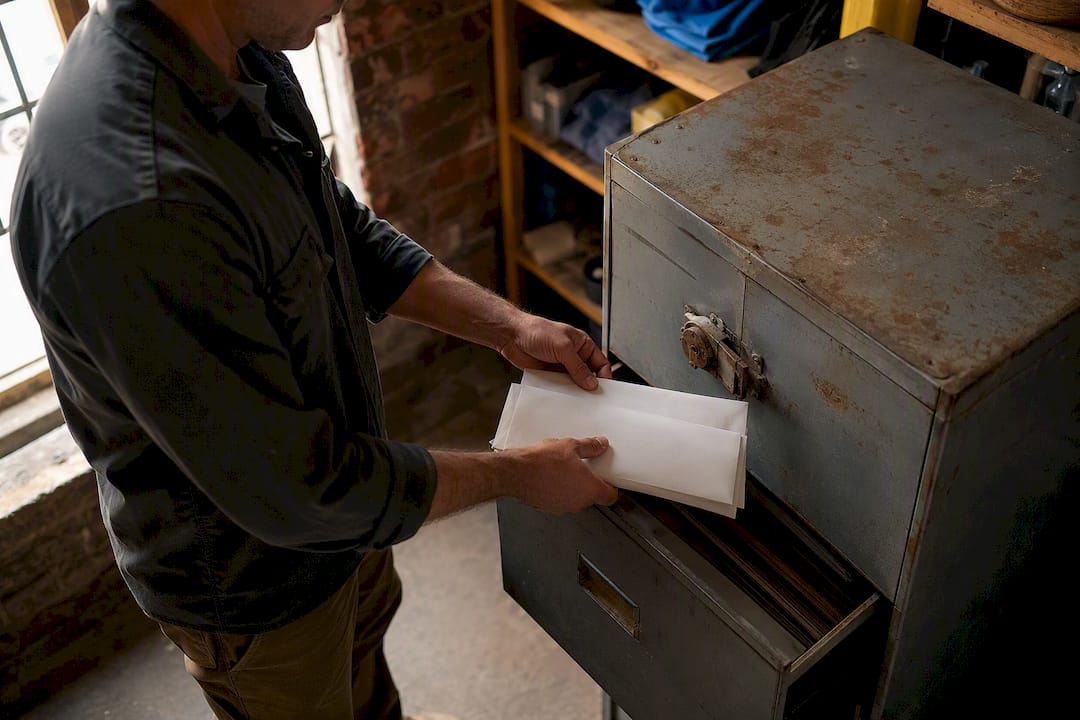
A few practical rules keep an assessment legally sound and ethically defensible. Aggregate results at a team size large enough that no individual can be identified, typically five or more respondents per reported group. Store raw survey responses separately from any system tied to performance reviews or compensation decisions, so the data can’t be repurposed later without explicit consent. If interviews are recorded, get verbal or written consent first and let participants know they can decline any question.
Different jurisdictions layer on their own requirements around employee data collection and consent, particularly for anything touching health-related wellbeing questions, so check your local labor and privacy rules before finalizing the survey design rather than after collection starts. When in doubt, ask less. A shorter survey that respects boundaries gets better participation and cleaner data than a long one that makes people suspicious of the exercise.
Finally, close the loop. Employees who fill out a survey and never hear what happened with it will not participate honestly next time. Share a summary of themes, even if leadership can’t disclose every detail, and name at least one action taken as a direct result.
Why Most Assessments Fail Before They Start
The conventional advice treats an org health assessment like a report card: measure, score, file, repeat next year. That’s backwards, and it’s why so many surveys generate a stack of PowerPoint slides nobody opens again. The evidence here points somewhere else entirely. The instruments that actually change outcomes, OHI, OHBI, a well-run pulse survey, all work because someone attached a facilitated debrief and a named owner to the results within days, not months.
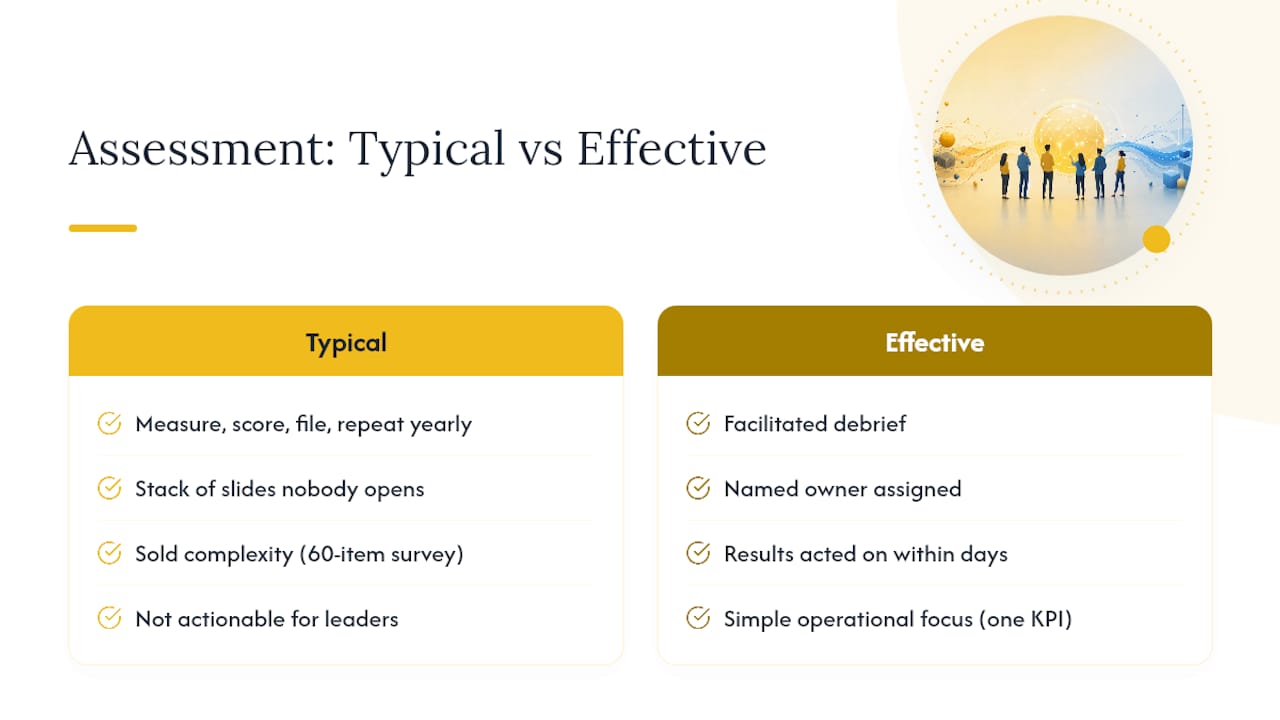
Trade business owners get sold on complexity they don’t need. A 60-item psychometric survey sounds rigorous, but if nobody on your leadership team can act on domain-level factor loadings, you’ve bought sophistication instead of clarity. What actually moves the needle for a 20-person HVAC company is embarrassingly simple: one operational KPI, one honest conversation with the crew, one accountability chart that finally puts a name on the seat everyone’s been covering for.
Prioritize the redesign over the diagnosis. The assessment is the easy part.
— Dan
A Faster Path From Diagnosis to Fixed Operations
Most consultants stop at the report. Rebuildingthetrades builds the assessment and the fix into a single engagement, so the accountability chart, KPI dashboard, and leadership coaching all launch off the same diagnostic instead of waiting on a second contract.

That matters because trade businesses rarely have the internal bandwidth to translate a 40-page findings document into a working system on their own. Rebuildingthetrades focuses exclusively on HVAC, plumbing, electrical, roofing, remodeling, and siding companies, which means every recommendation accounts for dispatch realities, technician scheduling, and job margin pressure instead of generic corporate playbooks. Case results include a documented $21 million run rate tied directly to sharper operational clarity and accountability structure.
If your business matches any of the growth or turnover triggers covered earlier, check current engagement pricing and see what a hands-on operational audit would look like for your team.
Sources
- Organizational Health Behavior Index (OHBI) validation study
- Organizational Health Index | McKinsey & Company
0 Comments