
An HVAC shop generating $500,000 in adjusted EBITDA typically sells for several multiples of EBITDA, illustrating how valuation multiples can vary widely, and where you land in that band depends on three things: how much of your revenue comes from recurring maintenance contracts, how clean your books are, and whether the business can run without you standing in the shop every morning.
Here’s the formula buyers actually use: normalized earnings × market multiple = enterprise value, then adjust for debt, cash, and working capital to get what actually lands in your pocket. The fastest ways to move up that multiple band are:
- Push recurring maintenance agreement revenue to a significant portion of total sales
- Get a Quality of Earnings (QoE) review done before you list, not after a buyer demands one
- Build a second layer of management so the business survives without you for 90 days
Pro Tip: Pull your last 12 months’ profit and loss statement today and calculate your recurring revenue percentage. That single number will shape more of your valuation conversation than anything else in this article.
TL;DR:
- Recurring maintenance contract revenue significantly boosts valuation multiples, especially if it comprises a large share of total sales.
- A Quality of Earnings review and clean financial records are crucial to reduce discounts and accurately reflect true cash flow.
- Scaling management depth and documenting operational processes decrease owner dependence, which positively influences valuation.
- Market multiples for small shops range from 2.5 to 4.0 times SDE, while larger, professionally managed companies may reach 7.5 times EBITDA.
- Local market conditions, customer concentration, and fleet age heavily influence the valuation and sale success of an HVAC business.
Table of Contents
- HVAC Business Valuation Methods: Income, Market, or Asset Approach
- What Are Current HVAC EBITDA and SDE Multiples?
- How Do You Normalize Earnings for a QoE Review?
- Which Operational Levers Actually Move Your Multiple?
- How Do You Calculate Your HVAC Business’s Value?
- What Operational Fixes Actually Raise Accepted EBITDA?
- What Are the Tax Implications of Selling an HVAC Business?
- How Does Your Local Market Affect HVAC Business Value?
- What Does Due Diligence Involve for an HVAC Business Sale?
- What Are the Most Common HVAC Valuation Mistakes?
- How Can You Increase HVAC Business Value Before Selling?
- What Should HVAC Owners Actually Prioritize Before Selling?
- Key Takeaways
- Sources
HVAC Business Valuation Methods: Income, Market, or Asset Approach
Three approaches exist, and picking the wrong one skews your number badly. HVAC valuation methods split into income, market, and asset-based approaches, with the income approach often serving as the primary method for service-heavy contractors because it directly captures what the business generates in cash.
-
Income approach. This uses either a discounted cash flow (DCF) model or a capitalized earnings method. DCF requires multi-year forecasts of revenue, margin, and capital spending, which works well for larger, more predictable HVAC platforms. Capitalized earnings is simpler: take one normalized earnings figure and divide by a capitalization rate. Most owner-operated shops use this shortcut because reliable five-year forecasts for a 12-truck operation are mostly guesswork anyway.
-
Market approach. This applies a multiple to your seller’s discretionary earnings (SDE) or EBITDA, based on what similar HVAC businesses have sold for. The catch: public comps barely exist for this trade, so you’re relying on private transaction databases and broker listings, which skew toward optimistic asking prices rather than closed deals.
-
Asset approach. This values trucks, tools, inventory, and equipment minus liabilities. It’s rarely the right primary method for a healthy service business. Use it as a floor, not a target. If your asset value exceeds your income-based value, that’s usually a sign the business isn’t generating enough cash flow to justify staying open.
The purpose of your valuation changes the weighting. A bank underwriting a loan leans hard on asset coverage and historical cash flow stability. A buyer evaluating an acquisition leans on market multiples and normalized EBITDA. An owner planning succession to a family member often blends capitalized earnings with a discount for lack of marketability.
What Are Current HVAC EBITDA and SDE Multiples?
Multiples vary by size, buyer type, and how clean your financials are, and the spread is wider than most owners expect. HVAC valuation multiples commonly range from about 2.5× to 4.0× SDE for small, owner-operated shops, climbing to roughly 3.5× to 7.5×, or higher, normalized EBITDA for scaled, lower-middle-market companies with professional management in place.
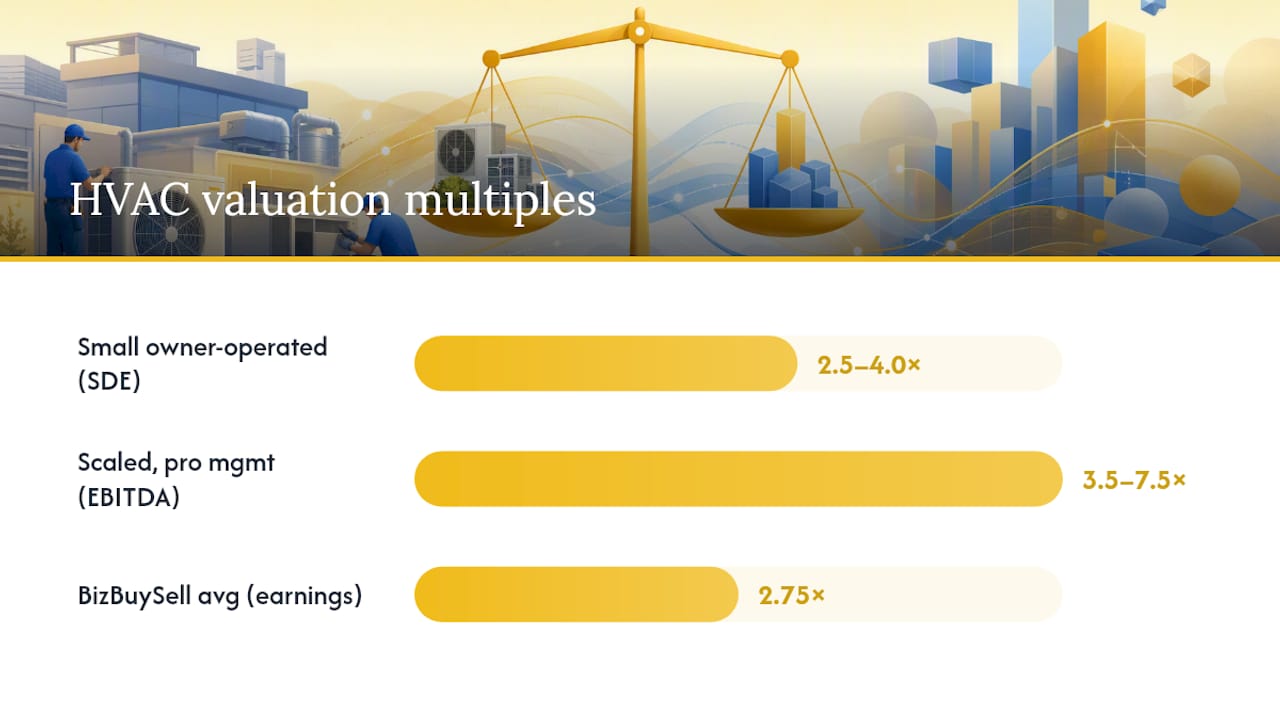
Transaction data tells a more conservative story than the aspirational ranges you’ll see in broker marketing decks. BizBuySell’s five-year average earnings multiple sits around 2.75×, with sold-business medians commonly clustering near 2.6× to 3.0× SDE and revenue multiples around 0.59×. That gap between listing prices and what actually closes matters. Sellers anchor to the high end of published ranges; buyers underwrite to what a lender or investment committee will actually approve.
Three buyer types set different ceilings:
- Main-street buyers (individuals financing with SBA loans) top out lower because lender debt-service coverage requirements cap how much they can pay relative to cash flow.
- Strategic buyers (competitors or adjacent trade companies) will pay up for route density and technician capacity they can absorb without adding overhead.
- Private equity and platform buyers chase recurring, contract-backed revenue and will pay the highest multiples for businesses that plug cleanly into an existing branch network.
Practical benchmarking shows two shops with identical revenue can sell several multiples apart depending entirely on recurring revenue share and how defensible the numbers are. Local comps matter more than national averages here. A shop in a fast-growing Sun Belt metro with dense residential construction is not comparable to one in a shrinking rural market, even if their P&Ls look identical.
How Do You Normalize Earnings for a QoE Review?
Buyers rarely accept your P&L at face value, and normalization is where most of the negotiation actually happens. A Quality of Earnings review reconstructs your true, ongoing cash flow by stripping out owner-specific and one-time items, then adding back what a new owner wouldn’t inherit.
Typical add-backs include:
- Owner salary above or below fair market replacement cost
- Family members on payroll who don’t perform equivalent work
- Personal vehicle, travel, or insurance expenses run through the business
- One-time legal settlements, bad debt write-offs, or storm-related revenue spikes
- Non-recurring equipment purchases misclassified as repairs
Buyers expect documentation for every add-back, not just a spreadsheet claim. Bring tax returns, payroll records, and vendor invoices that support each adjustment, because an unsupported add-back gets discounted or rejected outright during diligence.
Beyond add-backs, a QoE team will dig into work-in-progress (WIP) balances, unbilled revenue, accounts receivable and payable aging, and deferred capital expenditures. Buyers know EBITDA is not cash flow for a contractor. A shop that pushed off truck replacements for three years looks profitable on paper but is sitting on a hidden capital bill the new owner will pay.
Pro Tip: Separate owner compensation from payroll reports, reconcile job costing monthly, and close your books within 10 days of month end for at least two years before you go to market. That single habit change is what turns a “trust me” conversation into a defensible number.
Which Operational Levers Actually Move Your Multiple?
Recurring maintenance revenue is the single highest-impact lever available to HVAC owners, and it isn’t close. Buyers underwrite maintenance agreements almost like a subscription business: they want to see what percentage of revenue is contract-backed, what the renewal rate looks like year over year, what margin the plans carry after labor and parts, and how much customer churn you’re absorbing annually.
Owner dependence is the second lever, and it’s the one most owners underestimate. If every big decision, every key customer relationship, and every technician escalation runs through you personally, a buyer discounts the business heavily for transferability risk. Documented process maps and a genuine second layer of management (a service manager, an office manager who doesn’t need you to approve every PO) directly reduce that discount.
Fleet age and capital planning matter more than owners think. A buyer who inherits six trucks averaging nine years old is staring down a six-figure capex bill in year one. Show a documented replacement schedule tied to mileage and maintenance cost, and you remove that objection before it’s raised.
- Track recurring agreement revenue as a distinct P&L line, not blended with one-off service calls
- Measure technician productivity in billed hours per truck per week, not just total revenue
- Maintain a rolling fleet replacement calendar with age and mileage by unit
Growing maintenance revenue and documenting job costing consistently rank among the most reliable levers for moving into a higher multiple band within a 12 to 36 month window.
How Do You Calculate Your HVAC Business’s Value?
Start with your last 12 months of financials, then work through the same inputs a buyer’s team would pull: normalized owner compensation, recurring revenue percentage, backlog, fleet age, AR/AP balances, and capex history.
- Calculate SDE (for smaller shops) or normalized EBITDA (for larger ones) by adding owner add-backs to net income.
- Select a multiple based on your size, recurring revenue share, and financial documentation quality, not the top of a range you saw in an article.
- Multiply normalized earnings by that multiple to get enterprise value.
- Adjust for debt, excess cash, and a working capital target to arrive at equity value, which is what actually hits your account.
Here’s a simplified example:
Online calculators are useful for a directional number, nothing more. They can’t account for customer concentration, a pending lawsuit, or a fleet that’s about to need $200,000 in replacements. Once your normalized earnings exceed roughly $750,000 to $1 million, or the deal involves an earnout or seller note, bring in a professional appraiser or M&A advisor.
What Operational Fixes Actually Raise Accepted EBITDA?
Case work with trade businesses shows the gap between reported and accepted earnings usually comes down to operational discipline, not the underlying business quality. One Rebuildingthetrades engagement helped a client build toward a $21 million run rate by fixing dispatch systems, financial reporting, and management accountability, the same fundamentals a buyer’s QoE team scrutinizes.
The changes that correlate most with higher accepted EBITDA:
- Monthly job costing that ties labor and material cost to specific jobs, not blended averages
- A KPI dashboard tracking recurring revenue percentage, technician utilization, and gross margin by service line
- A documented management structure that doesn’t collapse if the owner takes a month off
Pro Tip: Start your QoE and transferability fixes at least 18 months before you plan to sell. Buyers can smell a business that got cleaned up for a data room versus one that’s actually run this way.
What Are the Tax Implications of Selling an HVAC Business?
How a sale is structured changes your after-tax proceeds substantially, often more than the multiple itself. Asset sales, common in main-street HVAC deals, let buyers step up the basis on equipment and allocate purchase price to categories like goodwill, equipment, and covenants not to compete. Sellers organized as C-corporations can face double taxation on an asset sale: once at the corporate level, once again when proceeds are distributed. Pass-through entities like S-corporations and partnerships generally avoid that layer, which is one reason so many HVAC shops are structured that way.
Stock or equity sales shift more risk and often more favorable tax treatment to the seller, since gains are typically taxed once at capital gains rates rather than as ordinary income. Buyers resist equity deals more often, though, because they inherit historical liabilities along with the business.
Purchase price allocation is where a lot of value quietly leaks. Equipment allocated to depreciable assets creates different tax consequences than the same dollars allocated to goodwill. Seller notes and earnouts also spread the tax liability across multiple years instead of triggering it all in one lump sum, which can matter if a large gain would otherwise push you into a higher bracket in a single year.
None of this is something to work out during closing week. Loop in a CPA or tax attorney who has handled trade business sales specifically, ideally before you sign a letter of intent, not after. The allocation language in that letter often locks in tax consequences you can’t undo later.
How Does Your Local Market Affect HVAC Business Value?
Geography changes your multiple more than most owners expect. Climate is the obvious driver: a shop in a region with brutal summers and cold winters generates dual-season demand that smooths out cash flow across the year, which buyers reward with more stable multiples than a business dependent on a single peak season.
Local growth trends matter just as much. A market adding new housing stock and commercial construction feeds you a steady pipeline of installation work and, more importantly, a growing base of future maintenance customers. A shrinking or aging market means your addressable customer base is contracting even if your current numbers look fine.
Labor market tightness in your area directly affects transferability. If licensed technicians are scarce and hard to hire in your region, a buyer will discount for the risk of losing key staff post-sale, since replacing them could take months. Conversely, a market with a strong technical school pipeline feeding new technicians reduces that risk and supports a stronger multiple.
Competitive density plays a role too. A fragmented local market with mostly small, undercapitalized competitors is attractive to platform buyers looking to consolidate through acquisition, sometimes called roll-up activity. That consolidation appetite can lift multiples in specific regions independent of any changes to your own operations. Regulatory factors like local licensing requirements or refrigerant transition mandates can also shift buyer interest, since compliance costs and timelines vary meaningfully by jurisdiction.

What Does Due Diligence Involve for an HVAC Business Sale?
Due diligence on an HVAC company runs deeper than a standard small business sale because of licensing, safety, and equipment-heavy operations. Expect scrutiny in these areas:
Licensing and compliance. Buyers verify that technician licenses, EPA refrigerant handling certifications, and any state contractor licenses are current and transferable. A lapsed certification anywhere in the technician roster is a red flag that slows the timeline.
Contract review. Every maintenance agreement, warranty obligation, and vendor supply contract gets read line by line. Buyers check whether agreements are assignable to a new owner without triggering a renegotiation or cancellation right for the customer.
Fleet and equipment inspection. Trucks, diagnostic tools, and shop equipment get physically inspected and cross-checked against maintenance logs. A fleet that looks fine on a spreadsheet but is mechanically neglected changes the capex assumptions fast.
Customer concentration analysis. Buyers calculate what percentage of revenue comes from your largest customers or largest commercial contracts. Heavy concentration in a handful of accounts is one of the fastest ways to see a multiple discounted mid-negotiation.
Employee and safety records. Workers’ compensation claims history, OSHA incidents, and technician turnover rates all factor into the risk assessment.
A formal valuation or full sale preparation process typically runs three to six months from engagement to closing, longer if a QoE review surfaces issues that need correcting before the deal can proceed. Budget for legal, accounting, and advisory fees that commonly run from the low tens of thousands into six figures depending on deal size and complexity.
What Are the Most Common HVAC Valuation Mistakes?
The biggest mistake is anchoring to a multiple you read in an article instead of your actual financial documentation quality. Owners frequently quote the top of a published range without recognizing that range assumes clean books, low customer concentration, and management depth their business doesn’t have.
A close second: waiting until you’re ready to sell to start fixing the numbers. QoE issues, undocumented add-backs, and messy job costing take months to clean up properly. Trying to fix them during an active deal process signals distress to a buyer and often costs you leverage in negotiation.
Confusing revenue multiples with earnings multiples trips up plenty of owners too. A 0.6× revenue multiple and a 3.5× SDE multiple can describe the exact same business; conflating the two creates wildly unrealistic expectations in either direction.
Ignoring deal structure is another frequent error. A headline 4.5× multiple with a large earnout tied to post-close performance you don’t control is often worth less in practical terms than a 3.8× multiple paid mostly in cash at close. Deal structure changes what actually lands in your account regardless of what number appears on the letter of intent.
Finally, owners often skip a professional appraisal entirely and rely on a broker’s informal opinion, which is frequently optimistic because the broker’s compensation is tied to the sale price, not its accuracy.
How Can You Increase HVAC Business Value Before Selling?
Value improvement work pays off fastest when it targets the specific factors buyers underwrite hardest: recurring revenue, customer concentration, and financial credibility.
Reduce customer concentration. If any single customer represents more than 10% of revenue, actively diversify your book before you go to market. A commercial HVAC contractor tied to one large property management company is one lost contract away from a very different valuation conversation.
Grow recurring maintenance revenue deliberately. Set an internal target, such as moving from 20% to 35% of revenue under contract within 18 months, and track it monthly. This is the single lever with the clearest, most consistent effect on multiple.
Build management depth. Promote or hire a service manager and an office manager who can run daily operations without you. Document the handoff in writing so a buyer can see the business functions independently.
Clean up the books early. Separate personal expenses from business accounts, reconcile monthly instead of quarterly, and get comfortable producing a clean, buyer-ready P&L on short notice.
Plan capital expenditures visibly. A documented fleet and equipment replacement schedule removes one of the easiest objections a buyer can raise during negotiation.
What Should HVAC Owners Actually Prioritize Before Selling?
The conventional advice in this space treats multiples as the whole story, and that’s the biggest blind spot I see. Owners fixate on whether they’re a “4× business” or a “6× business” while ignoring that the multiple only applies cleanly to earnings a buyer actually believes. A shop reporting $600,000 in SDE with messy books and 15% customer concentration isn’t a 4× business. It’s whatever discounted number survives due diligence, which is often meaningfully lower.
The gap between conventional guidance and what actually works comes down to sequencing. Most owners think about valuation the month they decide to sell. The businesses that command real premiums started fixing job costing, building management depth, and growing recurring revenue two or three years earlier, because those changes take time to show up as a trend, not a one-time bump.
If you take one thing from this, prioritize documentation over decoration. A buyer doesn’t pay for a business that looks good. They pay for a business whose numbers survive someone else poking at them for 60 days.
— Dan
Get Your HVAC Business Valuation-Ready With Rebuildingthetrades
The gap between a business owner’s spreadsheet estimate and what a buyer’s QoE team accepts is usually operational, not financial. Rebuildingthetrades works directly inside HVAC companies to fix the specific things that move accepted earnings: dispatch and job costing systems, management accountability, and the financial visibility a buyer’s diligence team will demand before closing.

Engagements typically run multiple months and fit owners who are one to three years from a sale, a recapitalization, or simply want a business that runs without them in the room. One client’s operational cleanup work helped push toward a $21 million run rate, the kind of measurable outcome that translates directly into buyer confidence during diligence. Check current engagement packages and pricing to see what fits your timeline and start closing the gap between what your business earns and what a buyer will actually pay for it.
Key Takeaways
HVAC business valuation depends far more on recurring revenue percentage, financial documentation quality, and owner dependence than on any single published multiple.
| Point | Details |
|---|---|
| Formula basics | Normalized earnings multiplied by a market-appropriate multiple gives enterprise value, then adjust for debt and working capital. |
| Multiple ranges vary widely | Small owner-operated shops typically see 2.5×–4.0× SDE, while scaled companies reach 3.5×–7.5×+ EBITDA. |
| QoE readiness pays off | Documented add-backs, monthly job costing, and clean books reduce diligence discounts on accepted earnings. |
| Recurring revenue is the top lever | Growing contract-backed maintenance revenue as a share of total sales consistently moves multiples higher. |
| Rebuildingthetrades builds the operational base | Hands-on consulting fixes dispatch, financial reporting, and management systems that directly support a stronger valuation. |
Sources
- HVAC Company Valuation Multiples: 2026 Guide | Auxo Capital
- HVAC Business Valuation Benchmarks – BizBuySell
- Valuation multiples for HVAC companies | Peak Business Valuation
0 Comments