
Truck stock standards come down to one operational discipline: treat every truck as its own inventory location, set min/max par levels from real usage data, and let every work order trigger the replenishment. Shops that run this way typically see higher first-time-fix rates, less shrinkage, and fewer techs driving to the supply house mid-job. Start small: pick one truck, pull your top 10 SKUs, and set a par level this week.
TL;DR:
- Most service trucks should carry between $3,000 and $8,000 worth of parts, depending on call types and workload, to optimize first-time fix rates.
- Building an accurate starter list involves analyzing six to twelve months of dispatch history and ranking the top 50 SKUs by usage frequency to set appropriate par levels.
- Par levels are determined by usage data and should follow ABC analysis, with tight ranges set for fast movers and lean stocking for rare or expensive parts.
- Replenishment relies on recording parts on work orders, with daily A-item quick picks and weekly full reloads guided by inventory software or manual par sheets.
- Regular cycle counts, especially weekly for high-value items, help control shrinkage and keep stock accuracy aligned with actual usage.
Table of Contents
- What Are the Best Starter SKU Lists for Truck Stock?
- How Do You Set Par Levels and Choose an Inventory Model?
- What’s the Replenishment Process and What Technology Do You Need?
- How Often Should You Cycle Count and Catch Shrinkage?
- How Should Stock Change by Season and Budget?
- Inventory Is a Leadership Problem, Not a Warehouse Problem
- Get Help Turning This Playbook Into a Working System
- Sources
- FAQ
What Are the Best Starter SKU Lists for Truck Stock?
The industry-standard term for this discipline is “field service inventory management,” and the goal of a starter list is simple: stock what actually moves. A practical field guide recommends building your list from the top 50 SKUs pulled from six to twelve months of dispatch history, then setting a par range for each one rather than guessing at quantities.
Every trade has its own core set. HVAC trucks lean heavily on capacitors, contactors, universal filters, thermostats, refrigerant fittings, and igniters. Plumbing trucks need wax rings, faucet cartridges, supply lines, various-size PVC and copper fittings, and a range of shutoff valves. Electrical trucks carry breakers by amperage, GFCI and standard receptacles, wire nuts, electrical tape, and grounding hardware.
Budget matters as much as the list itself. Residential service trucks typically carry $3,000 to $8,000 in parts, and that range aims for roughly 85 to 90 percent first-time-fix on service calls. Where you land in that range depends on your call mix. A shop doing mostly maintenance and light repair can run leaner, closer to $3,000. A shop taking on heavier installs, retrofits, or emergency service should stock closer to $8,000 to avoid callbacks and repeat trips.
Your starter list should include:
- Top 10 to 15 A-item SKUs specific to your trade (the parts used on more than half your calls)
- A modest set of B-item SKUs covering common but less frequent repairs
- A thin C-item layer for rare but critical parts, kept lean to avoid dead cash
- Consumables (tape, sealant, fittings, fasteners) stocked at higher quantities since they’re cheap and used constantly
- Trade-specific safety and compliance items (lockout tags, PPE, spill kits) required regardless of call volume
The next step is pulling your own dispatch data and ranking parts by frequency of use, not by what feels important. That’s the only way a starter list becomes a real par list instead of a guess.
How Do You Set Par Levels and Choose an Inventory Model?
Par levels come from usage data, not intuition. Pull six to twelve months of parts consumption per truck, rank every SKU by how often it moves, then apply ABC analysis to sort items into three tiers. A items are your fast movers and deserve the tightest attention. B items move steadily but less often. C items are the rare, expensive, or job-specific parts you stock thin or not at all.
Rules of thumb help you set the actual numbers:
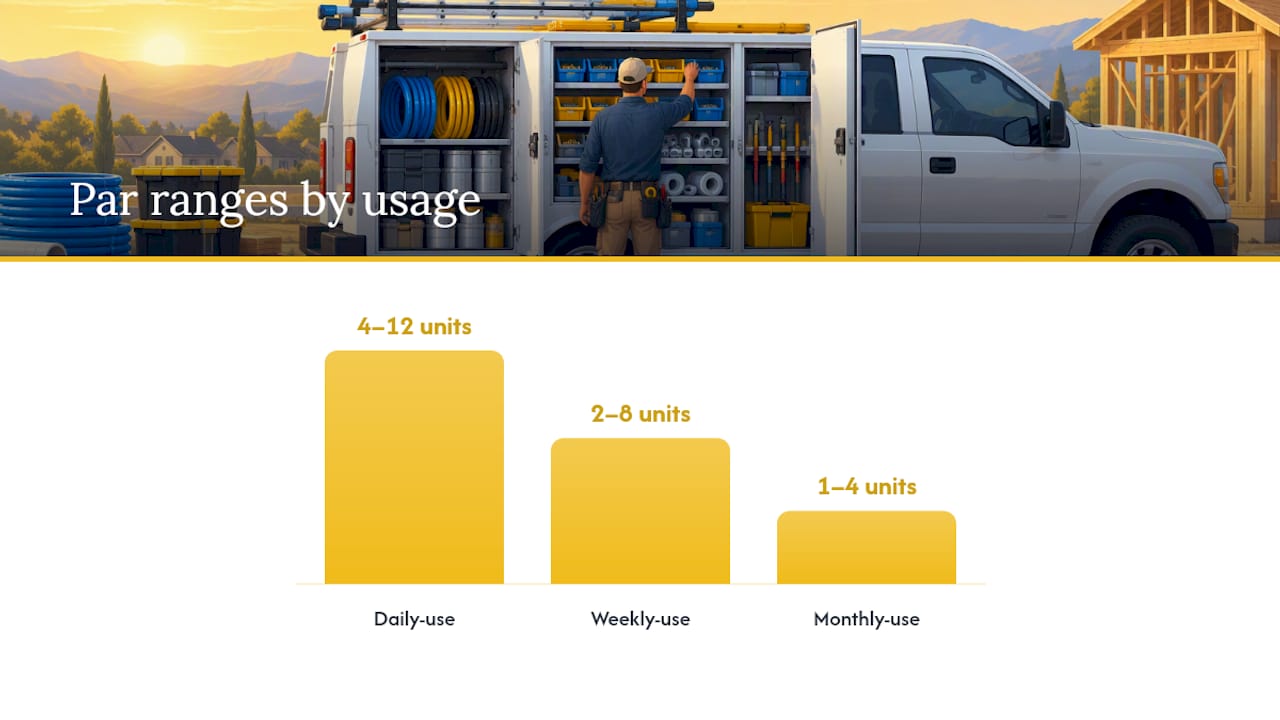
- Daily-use items (filters, tape, fittings): minimum 4 to 6 units, maximum 8 to 12
- Weekly-use items (capacitors, cartridges, common breakers): minimum 2 to 3, maximum 5 to 8
- Monthly-use items (specialty valves, uncommon fittings): minimum 1, maximum 2 to 4
Choosing the right physical model matters just as much as the numbers. A single-warehouse model, where trucks pull from one central stock, works for tiny operations with one or two trucks and short drive times. A per-truck location model, where every truck is tracked as its own inventory point in software, fits most mature fleets running three to fifteen trucks. Multi-location models, with regional depots feeding trucks, suit operations spread across a wide service area, according to the Smart Service operational guide.
Pro Tip: Don’t try to set par levels for every SKU on day one. Start with your top 10 A items on one pilot truck, get those numbers right over a month, then expand.
What’s the Replenishment Process and What Technology Do You Need?
The work order is the single source of truth. Every part a tech pulls off the truck gets recorded on that ticket, which decrements the truck’s inventory count, feeds the customer invoice, and triggers a reorder when the count drops below par. That single habit closes the loop between what’s billed and what’s actually on the truck.
A working replenishment rhythm looks like this:
- Daily quick picks for A items, letting techs grab fast movers from the shop before heading out
- Weekly full reloads where a parts manager checks each truck against its par sheet and restocks the gaps
- A supplier run sheet generated from what’s below par across the fleet, consolidated into one order instead of five separate ones
- A monthly review of any SKU that consistently runs short or long, adjusting par levels accordingly
On the technology side, ServiceTitan’s Inventory module sets up each truck as its own inventory location, complete with per-location par templates, mobile capture for techs, and vendor integrations that map purchases to the general ledger. The tool only works as well as the setup behind it. Pricebook completeness and vendor data matter more than the software itself.
If you’re not ready for that investment, a manual system still works: laminated par sheets taped inside each truck’s cabinet, paired with a weekly pick list a parts manager works through by hand. It’s slower, but it beats guessing.
How Often Should You Cycle Count and Catch Shrinkage?

Skip the annual full inventory count. It’s disruptive and it hides problems for months at a time. A 5 to 10 percent weekly cycle count means every truck gets fully counted once a quarter, without ever pulling a vehicle off the road.
Prioritize by tier:
- A items: counted weekly or even daily if they’re high-value or high-theft-risk
- B items: counted monthly
- C items: counted quarterly, since the cost of counting them often exceeds their value
Vendor-managed programs report shrinkage dropping from a typical 10 to 15 percent down to 3 to 5 percent once trucks are treated as tracked locations with regular counts. When your count doesn’t match your records, work through a short checklist before assuming theft: check for unrecorded transfers between trucks, unbilled work orders that never decremented stock, tech personal purchases charged to the wrong bucket, and barcode scans that failed to register.
How Should Stock Change by Season and Budget?
Rebalance quarterly, but swap emphasis seasonally. HVAC trucks shift toward cooling parts, refrigerant, and capacitors heading into summer, then toward igniters and heat exchangers before winter.
Expensive or model-specific parts don’t belong on every truck year-round. Move them to the shop or into a consignment or vendor-managed program instead, which lets a distributor stock and replenish specialty bins and cuts the cash tied up on your trucks.
- Run a 90-day dead-stock review: anything untouched in three months gets returned, transferred, or written off
- Route returns through a documented credit workflow so vendor credits actually land on your books
- Reassess seasonal SKUs at each quarterly rebalance rather than waiting for a full year to pass
Inventory Is a Leadership Problem, Not a Warehouse Problem
Most owners treat truck stock as a back-office chore. It’s actually a leadership issue, tied directly to KPIs like first-time-fix rate, inventory carrying cost, and shrinkage. Get those three numbers in front of your management team monthly and the conversation changes fast.
A working rollout looks like four phases: audit your top 50 SKUs, build par templates for a pilot truck, train techs and parts staff on the new workflow, then hold monthly KPI reviews to catch drift before it becomes a habit. Done right, this shows up as fewer mid-job supply runs, tighter cash tied up in parts, and technicians who trust their trucks are stocked before they leave the yard.
— Dan
Get Help Turning This Playbook Into a Working System
Reading a checklist is one thing. Getting your techs to actually record parts on every work order, your parts manager to run weekly reloads, and your managers to review KPIs monthly is another problem entirely. Consultants work hands-on inside trade businesses to close that gap, instead of handing owners another template to file away.

That means building your par-level templates from your own dispatch data, training technicians and parts staff on the daily and weekly rhythms, and setting up the accountability reviews that keep the system honest after month one. This is the same operational approach Rebuildingthetrades applies across management and leadership training, dispatch optimization, and financial visibility work with HVAC, plumbing, and electrical shops. If your truck stock has been more guesswork than system, start with a Rebuild engagement and get an operational audit that pinpoints exactly where your fleet’s inventory is leaking cash.
Sources
These references back the standards covered above: ServiceTitan’s Inventory module for software setup, the vendor-managed replenishment case study for VMI tradeoffs, and the Anvilfield field guide for par levels and cycle counting. For additional trade-specific stock examples, see Caledonian Mechanical’s blog.
- ServiceTitan — Inventory module
- Vendor-managed truck replenishment
- Field Service Inventory Management — The Operational Guide (Smart Service)
FAQ
How Much Should a Service Truck Carry in Parts?
Most residential service trucks carry $3,000 to $8,000 in parts, depending on call mix and trade. Shops doing heavier install or emergency work should stock toward the higher end to reduce callbacks.
How Often Should You Cycle Count Truck Stock?
Count 5 to 10 percent of parts weekly so each truck gets a full count once a quarter without pulling it off the road. Fast-moving A items deserve weekly or even daily spot checks.
Can You Manage Truck Stock Without Software?
Yes. Small fleets can run laminated par sheets per truck paired with a weekly manual pick list, then migrate to per-truck software tracking once they scale past a handful of trucks.
Does Vendor-Managed Inventory Actually Reduce Shrinkage?
Vendor-managed replenishment programs report shrinkage dropping from a typical 10 to 15 percent to about 3 to 5 percent once distributors take over stocking specialty bins. Expect a few months of tuning as catalogs and processes settle in.
What Does Rebuildingthetrades Charge to Help Implement This?
Pricing depends on the scope of the engagement, so current rates are listed on the Rebuildingthetrades site rather than published as a flat number here. Engagements typically combine an operational audit with hands-on training and accountability systems tailored to your fleet.
0 Comments