
A service rate increase should be sized by your costs, not by a hunch or a competitor’s price sheet. Work out your fully loaded cost per billable hour, add the margin you need, and compare the result to what you charge today. The gap is your increase. Then move in small, regular steps, give customers notice, and watch gross margin and renewals to confirm it worked.
This guide walks through each step for HVAC owners: the math, the timing, how to apply the new rate to service calls and maintenance plans, and how to measure the result.
TL;DR
- Review pricing at least once a year, ideally twice, and fix anything priced below cost right away.
- Calculate the rate from your loaded labor cost, overhead per billable hour and a target margin. A 5% cost rise needs roughly a 5% price rise just to hold your margin percentage.
- Tell customers early, with the new price, the start date and a short reason. Give maintenance plan members notice before renewal.
- Track gross margin per job, close rate and agreement renewals for a few months after the change.
- Your technicians and CSRs must understand the math, or the increase dies at the point of sale.
Table of Contents
- How often should you raise HVAC service rates?
- How to calculate the increase from your costs
- How much should the rate go up?
- Applying the increase across service calls, labor and plans
- How to tell customers
- Measuring whether the increase worked
- Our perspective
- Where hands-on help fits
- FAQ
- Sources
How often should you raise HVAC service rates?
Plan on a pricing review at least every year. ACCA’s HVAC blog advises reviewing a flat rate system at least annually, if not twice a year. ACHR News adds that the end of the calendar year or the shoulder season is a sensible time, because you have 12 months of cost data and demand is usually calmer.
The reason to go often is that small steps are easier to absorb than big ones. A shop that adjusts a few percent a year tracks its costs and customers rarely notice. A shop that waits five years may face a correction of 30% or more, and that lands hard on customers and on your own team. One pricing guide recommends checking costs quarterly, adjusting once or twice a year, and fixing anything priced below cost immediately.
A practical rhythm looks like this:
- Quarterly: compare gross margin on closed jobs against your target. Note which costs moved.
- Annually: rebuild the budget, recalculate the loaded hourly rate, and set the new price book.
- Anytime: correct a line item that sells below cost, such as a repair or a part with a stale markup.
You also don’t need to react to every swing. ACHR News reported in July 2026 that contractors should use a disciplined pricing process and act when inflation is eroding margins, not chase every change.
How to calculate the increase from your costs
Start with the budget. Labor, overhead, billable-hour capacity and a profit target go in first. Prices come last.
Step 1: Find your loaded labor cost
A technician’s wage is not what the technician costs you. Payroll taxes, workers’ comp, benefits, vehicle costs and drive time all sit on top. Relay’s flat rate guide notes that a tech earning the BLS median wage of $59,810 in May 2024 (roughly $28 an hour) costs the shop closer to twice that per billable hour once those items are added.
Also count only the hours you can bill. A tech paid for 2,080 hours who bills 1,400 is 67% utilized, and your rate has to carry the other third.
Step 2: Add overhead per billable hour
Divide total monthly overhead (office staff, rent, insurance, software, marketing, trucks) by the billable hours your techs actually produce. Use real numbers from your books, not last year’s estimate. If your financial reporting is thin, start there: our guide to contractor financial reporting covers what to track.
This is also the point where tooling helps. Field service software for HVAC that records work orders, technician time and reporting makes billable hours and job costs far easier to pull than spreadsheets do.
Step 3: Add the margin, using division
Most owners make the same mistake here: they multiply cost by 1.25 and call it a 25% margin. It isn’t. Margin is a share of the price, so divide by one minus the target margin. ServiceTitan’s pricing webinar recap describes this order: build the budget, divide break-even costs by billable hours, then divide by one minus the target profit margin.
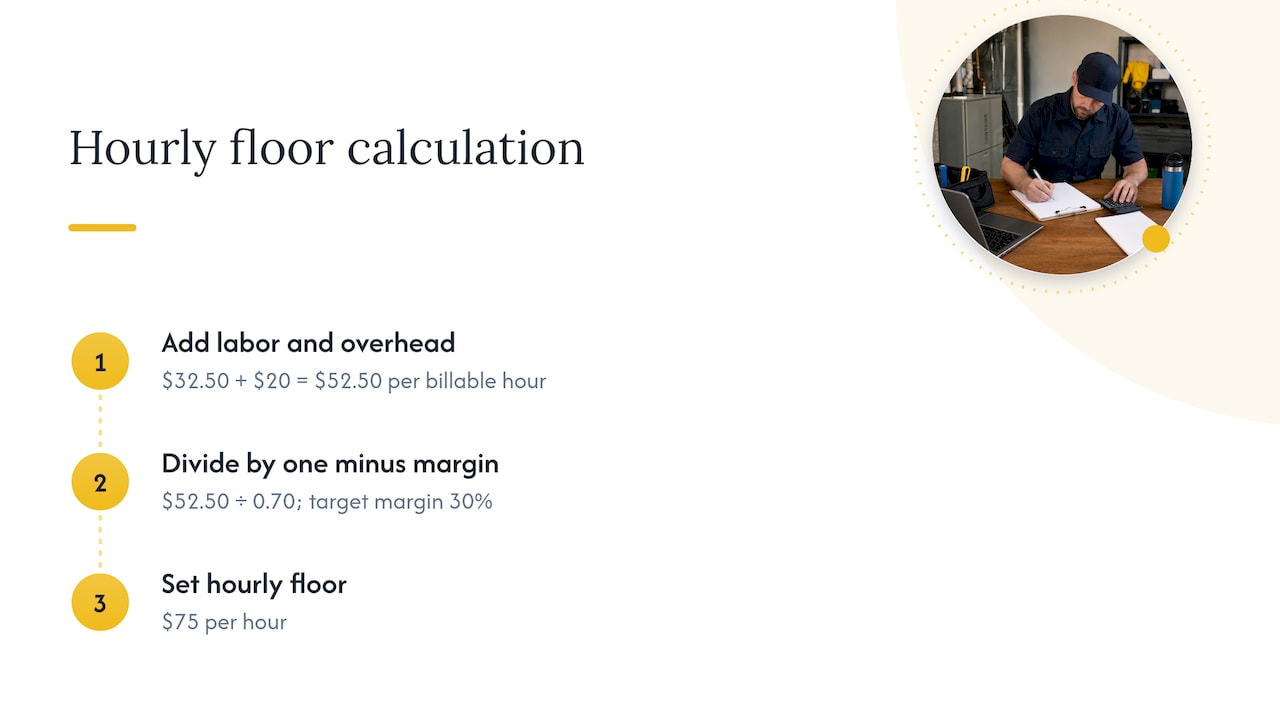
JobEstimator’s example shows the mechanics at small scale: $32.50 in labor plus $20 overhead gives $52.50 per billable hour, and $52.50 divided by 0.70 gives a $75 hourly floor. Your numbers will be larger, but the sequence holds.
A worked example
RateTicket’s formula is useful for owner-operators and small shops: required rate = (owner pay + annual overhead) ÷ (1 − target margin) ÷ billable hours.
Take a one-van shop with an $85,000 owner pay target, $48,000 in overhead, a 15% profit target and 1,150 billable hours:
- $85,000 + $48,000 = $133,000
- $133,000 ÷ 0.85 = about $156,471
- $156,471 ÷ 1,150 = about $136.06 per billable hour
If that shop charges $125 today, the gap is $11.06 an hour, or about $12,719 a year. That is the size of the increase, and it comes from the math rather than a guess.
How much should the rate go up?
There are three anchors: your cost increase, the margin you want to keep, and the market.
Cost pass-through. ACCA’s blog gives a clean illustration: a $10,000 annual cost increase spread across 1,000 billed technician hours needs a $10 hourly increase just to preserve profitability.
Margin protection. If costs rise 5% and your price doesn’t move, a 30% margin slips to 26.5%. Holding the same margin percentage takes a 5% price rise.
Dollars versus percent. Wrenchpost’s cost-based method shows a choice many owners miss. On a $120 visit whose cost rises from $90 to $95.55, protecting the same profit in dollars needs a 4.6% increase, while protecting the same 25% margin needs 6.2%. The same guide notes US CPI-U rose 3.7% from September 2025 to September 2026, a useful reference point when you explain the change to customers.
Market check. After you have your number, sanity-check it. EstimateKit reports that most residential HVAC companies bill $110 to $175 an hour for service and that after-hours work runs $165 to $250. If your calculated rate lands far outside the range, recheck your overhead and billable-hour assumptions before you blame the market.
| Input | What to use | Common mistake |
|---|---|---|
| Labor | Wage plus taxes, comp, benefits | Using the hourly wage alone |
| Hours | Billable hours only | Dividing by paid hours |
| Overhead | Actual monthly total ÷ billable hours | Last year’s guess |
| Margin | Divide by (1 − margin) | Multiplying cost by 1.25 and calling it 25% |
| Timing | Small steps once or twice a year | Waiting years, then jumping 30% |
If you run flat rate pricing, the rate change flows through your price book. Our guides on the HVAC price book and a flat rate pricing rollout show how to structure it.
Applying the increase across service calls, labor and plans
A rate increase is not one number. It lands differently on each part of the business.
Service calls and diagnostics
The service call fee covers the trip, the diagnosis and the first stretch of labor. Rebuild it from your floor rate times the minimum time, plus any trip charge, as in the JobEstimator method above. Because one-time customers see the price before they book, quote the new price on the phone and in the estimate from day one. That makes your CSR scripting matter, so see our guide to HVAC service scripting.
Hourly labor and after-hours work
After-hours and weekend rates should keep their premium over the new base rate rather than staying frozen. If your base moves 5%, the premium tier should move with it.
Maintenance agreements
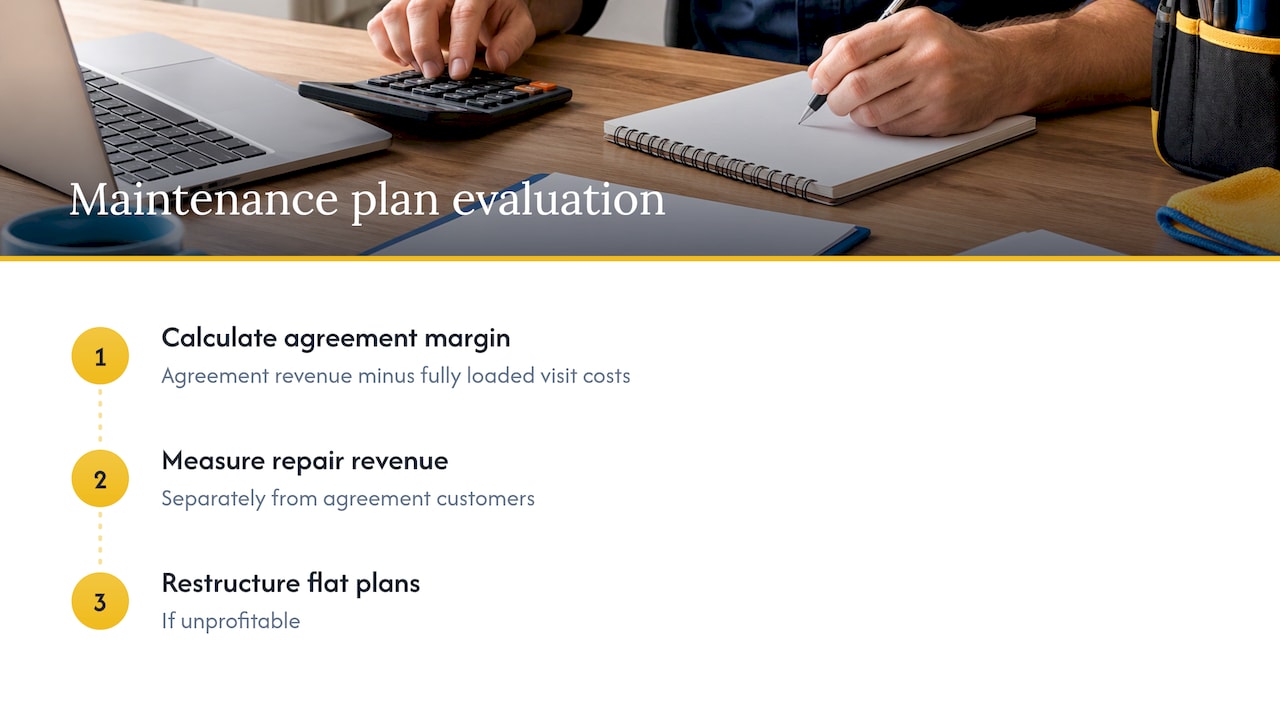
Plan renewals deserve their own treatment. ACHR News reported that one contractor addresses maintenance-renewal pricing formally, separate from hourly rates, truck charges and overhead handled in annual budgeting. Evaluate each plan on visit cost and on the repair revenue it brings, as MarginPlug recommends: agreement revenue minus fully loaded visit costs, then repair revenue from agreement customers measured separately.
If your plan structure is flat and unprofitable, restructuring it can do more than a rate bump. We cover one approach in our three-tier maintenance agreement strategy.
Existing customers versus new ones
New customers get the new price immediately. For existing customers, FieldEdge’s guidance is to test increases first with your least profitable customers, use their feedback to refine the process, and only then apply the change to profitable accounts. Treat it as a controlled rollout, not a switch.
How to tell customers
Most pushback comes from surprise, not from the number. Three habits cut it down.
- State the facts. Housecall Pro’s template guidance says a notice should state the new price, the start date and a short reason before the change appears on an invoice.
- Time it by customer type. One-time customers should see the new price before they book or approve an estimate. Recurring customers should hear before the next visit or renewal.
- Give plan members real notice. One sample plan notice gives agreement holders 30 days before renewal and spells out the old price, the new price, the timing and the reason.
The same source recommends leading with customer value and offering options such as maintenance agreements, price locks or financing. A member who gets a plan discount feels rewarded rather than charged.
Your own staff are the other audience. ServiceTitan’s consultant stresses that technicians accept and explain pricing with more confidence when management shows them the budget and the math. A tech who only hears “prices went up” will apologize for the price on the doorstep. A tech who knows the loaded cost of a truck roll will not.
For a full rollout plan, including a pilot and a 30-day scorecard, read our guide on price increase communication for trades.
Measuring whether the increase worked
Give the change a few months, then look at four numbers together. Watching only revenue hides the damage.
- Gross margin per job. ACHR News describes reviewing gross margin after every job against the target, finding which costs caused any shortfall, and acting on it. One published residential HVAC benchmark lists 40% to 55% as typical and 55% or more as best-in-class.
- Close rate. The same benchmark table lists 50% to 70% as typical and 70% or more as best-in-class. A sharp drop right after the change points to a communication or scripting problem more than a pricing one. Our operations-first sales process article digs into that.
- Agreement renewals. The benchmark table lists 60% to 75% as typical and 75% to 90% as best-in-class. ACprosite, citing Ruth King, says residential maintenance plan renewal should be at least 80%, except plans bundled with new installs, where it cites 60%.
- Customer-level margins. Spot-check them intermittently, as the ACHR piece describes, so a margin slide on one account type doesn’t hide inside a healthy average.
The benchmarks are a reference, not a verdict. Compare against your own numbers before the change, and judge the result by gross profit dollars and retention together.
Our perspective
Most HVAC owners we meet are not underpricing because they don’t care about money. They are underpricing because they can’t see their numbers. Without clear job costing, a real overhead figure and a known number of billable hours, every price is a guess, and every increase feels like a gamble.
That is why we treat pricing as an operations problem first. When dispatch, call handling, sales and financial reporting work together, the price becomes a decision made from data. Techs and CSRs can defend it because they were taught the reasoning behind it, not handed a new price sheet.
We work only with trades businesses, and our approach combines data-backed systems, in-field engagement and leadership development. In our case studies, we have seen the clarity that comes from this work reflected in results like $21 million run rates. A rate increase is a chance to build that discipline in your company, not just to move a number.
Dan
Where hands-on help fits
If you have run the math and still can’t see where your margin leaks, or your team resists the new prices, the cause is usually operational: weak job costing, inconsistent call handling or managers who haven’t been taught to hold the line.
Rebuilding the Trades works with HVAC, plumbing, electrical and other trade businesses on sales training, management and leadership training, call management and dispatch training, and financial operations assistance. See the Rebuild program for how an engagement works.

If you would rather start with the numbers, our weekly cash flow rhythm guide is a good first step. More guides are on our Trade Intel blog.
FAQ
How much should I raise HVAC service rates each year?
Let your costs set it. If your costs rose 5%, you need about a 5% price increase to keep the same margin percentage. Small annual adjustments are easier on customers than large catch-up jumps after several years of no change.
Should I raise prices for maintenance plan members too?
Yes, but handle it as its own decision at renewal. Give members written notice, with the old price, the new price, the timing and the reason, ahead of the renewal date. Pair it with a visible benefit so the plan still feels like good value.
Will a rate increase make me lose customers?
Some price-sensitive customers may leave, but surprise causes more complaints than the number does. Advance notice, a clear reason and options such as plans or financing help retention. Track close rate and renewals for a few months and compare against your pre-increase baseline.
Do I need flat rate pricing to raise rates properly?
No, but it makes the change cleaner. With a flat rate price book, you update the formula inputs once and every task price follows. Hourly shops can apply the same math to the loaded hourly rate.
Sources
- ACCA HVAC Blog: When Was The Last Time You Updated Your Flat Rate System?
- ACHR News: The Best Time For HVAC Contractors to Review Pricing
- ACHR News: Rising Costs Force Contractors to Take a Harder Look at Pricing
- How to Raise HVAC Prices Without Losing Customers
- Back 2 Basics: Increase Prices, Protect Margins
- HVAC Service Call Pricing: How Much to Charge in 2026
- HVAC flat rate pricing: build a price book that holds
- How to Raise Your Prices Without Losing Customers
- How Much Should I Raise My Prices? A Cost-Based Method
- HVAC Labor Rate Calculator: Average Hourly Rates 2026
- Are HVAC Service Agreements Actually Profitable?
- Raise HVAC Prices Without Losing Clients
- Price Increase Letter and Notice Templates for Pros
- HVAC Pricing Strategy: The Complete 2026 Playbook
- Key KPIs for HVAC Businesses
- The Last Critical KPI to Track by Ruth King
0 Comments