
A trade accountability system is a written set of roles, expectations, numbers and meetings that makes it clear who owns each result in your company and what happens when a result is missed. In an HVAC, plumbing or electrical business, it replaces “I thought you had that” with a name, a standard, a measure and a date. This guide shows you how to build one, in what order, and how to keep it from turning into micromanagement.
TL;DR
- An accountability system has four working parts: a defined outcome, clear communication of the expectation, a regular check on progress, and real follow-through.
- Start with roles and written workflows, then add a short list of numbers each role controls, then a weekly rhythm to review them.
- Set the result and the guardrails, and let people choose their method. That is accountability without micromanagement.
- Support comes before consequences: confirm people have clarity, tools, training and authority before you escalate.
- Most systems fail at follow-through, not design. Missed expectations that nobody acts on teach the team that the standard is optional.
Table of Contents
- What an accountability system means in a trades business
- Why growing shops need one
- The five parts of a system that works
- Accountability without micromanagement
- How to roll it out in a small or family-owned company
- Mistakes that break accountability systems
- Our perspective
- Get help building it with your team
- FAQ
- Sources
What an accountability system means in a trades business
In a trades company, accountability is not a software package and not a punishment policy. It is the answer to four questions for every important result: who owns it, what does “done right” look like, how will we know, and what happens next if it is off.
Those four questions line up with a simple cycle that the University of Minnesota’s HR guidance describes: define, communicate, assess and follow through. Clarity and support come first, and consequences come after. That order matters in a shop where your best technician may also be your most stubborn one.
In practice, the system touches every seat:
- Technicians: a repeatable job workflow, documentation and a completion standard.
- Call takers and dispatchers: booking and scheduling standards, with call data reviewed.
- Sales and comfort advisors: a defined process and closing and average-ticket numbers.
- Install and project leads: a handoff, a schedule, a budget and a closeout.
- Office and finance: timely invoicing, job costing and a regular report to the owner.
- The owner: the same system applies, including the habit of reviewing numbers on schedule.
Why growing shops need one
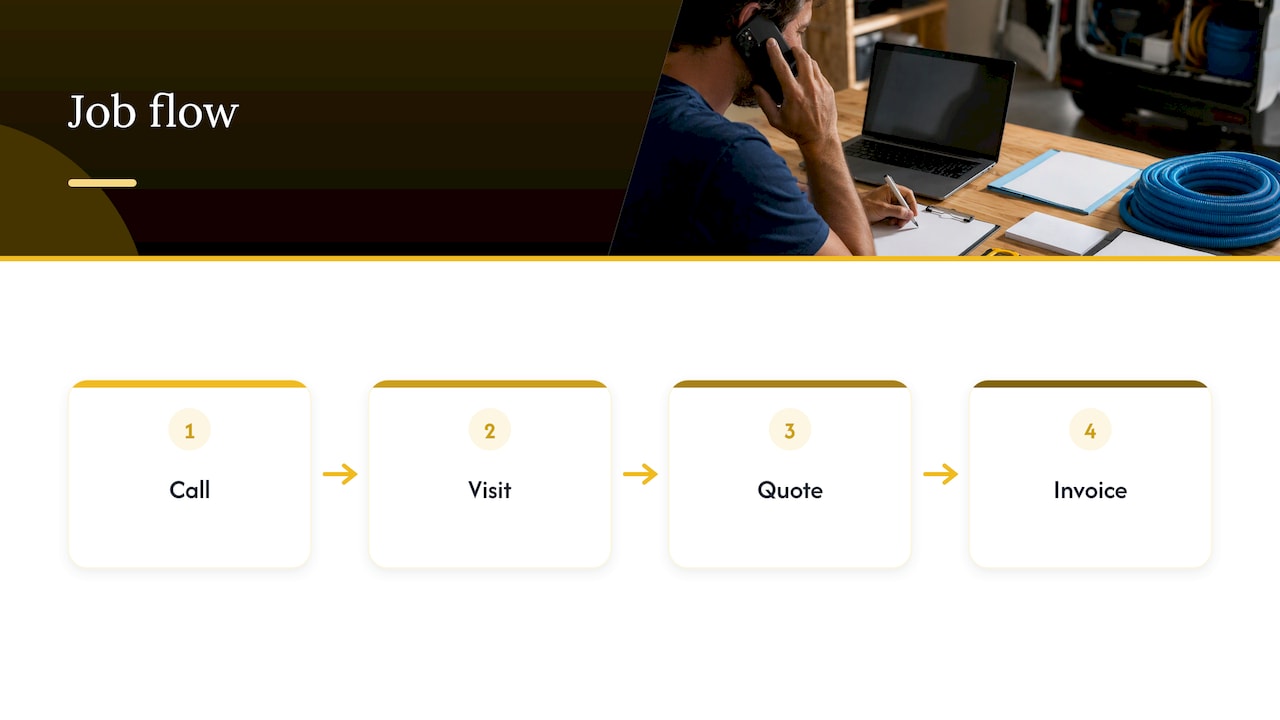
A five-person shop runs on conversation. The owner hears what happened because the owner is in the truck, on the phone or in the office. Add trucks, crews and job sites and that stops working. Work stalls between the call, the visit, the quote and the invoice, and nobody can say where.
One field-service software company’s guide on scaling from 5 to 25 employees makes the same point: explicit responsibility and tracking from first customer contact through final invoicing keep work from falling through the cracks, and standardized workflows protect quality as teams and job sites multiply.
Family-owned companies feel this sharply. Relationships feel like governance, but they are not. A construction-industry account of taking over a family business says that good intentions alone do not stop important work from slipping. Its fix is a clear organizational structure with position descriptions, a documented operations manual and accounting information the owner can see in real time. Written roles also take the personal edge off hard conversations: the standard is on paper, so the discussion is about the standard and not about a son, a cousin or a brother-in-law.
The five parts of a system that works
1. Roles and position descriptions
Start with who owns what. Draw the org chart as it should be, not as it is today, and put one name next to each box. Then write a one-page description for each seat covering the outcomes the role owns (not a list of tasks), the decisions the person can make alone, and the numbers that show whether they are winning.
If two people own the same result, nobody owns it. If your service manager and your dispatcher both “handle” callbacks, pick one.
2. Written workflows for repeatable work
Accountability needs something to be accountable to. The ACCA HVAC Blog’s example for technicians uses step-by-step job workflows that cover safety, job-site documentation and service completion. The work becomes repeatable, and managers can verify the required steps were done. The same piece frames accountability as taking responsibility for commitments and expected outcomes, with transparent communication about work, successes, challenges and roadblocks.

Begin with the three or four workflows that cause the most rework: a standard service call, a replacement install, a callback, and job closeout. Keep each to one page or a mobile checklist. A closeout standard is a good first target, and our job closeout checklist for trade contractors shows what to include.
3. A short list of numbers per role
Every role needs between one and three numbers it can influence. More than that and nobody can remember them. Pick measures that reflect the outcome of the role, not just effort.
| Role | Example measures | Why it fits |
|---|---|---|
| Technician | First-time-fix rate, callbacks, technician utilization | Shows quality and productive time |
| Dispatcher / CSR | Booking rate, answer time, schedule fill | Shows whether demand becomes jobs |
| Sales / advisor | Close rate, average ticket | Shows conversion and value per call |
| Project lead | Labor variance against quote, schedule adherence | Shows whether the job was run to plan |
| Office / finance | Time-to-invoice, cash position | Shows how fast work turns into cash |
| Owner | Gross margin per job, flash report, forecast | Shows whether the company is healthy |
Some definitions you can use as they stand. AroFlo defines first-time-fix rate as jobs completed on the first visit divided by total service calls, multiplied by 100, and suggests technician utilization as billable hours divided by available hours. The same article also recommends tracking gross margin per job, labor variance against quote, material-cost drift, time-to-invoice, callback and warranty work, and repeat-customer rate.
For electrical contractors, the ELECTRI International KPI list identifies productivity and purchases against budget as leading indicators for profit and loss. Those two numbers show trouble before the month-end statement does.
For a longer menu of shop-level measures with benchmarks and formulas, see 12 HVAC KPIs for small shops. If you want our own take, read our guides to HVAC KPIs owners must track and field service KPIs with formulas and rules.
4. A weekly operating rhythm
Numbers on a dashboard that nobody discusses are decoration. Build a fixed rhythm:
- Daily huddle (10 to 15 minutes): today’s schedule, open problems, who needs help.
- Weekly department review (30 to 45 minutes): each role owner reports last week’s numbers against target, names the cause of any miss, and commits to one action with a date.
- Weekly owner review: a one-page financial snapshot. Our one-page flash report and 13-week rolling cash forecast are built for this.
- Monthly and quarterly: review job costing, work-in-progress and labor capacity. WIP accounting catches profit fade early, and labor forecasting shows whether you can staff the work you are selling.
Keep the agenda identical every week. Sameness is what makes it a rhythm, and it is what lets people prepare.
5. Follow-through
This is where most systems fail. The University of Minnesota’s guidance on driving accountability says that taking no action after an expectation is missed can amount to having no accountability at all, and that consequences should increase if behavior does not improve.
Follow-through is not always discipline. It can be recognition when a number improves, coaching when it stalls, or a firmer conversation when the pattern holds. What it can never be is silence.
Accountability without micromanagement
Technicians and managers who hear “accountability” often hear “surveillance.” The fix is to be exact about what you control and what you leave to them.
A piece in Inman on leadership draws the line clearly: accountability sets the result and the guardrails while the employee keeps discretion over the method. Micromanagement dictates the method. If your technician hits first-time-fix and customer standards, you do not need to dictate the order in which they check the system.
The same article recommends investigating obstacles, clarity, tools, training and authority before escalating a performance issue. In a shop, that checklist looks like this:
- Clarity: Did they know the standard? Is it written down?
- Tools: Do they have the parts, vehicle stock, software and equipment?
- Training: Were they trained on the workflow, or did they pick it up from whoever sat next to them?
- Authority: Can they make the decision the standard requires, such as approving a return trip or adjusting a quote?
- Obstacles: Is something upstream, like dispatch or purchasing, making the standard impossible?
Only after those answers are “yes, yes, yes, yes, no obstacle” does a miss become a performance conversation. Teams trust systems that work like this because the first question is “what is in your way?” and not “who is to blame?”
How to roll it out in a small or family-owned company
You do not need to build everything at once. A sensible order for a company of 5 to 30 people:
- Week 1 to 2: Map the seats. Draw the org chart, assign one owner to each result, and write the one-page role descriptions. Involve the people in the seats, since they know where the real work is.
- Week 2 to 4: Pick the numbers. Choose one to three per role. If you cannot measure something today, put it on the list and begin tracking it by hand.
- Week 3 to 6: Write the top workflows. Service call, install handoff, callback and closeout. Pilot each with one crew before rolling it out.
- Week 4 onward: Start the rhythm. Hold the first weekly review even if the numbers are rough. The meeting shapes the data, not the other way around.
- Month 2 to 3: Close the loop. Decide in advance what happens for a green, yellow and red result. Tell the team in advance so nothing feels like a surprise.
- Quarterly: Revisit. Retire measures nobody acts on, tighten targets that are always green, and update the written workflows.
If the person you are holding accountable is a family member, run the same process. Put the role description in writing, use the same scorecard, and have the conversation in the same meeting. Treating relatives differently, in either direction, is what erodes morale among everyone else.
A system also needs trained leaders to run it. A scorecard in the hands of a supervisor who has never been taught how to coach turns into a list of complaints. That is why training for the people who run the meetings matters, for example field supervisor training, service manager training and the 3 Ds of coaching versus managing.
Mistakes that break accountability systems
- Too many measures. Twenty numbers per person means none get acted on. Keep it to one to three.
- Numbers without owners. A KPI that belongs to “the team” belongs to nobody.
- Targets set without input. People defend numbers they helped set and resent numbers handed down.
- Skipping the support step. Consequences without clarity, tools and training feel arbitrary, and the best people leave first.
- Inconsistent follow-through. Enforcing the standard for the new hire but not the 20-year veteran destroys credibility fast.
- The owner exempts themselves. If the owner skips the weekly review or ignores the cash report, the system is optional by example.
- Building it once and never revising it. Roles, pricing and the market change, and the scorecard has to follow.
Our perspective
We have sat in a lot of trade company offices where the owner is the accountability system. Every problem lands on their desk because nobody else has the authority, the numbers or the written standard to solve it. That works until about the time the company gets busy enough to really matter.
What we have seen is that the missing piece is rarely effort. It is structure: clear seats, a few numbers that mean something, and a leader at each level who knows how to hold a conversation about a miss without starting a fight. When those three things are in place, owners get time back and the team gets clearer about what winning looks like.
We work only with trade businesses, so we build the system around how a dispatch board, a service truck and a job file really operate, and not around a template from another industry. We do it hands-on, on site, alongside your people, because a system that lives only in a binder does not change behavior. Leadership training and accountability routines come together, since one without the other either becomes a lecture or becomes a spreadsheet nobody reads.
If you take only one thing from this guide, make it this: start with the weekly review. It is the smallest piece of the system and the one that turns everything else into habit.
Dan
Get help building it with your team
If you would rather not build this alone, our Rebuild program is hands-on operational work for trade businesses. It covers leadership and management training, sales training, call management and dispatch training, install and project management training, financial operations and compliance assistance, and marketing analysis and strategy. We tailor the work to HVAC, plumbing, electrical and related trades.

See how the program works on the Rebuild page, or read how a tri-trade company went through the process. You can also start at our home page and tell us where your shop is stuck.
FAQ
What is an accountability system in a trades business?
It is the set of written roles, standards, measures and regular meetings that show who owns each result and what happens when it is missed. It covers technicians, dispatch, sales, project leads and the office. The goal is to move responsibility off the owner’s memory and into the company’s routines.
How is accountability different from micromanagement?
Accountability defines the result and the guardrails, then leaves the method to the person. Micromanagement dictates each step. If you can state the outcome and the standard clearly, you rarely need to watch the work itself.
How many KPIs should each person track?
One to three that the person can actually influence. Examples include first-time-fix rate for technicians, booking rate for call takers and labor variance against quote for project leads. Add more only when the team consistently acts on the ones it already has.
How long does it take to put a system in place?
You can define roles and start a weekly review within a few weeks, and most written workflows follow over the next couple of months. The habit takes longer than the paperwork. Expect to keep adjusting targets and workflows each quarter.
Does a family-owned shop need the same system?
Yes, and arguably it needs it more. Written position descriptions, documented processes and accessible financial information keep family relationships from standing in for governance. Apply the same scorecard and the same follow-through to everyone, relatives included.
Sources
- Establishing a Culture of Accountability, University of Minnesota
- Four Steps to Driving Accountability, University of Minnesota
- Technician accountability, ACCA HVAC Blog
- How service companies scale from 5 to 25 employees, OpusFlow
- Taking over a family business, Buildertrend
- Field service KPIs, AroFlo
- ELECTRI KPI List 2.0
- Accountability and leadership, Inman
- HVAC KPIs: 12 numbers for small shops, MEPflow
0 Comments