
The fastest way to grow HVAC revenue is a repeatable in-home sales process, tiered proposals on every job, and disciplined follow-up. Industry-wide close rates sit around 35 to 45 percent for presented replacement appointments, but top Comfort Advisors close 60 to 70 percent running the same checklist every time. Rebuildingthetrades sees this gap close fastest when owners fix three things immediately:
- Route today’s highest-value appointment to your best closer, not whoever’s free.
- Build a three-tier proposal template before your next site visit.
- Add a monthly-payment line to every quote you write this week.
Key Takeaways
Consistent close rates come from running the same in-home sales sequence, tiered pricing, and follow-up cadence on every single appointment.
| Point | Details |
|---|---|
| Structure beats talent | A repeatable 8-step process lifts close rates from the 35 to 45% average toward 60 to 70% among top performers. |
| Always show three tiers | Good/better/best pricing with monthly payments shown increases both close rate and average ticket. |
| Qualify before you dispatch | Capturing system age and decision-makers on the booking call roughly doubles closing probability. |
| Track three numbers daily | Appointments run, presentations made, and contracts signed reveal pipeline leaks fast. |
| Get expert help scaling it | Rebuildingthetrades builds the sales process, Comfort Advisor training, and KPI dashboards behind these gains. |
Table of Contents
- Selling HVAC Business Improvements: What to Fix First
- How Do You Build a Repeatable In-Home HVAC Sales Process?
- What Pricing Structure Actually Closes HVAC Deals?
- Why Operations Have to Keep Up With a Better Sales Process
- Who Should Sell: Comfort Advisor or Field Tech?
- Which KPIs Actually Tell You What’s Broken?
- Fast Tactical Wins for Selling HVAC Company Services
- What Results Have Trade Businesses Actually Seen?
- A 90-Day Plan to Roll This Out Without Chaos
- What I’ve Learned Watching HVAC Sales Teams Succeed and Fail
- How Rebuildingthetrades Builds This Into Your Operation
- Frequently Asked Questions
- Sources
Selling HVAC Business Improvements: What to Fix First
Not every fix pays off the same way. Some take an afternoon and move the needle immediately; others take months. Here’s the priority order, ranked by impact against effort.
- Enforce a discovery/comfort survey before every quote (high impact, low effort). Assign this to technicians today: no survey, no quote.
- Present three pricing options on every job, not one (high impact, low effort). Office staff can build the template this week.
- Add monthly-payment framing to every proposal (high impact, low effort). Shops that always show financing close at 50 percent versus 38% for shops that never offer it.
- Set a same-day follow-up cadence (medium impact, low effort). One call from the driveway, one text the next morning.
- Separate the Comfort Advisor role from the install tech (high impact, high effort). Worth planning now, executing over 60 to 90 days.
- Track three numbers daily: appointments run, presentations made, contracts signed (medium impact, low effort).
How Do You Build a Repeatable In-Home HVAC Sales Process?
A structured process turns average appointments into consistent contracts. Contractors using this kind of framework land close rates in the 40 to 55 percent range, well above the sub-35% national average for unstructured shops. Here’s the sequence to run on every replacement call:
- Lead intake — capture name, address, and system type immediately.
- Qualify on the phone — ask system age, decision-makers present, and rough budget range. Qualified booking calls roughly double closing probability versus unqualified ones.
- Confirm the appointment — text confirmation 24 hours out, reduces no-shows.
- Run the comfort survey — 6 to 10 questions covering comfort complaints, utility bills, allergy or air-quality concerns, and how long they plan to stay in the home.
- Measure and inspect — Manual J load calculation, ductwork condition, electrical panel capacity, thermostat type, photos of the equipment pad.
- Recommend based on discovery, not just equipment age.
- Present good/better/best, priced and printed on-site.
- Ask for the close directly — don’t let the homeowner “think it over” without a next step booked.
- Follow up within 24 hours if they don’t sign on the spot.
Phone script fragment: “Before I get you on the schedule, can I ask a couple quick questions so our tech shows up prepared? How old is the current system, and is everyone who’d be part of the decision going to be home?”
Your proposal template should capture equipment photos, the Manual J worksheet, duct and panel condition, and thermostat compatibility, all on one form the Comfort Advisor fills out during the visit.
What Pricing Structure Actually Closes HVAC Deals?
Margin discipline and tiered pricing aren’t opposites; they work together. Build allowance lines (permits, disposal, minor electrical) into your base price so you’re not eating cost surprises, and hold your target margin on the middle tier since that’s where roughly 60 percent of homeowners land when three options are on the table.
Structure it like this:
- Good — code-minimum equipment, basic warranty, no add-ons.
- Better — higher-SEER equipment, extended warranty, one comfort upgrade (zoning or a smart thermostat).
- Best — top-tier equipment, longest warranty, maintenance agreement bundled in, IAQ add-on included.
Upsell checklist for every tier above “good”: annual maintenance agreements, zoning systems, smart thermostats, and indoor air quality equipment like UV lights or whole-home filtration. Position these as comfort and health decisions, not add-on fees.
Pro Tip: Print the monthly payment number in a larger font than the cash price on your proposal. Homeowners compare monthly numbers against their current utility bill, not against your total project cost, and that framing alone can shift which tier they pick.
Why Operations Have to Keep Up With a Better Sales Process
A better close rate is worthless if install crews can’t deliver on time. Before you push harder on sales, tighten the handoff between the person who sold the job and the person who installs it.
- Confirm scheduling and parts staging happen within 24 hours of a signed contract.
- Require a pre-install call to the homeowner confirming access, pets, and parking.
- Route your highest-value, most complex jobs to your most experienced closers; send lower-trust lead sources (like paid search or LSA clicks) to junior sellers who are still building trust-based skills.
- Keep common allowance parts (thermostats, disconnects, pad materials) pre-staged so install day doesn’t stall waiting on a supply run.
Get this wrong and callbacks spike right when your sales numbers are finally moving.
Who Should Sell: Comfort Advisor or Field Tech?
Above roughly $1.5 million in revenue, most shops benefit from splitting the Comfort Advisor role away from the service technician. Techs who sell tend to skip discovery and quote a single option out of habit, which caps close rates below what a dedicated Advisor can achieve.
Either model needs a 30-day training checklist covering the comfort survey, objection handling, and proposal software, tracked against a simple ramp scorecard: appointments run, presentation rate, and close rate by week.
Shops that separate roles and train against a scorecard tend to hit full productivity faster than those throwing new hires straight into appointments. Track it weekly, not monthly, because early ramp problems compound fast.
Which KPIs Actually Tell You What’s Broken?
Start with 5 to 7 metrics tracked weekly. More than that and nobody looks at the dashboard.
| KPI | How to calculate it |
|---|---|
| Presentation-to-close rate | Contracts signed ÷ presentations made |
| Average ticket | Total revenue ÷ number of jobs sold |
| CAC by channel | Marketing spend per channel ÷ jobs closed from that channel |
| Tech/Advisor utilization | Billable hours ÷ total scheduled hours |
| Maintenance penetration | Active agreements ÷ total customer base |
CAC by channel matters more than blended CAC. If Google LSA is costing you $600 per closed job and referrals are costing $80, that gap tells you exactly where to shift budget, a distinction benchmark data consistently surfaces. For tooling, look at CRM and dispatch platforms, proposal software with built-in financing calculators, and a KPI dashboard that pulls numbers automatically instead of forcing someone to build a spreadsheet every Friday.
Fast Tactical Wins for Selling HVAC Company Services
- Enforce the comfort survey on every call. (48 hours)
- Print three-tier proposals as your default format. (1 week)
- Add monthly payment amounts to every quote. (48 hours)
- Pre-stage parts for your five most common install types. (1 week)
- Have Advisors call from the driveway to schedule follow-up before leaving. (48 hours)
- Track appointments run, presentations made, and contracts signed daily. (48 hours)
- Build a 24-hour follow-up sequence for unsigned proposals. (1 week)
- Separate Comfort Advisor comp from technician pay. (30 days)
- Route top leads to your best closer by lead source. (30 days)
- Review CAC by channel and reallocate one month’s ad spend. (30 days)
The first six cost nothing but discipline. The last four take planning but pay off within a quarter.
What Results Have Trade Businesses Actually Seen?
Owners who put process discipline ahead of personality-driven selling see the shift show up in the numbers within a quarter, not a year. Rebuildingthetrades’ client work has tracked close-rate gains, higher average tickets, and stronger run-rates once a structured process, tiered pricing, and KPI tracking replace ad hoc quoting.
Full breakdowns, including specific before-and-after metrics, are documented on the Tri-Trade case study page and the Spartan case study page. Both show what changes first (appointment discipline, then close rate, then average ticket) and roughly how long each phase took.
A 90-Day Plan to Roll This Out Without Chaos
Trying to fix everything at once is how good intentions die in week three. Sequence it instead.
Days 1 to 30 (owner and office lead this):
- Lock the booking script and qualification questions.
- Build and print the three-tier proposal template.
- Start tracking appointments run, presentations made, and contracts signed daily.
Days 31 to 60 (managers lead, field executes):
4. Train Comfort Advisors on the comfort survey and objection handling.
5. Set dispatch rules routing top leads to your strongest closer.
Days 61 to 90 (owner reviews, team scales):
6. Review presentation-to-close rate and average ticket against baseline.
7. Adjust CAC allocation by channel based on four weeks of clean data.
At day 90, it looks like a close rate several points above where you started and a CAC report you actually trust.
What I’ve Learned Watching HVAC Sales Teams Succeed and Fail
Process discipline beats charisma every time. The best closers I’ve seen aren’t the smoothest talkers, they’re the ones who run the identical checklist on their fortieth appointment as their first. Personality gets you in the door; the comfort survey and the three-tier proposal are what actually close the deal.
The mistakes I see repeated most often: no follow-up system beyond hoping the homeowner calls back, quoting a single option because it’s faster, and sending your newest hire to your best referral lead because the schedule happened to line up that way. Fix the routing first. It’s the cheapest change on this list and the one owners skip most.
How Rebuildingthetrades Builds This Into Your Operation
Rebuildingthetrades is the operations partner for trade owners who know their sales problem is really a process problem. We build the in-home sales sequence, train your Comfort Advisors on the comfort survey and tiered close, and set up the KPI dashboards that show you presentation-to-close and CAC by channel without a spreadsheet fight every Friday.

In an initial consult, ask specifically about sales process design, Comfort Advisor compensation structuring, and 90-day implementation support, and review the Tri-Trade case study first to see how the rollout actually plays out for a multi-trade shop. If you’re ready to see what a structured engagement costs, visit the pricing page to start the conversation.
Frequently Asked Questions
What’s a good close rate for HVAC replacement appointments?
Industry average sits around 35 to 45 percent for presented replacements.
How do I start selling HVAC business services more effectively without hiring a new team?
Start with what your current team already does: enforce a comfort survey before every quote, build a three-tier proposal template, and add monthly payment framing. These changes cost nothing and can start this week.
Should every technician also sell?
Below roughly $1.5 million in revenue, many shops run techs as sellers out of necessity. Above that, separating the Comfort Advisor role usually improves close rates because techs skip discovery under time pressure.
What KPIs should I check first?
Presentation-to-close rate and CAC by channel tell you the most in the least time. If close rate is low, it’s a process problem. If CAC is high on one channel, it’s a marketing allocation problem.
How fast can I expect results from these changes?
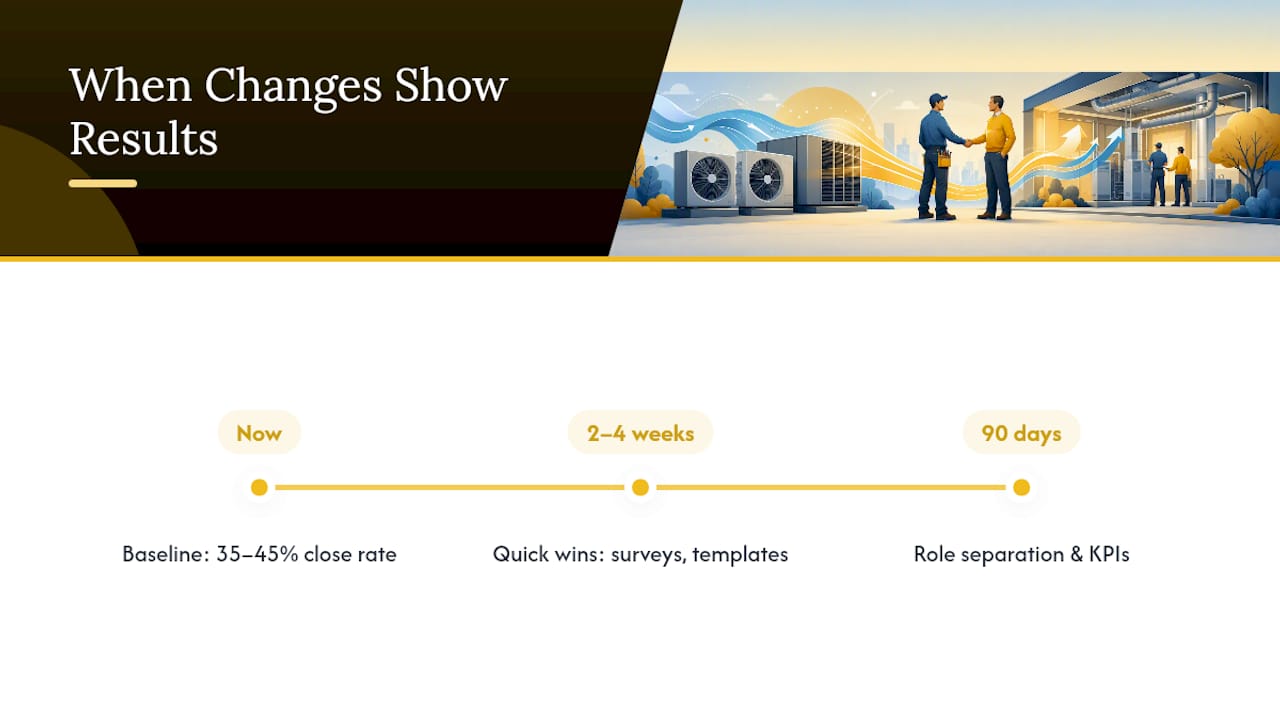
Booking script and proposal template changes show up in your numbers within two to four weeks. Role separation, dispatch rules, and full KPI tracking typically take a full 90-day cycle to show clean before-and-after data.
Sources
- Master the HVAC Sales Process: A Step-by-Step Guide
- The Kitchen Table Close: A Complete Framework for In-Home HVAC Sales – Heat Pump Network
- HVAC Sales: ✅ Complete Guide to Selling HVAC Systems 2026 July
- HVAC Business Benchmarks: The Complete 2025 Guide for $500K–$5M Operators | MarginPlug
- Key Performance Indicators for HVAC Companies
0 Comments