
Six actions reliably grow a plumbing business: stabilize operations, fix lead conversion, price for profit, build recurring revenue, hire into systems, and pick the right tech stack. Each one moves a different lever, and they compound when done in order.
- Stabilize operations and stop losing booked work. Quick win, 1 to 6 weeks. Fix dispatch chaos and missed follow-through before you spend another dollar on ads.
- Fix lead conversion and missed calls. Quick win, 1 to 6 weeks. Missed calls are a silent killer of growth because most callers just dial the next plumber.
- Price for profit and add recurring plans. Medium, 2 to 6 months. Flat-rate pricing and maintenance agreements lift ticket size and margin at once.
- Hire and train into systems. Medium, 2 to 6 months. You cannot delegate what has never been written down.
- Track the right financial KPIs and manage cash. Ongoing, but visible within weeks. A weekly scorecard catches problems before they become crises.
- Pick a focused tech stack and automate repeat tasks. Medium, 2 to 6 months. Fewer tools, better integrated, beats a pile of half-used software.
Watch three numbers starting this week: call-to-book rate, revenue per truck, and net profit margin. Everything else in this article feeds one of those three.
Key Takeaways
Growing a plumbing business profitably requires fixing operations and lead conversion before scaling marketing spend, then layering in recurring revenue and disciplined hiring.
| Point | Details |
|---|---|
| Fix missed calls first | Answering coverage and fast callback often recover booked jobs without added ad spend. |
| Build job costing before adding trucks | Splitting service, install, and maintenance revenue reveals which jobs actually make money. |
| Sell maintenance agreements aggressively | Recurring plans carry the highest margins and create predictable, repeat revenue. |
| Track a weekly financial scorecard | Revenue per truck, gross margin, CAC, and a 13-week cash forecast catch problems early. |
| Get hands-on support if systems are the bottleneck | Rebuildingthetrades runs onsite audits and installs accountability systems to fix operations directly. |
Table of Contents
- Why Growth Stalls: Three Common Traps Plumbing Businesses Hit
- Core Operations Systems to Build First
- How Do You Market Plumbing Services to Fill Trucks?
- Pricing, Margins, and Building Recurring Revenue
- Hire, Train, and Lead: Building a Team That Runs Without You
- Finance and Capital: KPIs Before You Add Trucks
- Tech Stack That Scales: What to Buy and What to Avoid
- 12-Month Growth Plan and Investment Timeline
- What Does Real Plumbing Business Growth Look Like?
- Building Partnerships and Networking Within the Local Industry
- Effective Customer Retention Tactics Beyond Referrals
- Training Programs to Improve Technician Skills and Productivity
- What Actually Moves the Needle in a Plumbing Business
- Get Hands-On Help Scaling Your Plumbing Business
- Sources
Why Growth Stalls: Three Common Traps Plumbing Businesses Hit
Most stalled plumbing businesses fall into one of three traps, and each one has a different fix. Mixing them up wastes months.
Trap one: the owner is the bottleneck. Every estimate, every hire, every tricky call routes through you. Symptom: revenue flatlines the moment you take a vacation. Root cause: no one else is authorized to make decisions. Self-test: step away for one full day, phone off, and see how many things break. If the answer is “everything,” you have your diagnosis.
Trap two: the business is undercapitalized. Symptom: you’re profitable on paper but constantly juggling which bill to pay first. Root cause: growth outpaced working capital, or receivables are aging faster than cash comes in. Self-test: build a 13-week cash snapshot and see whether you can survive a slow month without a credit line, a discipline financial consultants recommend before adding trucks or locations.
Trap three: chaotic operations with no systems. Symptom: quality and pricing vary by which tech shows up. Root cause: no standard operating procedures, no job-costing, no dispatch logic. Self-test: pull booking conversion by hour of day for one week; if it swings wildly, dispatch is guessing instead of following a process.
Pro Tip: If stepping away for a day causes a full-blown crisis but the books still look fine, that’s an owner-bottleneck problem, not an operations failure. If the books stay messy even when you’re fully engaged, systems are the real issue.
Core Operations Systems to Build First
You cannot scale chaos. Pouring marketing dollars into a business with no dispatch logic, no SOPs, and no job costing just multiplies the mess faster. Fix systems in this order: dispatch and booking, then SOPs and quality checks, then job costing, then parts and inventory, then invoicing and collections.
Dispatch comes first because it’s the traffic cop for everything else. If techs are routed inefficiently or double-booked, no amount of demand generation fixes the underlying leak. Field service platforms exist specifically to bring consistency to dispatching, on-site invoicing, and inventory, and that consistency is what makes job costing possible in the first place.
Here’s a simplified job-costing example for a standard service call. Say a technician bills a customer $450 for a two-hour drain clearing job. Labor burden (wages, payroll taxes, benefits) runs roughly $90. Parts cost $40. Vehicle cost, allocated per job based on fuel, insurance, and maintenance, adds another $25. Total direct cost: $155. Gross margin on that job: $295, or about 66%. Run that math across every job type and you’ll quickly see which services are subsidizing which.

Well-run residential plumbing trucks typically generate $300,000 to $400,000 in annual revenue depending on market and job mix. If your trucks are producing below a certain revenue threshold annually, the problem is usually pricing, dispatch efficiency, or average ticket size, not lack of demand.
Run a one-day operations audit using four checkpoints: booking rate (percentage of calls that become booked jobs), tech fill rate (percentage of scheduled hours actually worked), a truck stock check (are trucks missing parts that cause callback trips), and invoice close-out time (how many days between job completion and payment).
Pro Tip: Three operational fixes tend to pay for themselves within weeks: pre-priced job packages that eliminate on-the-spot pricing debates, mandatory on-site photos that cut disputes and speed up collections, and a zero-callback bonus that quietly improves first-time fix rates.
How Do You Market Plumbing Services to Fill Trucks?
Marketing only works once operations can absorb the demand it creates. Once dispatch and job costing are solid, prioritize channels in this order.
- Organic local presence. Google Business Profile optimization and on-page local SEO. Time to results: 2 to 6 months. Budget: minimal cash cost, mostly time. KPI to watch: review velocity and profile views converting to calls.
- High-intent paid leads. Google Local Services Ads and targeted paid search. Time to results: days to weeks. Budget: 5% to 10% of revenue as a starting guideline. KPI to watch: cost per booked job, not cost per click.
- Review and reputation systems. Automated review requests after every job. Time to results: 1 to 3 months to build volume. KPI to watch: reviews per month and average rating trend.
- Referral and partnership pipelines. Property managers, general contractors, real estate agents. Time to results: 3 to 6 months to build trust. KPI to watch: number of active referral partners generating repeat work.
- Niche content and SEO. Service pages for slab leaks, tankless water heaters, sewer line work. Time to results: 6 to 12 months. KPI to watch: organic traffic converting on high-margin service pages.
Diversification matters because relying on one channel creates feast-or-famine cycles that kill operational momentum. A local partner specializing in regional lead generation and paid local strategy can be a useful gut-check when you’re deciding how much to put behind paid channels versus organic.
Run a 90-day test across your top three channels, tracking customer acquisition cost and lead-to-book conversion for each. Measuring booked jobs and CAC, rather than raw traffic or call volume, is the only way to know which channel deserves more budget next quarter.
Pricing, Margins, and Building Recurring Revenue
Flat-rate pricing tends to outperform hourly billing on both close rate and average ticket, mainly because customers know the number before the work starts and stop comparing you to a lower hourly quote down the street. Hourly pricing invites second-guessing; flat-rate pricing sells a solution.
A simple pricing matrix helps clarify where your margin actually lives:
Maintenance agreements deserve special attention because they’re the highest-margin line item you sell and the one most owners undersell. On a service call, pitch it simply: “For $19 a month, we cover two seasonal inspections, priority scheduling, and 10% off any repair.” That framing beats a hard sell every time. Follow up by phone or text within 48 hours for anyone who didn’t sign on the spot.
A basic onboarding checklist for new members: confirm billing method, schedule the first inspection within 30 days, log the unit and system details, and set an automated reminder for the second visit.
Specializing in a niche like tankless water heater service or sewer line repair lets you charge a premium and avoid racing competitors on price for commodity work. Once recurring revenue reaches roughly 15% to 20% of total revenue, it’s reasonable to test increasing marketing spend, since predictable cash gives you more room to invest without risking payroll.
Hire, Train, and Lead: Building a Team That Runs Without You
Hire a dispatcher once call volume exceeds what you can personally manage, usually around three to four trucks. Bring in a service manager once you’re running five or more trucks and spending more time managing people than customers. A second-in-command becomes necessary once revenue per truck is solid but your own bandwidth is the ceiling on adding more trucks.
A 30/60/90 onboarding framework keeps new hires from drifting:
- Days 1 to 30: shadow calls, learn job templates, understand pricing matrix and SOPs.
- Days 31 to 60: run solo calls with manager review of every job ticket.
- Days 61 to 90: hit KPI targets independently (booking rate, callback rate, average ticket).
For lead technician or dispatcher interviews, ask systems-thinking questions: “Walk me through how you’d handle three overlapping emergency calls with two trucks available.” Look for structured thinking, not just technical knowledge.
Tie bonuses to zero-callback rates and use a transparent pay dashboard so techs see exactly how their numbers translate to pay. Given how tight the skilled labor market has become, retention through clear pay structure often costs less than constant rehiring.
Finance and Capital: KPIs Before You Add Trucks
Six numbers belong on a weekly scorecard: revenue per truck, gross margin by job type, net profit percentage, customer acquisition cost, accounts receivable aging, and cash runway from a rolling 13-week forecast.
Before adding a truck, run the math on break-even timeline (most owners target 3 to 6 months), working capital needed to cover payroll and fuel during ramp-up, and full onboarding costs including training time. Adding a truck before the previous one is profitable just compounds cash pressure.
Job costing discipline matters because service, install, and maintenance revenue behave completely differently. Splitting these revenue streams reveals whether install work is quietly subsidized by service margin, a pattern that’s common and usually invisible until someone actually separates the numbers.
- Track revenue per truck weekly, not quarterly.
- Review AR aging every Friday; anything over 30 days needs a call.
- Rebuild the 13-week cash forecast monthly, not just when cash feels tight.
Tech Stack That Scales: What to Buy and What to Avoid
Buy in this order: field service management and dispatch, then CRM, then payments and invoicing, then review automation, then team communication tools. Each layer depends on the one before it working reliably.
Platforms like simPRO and Weave represent two different approaches worth evaluating: simPRO leans toward job costing, estimating, and inventory for larger operations, while Weave focuses on communication, reviews, and payments in one hub. Neither is universally “best.” The right choice depends on your team size and which bottleneck hurts most right now.
When evaluating any platform, check integrations with your existing tools, mobile usability for techs in the field, reporting depth, onboarding effort, and whether pricing scales with your truck count or punishes growth.
- Don’t buy a tool for one flashy feature if the core workflow doesn’t fit your team.
- Don’t over-license software before your processes are stable enough to use it well.
12-Month Growth Plan and Investment Timeline
Growth compounds fastest when it follows a quarterly sequence instead of trying to fix everything simultaneously.
- Q1: Stabilize operations and fix missed-call coverage. Cost: minimal, mostly time and possibly an answering service. Payback: immediate, since you’re recovering revenue already being lost.
- Q2: Roll out flat-rate pricing and launch a maintenance plan. Cost: modest, mainly staff training time. Payback: 1 to 2 months as ticket size rises.
- Q3: Hire a dispatcher or service manager and scale marketing spend. Cost: the largest quarter, covering salary and ad budget. Payback: 3 to 6 months.
- Q4: Optimize margins across job types and evaluate whether expansion makes sense. Cost: minimal if the prior quarters worked.
If KPIs slip at any point, pause new spending and go back to fixing operations before layering on more growth initiatives.
What Does Real Plumbing Business Growth Look Like?
A multi-location trade business came into a hands-on operational engagement with familiar symptoms: dispatch running on gut feel, no job costing, and a maintenance plan that existed on paper but wasn’t actively sold.
The intervention combined three things: automated dispatch and booking logic, a relaunched membership plan with a clear on-site pitch script, and job costing broken out by service, install, and maintenance revenue.
- Before: revenue per truck stagnant, booking rate inconsistent by hour, net margin compressed by unpriced install work.
- After: booked jobs increased, margin visibility improved enough to reprice underperforming service lines, and recurring revenue gave the business a cash cushion it hadn’t had before.
Rebuilding the Trades’ case study work documents these kinds of before-and-after shifts across multiple trade businesses, including operations that scaled toward multi-million dollar run rates once systems were in place. If your numbers look similar to the “before” column, a diagnostic audit is usually the fastest way to find out which lever to pull first.
Building Partnerships and Networking Within the Local Industry
Referral partnerships with property managers, general contractors, and real estate agents often produce higher-margin work than paid advertising, mainly because the trust is pre-built. A property manager who calls you first for every unit in their portfolio is worth more than a dozen one-off Google leads.
Start by identifying five to ten property management companies and GCs in your service area who handle volume you can realistically absorb. Offer them priority scheduling and a direct line to a dispatcher instead of the general call queue. That single perk often matters more than a discount.
Local trade associations and supplier events are underused for a different reason: they put you in a room with other business owners solving the same problems, not just potential referral sources. Swapping notes with a non-competing plumber in a neighboring market can surface a pricing mistake or a hiring approach you hadn’t considered.
Supplier relationships count too. A distributor who knows you’re growing may extend better payment terms or first access to inventory during shortages, which matters more than people expect when a truck is sitting idle waiting on a part.
Track partnership-sourced revenue separately from other channels so you know which relationships are actually generating booked jobs versus just goodwill.
Effective Customer Retention Tactics Beyond Referrals
Referrals are lagging indicators of good service, not a retention strategy on their own. Real retention starts with what happens between service calls, not just how someone talks about you afterward.
Maintenance agreements are the backbone of retention because they create a scheduled reason to be back in the customer’s home twice a year, which is also when upsell conversations happen naturally. A membership customer who sees you consistently is far less likely to call a competitor when something breaks.
Proactive communication matters more than most owners assume. A simple text reminder before a scheduled maintenance visit, or a follow-up message 48 hours after a repair asking if everything’s holding up, signals attentiveness that most competitors skip entirely.
Segment your customer list by service history and reach out to anyone who hasn’t had a touchpoint in 12 months with a direct offer, not a generic newsletter. A short list of dormant customers, called personally, often converts better than any ad campaign.
Warranty clarity also drives retention. Customers who understand exactly what’s covered and for how long are less likely to shop around when something goes wrong within that window, because they already know who to call.
Training Programs to Improve Technician Skills and Productivity
Technician productivity is a training problem as much as it is a scheduling problem. A tech who takes 20% longer on every job because of an inefficient process is quietly eating into revenue per truck no matter how well dispatch is running.
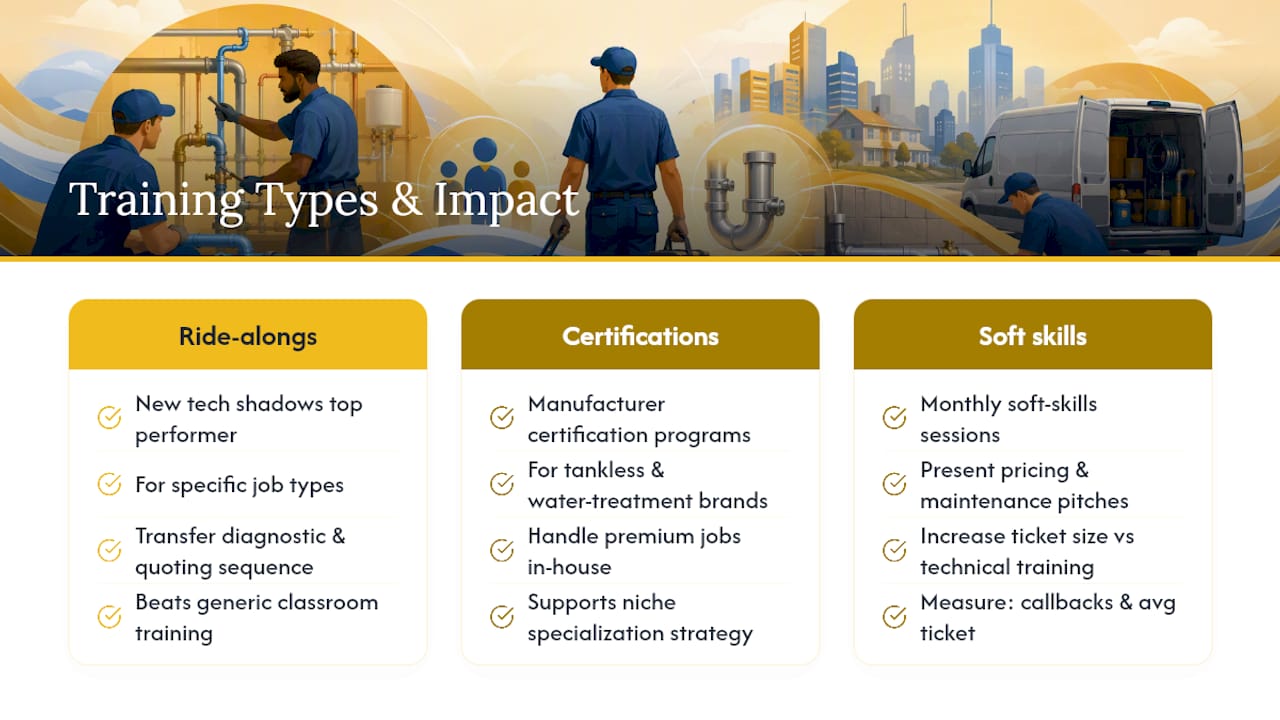
Structured ride-alongs where a newer tech shadows a top performer for specific job types beat generic classroom training. The goal is transferring the exact sequence a top performer uses to diagnose and quote a job, not just teaching the technical skill in isolation.
Manufacturer certification programs for specific equipment, like tankless water heaters or specific brands of water treatment systems, let techs handle premium jobs other companies have to subcontract or turn down. That directly supports the niche specialization strategy that lets you charge more.
Monthly skills sessions on soft skills, particularly how to present pricing and pitch maintenance plans, often move the needle on ticket size more than technical training does. A technically excellent plumber who can’t confidently explain a $19 monthly plan will consistently underperform one who can.
Track training investment against callback rate and average ticket per tech. If a specific training program doesn’t move either number within a quarter, it’s worth reevaluating whether that training was the right investment.
What Actually Moves the Needle in a Plumbing Business
Across every trade business we’ve looked at, the pattern repeats: the businesses that stall aren’t short on demand, they’re short on systems that can absorb demand profitably. Owners chase more leads when the real leak is a missed call, an unpriced job, or a dispatcher guessing instead of following a process. Fix the leak before you turn up the faucet.
The one action worth doing this week: run a 7-day audit of your booking-to-book rate and missed-call coverage. Pull call logs, tag every missed call, and see how many turned into lost jobs. Whoever owns dispatch or answers the phones should own this audit, not the owner buried in field work. The number that comes out of it will tell you more about where to focus than any marketing plan will.
Get Hands-On Help Scaling Your Plumbing Business
Reading a roadmap is one thing. Having someone in your operation fixing dispatch, pricing, and job costing alongside you is another. Rebuildingthetrades runs onsite audits, builds KPI dashboards, and installs leadership and accountability systems directly inside plumbing, HVAC, and electrical businesses, so the fixes in this article actually get implemented instead of sitting in a notebook.

The work is hands-on: real audits of your dispatch and pricing, leadership training for your service managers, and accountability systems that keep KPIs visible week over week rather than reviewed once a quarter. Case studies from trade businesses that went through this process show what’s possible when operations, not just marketing, get fixed first.
If your revenue per truck is stuck below the $300,000 benchmark or your maintenance plan exists but isn’t converting, a diagnostic audit is the fastest way to find out why. Visit Rebuildingthetrades to see engagement details, check pricing, and schedule a discovery call to walk through your numbers.
Sources
- How to Grow a Plumbing Business | Proven Tips & Strategies
- How to Grow Your Plumbing Business in 2026 | The Ultimate Guide
- How to Grow an HVAC Business: From $2M to $10M Revenue
- Despite rising salaries, the skilled-labor shortage is getting worse — PBS NewsHour
0 Comments