
A performance improvement plan (PIP) is a formal, written opportunity for an employee to fix documented, measurable performance gaps within a set timeline. Use one after informal coaching has failed to change behavior, unless the issue is catastrophic (safety, fraud, harassment), which calls for immediate disciplinary action instead. Once you decide a PIP is the right move, your next step is simple: document the specific gaps and schedule a planning meeting with HR before you draft anything.
- A PIP is a written, time-bound corrective plan, not a punishment memo
- It follows informal coaching, not the first sign of trouble
- Gross misconduct skips the PIP process entirely
Pro Tip: Federal guidance from OPM treats a typical opportunity period as 30 calendar days, a useful default if your organization has no internal policy yet.
Key Takeaways
A performance improvement plan works when it pairs measurable, SMART objectives with a realistic timeline and a manager who actually shows up for every scheduled check-in.
| Point | Details |
|---|---|
| Use a PIP after coaching fails | Escalate to a formal plan only once informal feedback over an appropriate period hasn’t changed the behavior. |
| Skip straight to discipline for misconduct | Safety violations, fraud, or willful misconduct don’t need a development plan first. |
| Match timeline to complexity | Use shorter timelines for conduct issues, with longer periods for skill gaps and complex behavioral changes as appropriate. |
| Document every check-in | Weekly or biweekly notes protect both the employee’s fairness and the company’s legal position. |
| Get operational support if capacity is thin | Rebuildingthetrades builds the accountability systems and leadership training that keep PIPs from stalling in trade businesses. |
Table of Contents
- What Does a Performance Improvement Plan Actually Do?
- When Should You Use a PIP Instead of Coaching or Firing?
- What Should Every Performance Improvement Plan Include?
- How Do You Build and Run a Performance Improvement Plan?
- How Should You Monitor Progress During a PIP?
- What Happens After a PIP Ends?
- What Do Managers Get Wrong About Running a PIP?
- Why Most PIP Advice Undersells the Manager’s Role
- Get Help Building Systems That Make PIPs Work
- Where to Find Templates and Official Guidance
- Sources
What Does a Performance Improvement Plan Actually Do?
A PIP is a formal written document that lays out specific performance gaps, the standard the employee needs to hit, and a deadline for hitting it. It’s a development tool wearing a legal hat: it gives the employee a real shot at correction while creating a paper trail if things don’t improve.
The plan isn’t something a manager hands down alone. It’s typically co-developed by the manager, the employee, and HR, which keeps expectations grounded in company policy rather than one supervisor’s personal standards. That distinction matters because a PIP is not the same thing as a disciplinary write-up.
- Developmental PIP: addresses a skill or output gap with training, coaching, and a timeline
- Disciplinary action: addresses a conduct violation and may not include a recovery path at all
Mixing the two confuses employees and weakens your legal position if termination follows. Keep them separate in both language and process.
When Should You Use a PIP Instead of Coaching or Firing?
Start with informal coaching every time performance dips. A PIP is the second stage, not the first response to a bad month. SHRM’s guidance on PIP timing recommends at least two weeks of informal feedback before you escalate to a formal plan, giving the employee real room to self-correct without paperwork hanging over them.
Some situations skip that step entirely. Gross negligence, safety violations, and willful misconduct justify moving straight to disciplinary action, because a PIP assumes the employee wants to improve and simply needs structure. Willful violations don’t meet that bar.
Before you draft anything, run through this quick check:
- Has the employee received clear, specific feedback already?
- Do they have the tools, training, and resources to succeed?
- Is the performance gap measurable, not just a feeling?
- Has this issue repeated after prior feedback?
If you answer yes to all four, you’re looking at a PIP situation.
Pro Tip: SHRM’s own reporting notes many performance gaps trace back to missing training or unclear onboarding, not unwillingness. Rule that out before you formalize anything.
What Should Every Performance Improvement Plan Include?
A PIP that skips components tends to fall apart under scrutiny, either from the employee, from HR, or from a lawyer six months later. US Chamber guidance points to five pillars: expectations, measurable goals, timeline, support, and consequences. Build your template around these seven pieces.
- Role context — what “good” looks like in this position, stated plainly
- Specific performance gaps — dated examples, not vague impressions (“missed three deadlines in April” beats “poor time management”)
- Measurable objectives — tied to metrics the employee can track themselves
- Action plan — training, shadowing, tools, or manager support the company will provide
- Timeline and milestones — check-in dates and a final evaluation date
- Consequences — what happens if goals aren’t met, stated without ambiguity
- Signatures and distribution — acknowledgment from the employee, copies to HR and the employee’s file
Vague goals are the most common failure point here. University HR guidance on SMART-format PIPs emphasizes specificity for exactly this reason: “improve communication” gives an employee nothing to aim at, while “respond to customer emails within four business hours, verified weekly” gives them a target and gives you a way to measure it.
| Component | What It Answers |
|---|---|
| Role expectations | What does success in this role look like? |
| Performance gaps | Where, specifically, did the employee fall short? |
| SMART objectives | What number or outcome proves improvement? |
| Support and resources | What will the company provide to help? |
| Timeline | When is progress checked, and when does the plan end? |
| Consequences | What happens if targets aren’t met? |
How Do You Build and Run a Performance Improvement Plan?
Building a PIP is a sequence, not a single document you write in an afternoon. Skip a step and the plan tends to unravel by week three.
- Document the gap first. Pull specific incidents, dates, and evidence before you write a single objective. A PIP built on impressions instead of examples falls apart the moment an employee pushes back.
- Draft SMART objectives on a realistic timeline. Timeline guidance from monday.com’s PIP framework suggests matching duration to complexity: 30 days for attendance or conduct issues, 60 days for moderate skill gaps, and 90 days for complex behavioral or leadership changes. Don’t default to 90 days out of caution. It drags out an outcome that’s already clear by day 30.
- Meet with the employee to launch it together. This isn’t a memo you slide across a desk. Walk through each objective, ask what support they need, and get their signature as acknowledgment, not agreement with every word.
- Run regular check-ins and write them down. Weekly or biweekly, with a short summary after each one. No summary means no record, and no record means no defense if the outcome is disputed later.
- Evaluate and decide. At the end date, you have three real options: close it out as successful, extend it with a documented reason, or move to the next disciplinary step.
Pro Tip: Build in a checkpoint at the plan’s midpoint, even inside a 60 or 90 day PIP. A two-week interim review inside a longer plan catches drift early, before it hardens into a pattern you can’t reverse by the final evaluation.
How Should You Monitor Progress During a PIP?
Check-ins should happen weekly or biweekly, never less often, with a short written summary after each one. That cadence is what turns a PIP from a document into an actual improvement process.
Judge progress on evidence, not gut feel. Pull the specific metric the plan named, cross-reference it against manager observations, and note any outside factors that might explain a dip. If the employee is hitting the numbers but the trend looks fragile, that’s a case for extension rather than a hard stop.
- Extend when progress is real but incomplete, and document why
- End the plan early only when the outcome (success or failure) is already unambiguous
- Never let a PIP run silently with no check-ins scheduled
SHRM’s research on manager readiness flags absent manager follow-through as a leading cause of PIP failure. A plan with no check-ins isn’t neutral. It’s actively unfair to the employee trying to meet it.
What Happens After a PIP Ends?
A PIP closes one of five ways: successful completion, an extension, reassignment to a better-fit role, demotion, or termination. Each outcome needs its own paper trail.
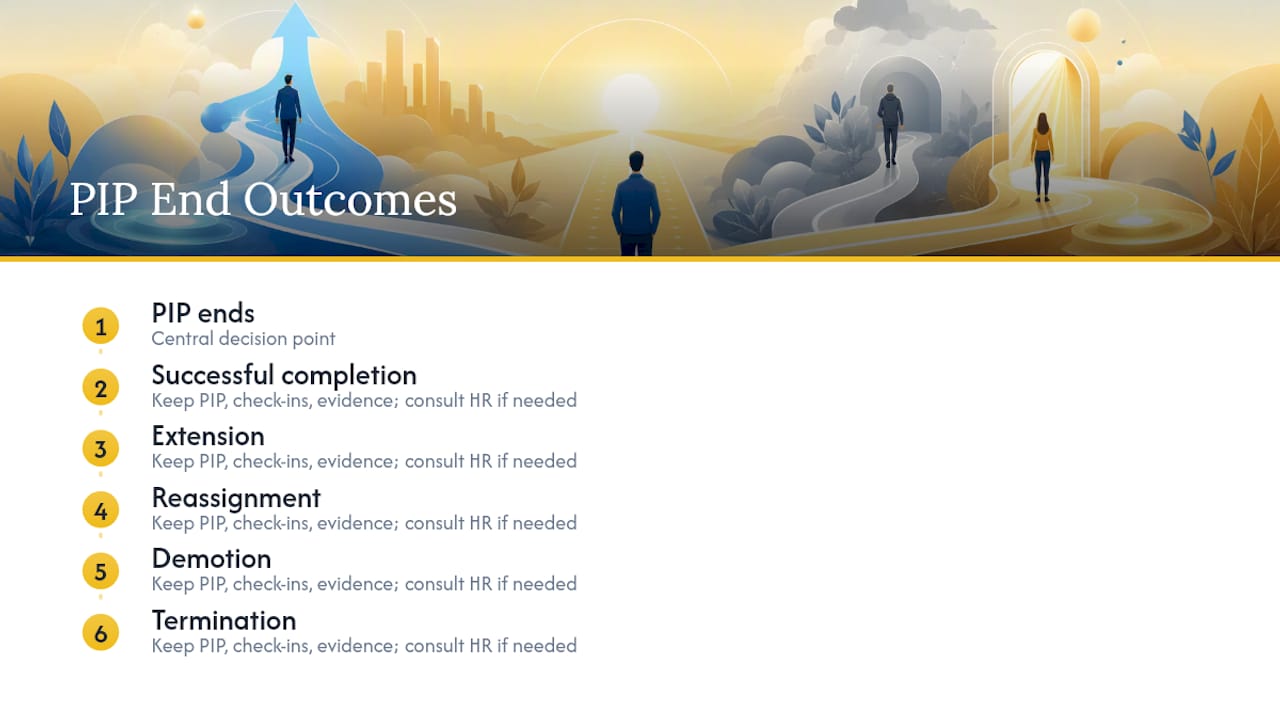
Keep the signed PIP, dated check-in notes, and evidence of the support you actually provided (training records, resource access, meeting logs). If a union contract, an accommodation request, or a complex regulatory situation is involved, loop in HR or legal before you finalize the outcome, not after.
What Do Managers Get Wrong About Running a PIP?
A PIP fails most often not because the employee couldn’t improve, but because the manager stopped showing up for check-ins after week two. In trades businesses, that gap shows up fast: a dispatcher’s on-time rate or a technician’s first-time fix rate either moves within four weeks of consistent follow-through, or it doesn’t move at all.
Why Most PIP Advice Undersells the Manager’s Role
Most guidance on this topic treats the PIP document as the hard part. It isn’t. Any manager can fill in a template with SMART goals and a 60-day deadline in twenty minutes. The part nobody plans for is the eight or ten hours of check-ins, coaching, and documentation that follow, and that’s exactly where most plans quietly die.
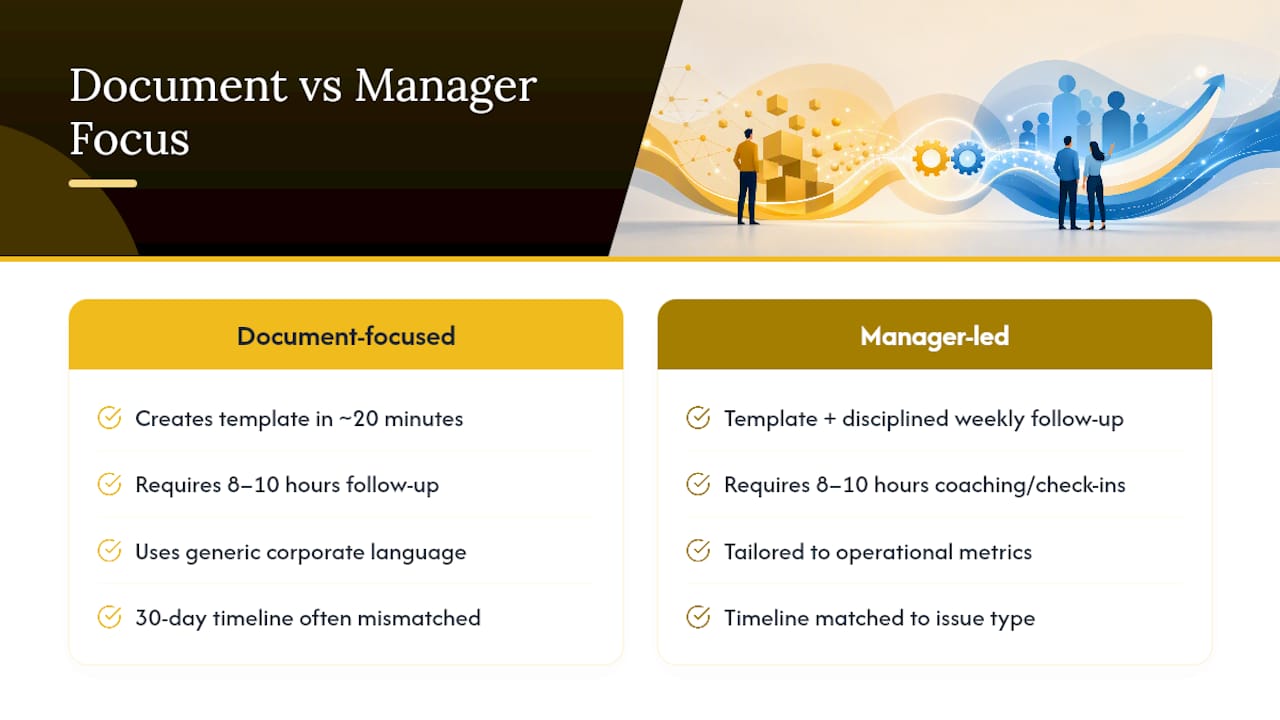
The conventional advice also underrates tailoring. A 30-day timeline that works for an attendance issue is meaningless for a service manager who needs to rebuild dispatch accuracy or a technician relearning a diagnostic process. Trade businesses in particular need to tie objectives to operational numbers, first-time fix rate, callback percentage, invoice accuracy, rather than generic language borrowed from a corporate template.
If you take one thing from this guide, prioritize the check-in cadence over the document itself. A mediocre template with disciplined weekly follow-through beats a flawless template that a manager abandons by week three.
— Dan
Get Help Building Systems That Make PIPs Work
A performance improvement plan only works if the manager running it has the time, training, and accountability structure to follow through, and that’s often where trade businesses hit a wall. Rebuildingthetrades works directly inside HVAC, plumbing, electrical, roofing, remodeling, and siding companies to build leadership training, documented processes, and accountability systems that make performance conversations stick instead of stalling out.

If your managers lack the internal HR capacity to run a PIP correctly, or if the same performance issues keep resurfacing across your team, that’s usually a sign the gap is operational, not individual. Rebuildingthetrades’s onsite process builds the check-in habits, KPI tracking, and leadership accountability that turn a one-off plan into a repeatable system. Case studies like the Tri-Trade turnaround show what that looks like when it’s done consistently. Visit Rebuildingthetrades to talk through your team’s specific situation and see what an engagement would look like.
Where to Find Templates and Official Guidance
- OPM’s PIP quick guide for federal opportunity-period rules
- 5 CFR Part 432 for the federal regulatory framework
- US Chamber’s PIP templates for ready-to-adapt formats
- University of Maryland HR’s PIP guidance for SMART-goal examples
Sources
- When to turn to PIPs and when to skip them — SHRM
- Performance improvement plan quick guide — OPM
- How to Create, Implement, and Execute a Performance Improvement Plan — US Chamber
0 Comments