
Coaching develops people; managing directs outcomes. Use coaching when someone has the skill and time to solve a problem themselves and just needs help finding the answer. Manage instead when the task is urgent, the stakes are high, or the person genuinely lacks the knowledge to get there alone. The fastest gut check: urgent and unclear means manage; experienced and stuck on growth means coach.
TL;DR:
- Coaching is suitable when the employee has the skill and time to solve the problem, while managing is needed for urgent, high-stakes tasks or when knowledge is lacking.
- Managers should switch between coaching and managing based on signals such as problem familiarity, cost of errors, and recurring issues, rather than defaulting to one style.
- Effective coaching involves structured techniques like the GROW model, focusing on defining goals, exploring reality, generating options, and committing to actions with clear follow-ups.
- Coaching conversations should be planned, with clear outcomes, reference to previous commitments, and tracked follow-through over multiple cycles to build long-term development.
- Routine integration of coaching into 1:1s and on-site leadership habits, supported by accountability systems, significantly improves the sustainability and impact of coaching efforts.
Table of Contents
- Coaching vs Managing: Clear Definitions Every Manager Needs
- Coaching vs Managing: The Practical Differences That Matter
- Coaching Techniques Every Manager Should Know: GROW and Beyond
- How to Run a Coaching Conversation From Prep to Follow-Up
- The 3 Ds: When to Direct, Delegate, or Develop
- Coaching vs Discipline: Where Development Ends and Correction Begins
- Making Coaching Part of Your Regular Management Routine
- Applying Coaching on the Shop Floor: A Practitioner’s View
- A Hands-On Path to Coaching That Actually Sticks
- Sources
Coaching vs Managing: Clear Definitions Every Manager Needs
Most managers use “coaching” and “managing” interchangeably, and that’s exactly why so many 1:1s go sideways. They’re different tools built for different jobs.
Coaching, in a management context, is a structured conversation where you ask more than you tell. You’re drawing out the employee’s own analysis of a situation, helping them commit to a specific next step, and then following up to see if they actually did it. The Center for Creative Leadership frames this as a deliberate shift away from advice-giving toward structured inquiry, because ownership sticks better when the person arrives at the answer themselves.
Managing is different. It’s setting direction, assigning work, clarifying deadlines, and holding a quality bar. It’s you telling someone what “done” looks like and by when. Neither approach is superior. They solve different problems.
Concrete cases make the split obvious:
- A new hire starting their first week on a jobsite needs managing: clear instructions, safety protocols, and a supervisor checking the work.
- A five-year technician who keeps missing the same callback deadline needs coaching: they likely know how to do the job, but something in their planning or mindset needs to shift.
- A project with a hard client deadline and no room for trial and error needs managing, even if the person assigned is capable of figuring it out eventually.
- A high performer asking “how do I get promoted” needs coaching, because you don’t have a script for their career. They do, if you help them find it.
Get this distinction wrong and you end up either micromanaging someone who’s ready to own the problem, or coaching someone who just needed you to tell them what to do three days ago.
Coaching vs Managing: The Practical Differences That Matter
The two approaches diverge on five practical dimensions, and mixing them up is the single most common leadership mistake in mid-level management.
| Dimension | Coaching | Managing |
|---|---|---|
| Primary focus | Building the person’s judgment and capability | Getting a specific task done correctly |
| Time horizon | Weeks to months; compounds over time | Now to end of shift or project |
| Manager behavior | Asking, listening, reflecting back | Telling, assigning, checking, correcting |
| What gets measured | Growth in independent problem-solving | Deadlines hit, quality standards met |
| Best-fit scenario | Recurring issue, capable employee, room to fail small | New task, tight deadline, safety or compliance risk |
Gallup’s analysis of 1.2 million employees found that the managers who drove the highest engagement scores acted primarily as coaches rather than traditional supervisors. That doesn’t mean directive management disappears. It means the best managers know which mode the moment calls for and switch deliberately instead of defaulting to one style for everything.
A few signals tell you which mode fits:
- If the employee has solved similar problems before, lean toward coaching. If this is genuinely new to them, lean toward managing.
- If getting it wrong costs real money, safety, or a client relationship, manage first and coach after the fire is out.
- If the same complaint keeps surfacing week after week, that’s a coaching gap, not a managing gap. Repeating instructions louder won’t fix a pattern.
- If you’re explaining something for the third time, stop and ask what’s actually getting in the way. That’s a coaching question, not a training gap.
Coaching Techniques Every Manager Should Know: GROW and Beyond
The most widely used coaching framework is GROW, and it works because it forces a conversation instead of a lecture.
- Goal. Define what the person actually wants out of this conversation. Sample question: “What would a win look like here?”
- Reality. Get an honest picture of where things stand right now, without judgment. Sample question: “What’s actually happening today, and what have you already tried?”
- Options. Generate more than one path forward before picking one. Sample question: “What are two or three ways you could approach this?”
- Will. Lock in a specific commitment: what, by when, and what obstacle might get in the way. Sample question: “What’s the first thing you’ll do, and by what date?”
The GROW model only works if the Will stage produces something concrete. A commitment without a named action, a target date, and a planned response to the likely obstacle rarely survives past the meeting.
Beyond GROW, four question types do most of the heavy lifting in coaching conversations:
- Clarifying: “Tell me more about what happened right before that.”
- Scaling: “On a scale of one to ten, how confident are you this will work?”
- Obstacle: “What’s most likely to get in the way of this plan?”
- Commitment: “What will you do differently starting tomorrow?”
The biggest pitfall isn’t a bad question. It’s using GROW for a five-minute status check that just needed a direct answer, or skipping the Will stage because the conversation ran long and you both wanted to wrap up.
Pro Tip: If you catch yourself offering a solution before you’ve asked at least two “what have you tried” questions, you’ve slipped from coaching into managing without noticing. That’s fine occasionally. It’s a problem if it happens every time.

How to Run a Coaching Conversation From Prep to Follow-Up
A good coaching conversation isn’t improvised. It follows a routine you can repeat in every 1:1 without it feeling scripted.
Before the meeting:
- Decide in advance whether this is a coaching conversation or a status check. Mixing the two confuses both of you.
- Write down the outcome you’re hoping for, and hold it loosely; the employee’s goal might differ from yours.
- Pull up notes from the last conversation so you can reference prior commitments instead of starting cold.
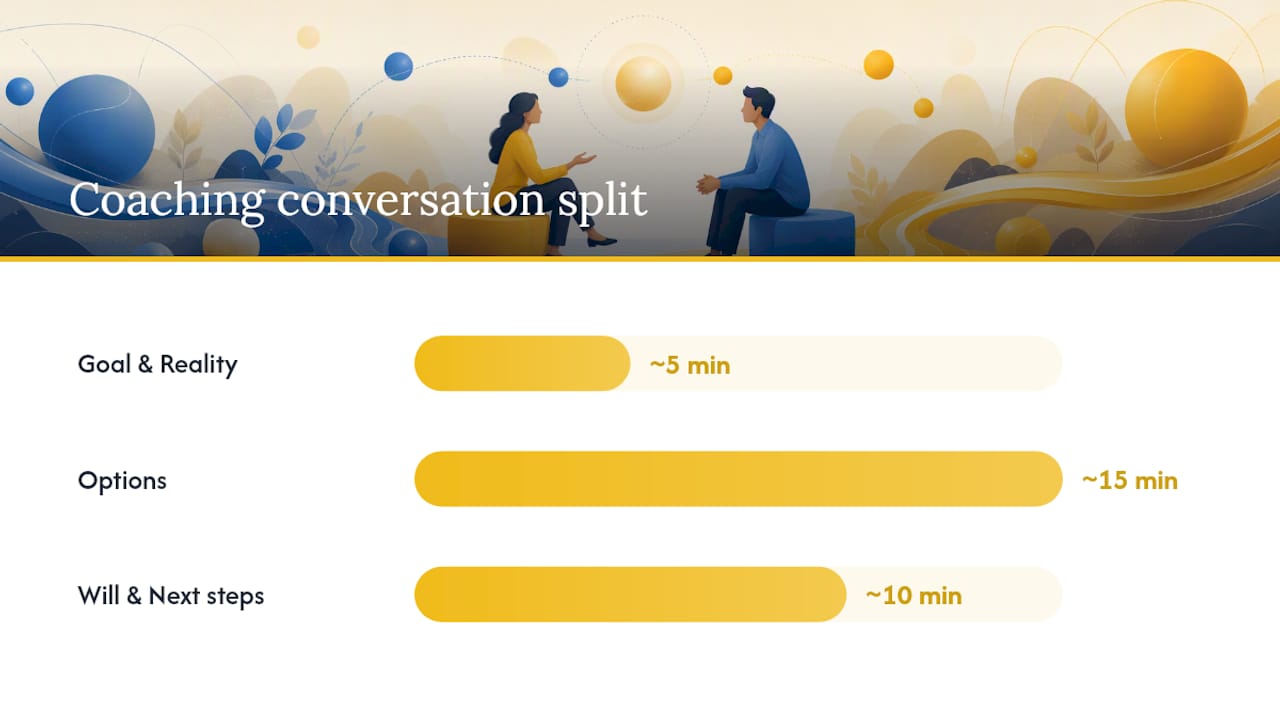
During the meeting, Harvard FAS’s coaching guidance recommends opening with a question rather than an update, then spending the bulk of the time in Reality and Options before landing on a specific Will. A 30-minute 1:1 might run roughly 5 minutes on Goal and Reality, 15 on Options, and 10 locking in Will and next steps.
After the meeting:
- Write down the exact commitment, in the employee’s own words, not your paraphrase.
- Set a specific date to check in, ideally at the next scheduled 1:1 rather than a vague “soon.”
- Track whether the commitment was met over two or three cycles before drawing conclusions about a pattern.
Coaching conversations compound only when commitments get tracked. A single great conversation with no follow up is just a nice chat.
The 3 Ds: When to Direct, Delegate, or Develop
Three decision checks cut through most of the ambiguity about which mode to use: urgency, clarity of the right answer, and whether this is a recurring pattern or a one-off.
Frameworks built around leading, coaching, and managing (sometimes called the 3 Ds: Direct, Delegate, Develop) map cleanly onto these checks:
- Direct when the task is urgent, the correct approach is already known, and the person lacks the experience to figure it out safely on their own. Think: a new hire’s first solo service call.
- Delegate when the person has the skill and the task is clear, but you don’t need to be involved in how they get there. Think: a technician who’s done this exact repair a dozen times.
- Develop (coach) when the person has the capability but is stuck on judgment, confidence, or a recurring behavioral pattern. Think: a crew lead who keeps underquoting jobs despite knowing the numbers.
Three quick scenarios show the split in action. Onboarding a new hire: direct, because safety and correctness outweigh the value of them “figuring it out.” A missed SLA on a one-off basis: probably direct, since the immediate priority is fixing the miss. A missed SLA that’s now the third time this quarter: that’s a coaching conversation, because something in their process or prioritization needs to change, not just this one ticket.
Coaching vs Discipline: Where Development Ends and Correction Begins
Coaching and discipline aren’t opposites. Discipline is what happens when coaching hasn’t produced consistent improvement, and the line between them matters more than most managers treat it.
The key question is ability versus willingness. If someone can’t do the task despite genuine coaching effort, that’s still a development problem, maybe one that needs more training or a different assignment. If someone can do it and simply isn’t, or the issue involves misconduct rather than skill, that’s a discipline conversation.
Practitioner guidance from AIM recommends treating discipline as a chance for correction and improvement rather than a step toward termination, but only after coaching attempts have been documented and expectations were genuinely clear. Escalate when you see repeated failure on the same issue after direct feedback, a pattern rather than a one-off, or behavior that crosses into policy violation.
A corrective conversation stays developmental when it includes three things:
- A specific description of the gap, tied to observed behavior, not personality.
- Clear consequences if the pattern continues, stated plainly and without threat.
- A concrete offer of support: training, a mentor, adjusted workload, whatever removes the real obstacle.
Documenting each coaching attempt, with dates and what was discussed, protects both the employee and the business if the situation ever escalates to formal HR action. It also makes the eventual discipline conversation feel earned rather than sudden, because the person has already heard the concern more than once.
Making Coaching Part of Your Regular Management Routine
Coaching fails when it’s treated as a separate event instead of a habit stitched into the meetings you already run.
A workable 1:1 agenda splits time deliberately: five minutes on status updates, twenty on one coaching topic using GROW, five on logistics. Micro-coaching moments, a 10 to 15 minute check-in mid-week, work well for catching a stuck decision before it becomes a Friday crisis.
- Keep a running document per employee with dated commitments from each conversation.
- Reference the last commitment at the start of the next 1:1, before moving to anything new.
- Reserve full GROW conversations for real development topics, not routine status checks.
Pro Tip: Block 20 minutes on your calendar labeled “coaching prep” the day before each 1:1. Reading yesterday’s notes for two minutes beats winging it every time.
Applying Coaching on the Shop Floor: A Practitioner’s View
Coaching theory assumes a manager and employee sitting across a desk with 30 uninterrupted minutes. Trade businesses rarely get that luxury. Crews are mobile, schedules are tight, and a foreman might see a technician for ten minutes between jobs.
The adaptation that works: shrink GROW into a toolbox-style exchange. Skip Goal and Reality if you already know the context, and spend most of your ten minutes on Options and Will. One documented commitment, checked at the next job briefing, beats an ambitious plan nobody revisits. Rebuilding the Trades has seen this pattern hold across operational turnaround engagements, where structured leadership habits, not longer meetings, drove the measurable gains.
— Dan
A Hands-On Path to Coaching That Actually Sticks
Reading about GROW is one thing. Getting foremen and supervisors to actually run it under a truck deadline is another problem entirely, and it’s the one most trade businesses never solve on their own.

Rebuilding the Trades builds coaching directly into the operational systems your leaders already touch every day: onsite leadership training, accountability structures, and KPI reporting that shows whether coaching commitments are actually being kept, not just discussed. The difference from a workshop or a book is that someone is physically on your jobsite watching whether the conversation happened and whether the follow-through stuck, which is usually where coaching initiatives quietly die. Case results from engagements like the Tri-Trade turnaround show what happens when accountability systems back up the coaching conversation instead of leaving it to individual willpower. If you’re a mid-level manager trying to get an entire supervisor team coaching consistently instead of just directing, check the pricing and program options and see what a structured engagement would look like for your business.
Sources
- Give Bossing a Break: Great Managers Act Like Coaches (Gallup)
- Performance management — Coaching in conversation (Harvard FAS HR Guidance)
- Ask the Helpline: When coaching alone isn’t working, is discipline the right next step? (AIM)
- How to have a coaching conversation (Center for Creative Leadership)
0 Comments