
Set your diagnostic fee from your actual loaded cost, not from what the shop down the road charges. Calculate your true cost per visit, publish a clean number like $79 or $99, and choose one policy: credit the fee to same-day repairs or let it stand on its own. Then run the calculator below, train your CSRs on the script, publish the price everywhere, and watch three numbers for 90 days before you touch anything else.
TL;DR:
- Set your diagnostic fee based on your actual loaded cost, generally in the $89 to $99 range, to maintain margins and cover expenses.
- Choose the policy—credit-to-repair or fee-stands—based on your close rate, capacity, and profit goals, as each impacts customer experience and bookkeeping.
- Train CSRs to plainly state the fee with a strong script, and implement a clear rollout plan with 60 days’ notice and KPI tracking for acceptance, cancellations, and ticket value.
- Typical diagnostic fees range from $89 to $135 for after-hours calls, depending on drive time, overtime costs, and market positioning.
- Rebuilding the trades advocates treating fee setting as a strategic system supported by accurate cost data, process mapping, and ongoing metric analysis.
Table of Contents
- What is a defensible diagnostic fee strategy?
- Credit-to-repair vs. fee-stands: which policy fits your shop?
- What should CSRs say when booking a diagnostic call?
- How do you roll out a new diagnostic fee without losing customers?
- What do diagnostic fees typically cost across trades?
- The Rebuilding the Trades take on getting this right
- Get help implementing your diagnostic fee strategy
- Sources
What is a defensible diagnostic fee strategy?
A defensible diagnostic fee strategy means your price traces back to a number you can defend on paper, not a guess borrowed from a competitor’s website. Most owners set service call fees by feel, then wonder why margins stay flat even as call volume climbs. The fix is arithmetic, not intuition.
Five inputs drive the math:
- Loaded hourly rate (L) — wages plus payroll taxes, insurance, and overhead allocated per billable hour.
- Windshield time (W) — average drive minutes to a typical call in your service area.
- On-site diagnostic minutes (D) — how long a tech actually spends finding the problem.
- First-hour productivity (P) — the realistic percentage of that first hour that’s billable, since setup, paperwork, and customer conversation eat into it.
- Diagnostic close rate © — the share of diagnostic calls that convert into a booked repair.
The formula converts minutes into effective billable hours, applies your productivity factor, and multiplies by your loaded rate to get a cost basis. Round that up to a clean number.
Pro Tip: Don’t round down to look competitive. A fee of $87.40 rounded to $79 quietly eats your margin on every single call. Round up to $89 or $99 instead.
Here’s a worked example. These inputs produce a calculated cost basis representing your true expense per visit, based on reliable HVAC tools and diagnostic equipment from HVAC Prime.
That $115 is your F_nonconvert, the breakeven price if the call doesn’t turn into a repair. If you plan to credit the fee toward booked jobs, you need a second number, F_pooled, which spreads that cost across your close rate so the fee you charge on non-converting calls still covers the ones that convert for free. This is why most shops land on a published price in the $89 to $99 range rather than trying to hit an exact breakeven figure.
Credit-to-repair vs. fee-stands: which policy fits your shop?
Two policies dominate the trades, and picking the wrong one for your capacity situation is the single most common diagnostic fee strategy mistake.
Credit-to-repair pools the math: you charge the fee, then wave it off the invoice if the customer books the repair same-day. The pooled breakeven calculation has to assume your close rate holds steady, because every credited call means the non-converting calls are quietly subsidizing the whole system.
Fee-stands keeps the diagnostic charge separate no matter what happens next. Members or maintenance-plan customers might get a small discount, but the fee itself never disappears from the invoice.
- Pick crediting when your close rate is moderate to high and you want to maximize booked repairs from every dispatched truck.
- Pick fee-stands when you’re capacity-constrained, want to filter out price-shoppers, or you’re positioning as a premium provider.
- If your close rate creeps close to 100%, pooled math effectively breaks down. Fee-stands becomes the safer default.
Each policy reshapes more than pricing. Credit-to-repair pushes CSRs toward a “we’ll apply it toward the fix” script that softens resistance but requires airtight same-day tracking. Fee-stands simplifies bookkeeping and protects margin on every call, but it demands a firmer conversation up front.
What should CSRs say when booking a diagnostic call?
The script matters as much as the number. A clean opening line, stated flatly and without apology, prevents most of the pushback that happens when fees feel buried or negotiable.
- Fee-stands script: “There’s a diagnostic fee to have a technician come out, evaluate the issue, and give you options. That fee covers the visit itself.” State it, then pause. Don’t fill the silence explaining or apologizing.
- Credit-to-repair script: “There’s a diagnostic charge, and if you decide to move forward with the repair that same day, we’ll apply that toward the job.”
- Objection rebuttal: “I understand. That fee covers the technician’s time and the diagnostic work itself, which is separate from any repair.” Repeat the value, don’t discount on the phone.
On the invoice, keep three distinct lines: the diagnostic/service visit charge (with travel folded in, per naming and disclosure guidance on trip fees versus diagnostic fees), the repair line item, and, where applicable, a diagnostic credit line showing the deduction. Folding windshield time into the diagnostic line, rather than billing it separately, avoids the confused “wait, what’s this second charge?” call three days later.
How do you roll out a new diagnostic fee without losing customers?
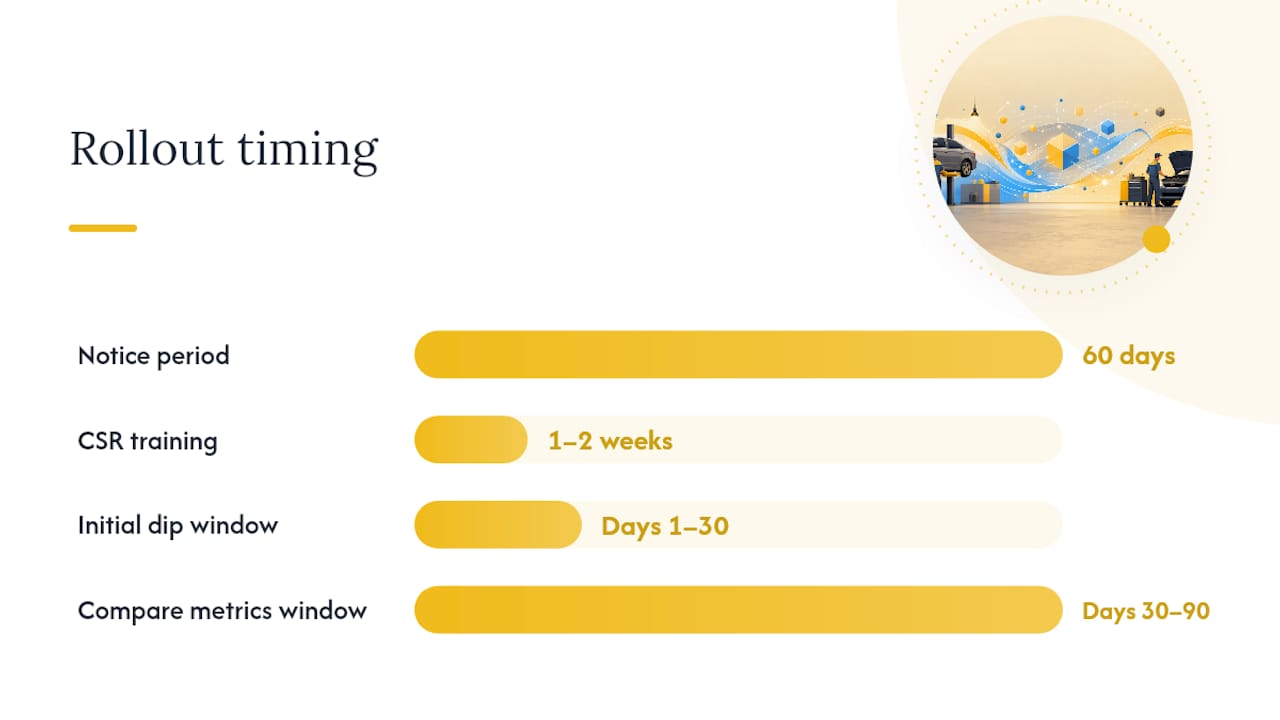
Announce before you enforce. Give customers and maintenance-plan members 60 days’ notice, grandfather existing members into whatever rate they signed up under, and get the new number onto your trucks, invoices, and website before a single CSR quotes it over the phone.
- Weeks 1 to 2: train every CSR on the exact script, run mock calls, and post the price where techs and dispatch can see it.
- Days 1 to 30: expect a modest dip in call volume as the fee filters out tire-kickers. This is normal, and industry data on fee increases shows the dip typically recovers within one or two billing cycles.
- Days 30 to 90: compare your three core metrics against pre-rollout numbers.
Track exactly three things. Fee acceptance rate is the percentage of dispatched calls where the customer agreed to pay the fee versus hung up or rebooked elsewhere; pull it from your CSR call log. Cancellations after disclosure measures how many bookings fall through specifically after the fee is quoted, not for unrelated reasons. Average ticket on diagnostic calls tracks total invoice value on jobs that started as a diagnostic dispatch, which tells you whether the fee is filtering for higher-value work.
If acceptance drops sharply with no ticket uplift, tighten your script before you touch the price. If cancellations spike specifically after disclosure, your CSRs may be apologizing for the fee instead of stating it plainly.
What do diagnostic fees typically cost across trades?
Your own cost basis should set your price first. Market bands are a sanity check, not a target.
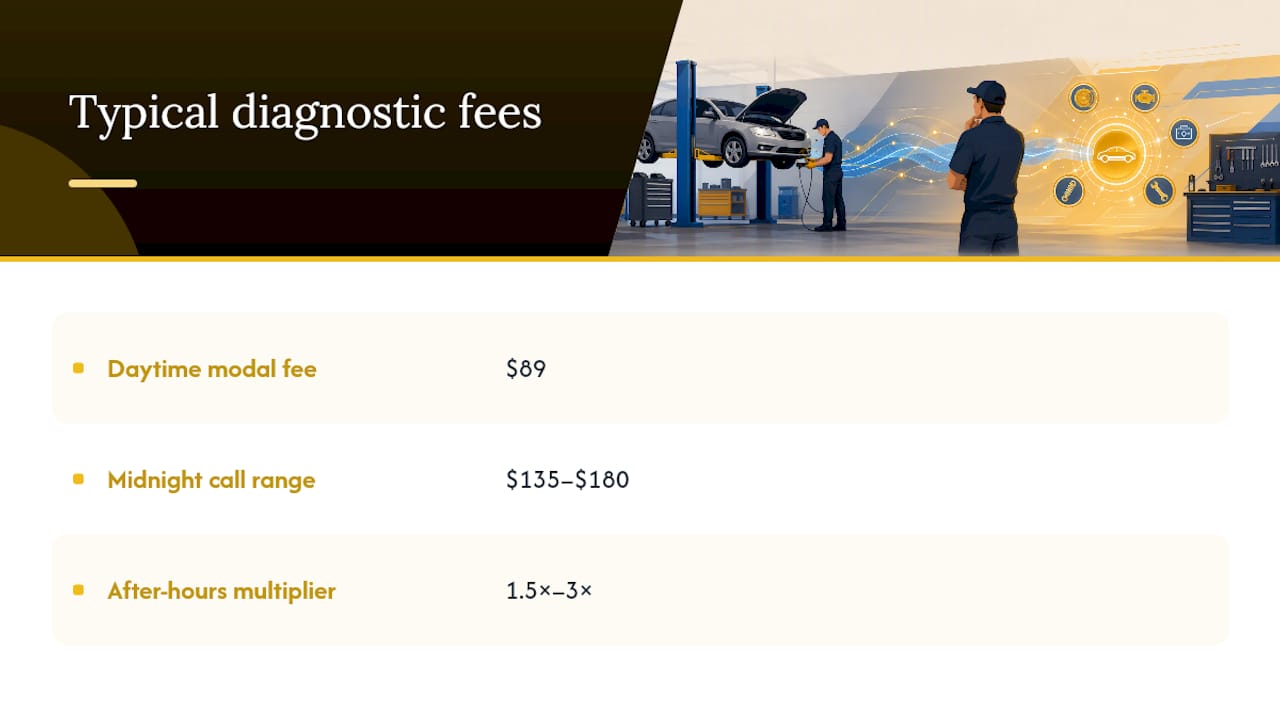
ServiceTitan’s analysis of over a million residential service visits found booking rates stay steady up to roughly $89.99, with a modal fee near $89 across many trades. Beyond that threshold, booking rates start to soften unless long drive times or premium positioning justify the higher number.
After-hours and emergency premiums should reflect loaded overtime wages, truck cost, and higher callback risk. Practical multipliers run 1.5x to 3x depending on the time window and whether it’s a holiday. A $89 daytime fee might become $135 to $180 for a midnight call, and larger companies in dense metros generally sit at the higher end of every band because their loaded rate runs higher.
The Rebuilding the Trades take on getting this right
Most owners treat the diagnostic fee as a line-item decision. It isn’t. It’s a proxy for whether you actually know your numbers. If you can’t state your loaded hourly rate off the top of your head, the fee conversation is premature.
Rebuilding the Trades built its three-tier maintenance agreement strategy that drove a $21 million run rate on exactly this kind of cost clarity. Fee strategy doesn’t live in isolation. It plugs into broader process mapping, dispatch scheduling, and the KPI dashboards that tell an owner whether a truck roll actually made money.
Before you touch your pricing, run this checklist: confirm your loaded rate with your bookkeeper, pull 90 days of windshield and diagnostic time averages from dispatch, estimate your real close rate from job history, assign one CSR as the script owner, and set up a dashboard that tracks the three metrics weekly, not quarterly. The Tri-Trade case study shows what happens when a shop finally treats pricing as a measured system instead of a guess.
— Dan
Get help implementing your diagnostic fee strategy
A calculator gets you the right number. Getting your CSRs, dispatch, and invoicing all pulling in the same direction on day one is a different problem, and it’s the one most shops actually struggle with. Rebuilding the Trades runs onsite audits that map your current dispatch and booking process, build the fee model from your real loaded rate, script your CSR team, and stand up the KPI dashboard so you’re watching fee acceptance and average ticket from week one instead of guessing three months later.

A typical engagement walks through fee modeling, CSR training, and a 90-day tracking window built around the same metrics covered above, with the goal of clearer revenue per truck-hour and less operational guesswork across the board. If you’re ready to stop pricing by instinct, visit the pricing page to request a consult and see what a structured rollout looks like for your shop.
Sources
Pull the diagnostic fee calculator and phone script mini-card for the formula and CSR wording. Check ServiceTitan’s benchmark analysis for booking-rate data by fee band. Review fee naming and disclosure guidance before you finalize invoice language. For implementation support, see Business Process Mapping or the HVAC KPI tracking guide.
- Diagnostic Fee Calculator (Sheet) + Phone Script Mini‑Card | The Service Operator
- The Right Home Service Diagnostic Fee to Increase Bookings | ServiceTitan
- Service Call Fee: What to Charge in 2026 and Why It Pays | PipelineOn
- Service Call Fee vs. Trip Fee vs. Diagnostic Fee | ShiftFlow
0 Comments