
Start an operational succession program 3 to 5 years before you plan to step back, and put three things first: a leadership readiness assessment, clean financials with accurate work-in-progress reporting, and an early conversation with your surety. Succession in the trades is not a document you sign once. It is a sequence of operational changes that either hold up under stress or fall apart the day you hand over the keys.
TL;DR:
- Effective succession planning should start at least three to five years before the planned transition, focusing on operational readiness rather than legal transfer alone.
- Building a leadership bench involves real project responsibility, documented standard procedures, and staged responsibility tests, validated by KPIs like margin control and client retention.
- Financial transparency, accurate work-in-progress reporting, and early bonding discussions with surety agents are crucial to prevent transfer delays or bonding capacity reductions.
- Transition success depends on a formal governance framework, clear communication with management, key clients, and surety, and documenting critical knowledge before handoff.
- Retirements should be preceded by operational, financial, and leadership improvements that allow the business to maintain bidding capacity, margins, and client relationships independently of the owner.
Table of Contents
- A step-by-step succession plan for trades
- Assessment phase: identify critical roles and score readiness
- Choosing a successor route and building a success profile
- Development phase: training successors to run the business
- Financial and bonding risks that can derail a transfer
- Capturing institutional knowledge before it walks out the door
- Who to tell, and when, without spooking your team
- A 3 to 5 year milestone checklist you can start today
- How Rebuilding the Trades operationalizes succession for trade businesses
- What succession planning actually means for a trade business
- Planning your own exit without wrecking the business
- Managing generational tension in a family trade business
- What owners consistently get wrong about succession
- Where Rebuilding the Trades fits into your succession plan
- Where to go for succession planning tools and guidance
- Sources
- FAQ
A step-by-step succession plan for trades
Trade succession fails when owners treat it as a legal event instead of an operational one. Bonding, licensing, and client relationships depend on continuity that a will or a buy-sell agreement alone cannot guarantee.
Work through these steps in order:
- Assess your role and identify which duties only you perform.
- Choose a route: family member, internal manager, employee buyout, or outside sale.
- Fix finances and bonding before you touch valuation or legal paperwork.
- Build the leadership bench through real project and financial responsibility.
- Pilot the transfer on smaller jobs or accounts before the full handoff.
- Finalize valuation and legal structure once the successor has proven results.
- Implement and monitor the transition against agreed KPIs.
Map these to a timeline: 5 or more years out for early assessment, 3 to 5 years out for financial cleanup and bench-building, 1 to 3 years out for piloting and legal work, and the final year for execution and handoff.
Assessment phase: identify critical roles and score readiness
Start by separating what only you can do from what someone else already could, with training. Estimating, key client calls, and surety liaison duties are common owner-only tasks in trade businesses. Dispatch oversight, routine job-costing, and vendor management usually are not.
Score your business and your bench against a Leadership Readiness Checklist that covers:
- Project management: can a successor run multiple jobs to budget without you checking in daily?
- Margin control: do they understand job-costing well enough to protect profit?
- Client relationships: have key accounts met and trusted anyone besides you?
- Surety liaison: could they represent the company credibly in a bonding meeting?
A practical toolkit built for small business owners frames this scoring as a Business Readiness Scorecard, used to prioritize which gaps to close first rather than tackling everything simultaneously.
Choosing a successor route and building a success profile
Family transfer, internal promotion, an employee buyout, and outside sale each carry different risks for a contractor. Family succession preserves culture but can stall if the next generation lacks bonding credibility or project experience. Internal managers often know operations cold but may need coaching on financial ownership. A management buyout or outside sale can bring capital and discipline but risks culture loss and client turnover.
Build a success profile for the role, not just the person, tied to concrete outcomes:
- Bonding credibility: can this person carry the financial trust a surety expects?
- Client retention targets: what percentage of key accounts should stay through year one?
- Margin benchmarks: what job-costing accuracy is the bar for approval?
- Cultural fit: does their management style match how your crews actually work?
Test candidates with staged responsibility, short rotations through estimating and field supervision, and small pilot projects before committing to a route.
Development phase: training successors to run the business
Readiness is proven on the job, not in a classroom. Mentoring on live projects, leading a pilot job start to finish, and rotating through billing and job-costing duties build the operational muscle a successor needs before they inherit full authority.
Document as you go:
- Short SOPs for estimating, change orders, and dispatch decisions.
- Video walk-throughs of recurring tasks like bid reviews or crew scheduling.
- A 30-60-90 playbook that sequences what a new leader owns in their first three months, similar to the onboarding framework used for new managers in other trade roles.
Validate progress with KPIs, not gut feel: margin control on assigned jobs, job-costing accuracy, and whether client retention holds steady once the successor takes the lead.
Pro Tip: Give a successor full ownership of one mid-size project, including the client relationship and the budget, before you hand over anything larger.
Financial and bonding risks that can derail a transfer
Buyers, lenders, and sureties all read the same signal first: clean, audited financials with accurate work-in-progress reporting. Sloppy WIP schedules are one of the fastest ways to stall or kill a transition in construction and trades.
Contractor-specific risks to manage early:
- Surety engagement: bring your bonding agent into the conversation years before the transfer, not months.
- Indemnity planning: common strategies keep the seller’s personal indemnity in place for a year or two after handoff to protect bonding lines.
- OldCo/NewCo structuring: sureties often prefer a phased entity transition over an abrupt ownership swap.
- Deal structure: seller financing and staged payouts reduce risk for both sides compared to a single lump-sum sale.
Sureties evaluate more than the balance sheet. According to guidance on construction succession, bonding capacity is directly tied to how early and how thoroughly a contractor brings its surety into the succession conversation, which means a rushed handoff can shrink your bonding line right when you need it most.
Capturing institutional knowledge before it walks out the door
The knowledge that keeps a trade business running rarely lives in a manual. It lives in the estimator’s head, the dispatcher’s habits, and the way a foreman handles a difficult customer. None of that survives a transition unless someone writes it down.
Prioritize documentation in this order:
- Estimating logic: how you price jobs and where margin gets protected or lost.
- Change order handling: the steps that keep scope creep from eating profit.
- Dispatch and scheduling rules: the informal judgment calls that keep crews efficient.
- Customer handoff scripts: how you introduce a successor to a long-standing client.
Short SOPs, quick videos, and role-based onboarding checklists work better than long manuals nobody reads. Confirm the documentation actually works by running a successor-led pilot project and watching whether the KPIs hold without your involvement.
Who to tell, and when, without spooking your team
Timing protects morale, client confidence, and your bonding relationship all at once. Announce in tiers, starting closest to the business and moving outward.
- Leadership first: your management team needs the plan before anyone else, so they can help execute it.
- Key clients and your surety next: both groups evaluate continuity risk, and hearing it from you directly builds confidence.
- Broader staff after the plan is set: vague rumors do more damage than a clear announcement.
- Public and vendors last: once the transition is confirmed, not while it is still in motion.
Retention tools like deferred compensation, retention bonuses for key staff, and joint client visits with the incoming leader help preserve both culture and revenue through the handoff.
A 3 to 5 year milestone checklist you can start today
A phased checklist keeps a multi-year program from stalling. Treat each year as a gate: you do not move to the next phase until the current one holds up under review.
- Year 5: complete a leadership readiness assessment and identify successor candidates.
- Years 3 to 4: clean up financials and WIP reporting, and start surety conversations.
- Years 2 to 3: assign pilot projects and document core SOPs.
- Year 1: finalize valuation, legal structure, and stakeholder communication plan.
- Transition year: execute the handoff and monitor KPIs closely.
Build three templates now: a Leadership Readiness Checklist, a Business Readiness Scorecard, and a Legal and Financial checklist covering entity structure, contracts, and licensing transfer.
| Advisor | Bring them in when |
|---|---|
| CPA | Before you start cleaning up financials |
| Valuation expert | Once financials are clean and reliable |
| Surety agent | At least 2 to 3 years before transfer |
| Attorney | When entity structure and contracts need review |
How Rebuilding the Trades operationalizes succession for trade businesses
Most owners already know they need a plan. What stalls them is execution: nobody in the company has run a leadership rebuild or a KPI system before. Rebuilding the Trades works inside HVAC, plumbing, electrical, roofing, and remodeling companies to install exactly that, from hands-on leadership training to job-costing visibility, including a maintenance-agreement strategy that produced measurable results for one trade client. Consulting engagements often start by mapping which roles depend entirely on the owner.
What succession planning actually means for a trade business
Succession planning is the process of preparing a business to keep running, with the same operational strength, after its owner or key leader steps away. In the trades, that means more than naming a replacement. It means the business can still bid accurately, maintain margins, keep its bonding capacity, and hold onto clients when the person who built those relationships is no longer making every call.
The purpose is continuity, not just transfer. A family-business succession study found that leadership style during the transition affects whether succession actually succeeds, with participatory and transformational approaches supporting better outcomes than a heavily transactional handoff. That lines up with what shows up on job sites: successors who are coached and given real authority tend to hold the business together better than those who simply inherit a title.
For contractors specifically, succession planning also protects things that have nothing to do with an org chart: your surety relationship, your license standing, and your ability to bid the next job at the same bonding capacity you had before. A plan that only covers ownership transfer on paper, without addressing those operational dependencies, leaves the business exposed exactly when it can least afford it.
Planning your own exit without wrecking the business
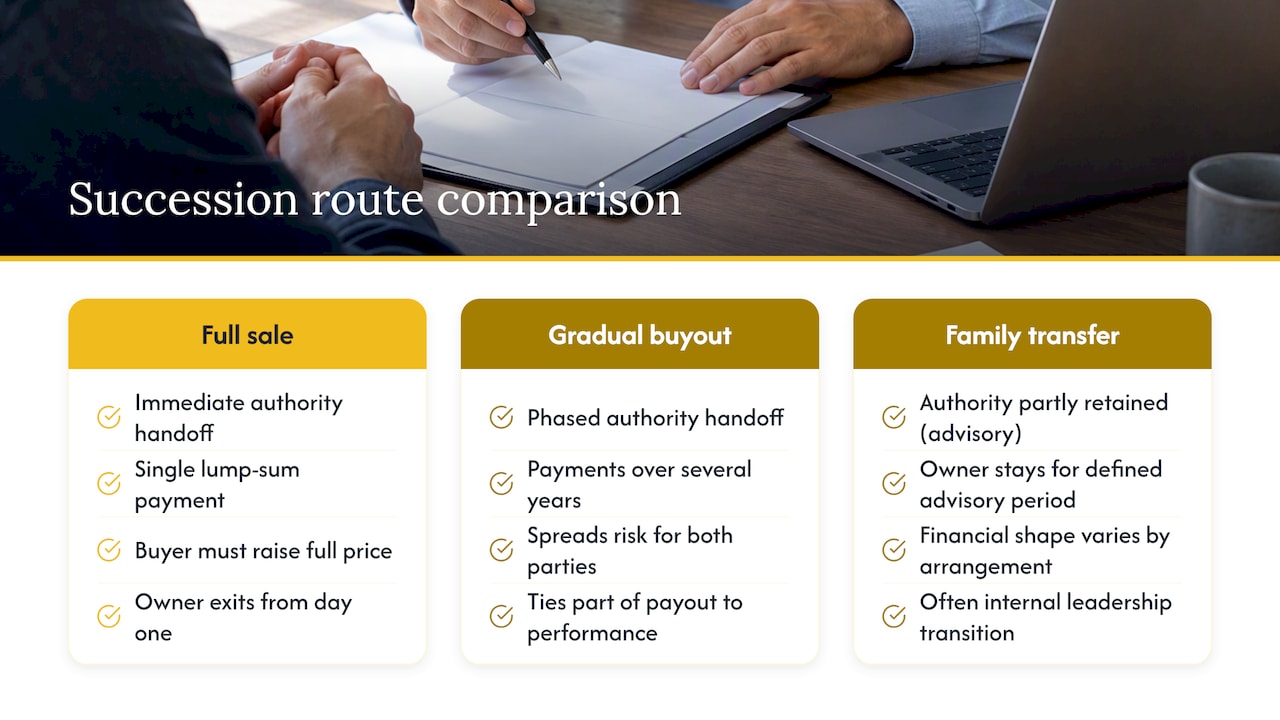
Retirement is the event. Succession is the years of work that make retirement possible without damaging what you built. Start by deciding what kind of exit you actually want: a full sale, a gradual buyout by internal leadership, or a family transfer where you stay on in an advisory role for a defined period.
Each path has a different financial shape. A staged buyout, paid out over several years, spreads risk for both you and the successor and often fits trade businesses better than a single lump-sum sale, since it ties part of your payout to the business continuing to perform. Seller financing works similarly: you get an ongoing income stream, and the buyer does not need to raise the full purchase price upfront.
Whichever path you choose, do not wait until you are ready to retire to start the financial and operational cleanup. Owners who begin years ahead have time to fix job-costing habits, resolve WIP reporting gaps, and prove to a surety or buyer that the business runs well without daily owner involvement. Owners who wait until the last year end up negotiating from a weaker position, often accepting a lower valuation or a less favorable deal structure because there is no time left to fix what a buyer or successor flags in due diligence.
Retirement planning and succession planning are the same project viewed from two angles: one protects your income after you leave, the other protects the business you are leaving behind.
Managing generational tension in a family trade business
Family-owned trade businesses carry a tension that outside hires rarely face: the founder wants to preserve what built the company, and the next generation often wants to modernize it. Neither instinct is wrong, but left unmanaged, that gap can stall a succession plan for years.
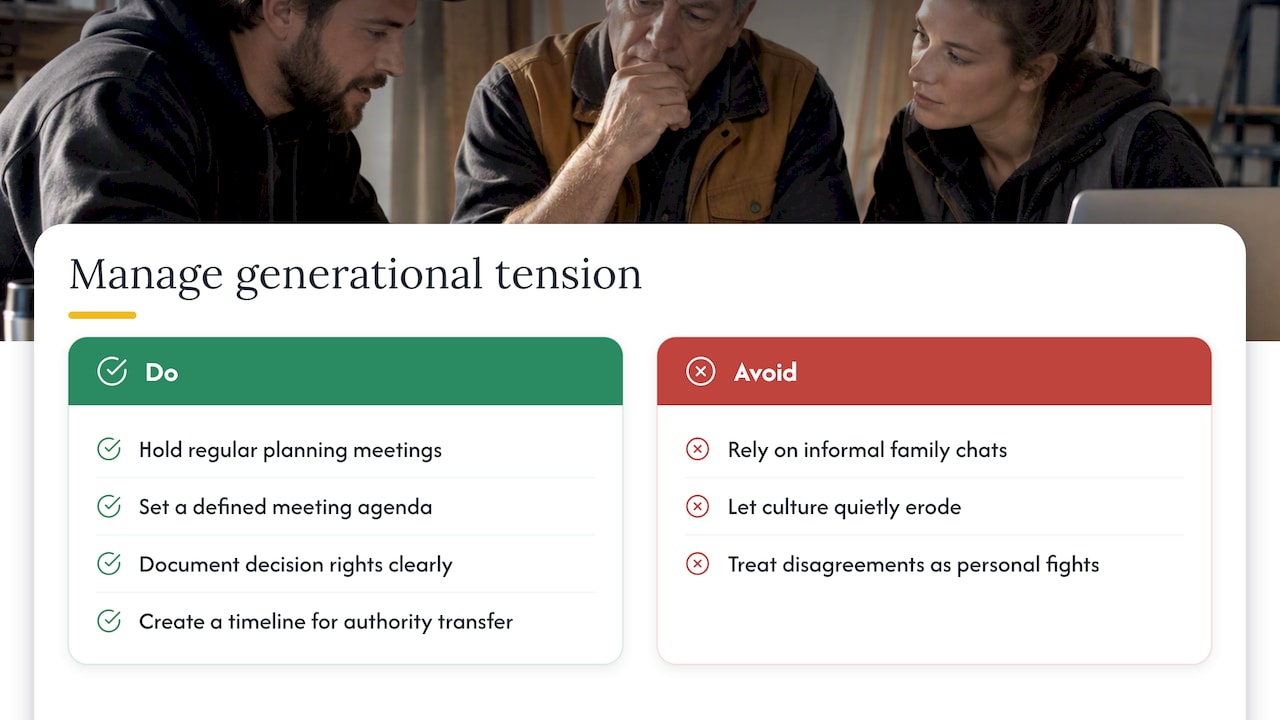
Founders tend to trust the systems, relationships, and instincts that got the business this far. Successors, especially those who came up through business school or worked outside the trade, often see opportunities in technology, marketing, or process that the founder has never needed. Structured governance, not informal Sunday-dinner conversations, is what actually bridges that gap. Regular planning meetings with a defined agenda, documented decision rights, and a clear timeline for authority transfer all reduce the friction that comes from unspoken expectations.
Culture is also easy to lose in a family transition. Crews who have worked for one owner for fifteen years judge a successor by consistency, not credentials. A governance framework built for family trade businesses can formalize how decisions get made and how the next generation earns authority, rather than simply inheriting it.
The businesses that handle this well treat generational disagreement as a design problem, not a personal one: they build a structure where both legacy and change have a defined place, instead of letting the two sides fight it out informally until one wins.
What owners consistently get wrong about succession
The most common mistake is treating succession as a legal event, something a lawyer handles in a single meeting the year before you retire. By the time owners think about it that way, the operational gaps are already baked in: nobody else can run the estimating process, the financials have not been cleaned up in years, and the surety has never met anyone but the owner.
Do this in the next 30 days: run a leadership readiness assessment on your top two or three potential successors, and pull together the last two to three years of financials to see how much cleanup work is really needed. Both take less time than owners expect, and both tell you immediately how far out your real timeline needs to be.
— Dan
Where Rebuilding the Trades fits into your succession plan
You do not have to build a succession program alone or from scratch. Some consulting firms work directly inside trade businesses on key transition needs, including leadership training, financial operations improvements, and management training to prepare successors with operational authority before the handoff.

Engagements typically start with an assessment of where your business stands today, followed by an operational plan and hands-on implementation support, similar to the flow outlined on the Rebuild services page. If you are ready to see where your leadership bench and financial systems stand, that page is the place to start.
Where to go for succession planning tools and guidance
For a full workbook approach to the timeline, checklists, and templates covered here, the Cambridge succession planning toolkit walks through readiness scoring and stakeholder communication in more detail. For contractor-specific bonding and financial guidance, Warren Averett’s construction succession piece covers indemnity structures and surety timing. Family-owned businesses can find leadership-style research in the Emerald Journal study on succession outcomes.
Sources
- Construction succession planning (Warren Averett)
- Succession planning practices and succession success in family-owned businesses (Emerald Journal)
- Cambridge succession planning toolkit (April 2025)
FAQ
What are the 5 D’s of succession planning?
Definitions vary across industries, but a common version covers death, disability, divorce, disagreement, and departure, the five triggers that can force an unplanned ownership change. Trade businesses should plan for all five, since a sudden trigger without a documented plan can jeopardize bonding capacity and client relationships overnight.
What are examples of succession planning in a trade business?
Examples include training an internal manager to take over estimating and client relationships, structuring a family transfer with staged authority over several years, or setting up an employee buyout tied to performance milestones. Each example works best when paired with clean financials and early surety engagement.
What are the key trends in succession planning for 2026?
Trade businesses are increasingly formalizing leadership development earlier, often 5 or more years before a planned exit, rather than waiting until retirement is imminent. There is also growing attention to structured governance in family-owned firms, since research on family business succession links leadership style during transition to whether the succession actually succeeds.
What is a career succession plan?
A career succession plan maps out how an individual employee develops the skills and experience needed to eventually take on a leadership role, often through mentoring, rotational assignments, and milestone-based responsibility increases. In trades, this usually means progressing from field supervision toward project management, job-costing ownership, and eventually client and bonding relationships.
How early should a trade business start succession planning?
Most advisors and toolkits recommend starting an operational succession program 3 to 5 years before the planned transition, with financial cleanup and leadership development beginning as early as possible within that window. Waiting until the final year typically leaves too little time to fix WIP reporting issues, build a credible leadership bench, or bring the surety up to speed.
0 Comments