
Open book management means running your trade company so that your people see the financial results, understand them, and share in the reward when the numbers improve. It is not the same as open book pricing or open-book construction management, which are contract structures between a customer and a builder. If you own an HVAC, plumbing, electrical or other trade business, this guide covers what to show your team, how to teach it, how to connect it to pay, and how to start small.
TL;DR
- Open book management is an internal management system: employees learn the company’s financials, track a few key numbers, and share in the upside. It is not a customer billing method.
- Start with managers, not the whole company. One monthly review with a fixed agenda is enough to begin.
- Teach before you show. Every successful example in the trades starts with financial education, not a spreadsheet dropped on the table.
- Tie a few measures to a bonus the team can influence, and keep the scoreboard simple.
- You can share real results without exposing individual salaries.
Table of Contents
- Open book management vs. open book contracting
- Why trade owners keep their numbers closed
- What to share, and what to keep private
- Teach the numbers first
- Build a scoreboard each department owns
- Run one monthly meeting with a fixed agenda
- What it looks like in real trade companies
- Tie incentives to numbers your team can move
- Perspective: why this works best in the trades
- How to start in 90 days
- Common mistakes to avoid
- Work with a team that only does trades
- FAQ
- Sources
Open book management vs. open book contracting
The search results for this topic mix three different ideas, and it helps to separate them.
Open book management is a way of running a company. Employees learn how the finances work, see the results regularly, and receive a stake in the outcome. This is what the rest of this article covers.
Open book contracting (also called cost-plus) is a pricing agreement. According to Lewis Silkin’s overview, an open-book contract gives the customer visibility of the supplier’s cost records and charges actual cost plus a fee, for example actual costs plus a management fee percentage. Your customer sees your costs. Your team does not necessarily see anything.
Open-book construction management is a delivery method. My Home Builders describes it as an arrangement where the owner holds each trade contract directly and the construction manager acts as the owner’s agent for a disclosed fee, with no markup on trades, materials or subcontracts.
If a homeowner or general contractor asked to see your cost breakdown, that is the second or third idea. If you want your service manager, lead installer or dispatcher to understand why gross margin matters and to act on it, that is the first.
Why trade owners keep their numbers closed
Most trade companies grow from one skilled technician into a business. Financials often stay in the owner’s head, the bookkeeper’s software, or an accountant’s year-end package. Managers get told to “watch costs” without ever seeing what costs are.
The result is predictable. A service manager discounts to win a job without knowing what the discount does to gross profit. A lead installer orders extra material because it is easier than a second trip. Nobody is being careless. They are working without the scoreboard.
Open book management closes that gap. Ellen Rohr, a plumbing and HVAC business coach, says in a ServiceTitan Growth Series interview that the point is sharing what is real, so everyone understands how their efforts affect the bottom line. She also says trust comes from telling the truth: sharing ever more accurate financials, and when a mistake is found, fixing it and showing the team it was fixed.
What to share, and what to keep private
Owners often assume open book means posting everybody’s pay on the wall. It does not have to. A real HVAC example shows a middle path.
At Conditioned Air, an HVAC company, monthly financial meetings with department managers review the prior month and year-to-date results. Each department appears as a profit center with gross revenue, direct costs and gross profit. Overhead accounts are shown in total by account, with payroll shown as one number rather than by names and salaries.
Another HVAC company, Yarbrough and Sons, shares line items above gross margin, explains overhead, and walks through the numbers in the same order each time: revenue and direct costs, the gross margin result, what sits in overhead, then net profit or loss.
A sensible first layer for a trade company looks like this:
| Share early | Share later, if at all | Keep private |
|---|---|---|
| Revenue by department | Overhead by account | Individual pay |
| Direct costs (labor, materials, equipment) | Net profit and how it is calculated | Owner draws and personal finances |
| Gross profit and gross margin | Balance sheet and cash position | Customer-specific disputes |
| A handful of department KPIs | Debt and loan terms | Anything your attorney or CPA advises against sharing |
The order matters more than the exact list. Start where your people have influence: the job and department level. Overhead and net profit make sense once they understand the gross profit that pays for them.
If you are not yet sure which reports to build, our guide to contractor financial reporting covers what to track, and our list of HVAC KPIs owners must track helps you choose the department measures.
Teach the numbers first
The step owners skip is the one every example puts first: education.
Conditioned Air’s managers had no experience with balance sheets, P&L statements, cash flow analysis or over/under billing reports. The company taught them an “Accounting 101”, using simple math examples to show how transactions affect the statements and how small expenses or small losses in gross profit add up to real money.
The same pattern shows up outside HVAC. Angie Stocklin, writing in the Indianapolis Business Journal, said her company required every team member to complete and pass a Finance 101 class. Bill Palmer of Commercial Casework Inc. puts it this way on the company’s page: they do not just show employees income statements, they teach a class on how to read them.
For a trade shop, a practical teaching session can be short and concrete:
- Pick one real job from last month and walk the revenue, labor, materials and gross profit line by line.
- Show what a 5% discount or one unbilled return trip does to that gross profit.
- Ask the room how many of those jobs it takes to cover one month of overhead.
- Repeat with a different job next month.
Keep it free of accounting jargon. If a lead tech can explain gross margin to a new hire, the lesson worked.
Build a scoreboard each department owns
Numbers only change behavior when people can see them and know what “good” looks like. In the Indianapolis Business Journal account, each department created a scoreboard tracking its most important metrics weekly, with annual goals assigned to individual team members. The leadership team also added a financial section to all-company meetings and found a way to reward team members.
For trade businesses, a starting scoreboard might look like this:
- Service: gross profit per tech, average ticket, callback rate
- Install: job gross margin against estimate, labor hours against budget
- Call center and dispatch: booked-call rate, same-day capacity used
- Sales: closing rate, average sale, margin on sold jobs
Limit each department to three to five measures. More than that and nobody remembers them. We go deeper on this in our piece on a 3 to 5 KPI scorecard for manager bonus plans.
Run one monthly meeting with a fixed agenda
You do not need a company-wide program on day one. A practical starting point, per The New Flat Rate, is one monthly financial review with a defined agenda: decide which numbers your people need, explain one decision those numbers affect, and return to the same measures the next month.
Here is a format that fits a small or family-owned shop:
- Results (15 minutes). Revenue, direct costs and gross profit by department, against last month and year to date.
- Explain (10 minutes). Name the one number that moved most and why.
- Decision (10 minutes). Tie that number to one choice the team controls: how you bid, when you reorder, how you schedule.
- Commitment (5 minutes). Each manager names one action for the month.
Recurring service agreements are a good example of a decision to bring to this meeting. Choices such as pressure washing contract frequency show how a service schedule affects repair costs over time, and a manager who sees the cost side can set visit frequency with the numbers in front of them.
Same room, same order, same measures. The repetition is what builds fluency.
What it looks like in real trade companies
These examples come from published accounts by the companies themselves or trade media. Results are theirs, in their own circumstances, and are not a promise for yours.
Gene Johnson Plumbing (Seattle). After a business makeover with Ellen Rohr, the company shared financial understanding with front-line employees. According to PHCPPros, they restructured their chart of accounts into three classes (service, installation, equipment replacement), found they were under-bidding jobs, overhauled bidding, and changed compensation so all service techs could sell mid-sized jobs. Kimberly Kean reported the company was making more than ever and that profitability sharply reduced stress.
Conditioned Air (HVAC). As of the HVACR Business article, the company had used open-book management with its managers for six years. Before formalizing it, results were held back by informal, limited sharing of information. Once formalized, company performance took off.
Commercial Casework Inc. (custom woodwork, Bay Area). The company began in 1993 and reports on its own page that profits rose 700%, revenue per employee went from $99,000 to $125,000, and annual sales grew from $4 million to $11 million. It is a woodwork firm rather than a service trade, but the mechanics (financial classes, shared numbers, a bonus) carry over.
Notice what the first story shows: the chart of accounts and bidding fixes came from looking at real numbers. Transparency exposed the under-bidding. That is a gain you can find before you ever share a number with a technician.
Tie incentives to numbers your team can move
Sharing numbers without sharing rewards asks people to care about something that does not affect them. Tim Gray, an HVAC owner, wrote on the ACCA HVAC Blog that he adopted open-book management after reading The Great Game of Business by Jack Stack. He tied bonuses to net profit and technician efficiency (hours billed divided by hours paid), and the team reached maximum bonus territory within the first two quarters. He also set a technician bonus based on each tech’s monthly gross profit, with a minimum threshold and a percentage of every gross profit dollar above it.
He described the moment the team realized they had hit the top bonus tier at a P&L meeting as one of real excitement, unlike anything he had seen in 20 years of business.
A few design rules we apply when owners ask about this:
- Pay on measures people influence. A tech can move billed hours and gross profit. A tech cannot move your insurance renewal.
- Set a floor. Gray’s threshold-plus-percentage structure means the bonus starts only after the shop clears a baseline.
- Protect quality. A bonus on revenue alone can push corners. Our 40% quality rule for performance pay plans explains how to keep customer outcomes in the formula.
- Pay out on a schedule people can count on. Monthly or quarterly keeps the link between action and reward visible.
Before launching any pay plan, have your accountant or an employment attorney review it. Wage and bonus rules vary by state and by how you classify employees.
Perspective: why this works best in the trades
We see the same pattern in trade companies again and again. The owner is the only person who knows the numbers, so the owner becomes the only person who can fix them. Every pricing question, every margin question and every cash question lands on one desk.
Open book management is the way out of that bottleneck, but only when it is done in the right order. First the owner needs accurate, timely financials. Then managers need to be taught how to read them. Then each department needs a short scoreboard. Only then does a bonus make sense. Skip a step and the transparency turns into noise.
That is why our work is built around the trades only. A dispatcher, a lead installer and a sales manager each need different numbers explained in the language of their own job. Our approach combines data-backed systems, in-field engagement and leadership development, so the numbers have an owner and a meeting rhythm to live in.
If you are not sure whether your books are ready to share, that is a good place to start. Get the reporting right first, then open it up.
Dan
How to start in 90 days
A small or family-owned shop can introduce the idea in stages without a big announcement.
Month 1: get the data right. Make sure your chart of accounts separates departments (service, install, replacement) the way Gene Johnson Plumbing’s did. Confirm that direct costs land in the right place. A one-page flash report is a good first output.
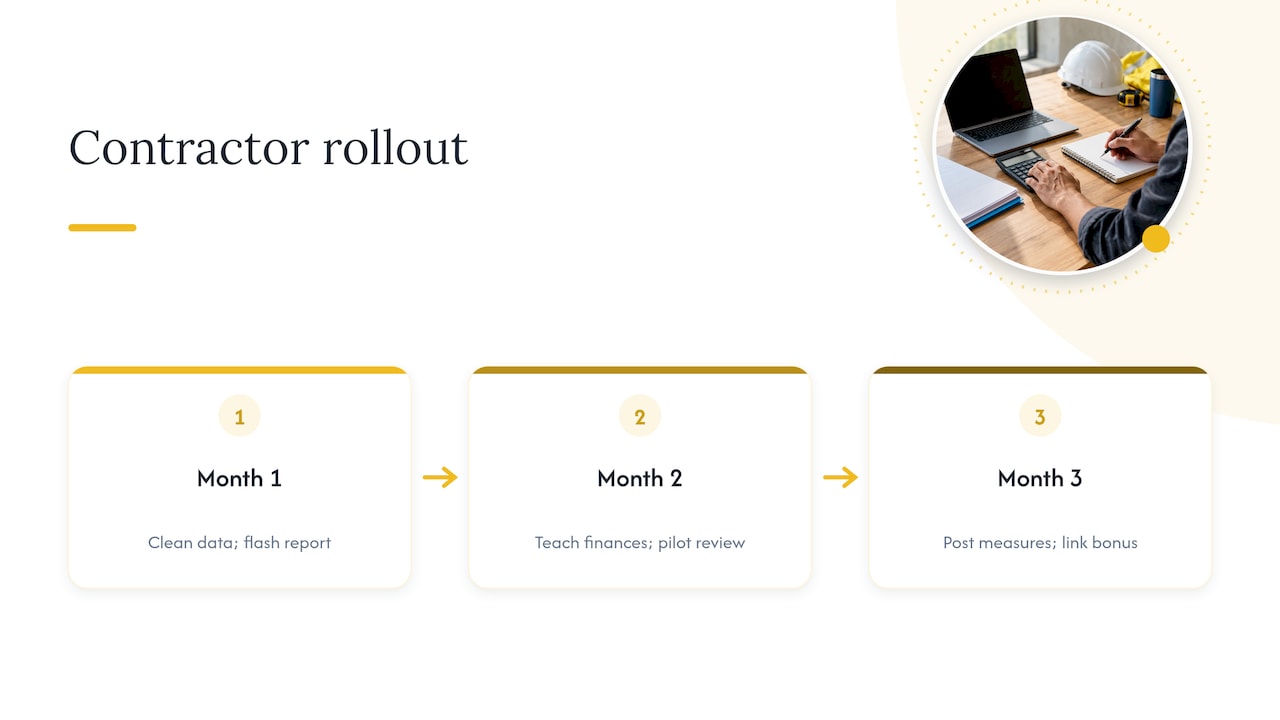
Month 2: teach and pilot. Choose two or three managers. Run a short financial literacy session using last month’s real jobs. Hold your first review meeting using the agenda above.
Month 3: add the scoreboard and a small reward. Give each department three to five measures, post them weekly, and set one modest bonus tied to one of them. Keep the cash side visible too, using a 13-week rolling cash flow forecast.
To judge whether it is working, compare the same measures month over month: gross margin by department, billed-hours efficiency, job margin against estimate, and how many questions managers can answer without calling you. If managers start raising pricing or scheduling problems before you spot them, the system is doing its job.
If your team is bigger, or the transition involves a family handoff, consider formal leadership and management training alongside the rollout. Managers who have never run a meeting about money need practice, and the HVAC operations audit can show where the gaps are before you start.
Common mistakes to avoid
- Showing numbers nobody can read. A full P&L handed to a service tech without a class creates questions, not decisions.
- Starting with net profit. Net profit includes costs your people do not control. Start with gross profit and direct costs.
- Changing the scoreboard every month. Fluency needs repetition.
- Promising bonuses before the data is reliable. If a reported figure turns out wrong, correct it openly and show the fix, as Rohr advises.
- Treating it as a one-time event. The meeting rhythm is the program.
Work with a team that only does trades
If you want help building the reporting, the manager training and the accountability rhythm that open book management depends on, that is what we do for HVAC, plumbing, electrical, roofing, remodeling and siding companies. Our Rebuild engagement includes management and leadership training, financial operations and compliance assistance, and the other programs listed on our Rebuild page.

See how a tri-trade company approached it in our case study, or start at Rebuilding the Trades to talk through where your business stands.
FAQ
Is open book management the same as open book pricing?
No. Open book management is an internal system for sharing financial results with employees. Open book pricing, or cost-plus, is a contract where the customer pays actual costs plus a fee and can review the cost records. A company can use either one, both or neither.
Do I have to share everyone’s salary?
No. In the Conditioned Air example, payroll appeared as one number rather than by names and salaries. Most owners begin with department revenue, direct costs and gross profit, and share more only as managers learn to use it.
How should an HVAC company start?
Hold one monthly financial review with managers. Use the same agenda each time: revenue and direct costs, gross margin, overhead, then net result, and one decision the numbers affect. Teach the basics first, then add a department scoreboard and a modest bonus.
Does open book management work for a small family business?
Published accounts from plumbing, HVAC and woodwork companies describe positive results, though each company’s results are its own. Small teams have an advantage: fewer people to teach and faster feedback. Start with your two or three key managers.
Sources
- Lewis Silkin: An overview of open versus closed book contracts
- My Home Builders: What Is Open-Book Construction Management?
- ServiceTitan: A Winning Game in the Trades, Ellen Rohr
- HVACR Business: Open Up To Open Book
- The New Flat Rate: How financial transparency helps HVAC teams own the numbers
- Indianapolis Business Journal: How open-book management helped us
- Commercial Casework Inc: It Pays To Listen
- PHCPPros: Business Advice that Leads to Profit
- ACCA HVAC Blog: Our Pay Performance Journey
0 Comments