
A workable meeting cadence for a contractor has four layers: a 10 to 15 minute daily huddle, a weekly meeting per department, a monthly leadership review of the numbers, and job-site meetings tied to each project. Each layer has one job, a fixed time and a short agenda. When the rhythm is set, decisions stop living in the owner’s head and the owner stops being the only person who knows what is going on. At Rebuilding the Trades we build this kind of structure with trade owners, because a team that meets on a schedule is a team that can be held to its commitments.
TL;DR
- Run four layers: daily huddle, weekly department meeting, monthly leadership review, and job-site meetings per project.
- Keep the daily huddle standing, at the same time every day, and 10 to 15 minutes at most.
- Every meeting gets a fixed length, an agenda and an owner for each action. If it has none of those, cut it.
- Start with the daily huddle for a week or two, then add the weekly and monthly layers one at a time to avoid meeting overload.
- Review the cadence itself once a year and ask whether what you are doing is working.
Table of Contents
- What a meeting cadence is, and why trades need one
- The cadence at a glance
- Layer one: the daily huddle
- Layer two: weekly meetings
- Layer three: job-site meetings
- Layer four: monthly leadership and accountability
- How to put the cadence in place
- Avoiding meeting overload
- Where we help
- Our perspective
- FAQ
- Sources
What a meeting cadence is, and why trades need one
A meeting cadence is the planned rhythm, frequency and structure of your meetings. It answers three questions for everyone on the team: when do we talk, what do we talk about, and who leaves with what to do.
Trade businesses feel the absence of a cadence in familiar ways. Dispatch changes plans at 7:30 and the install crew hears about it at 9:00. The sales manager and the service manager each think the other is chasing the same problem. The owner finds out about a margin leak three weeks after it started. None of these problems are technical. They come from information that has no scheduled place to travel.
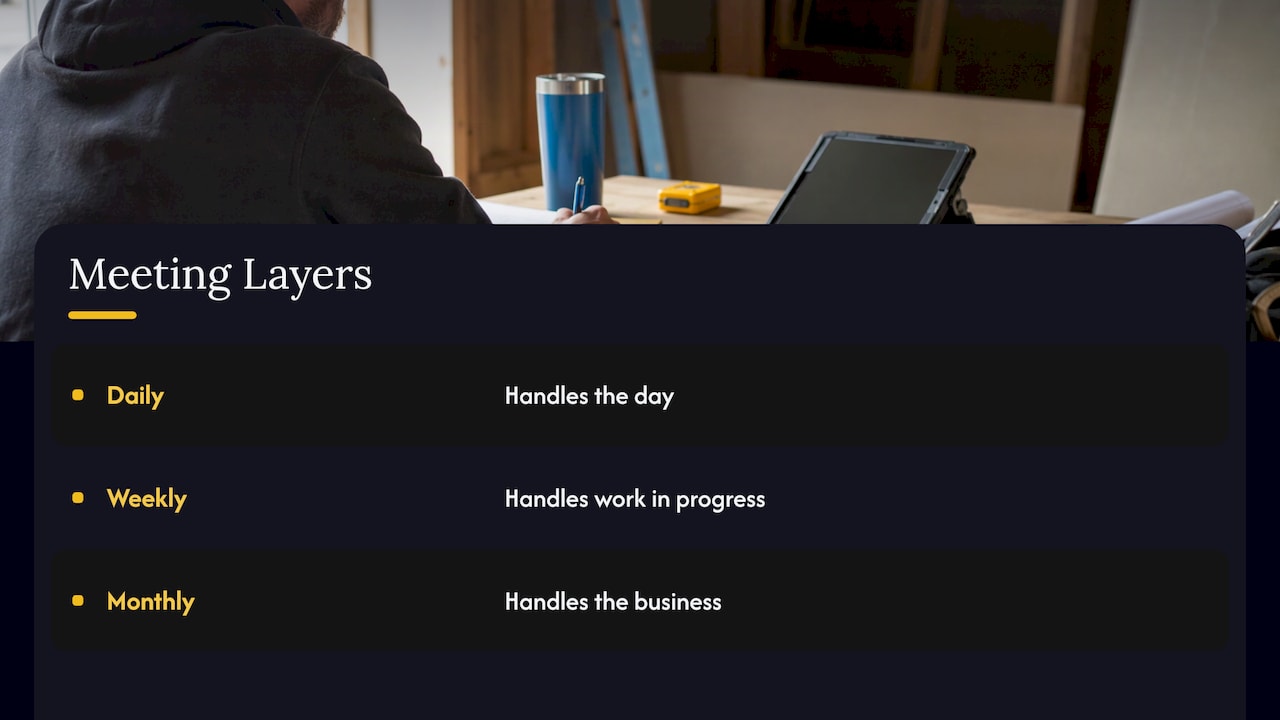
A cadence gives it that place. Short, frequent meetings handle the day. Weekly meetings handle the work in progress. Monthly meetings handle the business itself. If you put the right topic in the right layer, nothing needs an emergency meeting.
The cadence at a glance
The table below pulls together recommendations from the Lean Construction Institute, construction business writers and trade publications into one starting point. Treat the lengths as ceilings and adjust the days and times to your shop.
| Meeting | How often | Length | Who attends | What it covers |
|---|---|---|---|---|
| Daily huddle | Daily, same time | 10 to 15 minutes | Crew or department, standing | Today’s work, constraints, handoffs |
| Department weekly | Weekly | 30 to 45 minutes | Office, sales, service or install team | Last week’s results, this week’s priorities |
| Field coordination | Weekly, at the job site | 30 to 45 minutes | Supervisor and subcontractors | Schedule, sequencing, upcoming starts |
| Leadership review | Monthly | 1 to 2 hours | Owner and managers | KPIs across finance, sales, production |
| Accountability meeting | Monthly, per team | 45 to 60 minutes | Team lead and owner | Budgets, goals, schedules, progress |
| Annual review | Yearly | Half day or longer | Leadership team | Is what we are doing working? |
Layer one: the daily huddle
The daily huddle is the smallest meeting and usually the one with the biggest effect, so start here.
The Lean Construction Institute describes it as a daily check-in to communicate and measure progress against the team’s work plan. It is held where the work is being done, runs 10 to 15 minutes, and is meant for minor adjustments rather than long problem-solving. Construction business writer George Hedley describes a similar huddle-up: first thing every morning, in the office or at a jobsite, people standing in a circle for no more than five to ten minutes.
What to cover
Keep the agenda the same every day so nobody needs to prepare:
- Today’s work. Who is going where and what has to be finished.
- Constraints. Missing material, an unavailable permit, a customer who is not home, a truck that is down.
- Goals and targets. Progress against the weekly or job target.
- Deadlines and milestones. Anything due in the next few days.
- Parking lot. Anything that does not involve everyone gets written down and handled after the huddle by the people it concerns.
Roles that keep it moving
The Lean Construction Institute recommends at minimum a facilitator, a last planner, a subject matter expert and a scribe. The last planner is a tradesperson who controls the day-to-day schedule. The subject matter expert is the general contractor’s superintendent. The scribe records constraints and parking lot items.
In a plumbing or HVAC company, translate those roles to what you have. The facilitator can be the service manager or lead tech. The scribe can be the dispatcher or an install coordinator. The person who knows the schedule best talks about the schedule. Rotate the facilitator so the huddle does not become the owner’s meeting.
Where the daily record goes
A huddle works better when its output lands somewhere people can see it. Many crews pair the huddle with a written end-of-day record, and daily report examples for subcontractors show what a field team can capture in a few lines. For tracking what the crews actually produce against the plan, this guide to crew productivity tracking on job sites gives you a way to look at the numbers the huddle talks about.
Layer two: weekly meetings
Weekly meetings are where each department looks back at the week and sets the next one. They should be separate by function, because the sales team and the install team do not need to sit through each other’s issues.
A typical set for a trade company:
- Office and call management. Booking rates, callbacks, dispatch problems, open follow-ups.
- Sales. Opportunities, estimates sent, close rate, what is stuck.
- Service. Completed calls, memberships offered, recalls, tech capacity.
- Install. Jobs starting, jobs finishing, material status, crew assignments.
One trade publication source, Projul, states that construction teams should hold at minimum a weekly team meeting and a weekly safety meeting, with team meetings running 30 to 45 minutes and safety meetings 15 to 30 minutes. Put the safety meeting on the same morning as the team meeting if you want to protect your calendar.
The weekly owner review
On top of the department meetings, the owner needs a short review of the whole business. We cover this in detail in our guide to a 30 to 60 minute weekly ops review, and it pairs naturally with a one-page flash report. Cash belongs in this layer too, which is why we recommend a weekly cash flow rhythm with a rolling forecast.
Layer three: job-site meetings
Project meetings follow the life of a job rather than the calendar. Rural Builder Magazine’s September 2024 piece on field systems lists pre-job turnover, field start-up, a pre-job customer meeting, weekly customer meetings, biweekly subcontractor meetings, and a monthly meeting of all field supervisors. The subcontractor meeting covers everyone on the job now and everyone required in the next four weeks. The monthly supervisor meeting reviews systems and results and provides training.
Hedley suggests a weekly field coordination meeting at the jobsite, starting four weeks before subcontractors are required to start. He says this can improve schedule and completion record by 25 percent or more, with 30 to 45 minutes per session. That is his claim from 2011 and not a guarantee, so treat it as a reason to try it on your larger jobs rather than a promised result.
For jobs with an owner and an architect, expect an Owner-Architect-Contractor (OAC) meeting. Outbuild’s Tom Scalisi notes that these are generally weekly or biweekly, sometimes monthly, and that shorter meetings keep attention on decisions.
Two of these are worth a closer look because they prevent the most rework:
- The preconstruction meeting. Our preconstruction meeting agenda lists nine items to settle before the crew arrives.
- The closeout. Finish each job with a closeout checklist so lessons and punch items do not disappear.
Field supervisors carry most of these meetings, so their skill sets the quality of your cadence. See our page on field supervisor training for how we approach it.
Layer four: monthly leadership and accountability
Monthly meetings are where you look at the business instead of the work.
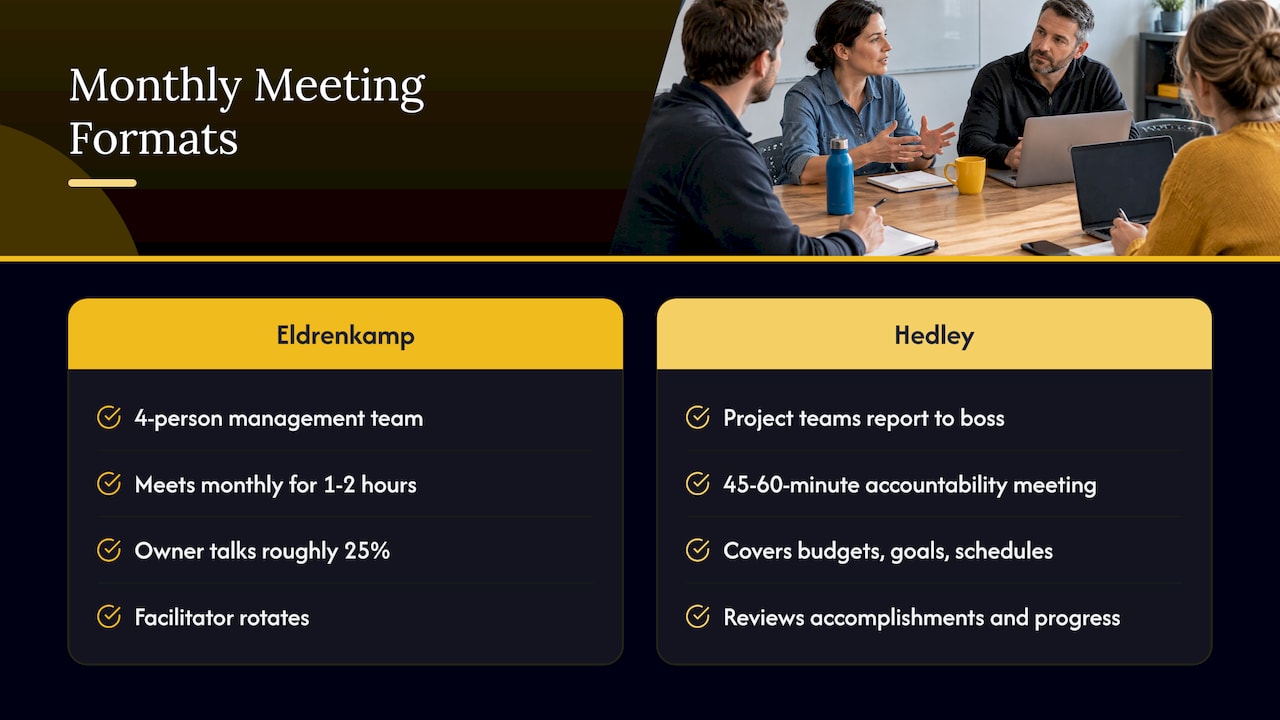
Fine Homebuilding’s Paul Eldrenkamp recommends a management team of four people who meet monthly for an hour or two to review company performance. The agenda covers KPIs in finance, sales and marketing, project development, production and overall strategy. In a four-person meeting, he says the owner should be doing roughly 25 percent of the talking, and the facilitator should rotate.
Hedley’s version is an accountability meeting, where each project, division or department team shows its boss how it is doing, covering accomplishments, budgets, goals, schedules, financials and progress in no more than 45 to 60 minutes.
The monthly meeting only works if the numbers are ready before anyone sits down. That means you need a small set of reliable reports, and our guide to contractor financial reporting covers what to track. When managers can see the same numbers as the owner, the conversation moves from opinions to decisions. See also our explanation of open book management for contractors.
The yearly question
Eldrenkamp suggests the goal of management meetings is to correct for the owner’s weaknesses and not reinforce them. He also recommends holding a longer meeting at least once a year, away from the office and with an outside facilitator, whose main agenda is to ask: is what we are doing working? Include your cadence in that review.
How to put the cadence in place
Do not launch everything on Monday. Meeting overload kills adoption faster than any pushback. Build the layers in order.
Step 1: Start with the daily huddle for two weeks
Pick one time, one place and one facilitator per team. The Lean Construction Institute says the main element is that it is daily, at the same time every day, with everyone standing. If you expect resistance, it suggests trying the huddle for a week or two before judging it.
Where it goes wrong: the huddle turns into a problem-solving session. The Lean Construction Institute notes that huddles are often derailed when people dive into problems that do not involve everyone, wasting the time of those who could be working. The fix is the parking lot. Write it down, move on, and let the two people who own the problem solve it afterward.
Watch group size too. If a huddle goes beyond 15 to 20 people, the Lean Construction Institute says the work area may need to be divided into smaller groups.
Step 2: Add one weekly meeting per department
Add the weekly meetings next, one department at a time. Each has the same agenda: last week’s numbers, this week’s priorities, who owns each action. Send the agenda the day before. End each meeting by reading back the actions and names aloud.
Where it goes wrong: the meeting becomes a status report that the manager could have read in an email. If nobody is deciding anything, shorten the meeting or fold it into the huddle.
Step 3: Give the owner a weekly review
Once the departments are reporting, the owner reviews the whole company from one page. This is a solo or two-person session. It protects the owner from the trap of managing by whoever called last.
Step 4: Add the monthly leadership meeting
Only add the monthly meeting when you can produce the numbers on time. Choose four to six KPIs, not twenty. Set the length (an hour or two), the facilitator (rotating), and the rule that the owner speaks about a quarter of the time.
Step 5: Attach every meeting to a commitment
Every action gets a name and a date, and every meeting begins with last meeting’s actions. This is the difference between a meeting and a conversation. Without it, even a perfect cadence is just a calendar full of talk.
Step 6: Prune quarterly
Once a quarter, look at every recurring meeting and ask what decision it produced. Shorten, merge or drop the ones that produced none.
Avoiding meeting overload
Four layers can sound like a lot. A technician’s week in this cadence is five huddles of about 10 to 15 minutes, which is about an hour, and a weekly department meeting of 30 to 45 minutes. A manager adds a monthly session. That is a modest cost compared to a single missed handoff on an install.
Three rules keep it lean:
- Right people only. If a topic involves two people, it is not a meeting topic.
- Fixed length. End on time even if the agenda is not done. Items that did not fit move to the next meeting or go in the parking lot.
- Standing where possible. Standing is a built-in timer for the huddle, and the Lean Construction Institute recommends it.
Where we help
Most owners know they need this rhythm. What they lack is the time to build it, the reports to feed it and managers who can run it without the owner in the room.
We work only with trade businesses, including HVAC, plumbing, electrical, roofing, remodeling and siding companies. Our Rebuild engagement is hands-on and includes accountability systems, KPI and reporting systems development, and Management & Leadership Training, so the cadence has people and numbers behind it. You can see how the engagement works on our Rebuild page, or read about our process.

If the weak point is the person running the meeting, Management & Leadership Training and Call Management & Dispatch Training are two of the offers that address it directly. Start from the Rebuilding the Trades home page to talk about which fits your shop.
Our perspective
We have one view after working only in the trades: a meeting cadence is a leadership system before it is a calendar. The meetings are the easy part. The hard part is a manager who can run a tight huddle, say no to a tangent and follow up on every action.
That is why we build the cadence alongside leadership training and accountability systems. A weekly meeting with no numbers is a conversation. A set of numbers with no weekly meeting is a report nobody reads. Put them together, with a named owner for each action, and the business starts to run on its own rhythm instead of on the owner’s phone.
Our approach combines data-driven insights, in-field engagement and leadership development, designed specifically for trade businesses and not borrowed from generic templates. For owners of family-owned and second-generation companies, this matters most: you inherit habits as well as a business, and a clear cadence is the quickest way to replace habit with structure your team can follow.
Start small, keep it daily and make every meeting end with a name and a date.
Dan
FAQ
How often should a contractor hold meetings?
Daily for a short huddle, weekly for each department, and monthly for leadership. Add job-site meetings that follow each project, such as a weekly field coordination meeting on larger jobs. Start with the daily huddle and add the others one at a time.
How long should a daily huddle last?
The Lean Construction Institute describes a 10 to 15 minute session held where the work is happening. Other writers suggest five to ten minutes. Anything that needs more discussion goes to the parking lot and is handled afterward by the people involved.
Who should attend a daily huddle?
The people doing that day’s work, plus whoever controls the schedule. The Lean Construction Institute lists a facilitator, a last planner, a subject matter expert and a scribe as the minimum roles. In a trade company, that is usually the crew, the lead or supervisor, and the dispatcher or coordinator.
How do I get my team to take meetings seriously?
Keep them short, start and end on time, and follow up on every action. Rotate the facilitator so the meeting does not belong to the owner alone. The Lean Construction Institute suggests trying the huddle for a week or two if you expect resistance, then judging how it feels.
Sources
- Daily Huddle, Lean Construction Institute
- The Business Owner Toolbox Part 10: 8 Meetings to Make Your Business Work, Construction Business Owner
- Top Field Systems to Achieve Results, Rural Builder
- Making a Management Team for Building Businesses, Fine Homebuilding
- Effective OAC Meetings: Keys to Construction Success, Outbuild
- Construction Team Meetings That Get Results, Projul
- Construction Daily Report Examples for Subcontractors
- Crew Productivity Tracking on Job Sites: 2026 Guide
0 Comments