
A stay interview is a short, planned one-on-one conversation where a manager asks a current employee what keeps them at your company and what might push them out. For a contractor, it is the cheapest way to hear about a problem before a good technician, installer, dispatcher or CSR hands in notice. This guide covers who should run it, when, which questions to ask, and what to do afterward.
TL;DR
- A stay interview is preventative: you talk to someone who is still working for you, unlike an exit interview, which happens after the decision is made.
- The direct supervisor should run it, not HR and not the owner by default. Use the same handful of questions every time.
- Listen about 80% of the time, take notes, and ask “tell me more” instead of defending anything.
- The conversation only counts if something changes afterward. Build a stay plan per person and tell people what you did with what they said.
- Start at the top: owner and managers first, then crew leads and their teams.
Table of Contents
- What a stay interview is, and what it is not
- Why trade companies should care
- Who should run the interview
- When to run them
- How to prepare
- Stay interview questions that work for trades
- How to run the conversation
- What to do after the interview
- Mistakes that kill the process
- Perspective: stay interviews are a symptom check on your systems
- When stay interviews point to a bigger operations problem
- A simple one-page stay interview plan
- FAQ
- Sources
What a stay interview is, and what it is not
A stay interview is a proactive, periodic and informal discussion between a supervisor and an employee. Its goal is to understand job satisfaction and decide what to do to improve engagement, according to the County of Los Angeles Stay Interview Guide.
It helps to separate it from two things owners already know:
| Stay interview | Performance review | Exit interview | |
|---|---|---|---|
| Timing | Scheduled, while the person is working | Scheduled cycle | After the person resigns |
| Purpose | Learn what keeps them and what could drive them out | Evaluate performance | Learn why they left |
| Who talks | Direct supervisor | Supervisor | Usually HR |
| Result | Actions you can take this month | Rating, raise, plan | Lessons for the next hire |
The same LA County guide points out that exit interviews are reactive and usually run by HR, while stay interviews are conducted by supervisors and give results the supervisor can act on right away. A stay interview is not a review, so do not bring scorecards, comeback rates or sales numbers into the room. The employee should feel the conversation is about them and about the company, not about their grade.
Why trade companies should care
Trade businesses lose people in ways that are easy to miss. A technician who is quietly fed up with scheduling chaos rarely announces it. He or she starts taking calls from other shops, or just goes. Your quit rate is already a signal: the federal JOLTS quits table shows construction at a 1.8% monthly quits rate in August 2026 (preliminary), which means roughly 152,000 construction workers quit in a single month.
Replacing a skilled field worker also costs you in lost billable hours, ride-alongs, training and customer trust. A conversation costs about 30 minutes. That ratio is why stay interviews are worth the awkwardness of a first attempt.
There is also a leadership angle. A Contracting Business column on intentional leadership describes deliberate, personalized communication and a culture of recognition as a competitive advantage for attracting skilled talent. Stay interviews are one of the simplest ways to practice both.
Who should run the interview
The direct manager should run it. A Contracting Business article on stay interviews recommends having the employee’s direct manager, not HR, conduct them, with standardized questions and a safe, listening-focused approach. The reason is practical: the manager is the person who can change the schedule, the truck assignment, the training plan or the way jobs are handed off.
In a small shop, that may be you, the owner. That is fine for your office manager, your service manager and your lead installer. For a technician three layers down, it is usually better to let the crew lead or service manager ask.
Start at the top and cascade down
SHRM’s article Before It’s Too Late: The Stay Interview notes that stay interviews work best when cascaded top-down: the most senior leader interviews direct reports, who then interview their own people. For a contractor, that looks like this:
- Owner or GM talks with the service manager, install manager, sales manager and office manager.
- Each of those managers talks with their crew leads, comfort advisors, dispatchers and CSRs.
- Crew leads talk with technicians and helpers.
This order does two things. Your managers experience the process before they have to run it, and you hear what they need from you before you ask them to do more for their teams.
When to run them
Suggested frequency varies. The Contracting Business article above mentions quarterly conversations and one within 14 days of hire. A realistic schedule for a trade company:
- Every employee once a year at minimum. The LA County guide cites a Texas customer contact center that reduced turnover by 20% after implementing annual stay interviews. That is one organization’s result, not a promise for yours.
- Top performers and key roles (lead techs, your best comfort advisor, dispatch) every quarter.
- New hires within their first two weeks, then again at a few months.
- After a big change: a new pay plan, a new software rollout, a manager change, the start of busy season.
Avoid scheduling during a heat wave or the week before a cold snap, when your people are slammed. A rushed conversation tells the employee it does not matter.
How to prepare
Pick a private, unhurried setting. Not the shop floor, not the truck in a driveway with a customer waiting. A coffee, the break room with the door shut or a short drive-and-talk away from the dispatch board all work.
Tell people ahead of time what this is. A one-line message is enough: “I’d like 30 minutes to hear what’s working for you here and what isn’t. This isn’t a review and nobody is in trouble.” Some employers prefer a friendlier name than “stay interview” to keep it informal. Use whatever phrase your crew will not roll their eyes at.
Decide on 5 to 7 questions and use them for everyone. Consistent questions let you compare answers across the company and spot patterns.
Check your ego. The Contracting Business piece advises leaders to leave their egos at home and be ready for uncomfortable truths. If you cannot hear “dispatch sends me across town three times a day” without arguing, wait until you can.
Stay interview questions that work for trades
SHRM’s guide to five key stay interview questions centers on what employees look forward to, what they are learning or want to learn, why they stay, when they last thought about leaving, and what the manager could do to make their job better. Here is how those translate to a contractor’s world.
Core questions
- What do you look forward to when you drive in each morning? This surfaces what the person actually values: the work itself, the crew, the customers, the schedule.
- What are you learning here, and what do you want to learn? Technicians who see no path beyond “tech” often leave for the first company that shows one. Listen for interest in install lead, commissioning, sales, estimating or management.
- Why do you stay? Plain and direct. The answer tells you what to protect.
- When did you last think about leaving, and what prompted it? This is the most useful question and the most uncomfortable. Ask it calmly and wait.
- What could I do to make your job better? Specific requests (a better van layout, parts on the truck, clearer job notes) are usually cheap to fix.
Trade-specific follow-ups
Pick a few that fit the role:
- How do the jobs you get on your schedule line up with your skills? (field staff)
- When you arrive on a job, do you have the information you need? (technicians and installers)
- Do you know what the next step up looks like here, and what it would take to get there? (everyone)
- How do you feel about the way calls are booked and handed off to you? (technicians, dispatchers and CSRs)
- Do you feel recognized when a job goes well? How would you like that to happen? (everyone)
- What would a competitor have to offer to get you to listen? (key people, asked only if the relationship is strong)
The point of every question is the same: understand what the person values, then do something about it.
How to run the conversation
According to SHRM’s stay interview guidance, the manager should listen about 80% of the time, take notes on key points and emotional cues, and probe with prompts like “tell me more.” In practice:
- Open by setting the tone. Say what the meeting is for and that honest answers will not be held against anyone.
- Ask, then stop talking. Silence is uncomfortable. Count to five before you fill it.
- Do not defend. If someone says the on-call rotation is unfair, the response is “tell me more about that,” not an explanation of how the rotation was built.
- Write down what you hear, including how it is said. A shrug or a pause around a question can matter more than the words.
- Do not promise what you cannot deliver. Say “I’ll look into it and get back to you by Friday” and mean it.
- Close with thanks. Recap the two or three main points to confirm you heard them right.
A good session lasts 20 to 40 minutes. If the person opens up, let it run longer.
What to do after the interview
This is where most stay interview programs fail. Collecting answers and doing nothing is worse than never asking, because people notice.
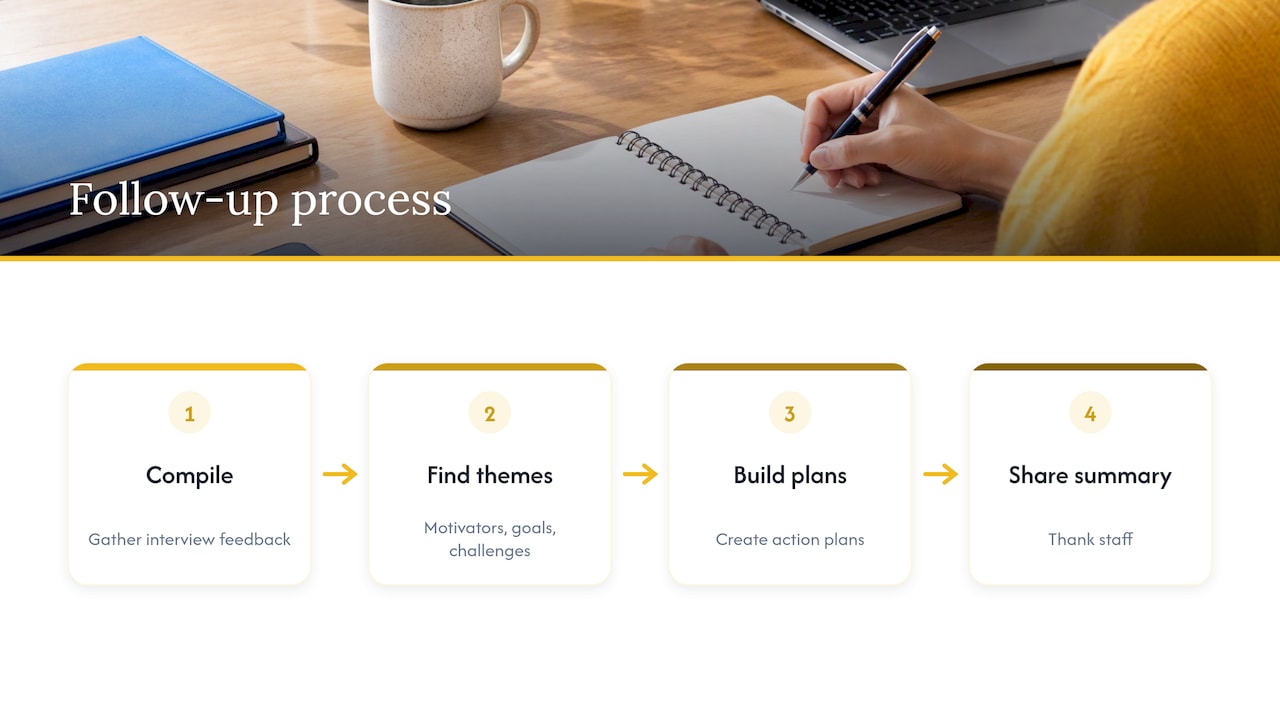
The University of Michigan’s stay interview guidance describes the follow-up in four steps: compile the feedback, look for common motivators, goals and challenges, build action plans, and share a summary with staff while thanking them. Here is that process for a trade company.
1. Write it up the same day
Capture the person’s motivators, concerns, ideas and any commitments you made. Keep these notes private and share only what the employee agrees to.
2. Build a stay plan for each person
The LA County guide recommends individual Stay Plans: a short list of things you will do to reinforce what keeps this person, and to reduce what could drive them out. For example:
- Technician who wants to move into sales: ride-along with a comfort advisor within 60 days.
- Dispatcher overwhelmed by after-hours calls: review the on-call process with the service manager this month.
- Installer frustrated by incomplete job packets: add a pre-job checklist for install managers.
Assign an owner and a date to every action.
3. Look for patterns across the company
One person’s complaint is an issue. Five people describing the same thing is a system problem. Common patterns in trade businesses include unclear career paths, inconsistent scheduling, parts and truck stock issues, uneven recognition and managers who were promoted for their technical skill but never trained to lead.
4. Close the loop out loud
SHRM’s article on maximizing employee engagement advises leaders to tell employees how changes relate to their feedback so they know they were heard. At a team meeting, say “Three of you told us job packets were missing information, so starting Monday here’s what is changing.” You do not need to name names.
5. Check back
The LA County guide advises managers to watch for signs of improved satisfaction and to check periodically whether a stay plan is working. Put a 60-day follow-up on the calendar. Ask: “Last time you mentioned X. Is it better?”
Mistakes that kill the process
- Letting it turn into a review. If you start discussing performance numbers, the candor is gone.
- Interviewing only your stars. Stay interviews are useful for solid middle performers too, who are often the ones quietly looking around.
- Using HR or an outside party for everything. The person who can fix the problem has to hear it.
- Skipping the follow-up. This is the main reason employees stop being honest the second time.
- Asking managers to run them without practice. A manager who has never done one will often over-talk. Role-play a few questions first.
- Treating a stay interview as a retention guarantee. It is a way to learn and act. Pay, hours and workload still have to be competitive.
Perspective: stay interviews are a symptom check on your systems
We work only with trade businesses: HVAC, plumbing, electrical, roofing, remodeling and siding. What we see over and over is that people rarely leave a trade company because of one bad day. They leave because the systems around them are weak. Dispatch sends them on poorly scoped calls, no one knows their numbers, promotions go to the best technician rather than the best leader, and nobody follows through when they raise a problem.
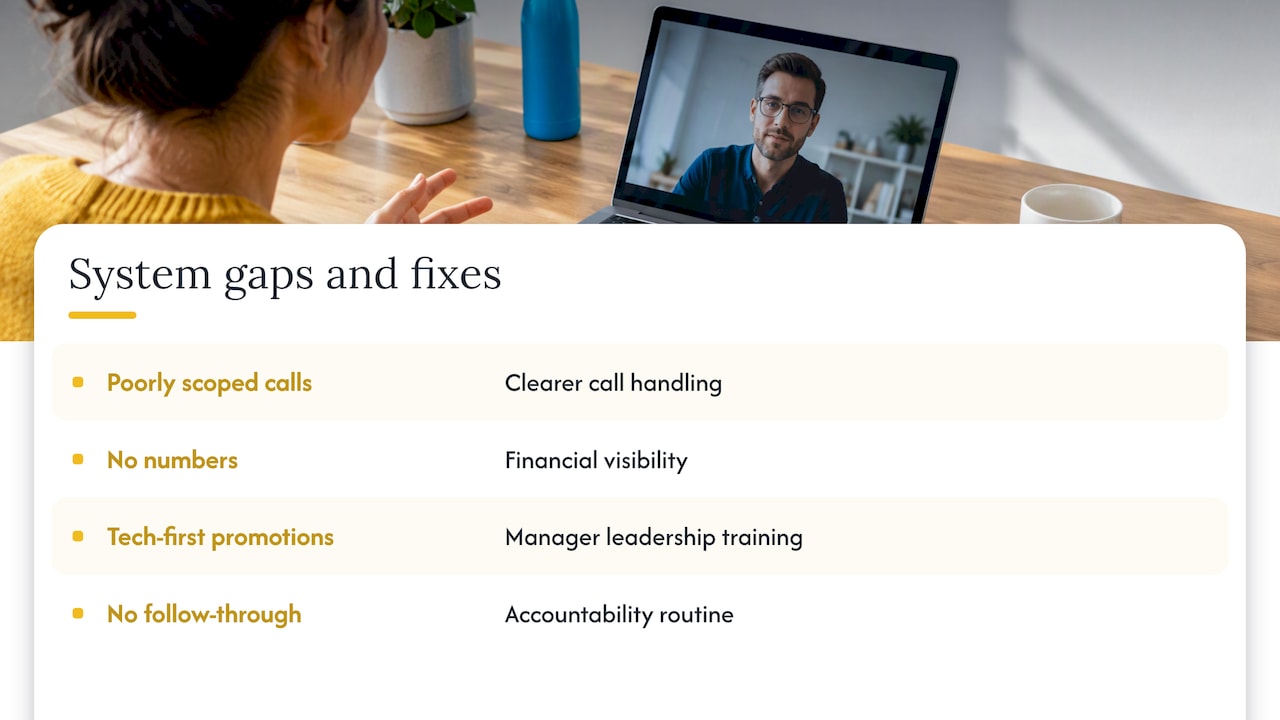
A stay interview is a good first diagnostic because it shows you where those weak spots are, in your employees’ words. Owners often find that the same two or three themes come up in nearly every conversation. When that happens, the answer is almost never another pep talk. It is a process: clearer call handling, a real accountability routine, training for the managers who run the crews, and financial visibility so people understand how the company makes money.
Our advice: run stay interviews with your managers first. If your managers tell you they do not have the tools or training to lead, then asking them to interview their crews will just surface problems they cannot fix. Fix that layer first, then cascade.
— Dan
When stay interviews point to a bigger operations problem
Sometimes the conversations reveal things that a better meeting cannot solve: chaotic dispatch, managers without leadership training, unclear pay-for-performance, no visibility into job profitability. These are operational problems, and they take structure to fix.
That is the work we do at Rebuilding the Trades. Our Rebuild program and training services include management and leadership training, call management and dispatch training, sales training, install and project management training, financial operations support and marketing analysis, all built for trade businesses and delivered hands-on. If your stay interviews keep turning up the same systemic issues, take a look at how we work with owners.
A simple one-page stay interview plan
If you want to start this week, here is the minimum:
- Pick your three most important people and block 30 minutes with each in the next two weeks.
- Choose five questions from the list above. Print them.
- Send a short heads-up message explaining the purpose.
- Run the conversations, listen for 80% of the time and take notes.
- Write a stay plan for each person with dates and owners.
- Share one visible change with the wider team within 30 days.
- Put the next round on the calendar, then train your managers to run theirs.
Start small, do it well once, then expand. A modest program that follows through beats a company-wide rollout that stalls.
FAQ
What is the difference between a stay interview and an exit interview?
A stay interview is held with a current employee to find out what keeps them and what could make them leave, so you can act in time. An exit interview happens after someone has decided to go, and it can only teach you lessons for the future. Stay interviews are usually run by the direct supervisor, while exit interviews are often run by HR.
How often should a contractor hold stay interviews?
At minimum once a year with every employee. Many employers add quarterly conversations with key people and one within the first 14 days of a new hire. Use extra rounds after major changes, such as a new pay plan or a change in management.
What are good employee stay interview questions?
Start with what the person looks forward to at work, what they are learning or want to learn, why they stay, when they last thought about leaving and what you could do to make the job better. Follow up with “tell me more” to draw out details. Keep the questions the same across employees so you can spot patterns.
Should the owner or a manager conduct the interview?
The employee’s direct supervisor should ask the questions, because that person can actually change schedules, assignments and training. In a small company the owner will often run them with managers, then let managers talk to their own teams. Cascade from the top so leaders experience the process first.
What if an employee says something I cannot fix?
Say so honestly, explain why, and offer what you can do instead. Not every request can be granted, but people respect a clear answer more than silence. Follow up on the items you did commit to.
Sources
- County of Los Angeles Stay Interview Guide (2024)
- Stay interviews give employers and employees valuable talk time, Contracting Business
- Before It’s Too Late: The Stay Interview, SHRM
- How to Conduct Stay Interviews: 5 Key Questions, SHRM
- How to Conduct Stay Interviews: 5 Key Questions, SHRM (MENA edition)
- Stay Interviews Guidance, University of Michigan
- Rethinking Maximizing Employee Engagement, SHRM
- Leading on Purpose, Contracting Business
- JOLTS Table 4: Quits levels and rates by industry, BLS
0 Comments