
An on-call rotation policy is a written agreement between you and your technicians. It says who answers after-hours calls, when, how fast, what they are allowed to do, how they get paid and who steps in when the first person fails. If you run an HVAC, plumbing or electrical company, write it down before the next heat wave or hard freeze. Without it, your best tech ends up on call every weekend by default, and you find out when he quits.
This guide shows what to put in the policy, how to build a schedule that holds up, and where the pay rules in the US can bite you.
TL;DR
- A good policy defines coverage hours, response times, scope of work, dispatch authority, pay and escalation in one page your techs can actually read.
- Use a primary and a backup every night, with a clear path to the dispatcher or owner if nobody acknowledges the call.
- Under the federal wage rules, on-call time is paid or not depending on how much the restrictions limit the employee’s freedom. Check your state’s rules too.
- Track nights, weekends, holidays and accepted calls per tech, then adjust. Fair does not have to mean identical.
- Finish every on-call night with a morning handoff so after-hours jobs land in the daytime workflow.
Table of Contents
- What an on-call rotation policy has to cover
- The pay question: is on-call time paid in the US?
- Build the rotation: schedule types and a worked example
- Calls, escalation and backup: the HVAC version
- Morning handoff: where after-hours calls usually get lost
- Protect your team from burnout
- Perspective: what we see when we audit trade companies
- Get help building your policy
- A one-page template to adapt
- FAQ
- Sources
What an on-call rotation policy has to cover
Most policies that fail are not too strict or too loose. They are vague. A trade-service policy should define coverage hours, response promises, scope of work and dispatch authority. Here is what that looks like in practice.
Coverage hours
Decide whether you offer true 24/7 emergency service or an after-hours window, say 5 p.m. to 8 a.m. on weekdays plus weekends and holidays. Write down which holidays count. Name the start and end time of a shift, including the exact hand-off minute. “Monday morning” is not a time.
Response promises
Separate two clocks. The first is time to answer: how fast the on-call tech must acknowledge a call or page. The second is time on site: how fast they must arrive. Many owners set a fifteen-minute acknowledgment and a window of one to two hours for arrival, but the numbers should come from your market, your service area and your pay. Write them as your own standard, not as an industry rule.
Scope of work
Decide what the on-call tech is there to do. Stabilize the situation (shut off water, make a furnace safe, restore a dead panel) and schedule the repair for daylight, or complete the repair on the spot? Techs who are unsure will either overreach or under-deliver. A short list of examples removes the guessing.
Dispatch authority
Spell out what the tech can decide alone: whether to roll a truck, whether to waive a diagnostic fee, whether to call in a second person, whether to turn a job down. Also say who they call when they are over their head. Those decisions are what you are really paying a premium for.
Eligibility and distance
A reasonable policy also lists who is eligible: required licenses and certifications, and a limit on how far from the service area the tech can be during their shift. Public works templates include both, along with compensation details such as stipends, callback pay and how remote troubleshooting is paid. Apprentices and new hires usually shadow a rotation before joining it.
The pay question: is on-call time paid in the US?
This is the part owners guess at and regret. Federal guidance from the Department of Labor says an employee required to remain on call on the employer’s premises is working, while one who is on call at home, or free to leave a message where they can be reached, is generally not working. The same page notes that additional constraints on the employee’s freedom could require the time to be paid.
What does that mean for a tech carrying the on-call phone?
- Light restrictions. The tech can go to dinner, run errands and has no tight response window. Waiting time is usually not counted as hours worked. Time spent actually answering calls and driving is.
- Heavy restrictions. A very short arrival window, a required stay within a few minutes of the shop, or such frequent calls that the tech cannot use the time for personal purposes can make the waiting itself compensable. One summary of employment guidance makes the same point: whether on-call time is compensable depends on the restrictions placed on the employee.
- Actual work. Phone troubleshooting, driving to the job, the repair and the drive home count as hours worked, and they count toward overtime for hourly techs.
Many states and some cities have their own rules on call-in pay, reporting-time pay and predictive scheduling that go beyond the federal baseline. Ask your employment attorney or state labor department before you finalize pay terms. If you also hire outside the US, note that countries differ widely: EU rules, for example, can treat on-call time as working time when restrictions significantly limit personal time, and national law varies.
Pay structures owners actually use
The policy should state the structure in plain numbers. Common building blocks:
- A flat on-call stipend per night, per weekend or per week, paid whether or not the phone rings.
- Callback pay, a guaranteed minimum number of paid hours once the tech is dispatched.
- Premium rates for holidays or for hours after a set time of night.
- Pay for remote troubleshooting, so a twenty-minute phone fix is not treated as free.
- Comp time or a day off after a long night, within whatever your state’s wage rules allow.
Pick amounts that match your market and margins. We do not publish a universal number because there is not one: what a tech in a cold-climate metro expects is not what a tech in a mild market expects.
Build the rotation: schedule types and a worked example
A rotation decides who responds. A schedule decides when. You need both, and you need them written down and shared well ahead of time.
Common patterns for small trade teams
| Pattern | How it works | Best for | Watch out for |
|---|---|---|---|
| Weekly rotation | One tech holds the phone for seven days, then hands off | Teams of four or more with moderate call volume | A heavy week can wreck a tech’s family life |
| Weeknight and weekend split | Separate people cover Monday to Thursday nights and Friday to Sunday | Teams where weekends are the real burden | Holidays need their own plan |
| Daily rotation | A different tech each night | High volume, larger teams | Constant handoffs, more room for dropped calls |
| Primary and backup pairs | One lead, one backup, rotating on a set cycle | Seasonal peaks, any size team | Backup needs a clear trigger for being called |
| Department-based | HVAC, plumbing and electrical each run their own rotation | Multi-trade companies | Small departments burn out faster |
If you want a person who is asked about “a typical on-call schedule,” the honest answer is that one week on, then several weeks off is the most common pattern for small teams. The right number of off-weeks depends on how many qualified techs you have, and it is the number of eligible techs, not your preference, that decides it.
A worked example
Say you have six eligible HVAC technicians and want weekly coverage with a backup:
- Weeks 1 to 6: each tech takes one week as primary.
- The backup for each week is the tech who was primary the week before, because they know the open issues.
- Each tech is primary one week in six, and backup one more week in six. That is roughly one-third of weeks carrying some responsibility.
- Holidays are pulled out and assigned by a separate list, so the same person does not always get Christmas.
- The schedule for the next eight weeks is published at least two weeks before the first shift, and swaps are allowed if both techs and the dispatcher agree in writing.
With only three eligible techs, the same pattern puts everyone on call every third week with no real recovery. That is the signal to train more people into the rotation, not to squeeze harder. Our training playbook for contractors covers how to build that bench.
Fairness is something you measure
Fair does not mean everyone gets the same exact count. A tech who lives close to the shop or asks for extra weeks for the money is a different case from one who is stuck with every holiday. The practical approach is to track descriptive numbers such as assigned nights, weekends, holiday blocks and accepted calls, and then look into the differences rather than forcing a rigid equal target.
A simple sheet works: one row per tech, one column per metric, reviewed monthly. If you already run jobs and crews through software, a construction task management guide shows how to keep workload visible across people, so on-call load does not hide behind daytime assignments.
Calls, escalation and backup: the HVAC version
An HVAC on-call policy lives or dies on what happens in the first ten minutes of a call. At minimum, define these steps:
- Screen the call. Whoever answers, an answering service, a dispatcher or the on-call tech, separates hazards from routine requests. A gas smell, carbon monoxide alarm, sparking panel or active leak is a different priority than a warm house at 9 p.m. Per one guide for home service teams, a policy should do this screening before dispatching.
- Dispatch the primary. The primary acknowledges within your stated window.
- Escalate if there is no answer. If the primary does not acknowledge, the call goes to the backup, then to the dispatcher or owner. One contractor handoff checklist uses this exact order and reviews missed handoffs the next morning.
- Decide the scope. The tech stabilizes, repairs or schedules, as your policy describes, and tells the customer what happens next.
- Close the loop. Notes go into your system before the tech sleeps, not three days later.
Safety situations deserve one more sentence in the policy: gas leaks and carbon monoxide alarms go to the gas utility or emergency services first, and techs are told they never have to take a risk to hit a response time.
Borrow a structure from incident response
Software operations teams have been solving the same problem for years. Google’s SRE guide to incident management centers on three actions, coordinate, communicate and control, with clear roles so urgent situations do not turn into chaos. For a trade company that translates simply: one person runs the call (the tech), one person coordinates resources (the dispatcher or backup), and one person is told what is going on (the customer, and the owner if it is big).
Morning handoff: where after-hours calls usually get lost
An emergency that was fixed at 2 a.m. often leaves loose ends: a part that needs ordering, a customer who needs a callback, an estimate for a replacement. If those live only in the tech’s head or texts, they disappear. A good policy requires a structured morning handoff that moves after-hours incidents into the daytime CRM so unresolved items are assigned to someone on the day team.
Keep it to five minutes:
- Every call received overnight, with outcome
- Jobs completed and jobs left open
- Parts, permits or follow-up visits needed
- Customer promises made (arrival windows, discounts)
- Any call that was missed or escalated, and why
Repeat callbacks are one of the costliest after-hours problems, because rushed night fixes come back. Our guide to HVAC callback reduction shows how to cut them.
Protect your team from burnout
On-call is a retention issue. Techs rarely quit over one bad night; they quit after months of unpredictable weekends. A few controls keep the load healthy:
- Cap frequency. Decide the maximum weeks or weekends per quarter a tech can be primary.
- Give recovery. After a night with a long call-out, let the tech start late or take comp time, subject to your wage rules.
- Measure the load. Borrowing from engineering on-call practice, look at pages per shift, share of off-hours calls, time to acknowledge and how often backup or escalation is triggered. Translate that to calls per night, after-midnight calls and backup activations.
- Forecast peaks. Brutally hot or cold weeks need more people. Use labor forecasting to decide when to add a second backup or temporary staff.
- Ask them. A stay interview with your best techs will tell you quickly whether the rotation is a problem.
Perspective: what we see when we audit trade companies
We work only with trade businesses, and on-call policy is one of the first things that shows us how a company is really run. When an owner tells us “we just rotate whoever’s available,” we usually find the same cluster of issues: no written response standard, a dispatcher who does not know who is on call, no overtime tracking tied to after-hours work, and the two or three most reliable techs carrying most of the load.
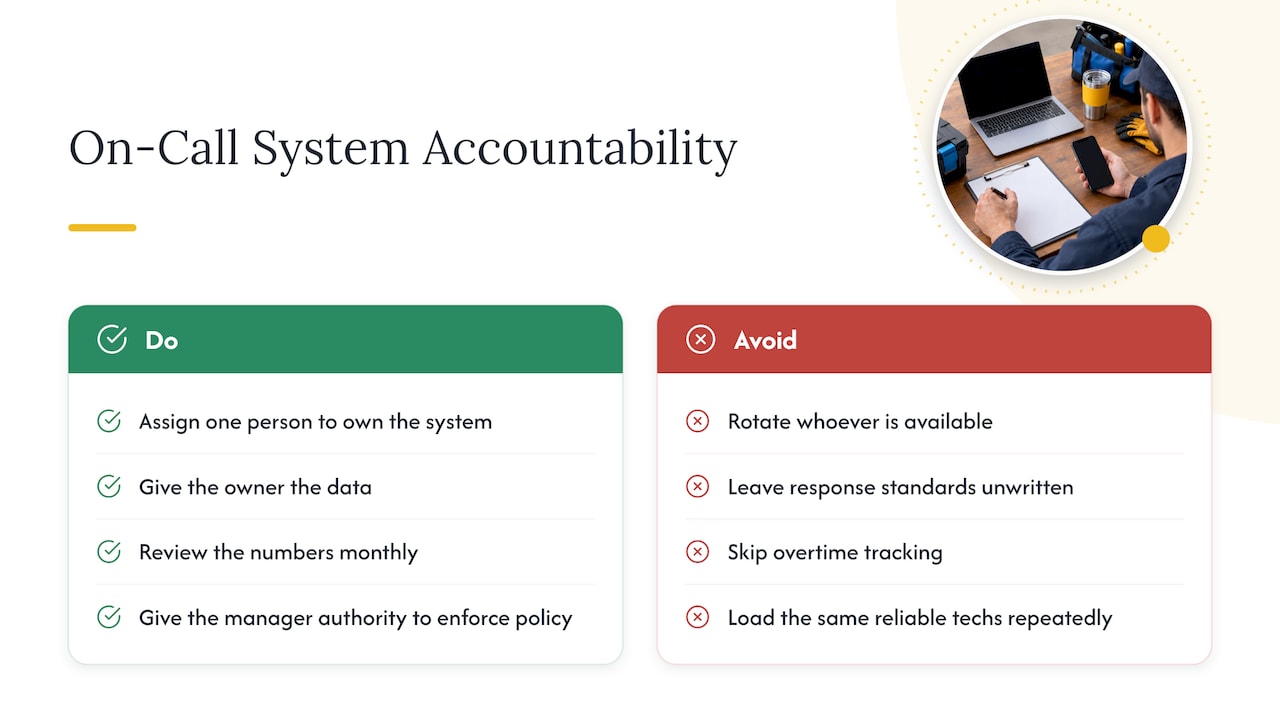
That is not a scheduling problem. It is a leadership and systems problem, and the schedule is just where it becomes visible. Our approach is hands-on: we look at the actual call data, sit with dispatch, and talk to the techs, then build a policy and accountability system the company can run without us. A written policy only works if a manager owns it, reviews the numbers and has the authority to hold people to it, including the owner.
If you take one thing from this article, make it this: pick one person who owns the on-call system, give them the data, and review it every month. Everything else, the pay, the pattern, the escalation chain, is easier to fix once someone is accountable.
— Dan
Get help building your policy
If you would rather not build this alone, our Rebuild program is hands-on operational consulting for HVAC, plumbing, electrical and other trades. It includes call management and dispatch training, management and leadership training, and financial operations support, which are the pieces an on-call policy depends on.

If your on-call burden is really a symptom of too few leaders or unclear roles, our piece on a 90-day leadership pilot for contractors is a good next step. To see what on-call costs against revenue, start with contractor financial reporting.
A one-page template to adapt
Copy this outline into a document and fill in your own numbers with your attorney:
- Purpose. Why we offer after-hours service and what we promise customers.
- Coverage. Hours, days, holidays, service area.
- Eligibility. License, experience, distance from the service area, vehicle and phone requirements.
- Schedule. Pattern, length of shift, how far ahead it is posted, how swaps work.
- Response standards. Time to acknowledge, time on site, priority levels.
- Scope and authority. What the tech can do and decide alone.
- Escalation. Primary, backup, dispatcher, owner, with phone numbers and time limits.
- Pay. Stipend, callback minimum, premiums, remote troubleshooting, overtime handling.
- Rest. Maximum frequency and recovery after long call-outs.
- Handoff and review. Morning notes, monthly fairness and load review, annual policy update.
Have every tech sign it, and revisit it after your first busy season.
FAQ
What is a typical on-call schedule for a small trade company?
Most small teams use a weekly rotation with a primary and a backup. With six eligible techs, each is primary about one week in six. Fewer than four eligible people usually means the rotation is too tight, so train more techs into it.
Do I have to pay technicians for on-call time?
Not always for the waiting itself. Federal guidance says time spent on call at home, with freedom to leave a message, is generally not working time, but heavy restrictions can change that. Time actually worked is always paid. Check your state’s rules and confirm with an employment attorney.
What on-call best practices matter most?
Publish the schedule well ahead, keep a named backup, define the escalation chain, pay clearly, and run a morning handoff. Then track nights, weekends and calls per tech so you can fix unfairness before it costs you someone.
How should an HVAC on-call policy handle emergencies?
Screen calls to separate safety hazards from routine comfort issues, dispatch the primary, and escalate to backup and then a manager if there is no acknowledgment. Gas leaks and carbon monoxide alarms go to the utility or emergency services first.
Sources
- Fact Sheet #22: Hours Worked Under the FLSA, US Department of Labor
- Google SRE incident management guide
- EU parliamentary document on working time and on-call
- On-call rotation for plumbing and HVAC crews
- Public works on-call policy template
- On-call policy for HVAC technicians and plumbers
- After-hours on-call plan for small trade teams
- On-call rotation and phone coverage for home service teams
- Contractor on-call rotation handoff checklist
- On-call and operational readiness
- Construction task management guide
0 Comments