
A job is not finished when the crew drives away. It is finished when the customer has accepted the work, you hold every record you need, the final invoice is issued and paid, and the file is closed. This job closeout checklist walks a trade contractor through that sequence, from the last day on site to the lessons-learned review, with an owner and a deadline for every task.
TL;DR
- Closeout starts when the job starts. Collect permits, warranties and change orders as you go, not in a scramble at the end.
- Run the checklist in five blocks: scope verification, punch list, documents and handover, money, and review.
- Every line needs one named owner and a due date. A checklist with no owners is a wish list.
- The job is not over until final payment lands, so keep the billing steps on the same list as the field steps.
- Check the contract, the permit authority and any public specification for extra closeout rules before you promise a date.
Table of Contents
- What closeout means and when to start it
- The job closeout checklist at a glance
- Step 1: Verify the sold scope and approved changes
- Step 2: Build a punch list people can actually close
- Step 3: Test, commission, clean up and walk the customer through
- Step 4: Collect the documents and handover materials
- Step 5: Reconcile the money before the final invoice
- Step 6: Give every task an owner and a deadline
- Our perspective: closeout is a leadership problem, not a paperwork problem
- Review the job after it closes
- Requirements that change by contract, location and job type
- Make closeout a system in your shop
- FAQ
- Sources
What closeout means and when to start it
Closeout formally completes the project and passes ownership to the client. It covers the administrative and physical tasks needed to meet your contractual obligations, according to Procore’s closeout guide. The same guide makes the point that effective closeout begins at the project’s inception so documentation, warranties and permits are gathered along the way.
There is a second reason to treat it seriously. Project closure marks the point where risk moves from the contractor to the owner, and the job does not end until final payment is received. Until then you carry exposure on work you consider done.
Closeout is also where jobs quietly stall. A 2022 analysis of 39 projects reported in a Buildr closeout guide found an average closeout length of 284 days, plus another 247 days from final payment to internal completion. Those are larger construction projects, not a water heater swap. Still, the pattern is familiar to any owner with a pile of “almost done” jobs: the last 5 percent of the work holds up the last 20 percent of the cash.
For a residential service or replacement job, closeout may take a day or two. For a remodel, a roofing job with permits, or a commercial electrical install, it can run for weeks. The checklist below scales: skip lines marked as not applicable, but record that you skipped them.
The job closeout checklist at a glance
Use this as the one-page version. The sections after it explain each block.
| Block | What to confirm | Typical owner |
|---|---|---|
| 1. Scope | Work matches the sold scope and approved changes | Project manager or lead tech |
| 2. Punch list | Every item has a location, an owner and a date | Project manager |
| 3. Testing and handover | System tested, customer walked through, site cleaned | Lead tech or installer |
| 4. Documents | Permits, inspections, photos, warranties, signed acceptance | Office or contracts admin |
| 5. Money | Job costs reconciled, change orders billed, final invoice sent, subs paid | Office manager or bookkeeper |
| 6. Archive and review | File stored, lessons learned logged | Owner or operations manager |
The owner column is a suggestion. A one-truck shop may have one person in every row. A 40-person company should not.
Step 1: Verify the sold scope and approved changes
Start by comparing what was installed or repaired with what was sold. A closeout guide from Urbld puts this first in its sequence: verify the sold scope and approved changes before anything else.
In practice:
- Pull the signed estimate, quote or contract.
- Pull every change order, with the signature or written approval attached.
- Walk the job against both documents. Note anything sold but not done, and anything done but not sold.
- Decide, before the customer does, how each gap gets resolved: finish it, credit it, or bill it with approval.
The AIA Contracts guidance adds a useful discipline: separate contract work from enhancements the owner requested along the way. A customer who asked for an extra outlet or a relocated cleanout has changed the scope. If that change is not on paper, it will show up later as a dispute over the final invoice.
Step 2: Build a punch list people can actually close
The punch list is where most closeouts stall. CMiC observes that punch list quality directly determines closeout speed: vague entries cause delays, while location-specific items with clear owners get resolved fast.
Compare:
- Weak: “Fix drywall.”
- Strong: “Patch and paint the drywall at the thermostat relocation, hallway wall by the master bedroom. Owner: Marcus. Due: Friday.”
A punch list should carry four things per line: where, what, who, and by when. If you want an example of how specific entries shorten the road to final payment, this guide to well-written punch list items shows how clear items help catch problems before they block final sign-off.
Two habits keep the list short:
- Walk the job yourself before the customer does. Anything you find is a fix. Anything the customer finds first is a complaint.
- Do not let the crew leave until the list exists in writing. Crews forget; photos and notes do not.
Step 3: Test, commission, clean up and walk the customer through
A trades job-completion checklist should cover testing and commissioning, site cleanup, customer confirmation, and the certificates, photos and notes you need for invoicing. The point is to cut callbacks and standardize the evidence that the work was done right.
For the field crew, that means:
- Test and record. Run the system, note readings or results, and photograph the final state. For HVAC this is your startup and commissioning data; for plumbing, pressure and leak tests; for electrical, panel labeling and test results.
- Clean the site. Remove debris, protect floors, and leave the work area better than you found it. Customers remember this more than the invoice.
- Demonstrate. Show the customer how the system operates where it applies, and give maintenance recommendations, as a field QA checklist lists it.
- Confirm completion. The customer should know the job is done. Silence is not acceptance.
Callbacks often trace back to skipped steps in this block. If that is a pattern in your shop, our HVAC callback reduction guide goes deeper on the causes and fixes.
Step 4: Collect the documents and handover materials
What goes in the closeout file depends on the job, but a solid baseline for trade work looks like this, based on a contractor handoff checklist:
- The approved estimate, quote or contract
- Approved change orders
- Photos of the finished work
- Product details (models, serial numbers)
- Permit, inspection or compliance notes, when they apply
- Final invoice and payment history
- Warranty and care instructions
- Customer approval or signature
For service work, a one-page job sheet is often enough. One 2026 template guide suggests eight fields: business details, customer information, job number and date, timestamps, a checklist of completed work, materials used, follow-up notes, and the customer signature.
Larger jobs need more
On commercial and public work, expect a longer list. A public-sector closeout checklist from MRSC calls for sending as-built drawings to a consultant to develop record drawings, filing digital and hard-copy records, holding an O&M handoff meeting, and separately tracking spare parts, keys or other owner-provided items, and a warranty binder.
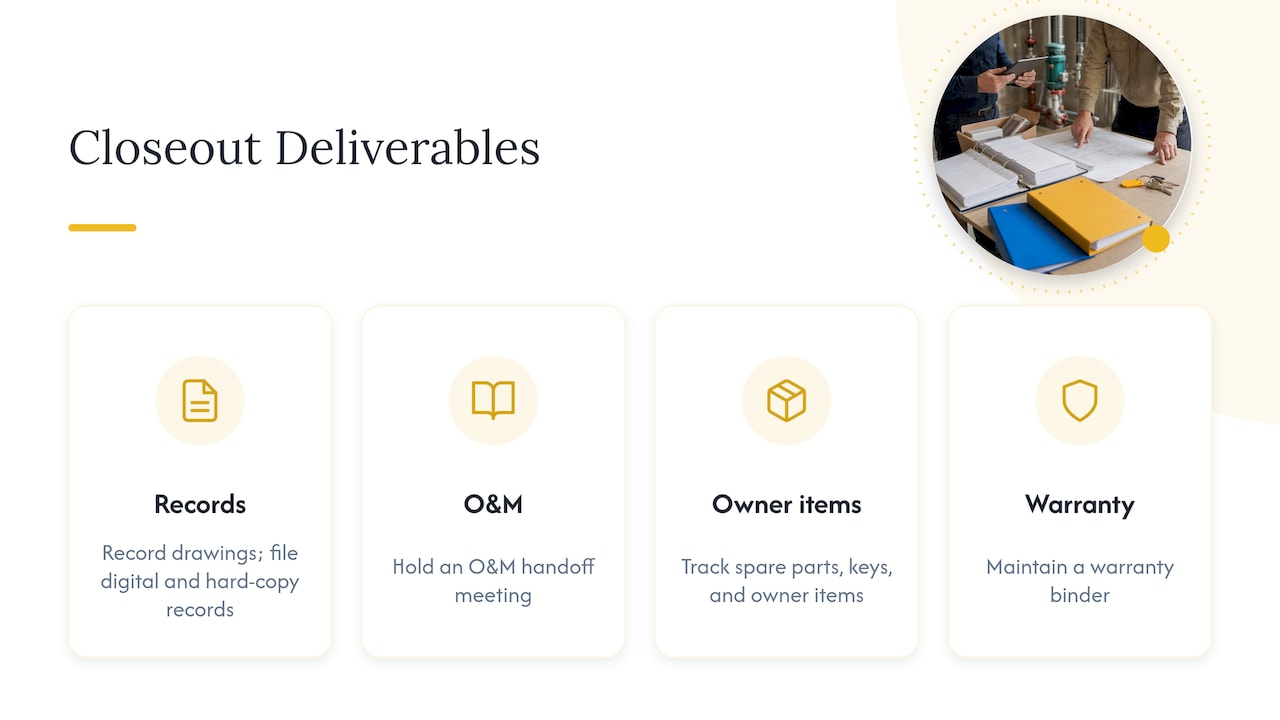
Why bother? Incomplete records can lead to warranty disputes, deferred maintenance failures and higher facility costs for the owner. They also come back to you as callbacks and arguments about who is responsible.
A word of caution on checklists themselves. The INGAA Foundation stresses that a checklist is not an end in itself: the completion documents behind each check need real verification. A box ticked without a document in the file is worse than a blank box, because it looks like proof. If you want a project-manager-level view of who owns which closeout document, this construction checklist guide for project managers lays out responsibilities and final completion requirements.
Step 5: Reconcile the money before the final invoice
This is the block owners most often under-manage, and it is where closeout turns into cash.
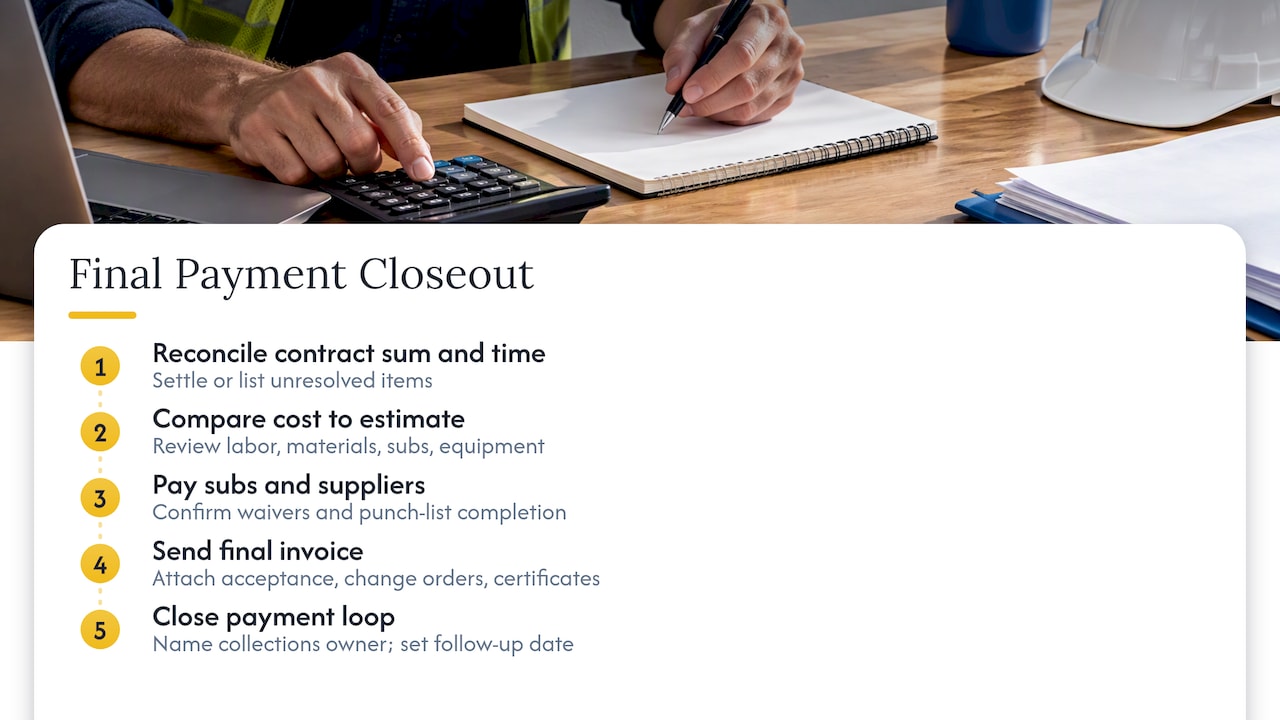
Reconcile the contract sum and time. Before the final payment package goes out, the AIA guidance says to confirm executed change orders and identify anything unresolved: proposals, claims, allowances, credits, back charges and disputed work. Settle each one or list it plainly.
Compare actual job cost to estimate. Pull labor hours, materials, subcontractor costs and equipment. Inconsistent cost codes during the job force manual reconciliation at the end, which delays final payment and retainage release. If your coding is messy, the closeout is where you feel it. Our guide to contractor financial reporting covers what to track so these numbers are ready when the job ends.
Pay your subs and suppliers properly. Holding retainage longer than necessary damages subcontractor relationships. Before you release it, confirm lien waivers are accepted and assigned punch-list items are complete.
Send the final invoice. Attach the signed acceptance, approved change orders and any required certificates. Record warranty terms on the invoice or in the handover packet so the customer has them in writing.
Close the loop on payment. Since project risk only fully transfers at final payment, put a follow-up date on the invoice. Someone owns collections, by name.
A simple closeout money check
Before sending the final invoice, answer yes to each:
- Does the invoice total equal the contract plus approved changes?
- Is every change order signed?
- Are all supplier and subcontractor invoices in and coded to the job?
- Are lien waivers collected where your contract or local practice requires them?
- Is the signed acceptance attached?
One “no” means the invoice waits a day. That is cheaper than a disputed invoice waiting a month.
Step 6: Give every task an owner and a deadline
The public checklist from MRSC assigns tasks to the project manager, contracts administrator and administrative assistant, and records each task as complete or not applicable. That structure is worth copying at any size: no blank lines, and every row ends in a clear status.
The AIA guidance also recommends progressive due dates for closeout documents rather than one deadline at the end. For a trade company, that could look like:
- Day of completion: tests recorded, photos uploaded, customer walkthrough done
- Within two business days: punch list written and assigned
- Within one week: documents filed, final invoice drafted
- Within two weeks: final invoice sent, warranty packet delivered
Adjust those intervals to your job size. The principle is that each step has a date before the next one begins.
Our perspective: closeout is a leadership problem, not a paperwork problem
We work only with trade businesses, and the pattern repeats: owners rarely lack a checklist. They lack someone who is accountable for finishing. The checklist sits in a binder or an app, the tech says the job is done, the office does not know it is done, and the invoice goes out three weeks late with a missing change order.
That is an operations gap, not a knowledge gap. Three things close it:
- A named owner for the whole closeout, not just for each task. Someone has to be able to say, today, which jobs are open and why.
- Numbers that expose the backlog. If you cannot see completed-but-unbilled jobs, or how long jobs sit between “done” and “paid,” closeout will never feel urgent. This is the financial visibility problem we see in many shops.
- Managers who hold the line. A checklist works when a lead can say “this job is not closed” and the crew respects it. That takes training and backing from the top. Our guide to stay interviews and our work on building a leadership pipeline both come from that same point.
Make the checklist short enough that people use it, strict enough that it means something, and visible enough that the owner sees every open job once a week.
— Dan
Review the job after it closes
Closing the file is not the end of the learning. The AIA guidance recommends assigning each lessons-learned improvement to a template, a process owner and a deadline. Without that, “lessons learned” becomes a meeting that changes nothing.
A 20-minute review per significant job is enough. Ask:
- Did we finish on the sold scope, or did changes pile up without paperwork?
- Which punch-list items could the crew have caught before leaving?
- How many days passed between completion and final invoice? Between invoice and payment?
- Was actual cost close to the estimate? If not, where did it drift?
- Did the customer receive their warranty and care information?
Turn each answer that points to a fix into an action: update the template, change the estimating assumption, add a line to the field checklist. Then assign an owner and a date. If the fixes are training issues, our training playbook for contractors shows how to build them into onboarding and ride-alongs.
Requirements that change by contract, location and job type
No universal checklist replaces your contract. Closeout rules shift with the customer, the permit authority and the delivery method.
- Public and institutional work often adds specification sections on closeout. One county specification, Section 01700 Contract Closeout, makes the contractor responsible for reinspection costs beyond the first reinspection at substantial completion, deducted from final payment. Read the equivalent section before you bid.
- Substantial completion is not final completion. The AIA guidance advises against treating them as the same and says to keep final inspection and payment requirements visible after substantial completion.
- Permitted work needs inspection sign-offs in the file. Ask your local building department what it issues at final and how you obtain copies.
- Residential service work can run on a lean job sheet. Larger remodels and commercial installs need as-builts, O&M material and a warranty binder.
When in doubt, ask the customer or general contractor at the start what their closeout package requires, and put the answer in the job file on day one.
Make closeout a system in your shop
If your jobs finish in the field but linger in the office, the fix is rarely a better template. It is clear ownership, visible numbers and managers who enforce the process. That is the work we do with trade owners: onsite audits, accountability systems, KPI and reporting setup, and training for the people who run the jobs. Our Rebuild program covers sales, management and leadership, install and project management, call management and dispatch, financial operations and compliance support, and marketing analysis, all built for trades rather than adapted from generic templates.

If closeout is where your cash and your reputation leak, start with an honest look at how jobs actually move from “done” to “paid” in your company.
FAQ
What is the difference between a job closeout checklist and a project closeout checklist?
In practice they are the same tool at different scales. “Job” usually describes a single service call, install or remodel, while “project” suggests a larger, multi-phase build. The blocks are the same: scope, punch list, documents, money and review. Larger projects just add more documents and more sign-offs.
When should I start closeout on a job?
At the start. Effective closeout begins at the project’s inception so warranties, permits and change orders are collected as you go, as Procore’s guide explains. Formal closeout steps, such as the punch list walk and final invoice, begin as the work nears completion.
Who should be responsible for closeout in a small trade company?
One person should own the whole process, even if several people complete tasks. In a small shop that is often the owner, an office manager or a project lead. Each task on the list still gets its own owner and date, and the status is complete or not applicable, never blank.
What documents should the customer receive at handover?
At minimum: warranty and care instructions, product details, a copy of the final invoice, and any permit or inspection records that apply. Larger jobs may add as-built or record drawings, O&M material and a warranty binder. Keep a signed copy of the customer’s acceptance in your own file.
Can I close a job before the final payment arrives?
Operationally you can complete the work, but the job is not truly closed until payment is received, since risk transfers to the owner at that point. Keep the job in a “closed, awaiting payment” status with a named person following up.
Sources
- The Construction Closeout Process Explained, Procore
- Project Management Best Practices on Electrical Job Sites, EC&M
- Construction Contract Closeout: 7 Best Practices, AIA Contracts
- Construction Project Closeout Checklist: A Guide, CMiC
- Job Completion, Invoicing and Close-Out, Urbld
- Job Completion Checklist for Trades, Wikidoc
- Field QA Inspection Checklists
- Contractor Project Handoff Checklist, QuoteAnvil
- What to put on a job sheet, Clara
- Construction Project Closeout Checklist, Port of Everett (MRSC)
- Guidelines for Practical Implementation, INGAA Foundation
- Section 01700 Contract Closeout, Taylor County
- Successful Project Closeout: The Comprehensive Guide, Buildr
0 Comments