
Training ROI for a contractor is the net financial gain from a training program divided by what the program cost you, expressed as a percentage. The formula takes one line. The hard part is deciding what goes into each side: the real cost of pulling techs off the tools, and the gains you can honestly trace back to the training. This guide covers the formula, a worked example with trade-shop numbers, the metrics that connect learning to results, and when to measure.
TL;DR
- Training ROI = (net benefits − training costs) ÷ training costs × 100. Count paid time off the tools as a cost, not just course fees.
- Benefits worth tracking in a trade business: callbacks, rework, billable hours, retention and injuries. Put a dollar figure on each before training starts.
- Industry research suggests $1.30 to $3.00 of benefit per training dollar in craft training. Treat that as a reference range, not a promise for your shop.
- Check whether the learning shows up in the field at 90 days or later. Happy attendees on day one prove nothing.
- If a result looks great only because you ignored costs or credited training for everything, the number is wrong.
Table of Contents
- What ROI means when you train contractors
- The training ROI formula
- Count the full cost, including time off the tools
- Which benefits to count
- A worked example
- What is a good ROI for a training program?
- Training effectiveness metrics that connect learning to money
- When to measure
- Handling attribution and indirect benefits
- Our perspective: training fails more often at the follow-up than in the classroom
- Where we can help
- A short checklist before you approve any training spend
- FAQ
- Sources
What ROI means when you train contractors
ROI compares the benefit of a program with the resources you put into it over time. According to NCCER’s 2025 report on training and performance, it is a way to judge whether a training initiative supports your performance goals and operational effectiveness. Berkeley Lab’s training evaluation guide puts it more plainly: ROI evaluation tells you whether a program hits the mark for its cost and gives you data to show management the value of learning.
For a trade business owner, “management” is you, and sometimes a partner, a spouse or a lender. The question is the same one you ask about a new truck: what does it cost, what does it return, and how long until it pays back?
Training is different from a truck in one way. A truck’s output is visible. Training’s output is a change in behavior (a tech who diagnoses cleanly, a CSR who books the right job type, a lead who holds people accountable), and that change shows up as money only through other numbers. That is why the measurement plan matters more than the formula.
The training ROI formula
The standard version is:
ROI (%) = (Net benefits − Training costs) ÷ Training costs × 100
The academic version used in construction research is a little more formal. A University of Texas construction study defines ROI as total net present benefits divided by total net present costs, as a percentage. “Net present” means money that arrives later is discounted to today’s value. For a program that pays back inside 12 to 24 months, most shops can skip the discounting and use plain dollars. If you are weighing a multi-year program against other uses of cash, discounting is worth asking your accountant about.
Two related ideas help:
- Benefit-cost ratio: benefits ÷ costs. A ratio of 3:1 means three dollars back per dollar spent. The ROI percentage for 3:1 is 200%, because you subtract the original dollar.
- Payback period: costs ÷ monthly net benefit. Owners often find this easier to explain to a team than a percentage.
Count the full cost, including time off the tools
Most owners undercount cost. Course fees are the easy part. A complete cost line includes:
- Course, instructor or program fees
- Assessment, certification or exam fees
- Paid hours while technicians or staff are in training, at loaded labor cost (wages, payroll taxes, benefits)
- The lost revenue from those hours, if the person would otherwise have been billable
- Travel, lodging and materials
- Your own time and your managers’ time to coach and follow up after the class
- Minus any grants, rebates or co-investment you actually received
Item 4 deserves care. If a tech sits in class on a Tuesday in July and your schedule was full, that day cost you a billable day. If it was a slow Tuesday in February, it cost you wages only. Be honest about which one it was. If the ROI only looks positive when you leave out the time off the tools, the contractor’s own payroll is quietly subsidizing the program.
Which benefits to count
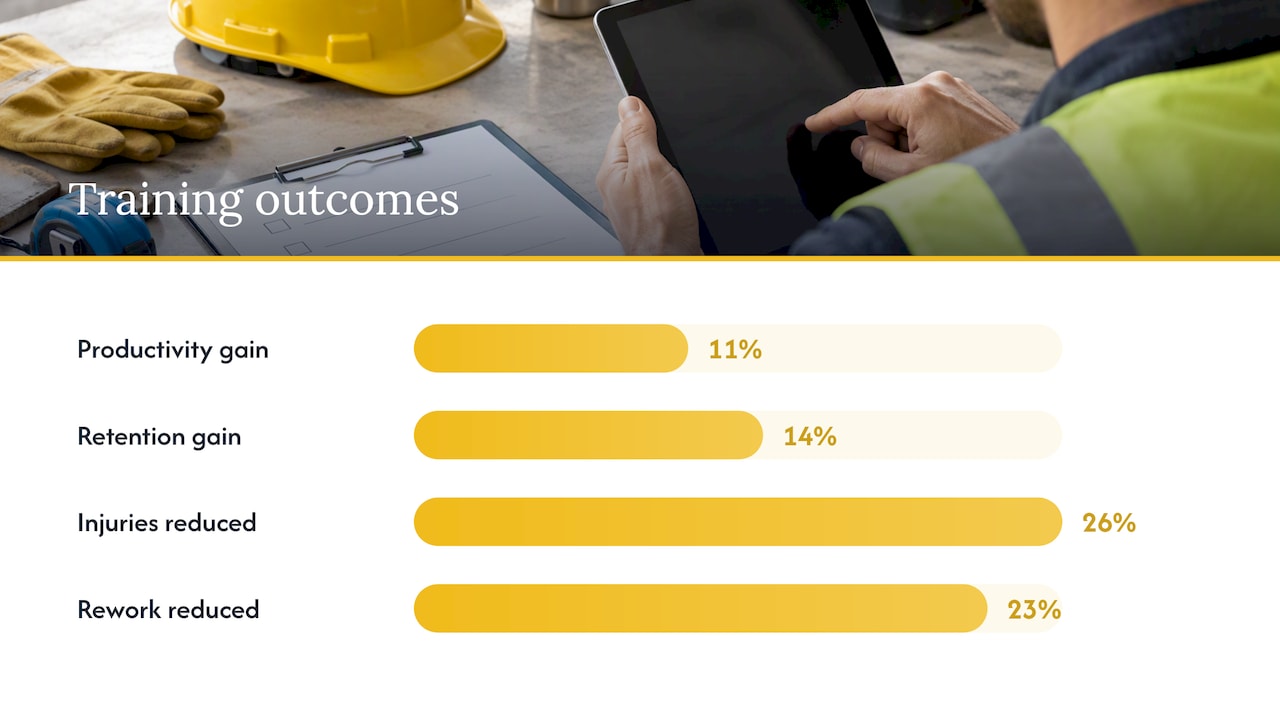
Research on construction training points to a consistent set of outcomes: productivity, rework, retention and safety. NCCER’s summary of the 2007 Construction Industry Institute findings associates training with an 11% productivity increase, a 14% retention increase, a 26% decrease in recordable injuries and a 23% reduction in rework.
For an HVAC, plumbing or electrical shop, translate those into line items you can price:
| Benefit | How to put a dollar value on it | Where the data lives |
|---|---|---|
| Fewer callbacks | Callbacks avoided × your average cost per callback (labor, truck, lost slot) | Dispatch or job software, warranty log |
| Less rework | Hours of rework avoided × loaded labor rate, plus materials | Job costing, change orders |
| More billable hours | Extra billable hours × charge-out rate × your margin | Timesheets, invoices |
| Better retention | Turnovers avoided × your cost to recruit, onboard and ramp a replacement | HR records, payroll |
| Fewer injuries | Incidents avoided × direct and indirect incident cost | Insurance claims, incident log |
| Higher close rate or ticket | Added revenue × margin | CRM, sales reports |
One caution on margin. Revenue is not benefit. If training lets a tech run one more call a week, the benefit is the gross margin on that call, less any commission or raise tied to it. Pay increases that come with new skills belong on the benefit side as a deduction, because they are a lasting cost of the training.
You also need a cost-per-callback figure that comes from your own books. Averages from other shops are a starting point at best. Pull twelve months of callbacks, price the labor, drive time, materials and the displaced paid job, and use that.
A worked example
This is a hypothetical shop, built to show the arithmetic. Your numbers will differ.
A residential HVAC company with six service technicians sends them through a 16-hour diagnostics and customer-communication program.
Costs
- Program fees: $4,800
- Paid training time: 6 techs × 16 hours × $40 loaded hourly cost = $3,840
- Travel and materials: $1,200
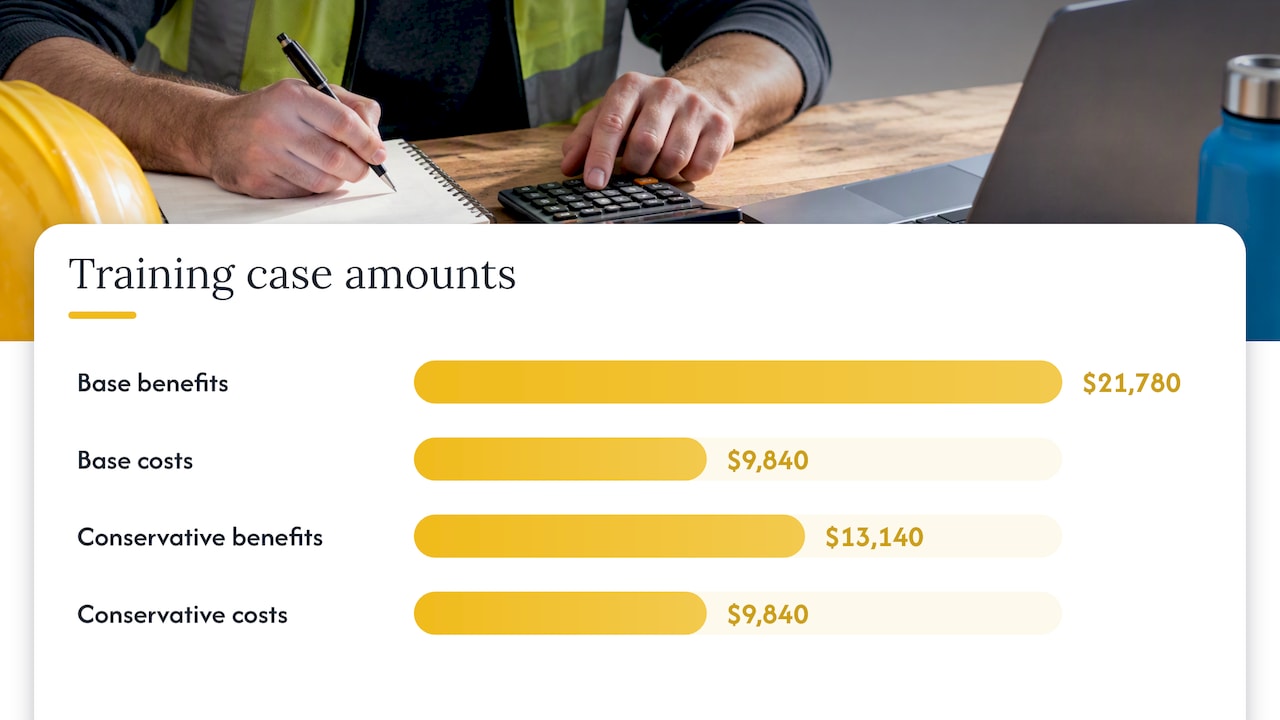
- Total cost: $9,840
Benefits over the next 12 months
- Callbacks fall from 160 to 130 a year. At $350 per callback from the shop’s own books, that is 30 × $350 = $10,500.
- Each tech gains one extra billable hour a week for 48 weeks: 6 × 48 = 288 hours × $150 charge-out rate × 40% margin = $17,280.
- Less: a $0.50 an hour raise tied to the new skill for six techs at 2,000 hours = $6,000.
- Net benefit: $21,780
Result
ROI = ($21,780 − $9,840) ÷ $9,840 × 100 = about 121%. Payback comes in under six months once the benefits are running.
Now stress-test it. Cut the extra billable hours in half and keep everything else. Benefits become $10,500 + $8,640 − $6,000 = $13,140, and ROI drops to about 34%. Still positive, but a very different story. Run a conservative case and a hopeful case before you sign anything, and decide on the conservative one.
Here is the other thing the example shows: the two big numbers are assumptions. That is exactly why you want to measure them afterward.
What is a good ROI for a training program?
There is no single good number, because a program that fixes a leak in your business is worth far more than one that polishes a strength. Some reference points:
- NCCER’s research summary reports that each dollar invested in craft training can yield $1.30 to $3.00 in benefit across the trainee, the employer and the broader economy. Not all of that lands in your pocket.
- The same report cites a 1999 analysis showing a worker only has to become about 2.34% more effective to earn an 8% return on a $1,000 training investment over two years. That works out to roughly 11 extra productive minutes a day. The bar for breaking even is lower than most owners fear.
- Older studies cited in the same report show larger effects for specific trades. A 1999 study of electrical contractors found a 42% productivity increase and a 50% drop in both absenteeism and turnover after training. A 1999 study of sprinkler fitters found a 14% productivity increase and average turnover and absenteeism reductions of 29% and 35%.
Those studies are decades old, were done in specific settings and say nothing certain about your shop. Use them to confirm that the direction is right, then rely on your own before-and-after numbers for the amount.
A practical rule: set your hurdle before the training. Many owners pick a payback period (say, 12 months) and a minimum ratio they would accept for any other investment. If a program clears it on the conservative case, buy it. If it clears it only on the hopeful case, fix the plan or pass.
Training effectiveness metrics that connect learning to money
Track two layers of metrics: whether people changed what they do, and whether the business numbers moved.
Behavior and learning metrics
Berkeley Lab’s guide describes four levels to evaluate: reaction, learning, behavior and results. It recommends checking whether learning transferred to work 90 days or more after training, using work observation, structured interviews or supervisor confidence ratings.
In a trade shop, that looks like:
- A ride-along checklist scored by the service manager at 30 and 90 days
- Call recordings reviewed against a booking script or rubric
- Sales reps’ use of a defined process in estimates, checked in the CRM
- A supervisor rating (1 to 5) of how confidently each person performs the trained task
Business metrics
Pick three to five, tied to the reason you trained:
- First-time fix rate and callback rate
- Rework hours per job
- Billable utilization per tech
- Average ticket and close rate
- Booked-call rate in the call center
- 12-month retention, plus recordable injuries
Tie each to a baseline from the previous 6 to 12 months. Without a baseline, you can only argue.
Most firms stop at the first layer or skip measurement entirely. A CIPD survey of learning and development teams found that 70% of organizations evaluate learning impact, but only 12% evaluate wider business impact and 16% assess behavior change. The same report notes that high-performing learning organizations are four times more likely than average to measure specific business metrics. That is UK survey data across all industries, but the pattern holds in the trades: the shops that decide on metrics in advance learn the most from each dollar.
When to measure
A simple cadence keeps this from becoming a project of its own.
- Before training: record baselines and write down the conservative and hopeful benefit assumptions.
- End of training: collect reactions and a quick skills check. This is useful for the instructor and tells you little about ROI.
- 30 days: observe behavior in the field. Are the new methods used, and where are they not?
- 90 days: the first honest read on behavior transfer, plus early movement in callbacks, close rate or call booking.
- 6 and 12 months: compare business metrics to baseline, then recalculate ROI with real numbers.
Retention and injury effects need the longer window. Callbacks and booking rates usually show up sooner.
When you track field performance after the class, the supervisor matters as much as the curriculum. Practical advice on crew supervision tips is a reminder that skills stick when someone on site reinforces them daily. Build that follow-up into your cost line.
Handling attribution and indirect benefits
Nobody can prove that training alone produced a given gain. NCCER’s report notes that isolating training’s effect is difficult because many other factors affect firm performance, and it lists improved morale and job satisfaction among the indirect benefits. Prices rise, a competitor closes, a hot summer fills your schedule. Here is how to stay honest:
- Use a comparison group. If only four of ten techs attend this quarter, compare them with the rest. Train the others next quarter.
- Claim a share. If callbacks fell 30 and you believe training drove two-thirds, count 20.
- Keep indirect benefits out of the headline. Morale and satisfaction are real, but list them beside the ROI number rather than inside it.
- Account for other changes. A new pricebook or a dispatch software switch in the same quarter muddies the picture. Write it down.
- Document the assumptions. When you or a lender reread the numbers next year, the logic should still be visible.
If you want to price job-level costs more precisely, strong job costing is what makes rework and callback figures reliable. A job costing software comparison shows what field reporting and costing tools can capture for contractors, which feeds the financial side of your business case.
Our perspective: training fails more often at the follow-up than in the classroom
We work only with trade businesses, and the pattern repeats. An owner buys a good class, the team enjoys it, and three months later the shop runs the way it always did. The content was rarely the problem. There was no system to make the new behavior the normal behavior.
Three things separate the shops that get a return from those that do not:
- They train toward a number they already track. If you cannot say today what your callback rate, close rate or booked-call rate is, fix that first. Financial and operational visibility comes before any training budget.
- Leaders own the follow-up. Technicians do not drift back to old habits out of defiance. They drift because nobody inspects the work. Management and leadership development is often the highest-return training, because it multiplies every other class.
- They measure in the field, not the classroom. Ride-alongs, call reviews and KPI dashboards tell you more than a satisfaction survey.
Our approach combines onsite audits, leadership training and accountability systems, so the training and the measurement are built together. If your team is also losing people, a good way to learn what would keep them is to run stay interviews before you spend on skills they might take elsewhere.
— Dan
Where we can help
If you want training tied to numbers you already track, our Rebuild program and training offers cover sales, management and leadership, install and project management, call management and dispatch, financial operations and compliance, and marketing analysis, all for HVAC, plumbing, electrical and other trades. The work is hands-on and built around your shop’s own data. Pricing is scoped to the engagement, so start with a conversation about which metric you want to move.
Two companion reads help with the inputs: labor forecasting for contractors shows how to size the hours you are putting into training, and a 90-day leadership pipeline pilot is a low-risk way to test a leadership investment against a clear measurement window.
A short checklist before you approve any training spend
- Name the one business problem the training should fix.
- Write the baseline for that metric from the last 6 to 12 months.
- Add every cost: fees, paid hours, lost billable time, travel, your follow-up time.
- Estimate benefits twice, conservative and hopeful, and decide on the conservative one.
- Assign a person to inspect the behavior at 30 and 90 days.
- Schedule the 6 and 12 month ROI recalculation now.
FAQ
How do you calculate the ROI of training?
Subtract total training costs from the dollar value of the benefits, divide by the costs, and multiply by 100. Costs should include course fees, paid time off the tools, travel and follow-up time. Benefits should be limited to measurable changes such as fewer callbacks, less rework, more billable hours and lower turnover.
What is a good ROI for a training program?
Research cited by NCCER suggests $1.30 to $3.00 of benefit per training dollar in craft training, but results depend on the program and the shop. A better test is whether the program clears the payback period and return you set before you bought it, using the conservative case.
When should contractors measure training results?
Set baselines before training, check behavior in the field at 30 and 90 days, and recalculate ROI at 6 and 12 months. Berkeley Lab’s evaluation guidance suggests checking for learning transfer at 90 days or later. Retention and injury effects take longer to show than callbacks or booking rates.
What does ROI mean in construction?
ROI means return on investment: the gain from spending money on something, compared with what it cost. In construction and the trades, that spending might be a truck, software, a hire or a training program. For training, the return comes through productivity, rework, retention and safety results.
Sources
- NCCER, From Training to Performance (2025)
- NCCER, A Compelling Case for Construction Craft Training
- Berkeley Lab, Training Evaluation
- University of Texas, construction training ROI study (1999)
- CIPD, Learning and Skills at Work 2020
0 Comments