
Shoulder season, the spring and fall stretch between heating and cooling peaks, isn’t downtime. It’s the cheapest, highest-margin selling window on your calendar. The move is simple: run tune-up campaigns, convert those tune-ups into maintenance agreements, and reactivate your past customer list while techs have open bays. Do that consistently and you’ll see smoother monthly revenue and lower cost per lead than you get fighting for attention in July or January.
TL;DR:
- Initiate tune-up campaigns in February for hot climates and earlier for shoulder seasons, based on regional weather trends and past job data.
- Focus marketing efforts on reactivating previous customers and converting tune-ups into maintenance agreements during slow periods to maximize margins.
- Prioritize fall campaigns, as service demand often peaks in October, later than most owners expect, requiring earlier promotion.
- Prepare operations by training techs, auditing inventory, and setting appointment blocks before launching marketing campaigns to ensure efficient execution.
- Track key metrics such as maintenance plan penetration, booked hours, and cost per lead to adjust marketing spend and improve campaign effectiveness.
Table of Contents
- What Counts as Shoulder Season HVAC, and When Does It Hit?
- Why Shoulder Season Hits Your Revenue, and What to Track
- The Shoulder-Season Marketing Playbook, Ranked by Return
- Get Your Operations Ready Before You Turn On the Marketing
- How to Turn a Tune-Up Into a Signed Maintenance Agreement
- Seasonal Maintenance Checklist: What to Do and When
- Running This at Scale: An 8-Week Rollout
- Why the Owners Who Win Shoulder Season Aren’t the Ones You’d Expect
- Rebuilding the Trades: Turning the Playbook Into a Repeatable System
- Sources
What Counts as Shoulder Season HVAC, and When Does It Hit?
Shoulder season is the window between your busiest heating and cooling stretches, typically mid-spring (March through May) and mid-fall (September through November) in most of the country. But the exact dates shift by climate, and pretending otherwise costs you leads.
- Desert and hot-climate markets (Phoenix, Las Vegas): shoulder windows are short and cooling season starts earlier, so spring tune-up campaigns need to launch in February.
- Temperate markets (Mid-Atlantic, Midwest): classic spring and fall windows apply almost exactly as textbook.
- Cold-climate markets (Northeast, Upper Midwest): fall shoulder season is longer since heating checks matter more than cooling.
Validate your own calendar with local weather-forecast trends and your last two years of completed-job data rather than a generic almanac date. EIA’s regional energy analyses show how differently demand curves behave state to state, which is exactly why a one-size calendar fails.
Why Shoulder Season Hits Your Revenue, and What to Track
Shoulder season creates a demand dip your cost structure doesn’t shrink to match. You’re still paying full staff, full overhead, and full lease costs while call volume drops. That mismatch, not lack of demand itself, is what actually threatens margin.
Operational data backs up why timing planning matters. Samsara’s trip-data analysis found HVAC service volume climbs through summer and often peaks in October, later than most owners assume, meaning fall campaigns need to launch earlier than instinct suggests.
The KPIs worth watching during shoulder months:
- Maintenance-plan penetration rate (percentage of service customers on a recurring agreement)
- Booked technician hours per week versus capacity
- Cost per lead (CPL) for shoulder-season campaigns versus peak-season campaigns
- Customer reactivation rate from your past-customer list
By the Numbers: Samsara’s operational data shows service demand often peaks in October rather than midsummer, which means most contractors are running fall campaigns weeks too late.
The Shoulder-Season Marketing Playbook, Ranked by Return
Not every tactic deserves equal budget. Rank them by what actually converts, then execute in this order.
- Tune-up campaigns first. A $75 to $175 tune-up offer, priced per HVACBase’s maintenance cost data, is the easiest yes you’ll get all year. It’s low commitment for the customer and high margin for you when bundled right.
- Maintenance-agreement conversion. Every tune-up call is a maintenance-agreement pitch waiting to happen. Train techs to make the offer at the point of service, not after they’ve left the driveway.
- Email-first reactivation. Pull your list of customers who haven’t booked in 12 to 18 months and email them before you spend a dollar on ads. It consistently outperforms cold advertising for reactivation because the relationship already exists.
- Text and call follow-up. Anyone who opens but doesn’t book gets a text within 48 hours, then a call three days later.
- PPC in shoulder months. Competition thins out when other contractors pull back their ad spend, which lowers your cost per lead. Run ad groups for “AC tune-up,” “furnace inspection,” and “indoor air quality,” not generic “HVAC repair” terms that attract emergency shoppers who won’t wait.
Pro Tip: Shift a larger share of your annual marketing budget into spring and fall rather than spreading it evenly across twelve months. Thinner competition during shoulder windows means the same dollar buys more attention.
Track conversion by channel from day one. If email reactivation is converting at three times your PPC rate, that’s your signal to shift budget, not a footnote to review at year-end.
Get Your Operations Ready Before You Turn On the Marketing
Marketing without operational readiness just creates callbacks and angry reviews. Fix the back end first, in slow weeks, not during the rush.
- Run one skill-focused micro-class per week for techs during slow stretches. Fifteen minutes on refrigerant charging or IAQ upsells beats a once-a-year all-day seminar nobody retains.
- Audit parts inventory against your supplier’s seasonal lead times, and pre-order capacitors, filters, and igniters before demand spikes.
- Use quiet weeks to set up automated review requests and clean up your Google Business Profile listing, both of which compound your lead flow later.
- Have your dispatcher block calendar windows specifically for tune-ups, sequence callback reminders, and queue upsell offers so nothing falls through.
Pro Tip: Give your dispatcher explicit authority to hold two tune-up slots per day, even when the schedule looks full. Those slots pay for themselves in maintenance-agreement conversions.
How to Turn a Tune-Up Into a Signed Maintenance Agreement
Build your tune-up scope around the standards buyers already trust, then use it as the doorway to recurring revenue.
- Align the tune-up checklist with ENERGY STAR and Trane guidance: filter inspection, coil cleaning, refrigerant charge check, and electrical safety checks, matching what ENERGY STAR recommends for spring cooling checks and fall heating checks.
- Bundle strategically. A filter subscription, an indoor air quality add-on, and a smart thermostat upgrade turn a $100 visit into a $300 to $500 ticket, especially when you frame the thermostat around the roughly 3% energy savings per degree that setpoint changes deliver.
- Script the reactivation email short. One line reminding the customer it’s been a year, one line naming the seasonal risk (frozen pipes, AC failure in a heat wave), one clear call to book.
- Log every conversion in your CRM with a 30-day follow-up flag for anyone who declined the agreement, so the offer resurfaces instead of disappearing.
Reference your price book when setting bundle pricing so techs aren’t improvising numbers on a customer’s porch.
Seasonal Maintenance Checklist: What to Do and When
Spring and fall tasks split cleanly between what a homeowner can handle and what needs a licensed tech. Getting that split right protects your callback rate and keeps warranty claims clean, since most manufacturer warranties require documented professional service on refrigerant and electrical components.

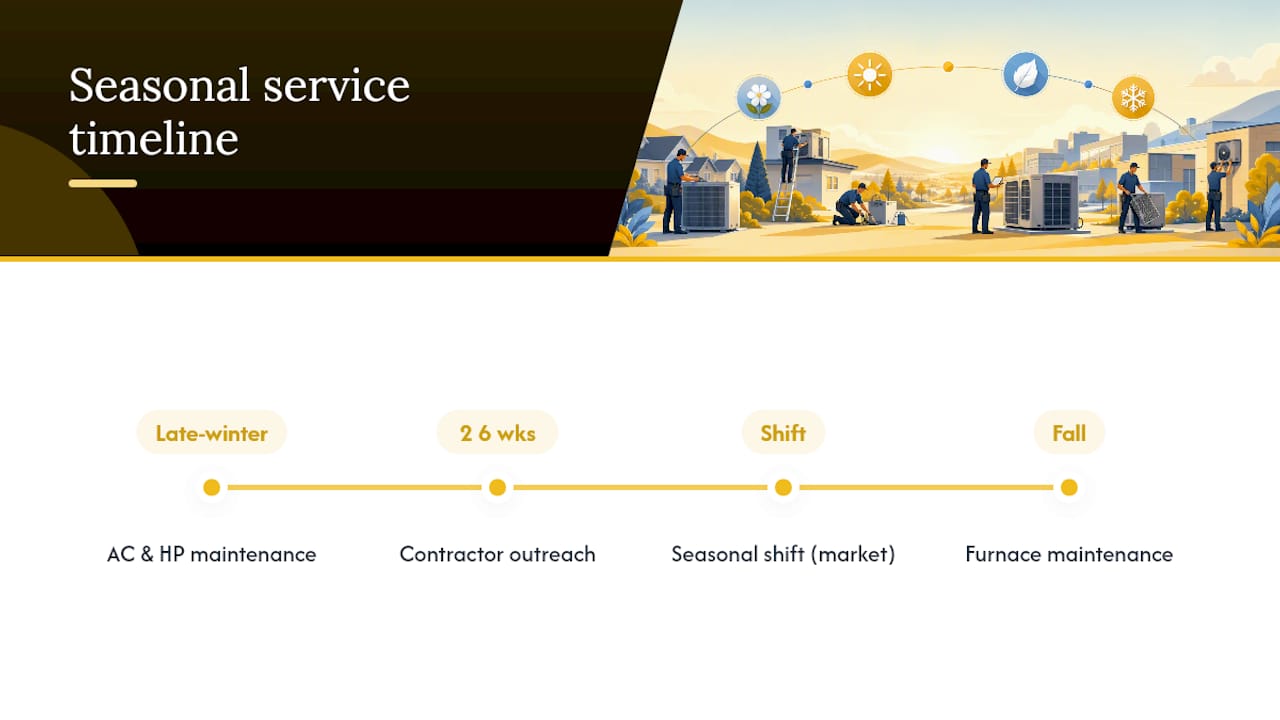
Schedule outreach two to four weeks ahead of the seasonal shift your market actually experiences, not the calendar date. Trane’s seasonal guide recommends AC and heat pump maintenance in late winter or early spring, and furnace maintenance in fall, both timed to beat the weather rather than react to it.
Running This at Scale: An 8-Week Rollout
A shoulder-season campaign only compounds if you treat it as a system, not a one-off promotion. Here’s the shape of a first sprint:
- Weeks 1 to 2: Pull the reactivation list, build the email and text sequence, brief dispatch on tune-up slot blocking.
- Weeks 3 to 4: Launch tune-up campaign, train techs on the maintenance-agreement pitch, start PPC on seasonal keywords.
- Weeks 5 to 6: Review CPL and reactivation conversion by channel, shift budget toward what’s converting.
- Weeks 7 to 8: Report on maintenance-plan penetration and booked hours, and lock the winning sequence into your standard operating calendar for next year.
One documented maintenance-agreement strategy helped a trades business reach a $21 million run rate by treating recurring agreements as the core revenue engine rather than a side offer, which is the outcome this whole sprint is built to produce.
Why the Owners Who Win Shoulder Season Aren’t the Ones You’d Expect
The owners who make the most of shoulder season usually aren’t the best marketers in the room. They’re the ones who fixed dispatch, trained techs on the upsell pitch, and had parts on the shelf before the campaign ever launched. Marketing amplifies whatever operational foundation already exists, good or bad. Pilot one focused campaign this season using the sequence above, measure it honestly, and build from there.
— Dan
Rebuilding the Trades: Turning the Playbook Into a Repeatable System
Running one good shoulder-season campaign is doable solo. Running it every spring and fall, with dispatch, training, and pricing all pulling the same direction, is where most owners stall out. Consulting services exist for that second part: turning a one-time campaign into a system your managers can execute without you standing over it.

A short engagement typically starts with process mapping to find where tune-up leads are leaking between marketing and dispatch, followed by service manager training so the maintenance-agreement pitch becomes standard practice, not a script techs forget by week three. Deliverables often include a documented dispatch workflow, KPI reporting managers use, and a training cadence designed to survive turnover. If you’re ready to see what that looks like for your business, check pricing for a consulting engagement and book a conversation about your next shoulder season.
Sources
- Complete seasonal HVAC maintenance checklist | HVACBase
- The real peak season for HVAC? It’s not when you think | Samsara
- HVAC Maintenance Tips & Checklist – Seasonal Guide – Trane®
0 Comments