
Labor burden is the employer-paid cost of employing a worker beyond their hourly wage, and it belongs in every estimate as a fully burdened productive-hour rate rather than a flat markup guess. Skip this step and you underprice jobs before you ever bid them. For most trades, burden commonly adds roughly 35% to 65% on top of base pay, so treating it as an afterthought is the fastest way to erode margin.
TL;DR:
- Failing to include all labor burden components typically leads to underpricing jobs by 35% to 65%, risking margin erosion on every project.
- High-risk trades such as roofing or excavation face significantly higher workers’ compensation costs and premiums due to elevated EMR ratings.
- Calculating the burdened rate involves dividing total annual employment costs, including taxes and benefits, by actual productive hours rather than paid hours.
- Owners should review and update their burdened rates twice a year tied to insurance renewals and payroll changes to prevent estimate drift.
- Using a fully burdened labor rate in bids helps avoid double-counting costs and ensures estimates reflect true labor expenses for accurate bid and profit margins.
Table of Contents
- What labor burden includes: a component checklist
- How to calculate a fully burdened labor rate
- A worked example: from base wage to burdened rate
- Where the burdened rate belongs in your estimate
- Common mistakes and compliance red flags
- A case example: fixing an estimating leak
- Why discipline beats clever math
- How we help you put burdened-rate estimating into practice
- FAQ
- Sources
What labor burden includes: a component checklist
Labor burden covers every dollar you pay to employ someone beyond their paycheck. Missing a single component skews your rate low and compounds across every job you price with it.
Payroll taxes come first: FICA, FUTA, and state unemployment (SUTA) apply to nearly every payroll dollar and are the most predictable piece of the calculation. Workers’ compensation is next, and it swings widely by trade class and by your Experience Modification Rate (EMR), which can push premiums far higher for roofing or excavation crews than for finish carpentry. Benefits, including health insurance premiums, retirement matches, and life or disability coverage, need to be annualized and divided across productive hours rather than treated as a flat add-on. Paid leave, training time, safety programs, and any company vehicle or tool allowance round out the labor burden components.
- Mandatory items: payroll taxes, workers’ comp, and any benefits required by contract or law.
- Voluntary items: retirement matches, supplemental insurance, bonuses, and allowances you choose to offer.
- Annualized costs: premiums and training budgets divided by total hours, not charged in the month they’re paid.
- Trade-specific variance: high-risk trades carry higher workers’ comp and often higher EMR-driven premiums.
Some owners fold PTO and training into “overhead” instead of burden. That works only if you never double-count it later. Keep a single home for each cost so your estimate doesn’t charge it twice.
How to calculate a fully burdened labor rate
Procore’s guidance on fully burdened labor frames the rate as the true hourly cost of employing someone, and the formula behind it is straightforward once you have clean numbers:
(Annual gross payroll + total annual burden costs) ÷ total annual productive hours = fully burdened hourly rate
- Total annual gross payroll for the worker or crew, including base wages and any guaranteed overtime.
- Add every burden cost: payroll taxes, workers’ comp, benefits, PTO, training, and allowances, annualized.
- Calculate productive hours, not calendar hours: start from 2,080 hours for a full-time employee, then subtract holidays, vacation, sick time, and average training days.
- Divide the total cost by productive hours, not total paid hours, so the rate reflects what an hour of actual work really costs.
- Decide individual versus composite rates: a single trade with similar pay levels can use one composite crew rate, but a mixed crew of apprentices and journeymen usually needs individual rates blended by hours worked.
Partial-year hires need prorated annual costs rather than a full year’s premium divided by a partial year’s hours, which would overstate their burden. The point of this exercise isn’t precision for its own sake. It’s making sure the denominator reflects hours you can actually bill, not hours you merely pay for.
A worked example: from base wage to burdened rate
Take a journeyman carpenter earning $28 per hour, working a standard 2,080-hour year with 1,840 productive hours after holidays, vacation, and average training time.
| Cost component | Annual amount |
|---|---|
| Base wages (2,080 hrs × $28) | $58,240 |
| Payroll taxes (FICA, FUTA, SUTA, ~10%) | $5,824 |
| Workers’ compensation (typical range) | $6,989 |
| Health insurance and retirement match | $7,200 |
| Paid time off and training (already in payroll hours) | included above |
| Total annual cost | $78,253 |
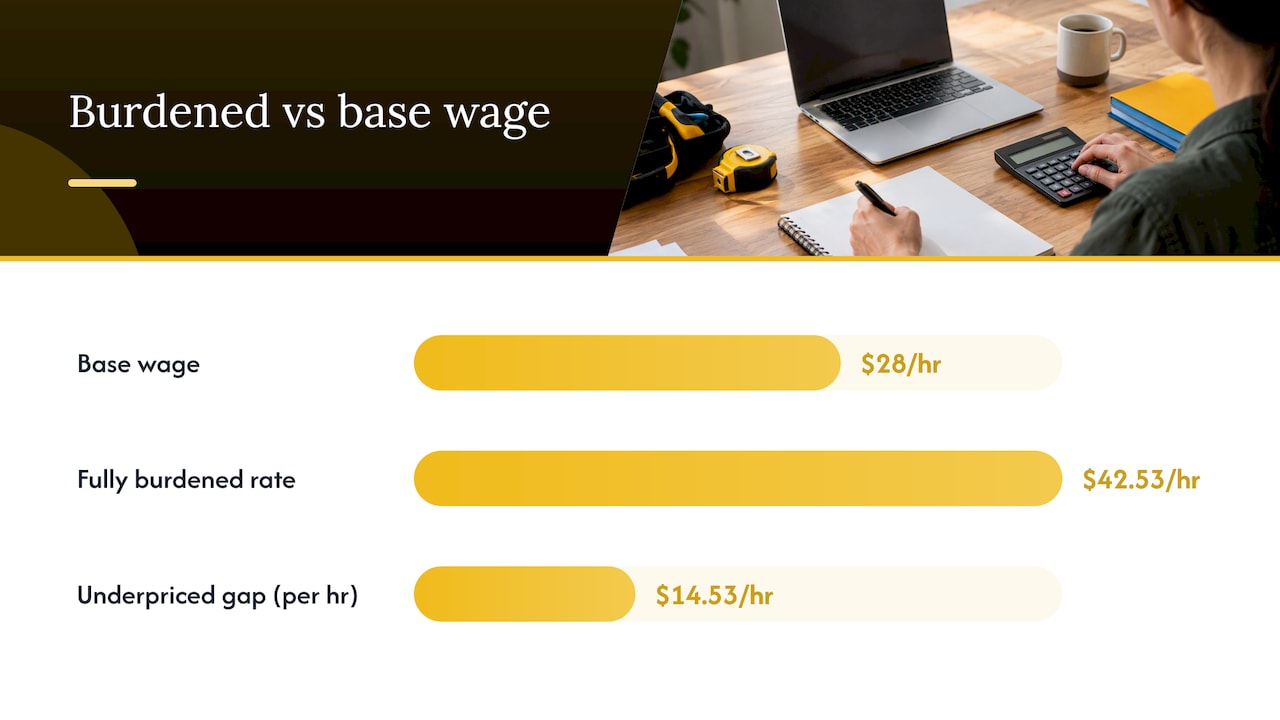
Divide $78,253 by 1,840 productive hours and the fully burdened rate comes to roughly $42.53 per hour, a multiplier of about 1.52 over the $28 base wage.
A rate this far above base wage changes bid math fast. Bid that carpenter’s labor at $28 per hour instead of $42.53, and a 2,000-hour project underprices labor by roughly $29,060, enough to wipe out most contractors’ expected margin on a job that size.
Where the burdened rate belongs in your estimate
The estimate math is simple once the rate is correct: productive hours × burdened hourly cost = labor line item. The discipline is keeping that line item separate from everything else in the bid.
- Burden is employee-specific: taxes, insurance, and benefits tied to the person doing the work.
- Overhead is company-level: rent, office staff, insurance on the business, software, and vehicles not billed directly to a job.
- Markup is profit, added last, on top of burdened labor, materials, and allocated overhead.
Each of these gets counted once. Folding workers’ comp into your overhead rate and then adding a separate “burden” line on top charges the client twice for the same cost, and it’s one of the quickest ways to lose a competitive bid without knowing why.
For fixed-price work, build the burdened rate into your base labor cost before markup. For time and material billing, quote the burdened rate as your labor cost basis and apply markup transparently on top. Change orders deserve the same rate, not a renegotiated lower number just to look competitive. If you’re formalizing this across a team, a documented price book keeps burdened rates consistent job to job instead of reinvented from memory each time, and the same logic applies when rates shift mid-project through the change order process.
Pro Tip: Build a small line for supervision and non-productive field hours into every estimate instead of absorbing them silently into overhead.
Common mistakes and compliance red flags
Most estimating losses trace back to a handful of repeatable errors.
- Omitting non-productive paid time: breaks, setup, teardown, and meetings are paid hours that never produce billable work, and leaving them out of the productive-hours denominator understates burden.
- Double-counting burden inside overhead or markup, which inflates client pricing in a way that costs you bids without adding to your actual margin.
- Ignoring EMR swings: a high Experience Modification Rate can push workers’ comp premiums well beyond typical ranges for high-risk trades, and a poor safety record compounds the problem year over year.
- Skipping prevailing wage checks: Davis-Bacon rules apply to many federally funded projects over a set contract threshold, and they change both the base wage and fringe assumptions you’re required to use.
- Underestimating tight-market premiums: when skilled labor is scarce, market rates can run above your standard burdened calculation, and ignoring that gap invites losing bids to competitors who price it in.
A case example: fixing an estimating leak
One trade contractor working with our team had been pricing labor using base wage alone for years, assuming overhead markup would cover the gap. It didn’t, and job-cost reports showed margin erosion on nearly every completed project despite healthy sales volume.
- Step one: rebuild the price book using fully burdened rates by trade classification.
- Step two: assign a single owner responsible for reviewing and updating burden inputs.
- Step three: set a recurring six-month review cadence tied to insurance renewals and payroll changes.
The result was cleaner job-cost reporting and estimates that matched actual field cost far more closely, the kind of operational clarity that shows up across the engagements detailed in our case studies.
Why discipline beats clever math
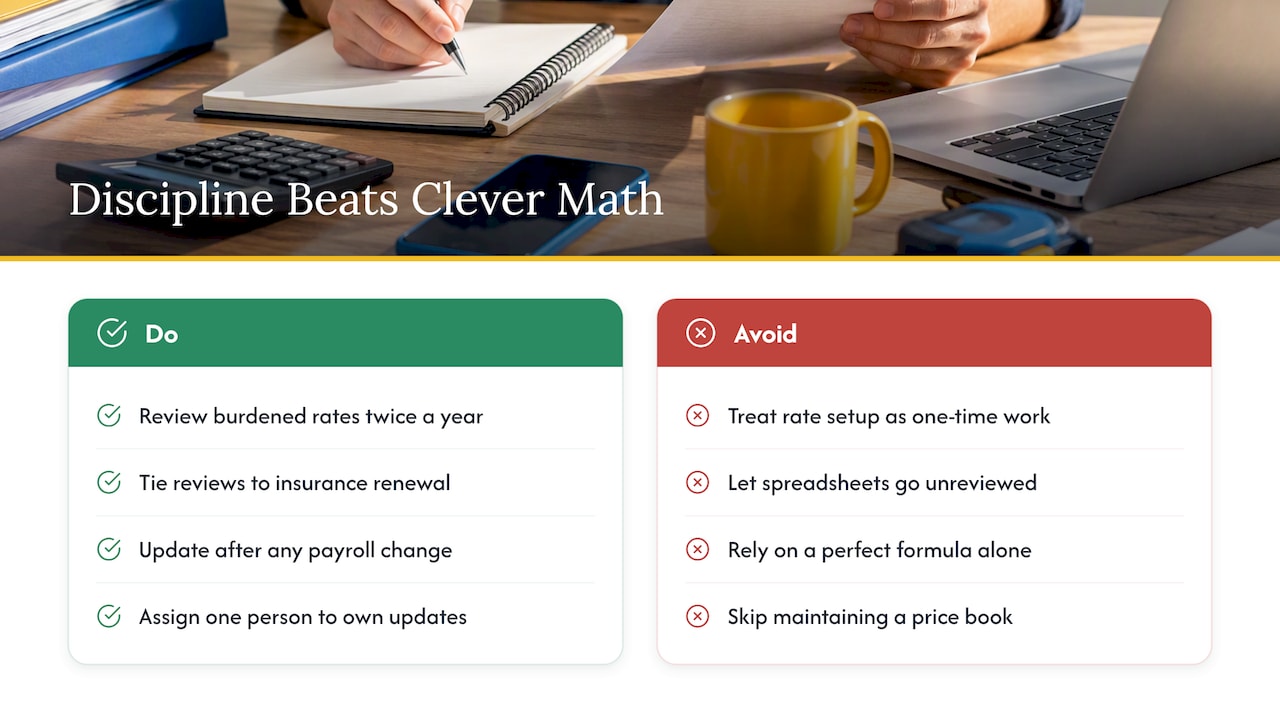
The formula for burden is not complicated. What separates contractors who protect margin from those who don’t is whether anyone actually owns the number. A spreadsheet built once and never revisited drifts out of date within a year as insurance renews and payroll shifts.
Owners who win long-term treat rate review as a recurring task, not a one-time project. Review your burdened rates twice a year, tied to insurance renewal and any payroll change, and assign one person to own the update. Small systems like a maintained price book and a scheduled check stop financial leaks far more reliably than a more precise formula ever will.
— Dan
How we help you put burdened-rate estimating into practice
Knowing the formula is one thing. Making it stick across every estimator, every bid, and every job is where most trade businesses lose the thread. We work with trade businesses to help rebuild estimating systems so burdened rates get used consistently instead of calculated once and forgotten.

A short engagement typically starts with an audit of your current pricing and payroll data, moves into building or correcting a price book with accurate burdened rates, and ends with a review cadence your team actually follows. That’s the kind of operational fix we specialize in across our services, built specifically for trade businesses rather than adapted from generic consulting templates. If estimating leaks have been quietly eating your margin, see our pricing and get a plan built around your numbers.
FAQ
What is the average labor rate for a contractor?
Base labor rates vary widely by trade, region, and experience level, so there’s no single national figure that applies across the board. What matters more for pricing accuracy is your fully burdened rate, which typically runs 35% to 65% above base wage once taxes, insurance, and benefits are included.
What does labor burden cover?
Labor burden covers every employer-paid cost tied to employing a worker beyond their wage, including payroll taxes, workers’ compensation, health and retirement benefits, and paid time off. It does not include company-level costs like rent or office staff, which fall under overhead instead.
Is 20% labor burden high?
A 20% burden rate is actually on the low end for most construction trades, where typical ranges run from 35% to 65% depending on workers’ comp class and benefits offered.
What is the average labor burden rate?
There’s no single universal average because workers’ comp, benefits, and payroll tax rates vary by trade and location, but industry guidance puts the common range at 35% to 65% above base wage. High-risk trades with elevated EMR or thin benefit packages fall at the higher end of that range.
Sources
For national wage and benefit benchmarking, the BLS Employer Costs for Employee Compensation report breaks down wages against major benefit categories. For trade-specific burden ranges and adjustment factors, start with the construction labor rate guidance above, then check the 2026 National Construction Estimator for productivity and site-condition adjustments specific to your region.
- Construction estimating: labor rates and burden (2024–2026 guidance)
- Procore: How to determine your fully burdened labor rate
0 Comments