
A good technician spiff rewards one specific behavior, for a short window, on top of normal pay. The best ideas for HVAC, plumbing and electrical companies tie a small cash reward to things you want more of: maintenance agreement attachments, no-callback jobs, 5-star reviews, clean documentation and safe work. The worst ones put a bounty on a single product and teach your techs to push it. This guide gives you the ideas, the logic for setting amounts, the spiff vs commission question, and the payroll rules to check before you announce anything.
TL;DR
- A spiff is a temporary, fixed reward for one narrow goal. It sits beside your pay plan and does not replace it.
- Reward outcomes, not just sales: callbacks avoided, reviews earned, agreements attached, paperwork finished.
- Offer several spiffed items so a tech can match the recommendation to the customer, instead of one item that invites pressure-selling.
- Pay only above a baseline built from your last six to twelve months of data, and track side effects like callbacks.
- In the US, announced spiffs generally count toward the overtime regular rate for non-exempt techs. Check this with your payroll provider or an employment attorney before launch.
Table of Contents
- What a technician spiff is, and what it is for
- Spiff vs commission: which one fits
- Technician spiff ideas by goal
- How to set amounts without causing rushed jobs or pressure-selling
- Tracking whether a spiff program works
- Payroll and overtime rules to check before you announce
- Our perspective: spiffs are a symptom check, not a strategy
- When a spiff is not enough
- Common spiff mistakes to avoid
- FAQ
- Sources
What a technician spiff is, and what it is for
A spiff is a bonus paid for a specific, narrow goal, such as selling an accessory or a maintenance agreement. It can be short-term or part of a longer plan. The defining feature is that it is a temporary, fixed reward for a defined window, paid alongside the existing pay plan.
That makes a spiff a steering tool. Trade companies use them for short-term focus: moving slow inventory, launching a new service line, or filling the calendar in a slow season. It is not a fix for a broken pay plan. If your techs are underpaid or your dispatch is chaotic, a $25 spiff will not change that.
Before you pick an idea, name the problem in one sentence. “Our maintenance agreement base is flat” is a problem a spiff can address. “Our techs are leaving” is not, at least not by itself.
Spiff vs commission: which one fits
The two get mixed up constantly, so separate them by purpose and time.
Commissions are standing, percentage-based incentives meant to drive sustained sales performance. Spiffs are tactical, time-bound nudges for specific behaviors.
| Spiff | Commission | |
|---|---|---|
| Duration | Short, with a start and end | Ongoing, part of the pay plan |
| Amount | Flat dollar amount | Percentage of the sale or margin |
| Best for | One behavior: attach an agreement, collect a review | Sustained revenue responsibility, like comfort advisors or sales techs |
| Risk | Gaming or pressure on a single item | Pushes volume over fit if margin is ignored |
| Easy to change | Yes | No, changing it feels like a pay cut |
A rule of thumb: if the behavior should happen on every call forever, build it into the base plan or commission. If you need a push for 30 to 90 days, or the behavior is hard to measure as revenue (a review, a photo, a completed checklist), use a spiff.
When a spiff works, you often promote it into the standing plan. When it stops working, you retire it without anyone feeling demoted.
Technician spiff ideas by goal
The amounts below are illustrative starting points for you to test against your own margins, not industry standards. Size each one from the gross profit the behavior creates.
Revenue and attachment spiffs
These are the classics, and the ones most likely to backfire if designed carelessly.
- Maintenance agreement attached. A flat amount per agreement sold, with a bonus if it is still active after the first renewal or first visit. This rewards the agreement that sticks, not the one that cancels in 60 days.
- Accessory or indoor air quality add-on. A small flat amount per item. In plumbing, think water treatment or shutoff upgrades. In electrical, surge protection or smoke alarm replacement.
- Qualified replacement lead. Pay when the lead is run by a comfort advisor, with a larger payout when it sells. Paying on the sale keeps techs from tossing every old unit onto the lead pile.
- Good, better, best presentation. Reward presenting all tiers on every proposal, verified in your field software, rather than rewarding the highest tier. This protects the customer and your reputation.
Quality spiffs
Quality spiffs keep the revenue ones honest.
- No-callback bonus. HVAC companies can reward quality with no-callback bonuses. A monthly payout for a tech whose jobs saw no return visit within a set number of days works well. Define what counts as a callback in writing, including whether parts failures outside the tech’s control are excluded.
- First-time fix. Pay for resolving the problem on the first visit when the job type is one you can reasonably expect to fix in one trip.
- Install inspection pass. A flat amount when an install passes inspection and your internal quality check without punch-list items.
- Under-book-rate completion. Rewarding jobs finished under book time is one of the ideas that circulates widely in service shops. Use it carefully. Without a quality gate such as no callbacks, it pays people to rush.
Customer experience spiffs
- 5-star review. Customer-service goals can be rewarded with 5-star review bonuses. Pay only for reviews that name the tech, and never tie payment to the rating the customer gives. Ask every customer, not just the happy ones, and do not coach customers on what to write. Check each review platform’s current policy on incentivized reviews before you launch.
- Membership welcome call. A small payout when a tech completes the introduction step for a new member, such as explaining what the agreement covers.
- Before and after photos. Paying for complete job photos is cheap and pays you back in warranty disputes and marketing content.
Safety and process spiffs
- Zero incidents quarter. A team payout when the crew goes a quarter without a recordable incident or vehicle accident. A team spiff builds peer pressure in the right direction.
- Paperwork closed same day. Pay for tickets that are complete, with payment collected and notes entered, by end of day. This does a lot for cash flow and for the office staff who chase missing details.
- Truck stock audit. A flat reward for a clean monthly stock check, which cuts the second trips that quietly eat your margins.
Team and slow-season spiffs
- Slow-season tune-up push. A short spiff for filling shoulder-season capacity with tune-ups booked and completed.
- Referral from a tech. A payout when a tech refers a qualified new hire who stays 90 days. Your techs know who is good.
- Training milestone. Reward a completed certification or a ride-along that moves a junior tech up. This one builds your bench rather than your month.
How to set amounts without causing rushed jobs or pressure-selling
The most common design error is placing a single spiff on a single item, which creates pressure-selling. The fix is to spiff several items so a tech can match the recommendation to what the customer needs. A tech who can earn on an agreement, a filter upgrade or a clean no-callback month has no reason to push the wrong thing.
A practical way to size a spiff:
- Work out the value of the behavior. If an agreement is worth a few hundred dollars in lifetime gross profit, a spiff that is a small share of that is reasonable.
- Keep it a small share of the tech’s income. If the spiff dwarfs base pay, you have built a commission plan by accident, with none of the structure.
- Set the baseline first. Use the last six to twelve months of data, with payouts starting at baseline and growing above it.
- Pay only above baseline. If you pay for performance you already get, you have given a raise, not built an incentive. Applause, a rewards platform, makes this the central design rule.
- Add a quality gate. Tie any volume spiff to a no-callback or customer-satisfaction condition.
- Write down eligibility. Who qualifies, which job types count, what happens on cancellations and refunds, and when the program ends.
A worked example
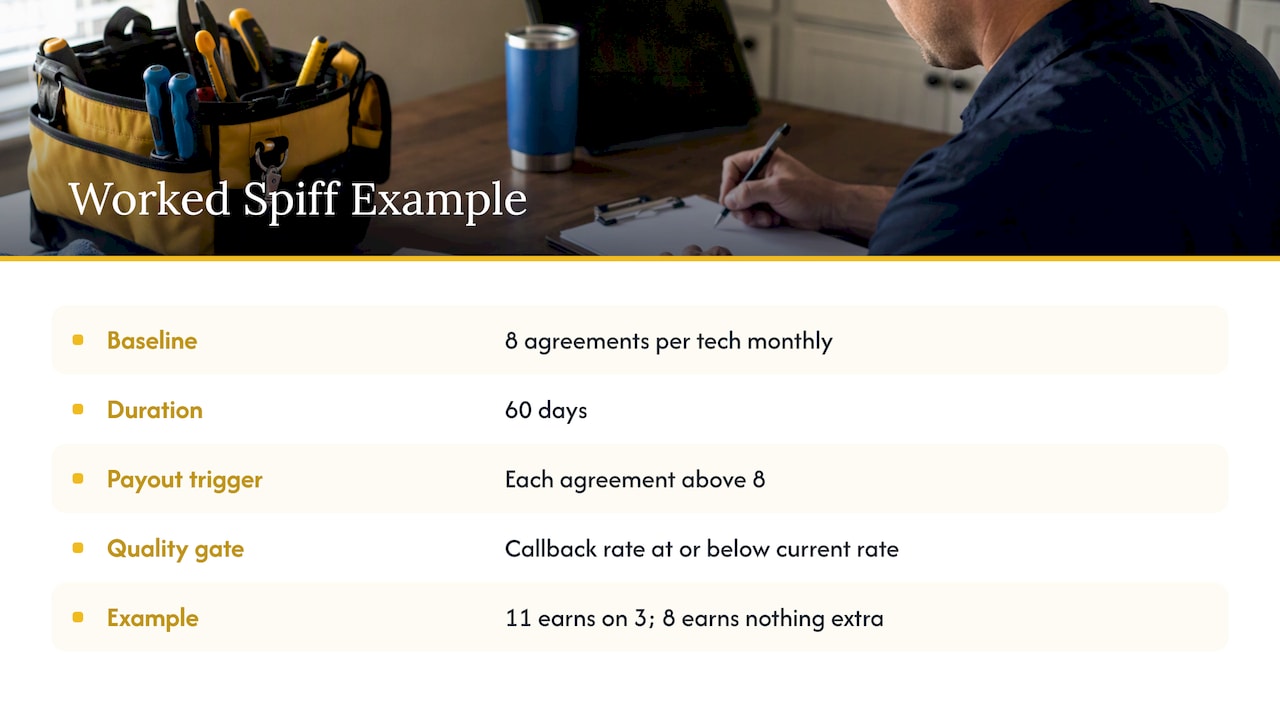
Say your baseline is 8 maintenance agreements attached per tech per month. You announce a 60-day spiff: a flat dollar amount for each agreement above 8, paid only if the tech’s callback rate stays at or below your current rate. You also spiff a no-callback month and a named 5-star review. A tech who hits 11 agreements and keeps jobs clean earns on three agreements plus the quality payouts. A tech who hits 8 earns nothing extra, which is the point. The amounts are yours to set from your own margins.
Tracking whether a spiff program works
A spiff you never measure becomes a permanent cost. Track the target metric against the baseline, and also the side effects. One industry guide frames it as checking that the incentive drives the goal without side effects such as callbacks, then adjusting.
A simple scorecard for each spiff:
- Target metric: agreements per tech, reviews per 100 jobs, same-day ticket close rate.
- Guardrail metrics: callback rate, cancellation rate on agreements, average ticket, customer complaints.
- Cost: total payout against gross profit created.
- Decision date: keep, change, promote to the standing plan, or end.
Review it at the halfway mark, not just the end. If one tech is earning most of the payout, ask whether the rest see the goal as reachable. If the callback rate climbs, pause and fix the rule.
Techs also need to see their numbers. A spiff they cannot verify feels like a rumor. Whether you use your field service software or a spreadsheet, show each tech what counted and what was paid, ideally weekly. Equipment and tool accountability platforms show how team accountability records can be shared with the people they affect, and the same transparency principle applies to incentive pay. Spiffs should appear as a separate earnings line on the paystub so techs can reconcile what they earned with what they did.
Payroll and overtime rules to check before you announce
This is where well-meaning owners get into trouble. The following is general information for US employers, not legal advice. Talk to your payroll provider or an employment attorney about your state.
Under the federal Fair Labor Standards Act, all compensation for hours worked, services rendered, or performance is included in the regular rate, apart from a short list of excludable payments. In practice, an announced spiff program is a nondiscretionary bonus that must be included in the regular rate used for overtime of non-exempt employees. So if a tech works 45 hours and earns a spiff that week or period, the overtime rate goes up, and you owe the difference.
The ACCA’s contractor blog makes the same point for the trade: HVACR technicians who do not qualify for an overtime exemption should be paid hourly with overtime after 40 hours, and wages and spiffs both go into the regular rate.
Three habits keep you out of trouble:
- Count spiffs in the regular rate for every non-exempt tech, every pay period. Do not treat them as a surprise gift.
- Keep a written plan with rules and dates, so you can show what was announced.
- Check state rules. Some states have their own wage, commission and final pay rules that go beyond the federal floor.
If you operate outside the US, payroll treatment differs by country, and bonuses and commissions are typically taxed or levied as wages. Look up your own jurisdiction’s rules before you copy any US-style plan.
Our perspective: spiffs are a symptom check, not a strategy
We work only with trade businesses, and the pattern we see is consistent. Owners reach for a spiff when something in the operation is not working: the agreement base is flat, callbacks are high, the office chases techs for paperwork. The spiff gets a bump for a month, then fades, because the underlying system never changed.
So before you launch one, ask what is causing the behavior you want to change. If techs do not attach agreements because nobody trained them on how to present value, a spiff will only reward the two who already knew. If callbacks come from poor dispatch or truck stock, a no-callback bonus punishes people for problems they do not control. If you cannot see gross profit by job type, you cannot size a spiff at all.
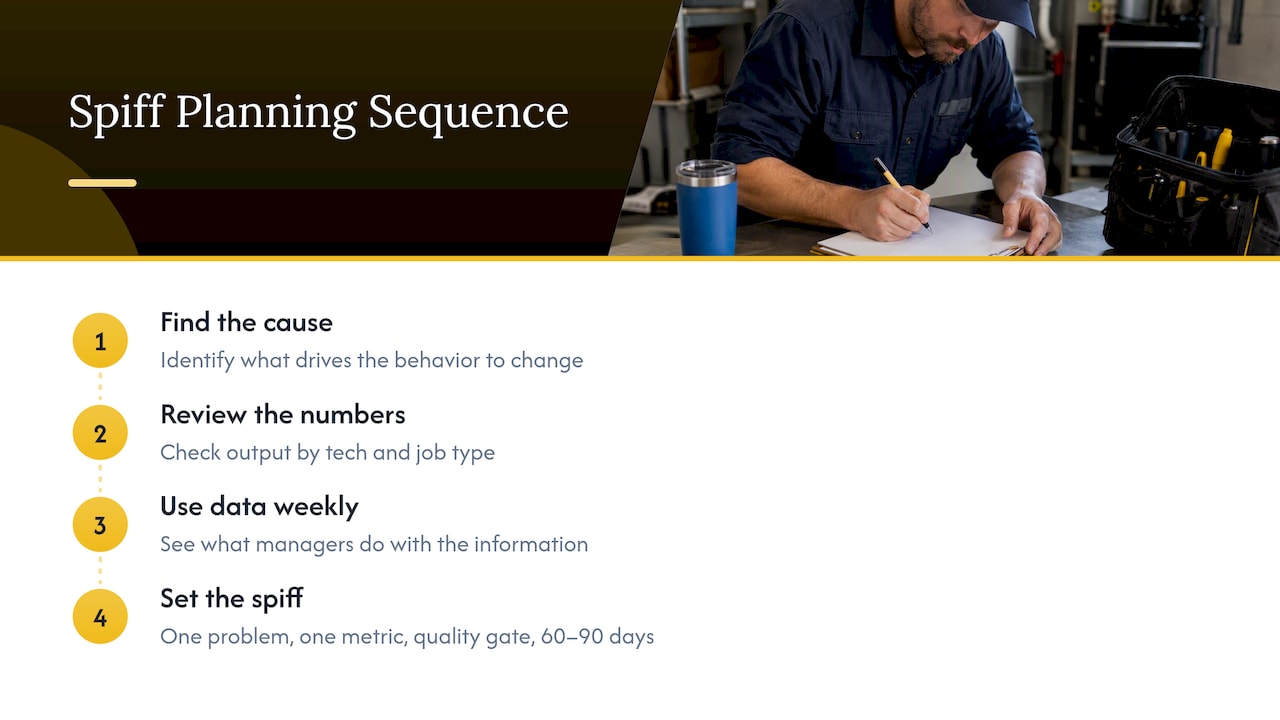
Our approach combines data, leadership training and accountability systems. That means we start with the numbers: what each tech and each job type actually produces, then what your managers do with that information each week. A spiff then becomes a small, well-aimed tool inside a structure that already works. In that setting it is cheap, easy to measure and easy to retire.
My advice: pick one problem, one metric, a handful of spiffed items, a quality gate and a 60 to 90 day window. Then look at the data before you decide what comes next.
— Dan
When a spiff is not enough
If you have run two or three spiffs and the numbers snap back each time, the problem is almost certainly upstream: sales process, call handling and dispatch, management follow-through, or financial visibility. Our Rebuild program and training offers cover sales training, management and leadership training, call management and dispatch training, install and project management training, financial operations support and marketing analysis for HVAC, plumbing, electrical and other trade companies. Pricing is not published, so the next step is a conversation about your operation.
Common spiff mistakes to avoid
- One item, one bounty. It invites pressure-selling. Spread rewards across several fitting outcomes.
- No end date. A spiff that never ends turns into an entitlement and an unplanned pay raise.
- Paying for baseline. If everyone already hits the number, you are just raising pay.
- Ignoring non-sales roles. Dispatchers, CSRs and install helpers shape the customer experience too. Consider a shared team spiff.
- Opaque payouts. Techs who cannot see why they were or were not paid lose trust quickly.
- Forgetting overtime math. Leaving spiffs out of the regular rate creates back-pay liability.
- Changing rules mid-stream. Announce, run, review, then change the next one.
FAQ
What are good spiff ideas for HVAC technicians?
Start with maintenance agreement attachments above baseline, no-callback months, named 5-star reviews, complete job photos and same-day paperwork. Spread rewards across several items so techs match recommendations to the customer. Add a quality gate to any volume-based spiff.
Is a spiff the same as a commission?
No. A spiff is a short, flat reward aimed at one behavior, while a commission is a standing percentage that is part of the pay plan. Use a spiff to steer for 30 to 90 days, and a commission when someone carries ongoing sales responsibility.
Do spiffs count toward overtime?
For non-exempt employees in the US, announced spiffs are generally nondiscretionary bonuses and belong in the regular rate used to calculate overtime. The Department of Labor’s fact sheet explains the rule. Confirm your specific setup with your payroll provider or an employment attorney.
How big should a technician spiff be?
Size it from the value of the behavior, such as the gross profit an agreement creates, and keep it a modest share of a tech’s income. Pay only above a baseline from your last six to twelve months of data. Test small, then adjust.
How do I know if a spiff worked?
Compare the target metric with your baseline, then check guardrails like callbacks, cancellations and complaints. Compare the payout with the gross profit created. Decide at a set date whether to keep, change, promote or end it.
Sources
- How to Use HVAC SPIFFs to Boost Business Profit
- HVAC Spiffs: How to Run a Spiff Program for Techs
- What is a Spiff? A Guide on Using Spiffs in Your Home Services Business
- Spiffs vs. Bonuses vs. Incentives
- HVAC Spiffs & Bonus Programs That Motivate
- Spiff and span: How to ensure you’re legally compensating your techs
- Fact Sheet #56C: Bonuses under the FLSA
- HVAC tool tracking for service fleets
0 Comments