
You reduce HVAC callbacks by doing four things in order. Define what counts as a callback, track the causes by category, verify every job with measured data before the truck leaves, and review each repeat visit as a process failure instead of a technician failure. Most shops skip the first step, which is why their numbers never improve.
This guide is for owners and managers who want a lower callback rate and a quality-control system that holds when the schedule gets tight.
TL;DR
- Decide what counts as a callback before you measure it. Companies that count different categories can report blended rates 4 to 6 percentage points apart.
- Most callbacks trace to setup and installation misses: airflow, refrigerant charge, drains, wiring and thermostat configuration, not defective equipment.
- Replace “checked it” checklists with measured values: static pressure, airflow, charge, and a signed record per system.
- Rushed schedules cause callbacks. Fix dispatch and time allowances, not just technician training.
- Review every callback in a short, blameless meeting and change one process each time.
Table of Contents
- What actually counts as a callback
- What callbacks really cost
- The most common causes
- Build a tracking system that finds patterns
- Quality control that works before the truck leaves
- Fix the system around the technician
- How to review a callback so it improves the process
- Perspective: why callbacks are a management problem
- Where we can help
- A 90-day plan to cut callbacks
- FAQ
- Sources
What actually counts as a callback
The phrase “callback” covers very different events, and that is the first reason shops argue about their numbers. Built on Tenth’s benchmark guide separates true defect, misdiagnosis, parts return, warranty, new issue, and nuisance or question callbacks. It notes that blended rates can differ by 4 to 6 percentage points purely because companies count different categories.
That matters because the categories need different fixes:
| Category | Example | Preventable? | Fix lives in |
|---|---|---|---|
| True defect | Loose connection fails a week later | Yes | Technician checklist, final verification |
| Misdiagnosis | Replaced a capacitor, the real fault was the board | Yes | Diagnostic training, test procedures |
| Parts return | Part fails or was wrong | Partly | Supplier handling, parts testing |
| Warranty | Manufacturer defect | Rarely | Supplier relationship |
| New issue | Unrelated failure at the same home | No | Do not count against the tech |
| Nuisance or question | Customer did not understand the thermostat | Yes | Customer walkthrough, communication |
Pick a definition and write it down. A workable shop rule: a callback is any return visit to the same address, for the same system, within a fixed window after your last visit, where the original work or explanation was the likely cause. Tag each one with a category when the ticket is closed. Once you tag, you can see which row is costing you.
Technicians also dislike the term, since in many shops a callback means lost commission or a reprimand. If that is how it works in your company, your people will stop reporting them honestly. Separate the data from the discipline. We come back to this below.
What callbacks really cost
The cost is easy to underestimate because it is spread across payroll, fuel, and lost schedule space. ACCA’s callback cost article lists technician labor, office and truck overhead, and the paid work you could have done instead. It also points to damaged reputation, frustrated customers, and burned-out technicians. In ACCA’s example business, cutting callbacks from 5% to 2% brings annual callback costs down to about $30,000.
Your own numbers will differ, so calculate them. ACCA’s Callback Calculator, announced in January 2026, needs at minimum your number of installations, service calls, and callbacks. You can replace the preloaded industry assumptions with your own figures, which you should do.
A simple version you can do on paper:
- Count callbacks last quarter, using your written definition.
- For each, add the second truck roll (drive time both ways), diagnostic time, repair time, paperwork, and the office time spent calling the customer.
- Add the revenue you could have earned in that slot. This is the number most owners forget.
- Multiply by four for an annual figure.
If the total shocks you, good. It is the budget you can spend on prevention and still come out ahead.
The most common causes
The pattern across industry sources is consistent: callbacks come mostly from what happens at installation and setup, and from rushed finishing.
HVAC School’s callback guide names improper system setup, failure to test the whole system, misdiagnosis, condensate-drain issues, customer miscommunication, forgotten disconnects, low-voltage and thermostat wiring errors, dirty coils, and improper refrigerant charge.
The National Institute of Standards and Technology found something similar from the performance side. NIST reported in 2014 that common installation faults include leaky ducts, improper refrigerant charge, oversized systems, and restricted airflow, with leaky ducts the dominant fault in the studies it reviewed. Those faults can degrade real-world performance even when the equipment is rated correctly.
Heat pumps add their own failure modes. ACHR News reported in April 2026 that heat-pump callbacks commonly arise from incorrect sizing, poor airflow, improper refrigerant charge, and thermostat or control configuration errors. The Lennox technical manager quoted there argues most heat-pump callbacks come from installation and setup mistakes, not equipment defects. The same article lists recurring commissioning misses: not recording static pressure and blower CFM, not weighing in refrigerant, and not testing the thermostat and equipment in heating mode. For a closer look at what to measure on these systems, this piece on heat pump performance monitoring covers the measurements in more detail.
Notice what is missing from every list: bad luck. These are process gaps, and process gaps can be closed.
The human cause behind the technical ones
The industry expert quoted by ACHR News attributes callbacks to rushed work, knowingly poor workmanship, and insufficient knowledge. His operational remedy is to give technicians enough time to diagnose, document, explain options, repair, and verify performance. Read that as a scheduling statement. If dispatch books a tech into a day with no room to verify, the checklist gets skipped no matter how good the tech is.
Build a tracking system that finds patterns
You cannot reduce what you cannot see. A tracking system for callbacks needs only a few fields on every closed ticket:
- Original job number and date
- Original technician and callback technician
- Category (use the table above)
- Root cause in one line (for example, “condensate switch not tested”)
- Preventable: yes or no
- Fix owner: technician, dispatch, sales, installer, supplier
Review the data monthly. You are looking for clusters: one technician with repeated drain-line callbacks, one install crew with repeated thermostat wiring issues, one equipment brand with repeated board failures, or a specific time of day when callbacks spike. Clusters point to training or scheduling problems. Scattered one-offs point to normal noise, and you should not overreact to them.
Diagnostic tools can strengthen the record. A Pacific Northwest National Laboratory case study describes smart diagnostic tools that capture airflow, temperature, refrigerant, pressure, and electrical measurements, calculate system performance, identify faults, and store verified performance in the customer record for later troubleshooting. When a callback comes in, the second technician starts with the baseline instead of guessing.
In that same case study, Simpson Salute reported its callback rate fell from 3% to 1% after using smart diagnostic probes on every call. That is one company’s reported result, not a benchmark you should promise yourself, but it shows what measurement on every call can do.
If your dispatch and ticketing are still manual, a service work order automation guide is worth reading when you decide how callback tags and fix owners should flow through your tickets.
Quality control that works before the truck leaves
Quality control in HVAC means verifying the system performs, not that the work was done. The gap between those two is where callbacks live.
Use measured commissioning, not tick boxes
The EPA’s ENERGY STAR program publishes a national HVAC commissioning checklist (April 2025 revision) that is a good model even if you do not work on ENERGY STAR homes. It has the contractor record refrigerant-charge readings, measure fan airflow against design, and verify room-by-room airflow against design. Room-by-room airflow must fall within the greater of plus or minus 20% or 25 CFM of design. One checklist is completed and signed per commissioned system and retained with the design report for at least three years.
Those tolerances are a useful template for your own standard. The reasons airflow tolerances and signed records matter are explained well in this guide to airflow efficiency in buildings, which is written from the building side of the same problem.
For installs, the ENERGY STAR HVAC Quality Installation sponsor guide specifies duct-leakage limits and recommends training and mentoring to build a qualified contractor network. The principle carries over: a standard only works if people are trained to it and coached on it.
Borrow the full quality-installation workflow
ACCA’s description of its Quality Installation workflow is a checklist of the steps most often skipped:
- Compliance with manufacturer instructions
- Nitrogen flowing during brazing
- A 60-minute pressure test
- Evacuation below 500 microns with a decay test
- Condensate preparation
- Wiring checks
- Recorded performance data
ACCA reports that, with practice, the full measureQuick verified-operation workflow takes about 30 minutes at the end of an install, and generally under an hour for new teams. Thirty minutes is cheap next to a second truck roll.
Why paper checklists fail
ACCA’s callback-cost article warns that paper checklists can be filled out on autopilot or copied after the job. It recommends performance-based verification with real-time system data. So require numbers: static pressure, blower CFM, superheat or subcooling, charge weight, delta-T. A tech cannot fake a reading that a supervisor can compare to the design.
A short pre-departure standard for service calls
Install commissioning is heavy. For service calls, a lighter version works if it is consistent:
- Run the whole system through a full cycle, not just the part you repaired.
- Check the condensate drain and safety switch.
- Confirm the thermostat settings and test in every mode the season calls for.
- Verify all panels, screws, disconnects and covers are secured.
- Record key readings on the ticket.
- Walk the customer through what you found, what you did, and what to expect.
The fifth and sixth steps do double duty. Readings give you the baseline for a future callback, and the explanation prevents the nuisance callbacks that come from customers who did not understand the result.
Fix the system around the technician
Owners often respond to a callback problem with a technician talk. That helps with knowledge gaps, but the other causes live elsewhere.
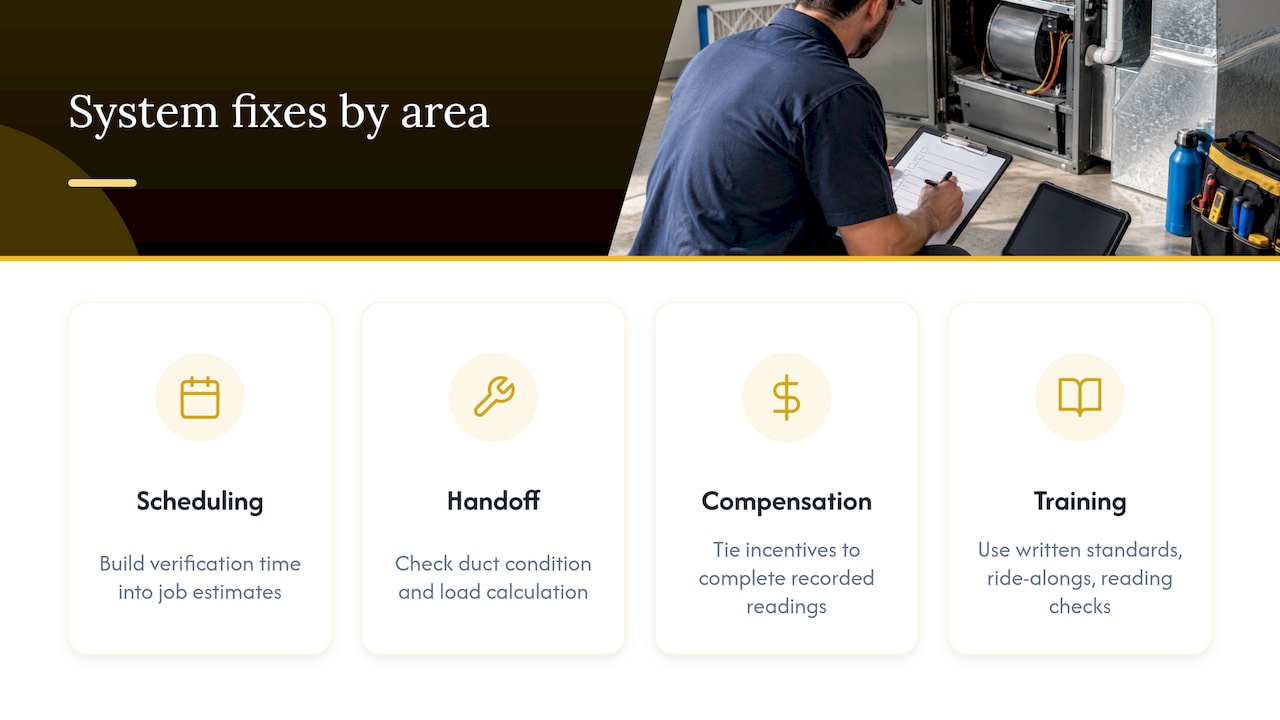
Dispatch and scheduling. If your best technicians run behind because the board is packed, the last 15 minutes of every job get cut. Build verification time into job-type estimates, and train dispatchers to protect it when the day gets busy. A dispatcher who knows a callback costs a second truck, a second diagnostic, and a slot you could have sold will make different calls.
Sales and install handoff. Oversized systems and ducts that were never evaluated are sales and design problems. If your comfort advisors price a replacement without checking duct condition or doing a load calculation, the install crew inherits a callback.
Compensation. If a callback costs a technician commission, you invite hiding them. Many owners get better data by treating callbacks as company data first, and tying incentives to the quality of verification, such as complete readings recorded, rather than punishing the count.
Training. Train to a written standard, with ride-alongs and checks on recorded readings. Mentoring is part of the ENERGY STAR approach for good reason: people copy what they see.
How to review a callback so it improves the process
Every callback is a free lesson, if you review it. Keep the meeting short, blameless, and routine.
- Gather the facts. Original ticket, readings, photos, and what the callback technician found.
- Categorize it using your definition.
- Ask what the process allowed. Not “who missed it” but “why did our process let it leave?” Was verification skipped, was the time unavailable, was the training missing, was the tool missing?
- Change one thing. A checklist line, a dispatch rule, a training session, a parts handling step.
- Close the loop. Tell the original technician the finding, and check next month whether the cluster shrank.
This mirrors the logic of commissioning. ASHRAE describes commissioning as verifying and documenting that systems are planned, designed, installed, tested, operated, and maintained to meet the owner’s requirements, with resources that include checklists, testing and reporting, training, and operations documentation. A callback review is that same cycle applied to your own company’s work.
Perspective: why callbacks are a management problem
We work only with trade businesses, and the callback conversation we hear most often starts with a technician and ends with a system. An owner says a certain tech keeps getting callbacks. When we look at the shop, we usually find the same upstream pattern: no shared definition of a callback, no data by cause, a dispatch board with no room to finish properly, and a compensation plan that punishes honesty.
Our view is that quality control is a leadership and accountability problem before it is a technical one. Technicians generally know what a good job looks like. What they need is time, a standard written down, a manager who checks recorded numbers, and a culture where reporting a miss is safe. When owners build those four things, callbacks drop because the process stops producing them, not because people are afraid of them.
That is why our work combines data, leadership training, and accountability systems, in the field with your team rather than from a template. Fix the system and the technicians do the rest.
— Dan
Where we can help
If your callback data shows clusters you cannot seem to close, the cause is usually in dispatch, training, or management routines. Our Rebuild program covers call management and dispatch training, management and leadership training, and install and project management training, plus the financial and KPI visibility to see what callbacks really cost. We work hands-on inside HVAC, plumbing, electrical and other trade businesses, so the standards we set fit how your crews actually work. You can also start from our home page to see how we work.
A 90-day plan to cut callbacks
Days 1 to 30: measure. Write your definition. Tag every callback by category and root cause. Calculate the true cost using your own numbers. Do not change anything else yet; you need a baseline.
Days 31 to 60: standardize. Write a pre-departure standard for service calls and a commissioning standard for installs, using measured values. Adjust job-time estimates so verification fits. Train your dispatchers on why.
Days 61 to 90: reinforce. Audit recorded readings weekly. Start the blameless callback review. Share the first month’s cluster data with the team and name the process change you made because of it.
After 90 days, compare your rate with your baseline using the same definition. Do not compare it with another company’s number unless you know how that company counts.
FAQ
What is a good HVAC callback rate?
There is no single accepted figure, because rates depend on which categories a company counts. Built on Tenth notes that blended rates can differ by 4 to 6 percentage points based on counting alone. Set your own baseline with a written definition, then track improvement against that.
What causes most HVAC callbacks?
Most trace to installation, setup, and finishing mistakes: airflow problems, incorrect refrigerant charge, condensate-drain issues, thermostat and low-voltage wiring errors, and misdiagnosis. Customer miscommunication also drives repeat visits. Equipment defects are a smaller share in the sources we reviewed.
How do you calculate the cost of a callback?
Add the second truck roll, diagnostic and repair time, paperwork, and office time spent with the customer. Then add the revenue you lost by using that slot for a repeat visit. ACCA’s Callback Calculator can help, and you should replace its default assumptions with your own figures.
Should technicians be penalized for callbacks?
Punishing the count tends to push people to hide or relabel callbacks, which ruins your data. A better approach is to review each one for process causes and reward complete verification records. Reserve discipline for knowingly poor workmanship.
Sources
- HVAC Callback Rate Benchmarks, Built on Tenth
- The true cost of callbacks, ACCA HVAC Blog
- Announcing the ACCA Callback Calculator
- Preventing Callbacks and Warranty Returns, HVAC School
- Underperforming? Energy Efficiency of HVAC Equipment, NIST
- Eliminating Heat Pump Callbacks Before They Start, ACHR News
- From Data to Decision-Making: Smart Diagnostic Tools, PNNL
- ENERGY STAR National HVAC Commissioning Checklist
- ENERGY STAR HVAC Quality Installation Sponsor Guide
- What’s required to issue an ACCA QI Certificate, ACCA HVAC Blog
- Commissioning, ASHRAE
0 Comments