
A training playbook for contractors is a written, shared system that shows every new and current employee how your company does the work, how it expects them to behave, and how they move from new hire to trusted lead. It covers technical steps, jobsite rules, customer conduct, and the review points that tell you whether someone is ready for the next level. If your best technician or you are the only person who knows how a job should go, a playbook is how you get that knowledge out of one head and into the whole crew.
This guide shows what goes in, a template outline you can copy, topics for HVAC, plumbing and electrical teams, how to roll it out, and how to check that it works.
TL;DR
- A training playbook documents how your company works and how people grow in it: safety, technical standards, customer conduct, role checklists and review milestones.
- Build it from the mistakes and questions that repeat on your jobs, not from a blank page or a generic binder.
- Start small: day-one rules, a ride-along checklist, a skills grid, and 7, 14 and 30-day reviews. Expand role by role.
- A playbook only works if leaders use it weekly. Tie it to toolbox talks, post-job reviews and accountability, then audit it on a schedule.
- Measure at three levels: reaction, retained learning, and on-the-job impact months later.
Table of Contents
- What a contractor training playbook actually is
- Why it matters when you want to grow
- What to put in the playbook
- Role-specific topics for HVAC, plumbing and electrical
- How to build it, step by step
- Using the playbook to onboard, develop leaders and hold people accountable
- Our perspective: a playbook is a leadership system, not a document
- Keeping the playbook current
- How to tell whether it is working
- Need help turning this into a working system?
- FAQ
- Sources
What a contractor training playbook actually is
People use “playbook” loosely. In a trade business it helps to separate three layers:
- Standard operating procedures (SOPs). Step-by-step instructions for specific tasks, such as how to run a no-cool call or how to close out a job. A construction SOP playbook organizes this knowledge into a hierarchy of processes, with SOPs documenting individual tasks inside each workflow.
- Training pathways. The route from day one to competent to lead: what someone learns, who teaches it, and how you confirm they have it.
- Expectations and accountability. The standards for punctuality, communication, paperwork, truck condition and customer conduct, plus who checks them and when.
A binder of SOPs with no pathway is a reference manual that nobody opens. A pathway with no standards is mentorship that varies by who rides with whom. The playbook joins all three.
It is also not software. Field service and project tools can store and deliver the content, but the content is a leadership decision: what good looks like at your company. No tool writes that for you.
Why it matters when you want to grow
Most trade companies hit the same wall. The owner or one senior tech is the standard. Every new hire learns by watching whoever they are paired with, so quality drifts, callbacks creep up, and the owner gets pulled into jobs and conflicts that should have been handled by someone else.
The pattern is consistent across the businesses we work with: growth stalls when the skill cannot be transferred. If you cannot teach it, you cannot scale it. Training done only in reaction to a mistake (“remember to do this next time”) fixes one job and creates no system.
A playbook changes three things:
- Speed to productivity. New hires know what is expected in week one and what they must demonstrate by day 30, instead of guessing.
- Consistency. Two technicians in two trucks do the same inspection, the same paperwork and the same customer walkthrough.
- Leadership time. Managers coach against a written standard instead of arguing about opinions, which is the foundation of real accountability.
What to put in the playbook
One research-backed starting point for a first version is to include day-one safety and jobsite rules, a ride-along checklist, a skills grid, and 7-day, 14-day and 30-day review forms, per a new-hire checklist for contractors. That is enough to use immediately, and you can grow it from there.
A template outline you can copy
Use this skeleton and fill each part with your own standards.
| Section | What it contains | Who owns it |
|---|---|---|
| 1. Company standards | Mission, values, dress, attendance, communication rules, truck and tool care | Owner or GM |
| 2. Safety and jobsite rules | PPE, site-specific briefings, incident reporting, ladder, electrical and confined-space basics that fit your work | Safety lead |
| 3. Day-one orientation | Paperwork, tour, vehicle and tool issue, who to call for what | Manager |
| 4. Ride-along checklist | Observations a new hire must see and a lead must sign off | Lead tech |
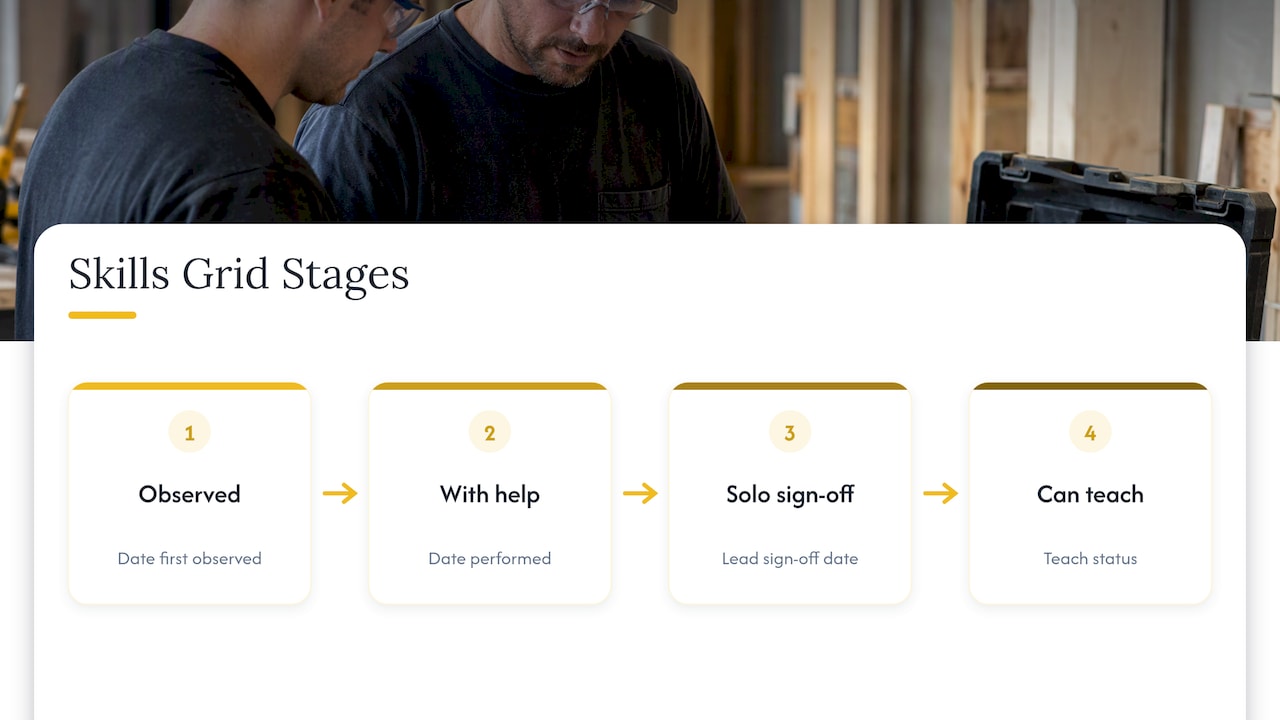
| 5. Skills grid by role | Every skill listed with levels: observed, assisted, independent, can teach | Department head |
| 6. Customer interaction standards | Greeting, walkthrough, options presentation, payment, follow-up | Service or sales manager |
| 7. Paperwork and systems | Dispatch notes, photos, invoices, timecards, how to use your software | Office manager |
| 8. Review forms | 7, 14 and 30-day reviews, then 90 days and one year | Direct supervisor |
| 9. Career path | What it takes to move up and what each level pays or earns | Owner |
Keep every page short. Concise bullets, photos and short videos beat long prose, which is the approach one construction training guide recommends for documenting standards.
Make the skills grid specific
A skills grid is the most useful single page in the playbook. List every task a person in that role might perform, and for each one record the date they first observed it, the date they performed it with help, the date a lead signed them off to do it alone, and whether they can teach it. Vague entries like “good with customers” do not help. “Explains three repair or replacement options with prices without being asked” does.
Role-specific topics for HVAC, plumbing and electrical
The company-wide sections are the same for every trade. The technical and customer content is where your trade shows.
HVAC
HVAC and refrigeration teams can build training around preventive-maintenance checklists for commercial systems, condensate-pump maintenance, capacitor testing, system diagnostics, coil inspection and cleaning, refrigeration measurements, defrost settings, documentation, truck stock and customer interaction, as laid out in a commercial HVAC/R tune-up and troubleshooting session. Notice that documentation and truck stock sit on the same list as diagnostics. Callbacks often come from a missing photo or an empty truck bin, not from a lack of technical skill.
Add your own: your standard for recording readings, how you present maintenance agreements, and the exact steps for a no-cool call.
Plumbing
Build in your standards for diagnosis and camera inspection, permit and inspection steps in your jurisdiction, water heater and drain call procedures, flat-rate or time-and-material pricing explanations, and how techs present options. Plumbing owners often struggle most with financial visibility, so include how a tech’s job notes and invoice coding feed job costing. If a tech does not record materials and time accurately, you cannot see which job types make money.
Electrical
Include load calculations and code references your team must follow, lockout/tagout and safe work steps, panel and service upgrade procedures, how helpers progress to journeyman duties, and the quality checks before a final inspection. If you run registered apprentices, your program already has structure to draw on. For example, one state electrical association’s apprenticeship standards show a training committee overseeing the program and monitoring apprentice progress against minimum education and experience requirements. Your playbook should do the same job for every employee, registered or not.
Sales, dispatch and management
Technical training is half the picture. A proven training program should also cover sales and customer service and product knowledge, with leadership and life skills as optional but highly recommended. Write the call script and booking standards for your CSRs, the dispatch rules for routing and priority, the sales process from lead to signed proposal, and the management basics for supervisors: how to run a one-on-one, give feedback and hold a standard.
How to build it, step by step
Do not try to write the whole thing in a month. Work in this order.
- Collect what repeats. Ask foremen, senior techs and office leads what new hires struggle with and which mistakes show up again and again. Building the curriculum from recurring difficulties and repeated job mistakes keeps the playbook anchored in real problems.
- Pick one role. Start with the role you hire most often, usually an installer, a service tech or a CSR.
- Write the day-one and week-one pages. Safety, orientation, tools, who to call, what a good first week looks like.
- Build the skills grid. Fifteen to thirty tasks is a fine first pass.
- Capture the top ten procedures. Use your best performer doing the work. Photograph or film it on a phone, then write five to ten bullets.
- Add the review forms. One page each for 7, 14 and 30 days, then 90 days and one year.
- Pilot with the next hire. Take notes on where they got confused and fix those pages that week.
- Expand. Add the next role, then the next, until every position has a path.
Make it interactive, not a slideshow
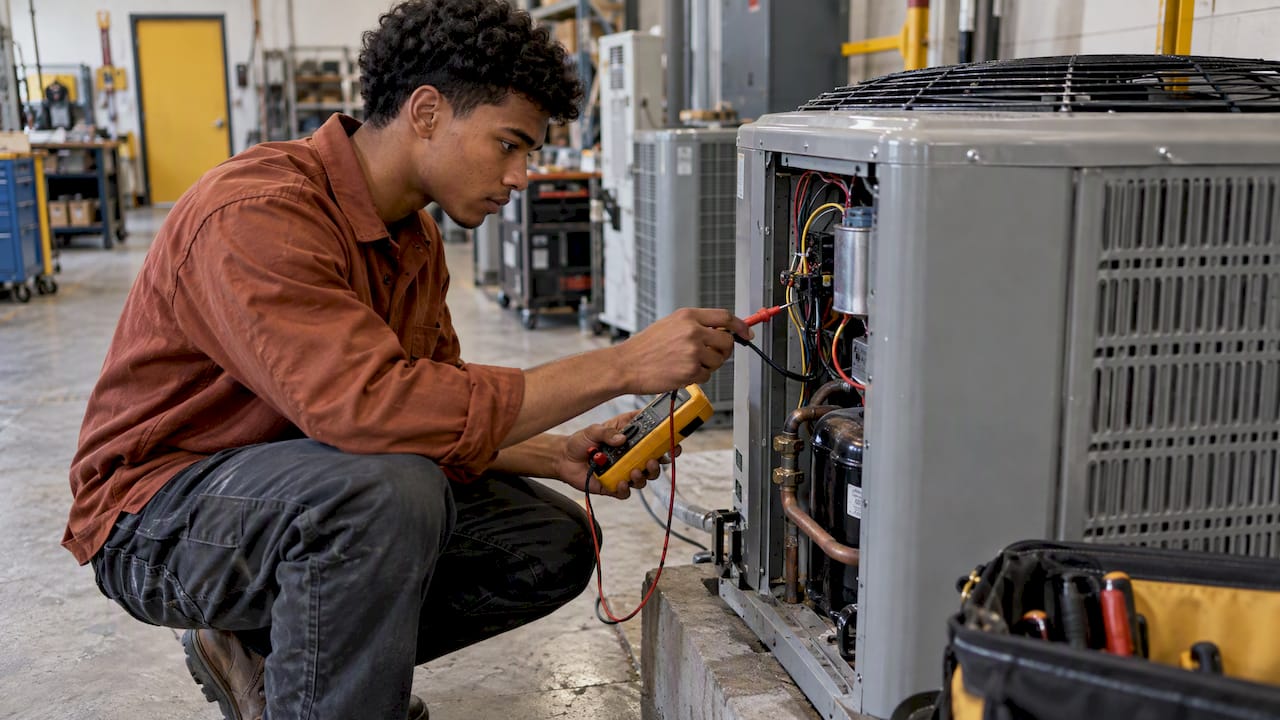
Copeland, an HVACR manufacturer, emphasizes application-based training that mirrors field scenarios and avoids passive, PowerPoint-style instruction. Practical ways to do that: run mock service calls in the shop, have trainees diagnose a deliberately faulted unit, and role-play the price presentation before they do it at a kitchen table.
Training also needs to connect to how work is assigned and tracked. A clear approach to construction task management helps you turn playbook standards into daily checklists that crews actually see on the job.
Budget for it
To start, one contractor guide suggests setting aside 1 to 2 percent of total revenue, or 3 to 5 percent of an individual’s compensation package, for training. Treat that as a starting range for planning, then adjust to your margins and hiring volume.
Using the playbook to onboard, develop leaders and hold people accountable
Onboarding
Tie the playbook to a calendar. Use role-based skills checklists with milestones at 30 days, 90 days and one year, a structured first-day orientation, and weekly toolbox talks of 10 to 15 minutes, plus post-job reviews and cross-training. The point is rhythm: training is part of how the company runs, not an event.
For each training session, document the basics: site readiness, PPE and tools, a site-specific safety briefing, an assessment such as a quiz or a practical check, attendance and feedback records, and completion logging. A simple log answers the question owners usually cannot: who was trained on what, and when.
Leadership development
Playbooks fail when supervisors are not trained to use them. Put a leadership track in the playbook: how to run a morning huddle, how to give corrective feedback, how to do a ride-along review, and how to read the numbers for their department. One practical tip from the same guide: build a year-long training calendar aligned to business needs, assess each employee’s strengths and weaknesses, and have team members present training topics. Teaching a topic is one of the fastest ways for a lead to master it, and it builds the train-the-trainer habit you need as you grow.
Accountability
Accountability is not blame. It is a written standard, a person who checks it, and a consistent consequence, good or bad. The playbook supplies the standard. Your review forms and KPIs supply the check. If a tech is signed off on a skill, the next callback tied to that skill is a coaching conversation, not a surprise.
Our perspective: a playbook is a leadership system, not a document
We work only with trade businesses, and we see the same story in HVAC, plumbing, electrical, roofing and remodeling shops. The owner is exhausted, the systems live in people’s heads, and the numbers are murky. A lot of owners respond by buying a template or software, and the folder sits unopened.
Here is what we believe, based on that work:
- The writing is the smaller job. The bigger job is deciding the standard and enforcing it consistently. A mediocre playbook that leaders use every week beats a beautiful one nobody references.
- Training has to come from the field. We start with onsite audits because the real process is what happens on the truck and in the office, not what the org chart says.
- Leaders go first. If managers are not trained to coach, the playbook becomes one more thing the owner enforces alone. That is why leadership and management training sits next to technical and sales training in our work.
- Tie it to the numbers. When training connects to KPIs, reporting and financial visibility, you can see which standards move revenue, callbacks and margin. Our case studies report operational clarity and run rates reaching $21 million for trade businesses that built that structure.
A playbook is the written form of your company’s operating system. Build it that way and it will carry the business when you step away.
— Dan
Keeping the playbook current
A playbook goes stale the moment your process changes. Give it an owner and a schedule.
- Audit on a cadence. OSHA’s guidance on internal audits says they should be done at a set frequency, such as quarterly or annually, and should evaluate the accountability system, training processes, resources, facilities, equipment and records. Borrow that structure even if your work is not under that particular standard.
- Update after every callback or incident. If a failure revealed a gap, change the page that week and tell the team.
- Version your pages. Put a date and an owner on each one so nobody trains from an old sheet.
- Keep it where people work. Techs need it on their phones, office staff at their desks. If finding a procedure takes more than a minute, it will not be used.
How to tell whether it is working
Set a goal for each training, measure and recognize improvements, and use assessments to find each employee’s strengths and weaknesses, as one contractor training chapter advises. For a more structured method, the OSHA Safety Staff Workbook describes evaluation at three levels: immediate reaction to a session, assessment of retained learning, and an impact assessment months later to see whether the training is applied at work.
For proficiency, OSHA’s non-mandatory training curriculum guidelines say it should be evaluated and documented using a written assessment and a skill demonstration. Those guidelines are written for hazardous waste operations, but the principle transfers well: do not just ask whether someone attended, have them show it.
Track a handful of measures that match your goals:
| Question | Example measure |
|---|---|
| Are new hires ramping faster? | Days to first solo job; 30-day review scores |
| Is quality more consistent? | Callback rate; inspection pass rate; invoice accuracy |
| Are leaders coaching? | Completed one-on-ones and post-job reviews per month |
| Is it affecting the business? | Average ticket, close rate, gross margin by job type |
| Is the playbook used? | Completed skills grids; training log entries |
Compare numbers before and after rollout, and give the data a few months before you judge it, since the real impact shows up on later jobs.
Need help turning this into a working system?
Most owners know what they want the playbook to do. The hard part is finding the time, gathering the standards from the field and getting supervisors to use it. Our Rebuild program is hands-on operational consulting for trade businesses. It includes sales training, management and leadership training, install and project management training, call management and dispatch training, financial operations and compliance assistance, and marketing analysis. If you want a partner to help build and install the system in your company, start there.
FAQ
What is a training playbook for contractors?
It is a written system that documents how your company does its work and how employees learn it. It combines procedures, safety and customer standards, role checklists, and review milestones. The goal is that anyone you hire can reach the same standard without relying on one person’s memory.
What should a training playbook template include?
At minimum: company standards, day-one safety and jobsite rules, a ride-along checklist, a skills grid for each role, and 7, 14 and 30-day review forms. Add customer interaction standards, paperwork and systems, and a career path. The template outline above is a ready starting point.
How long does it take to build one?
A usable first version for one role can be done in a few weeks if you focus on day-one pages, a skills grid and the top ten procedures. The full playbook grows over months, one role at a time. Test each section on the next new hire before writing more.
Who should write it?
Your best performers and supervisors should supply the content, because they know how the work is actually done. One person, such as the operations or office manager, should own the format and updates. The owner decides the standards and enforces them.
Do I need software to run a playbook?
Not to start. A shared folder with short documents, photos and phone videos works. Software becomes helpful when you need to assign tasks, track completion and keep records at scale, but it can only deliver standards you have already defined.
Sources
- How to Build a Construction SOP Playbook (Subtrak)
- Contractor Employee Training Checklist: First 30 Days
- Build a Construction Training Program (Projul)
- Commercial HVAC/R Systems Tune-Up and Troubleshooting (HVAC School)
- Minnesota Standards of Apprenticeship (Electrical Association)
- Training Program, Contractor Playbook chapter 14
- Training the Next Generation of HVACR Technicians (HVAC School podcast)
- Construction task management: a practical guide (Buildberry)
- OSHA standard operating procedures, Appendix B
- OSHA Safety Staff Workbook
- OSHA 1926.65 Appendix E, Training Curriculum Guidelines
0 Comments