
The best technician on your crew just became your first service manager, or you are the one stepping into the job. Either way, the next 90 days decide whether the role works. The service manager creates the management layer between ownership and the field: coaching technicians, holding standards, handling callbacks and escalations, and working with dispatch. That is a different job from fixing equipment, and it needs its own training. At Rebuilding the Trades we build that training for HVAC, plumbing and electrical companies, and this playbook covers the same ground.
TL;DR
- A service manager coaches, sets standards and watches the numbers. A technician fixes and a dispatcher runs the daily schedule.
- Most new managers are promoted technicians who never got leadership training, so the first skills to build are communication, delegation and reading the financials.
- Spend days 1 to 30 learning, days 31 to 60 fixing a few priorities, and days 61 to 90 building routines.
- Track daily calls, leads and dollars, plus gross margin, so you never wait for month-end to find a problem.
- Owners get faster results when the promotion comes with structured training and an accountability system.
Table of Contents
- What a service manager actually does
- Can you become a service manager with no management experience?
- Your first 90 days
- Earn trust and set expectations
- Numbers a service manager should watch
- What owners can do before the promotion
- Training that fits the new manager
- Our perspective
- FAQ
- Sources
What a service manager actually does
A service manager creates a layer between company leadership and the field team. The duties include technician coaching, field accountability, operational standards, callbacks, customer escalations, technical support, performance reviews and coordination with dispatch. In a small shop, the owner or a senior plumber often does all of this informally, which is why the first formal hire can feel like a big change.
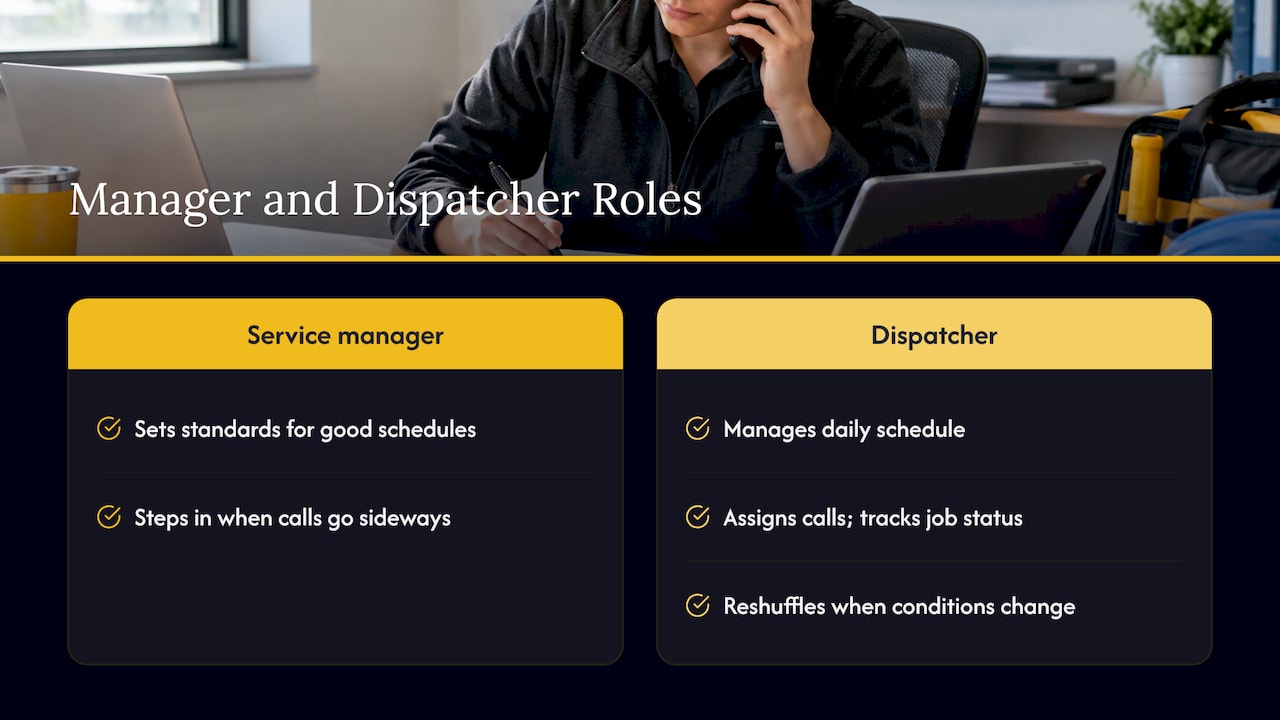
The dispatcher is a different seat. The dispatcher manages the daily schedule, assigns calls, tracks job status and reshuffles when conditions change. The service manager sets the standards that make a good schedule possible and steps in when a call goes sideways.
The job is also wider than most new managers expect. One trade publication describes the day as selling and maintaining service agreements, budgeting, scheduling and on-site attention to service calls. A posted service manager role from 2026 splits the work into daily, weekly and monthly rhythms: customer communications and huddles daily, receivables and ticket reviews and one-on-ones weekly, and financial close, commissions and KPI reviews monthly.
Technician, dispatcher, service manager
| Role | Owns | Measured by |
|---|---|---|
| Technician | The job in the home or building | Completed work, quality, customer feedback |
| Dispatcher | Today’s schedule | Booked calls, routing, schedule changes handled |
| Service manager | The team and the standards | Callbacks, team performance, department numbers |
If your dispatching is where the strain shows, our piece on audit-first dispatcher training shows how to separate the two seats cleanly.
Can you become a service manager with no management experience?
Yes, and in the trades it happens constantly. A service manager may or may not have managed before, and many were highly productive technicians who will need new skills, including a view of company strategy and an understanding of how each person contributes to goals.
If you are the one being promoted, a university career guide says you can move into management by showing transferable skills, such as leading a small project or training and mentoring a new hire. Ride-alongs with an apprentice, running a toolbox talk or owning a callback review all count.
The gap is usually not technical. An industry trainer quoted in ACHR News says many service managers are promoted without communication and customer-service training, have little experience with different personalities and leading teams, and struggle most with fear of change, failure and losing control.
Skills to build first
- Communication. Say what you expect, plainly, and say it more than once.
- Delegation. A strong tech finds it easier to do the job than hand it off. Good delegation is neither dumping work nor micromanaging: the right tasks go to the right people so they grow and the work gets done efficiently.
- Reading numbers. A service manager needs enough math to build a budget, read a profit-and-loss statement and price for a solid gross margin.
- Customer handling. Escalations land on your desk, so empathy and calm matter as much as technical judgment.
One honest note for the person stepping up: early management roles carry your old individual duties plus responsibility for other people’s careers, and that load is heavy. Owners should plan for it with training and clear authority, not hope the new manager figures it out alone.
Your first 90 days
A 30-60-90 structure keeps a new manager from changing too much too early. One operations planning guide suggests learning in the first 30 days, fixing the biggest problems in days 31 to 60, and setting routines in days 61 to 90. Here is how that looks in a service department.
Days 1 to 30: learn how the shop really runs
- Meet every technician one-on-one. Ask what slows them down and what they would change.
- Ride along on several calls, across your best and newest techs.
- Trace a call from the first phone ring to the invoice. Note every handoff.
- Pull 8 to 12 weeks of history: revenue per day, callbacks, booked versus completed calls, gross margin.
Resist reorganizing. The same guide notes that hiring managers do not expect big changes in month one, and that a manager who reshuffles shifts in week two often loses the team before the data arrives.
Days 31 to 60: fix three things and win one quickly
Pick three priorities from what you found. Typical candidates are callbacks, slow handoffs between the phones and the field, and first-visit completion. Add one quick win the team will feel, such as a cleaner parts-staging routine. Our list of quick wins for first call completion is a good place to start.
Days 61 to 90: lock in routines
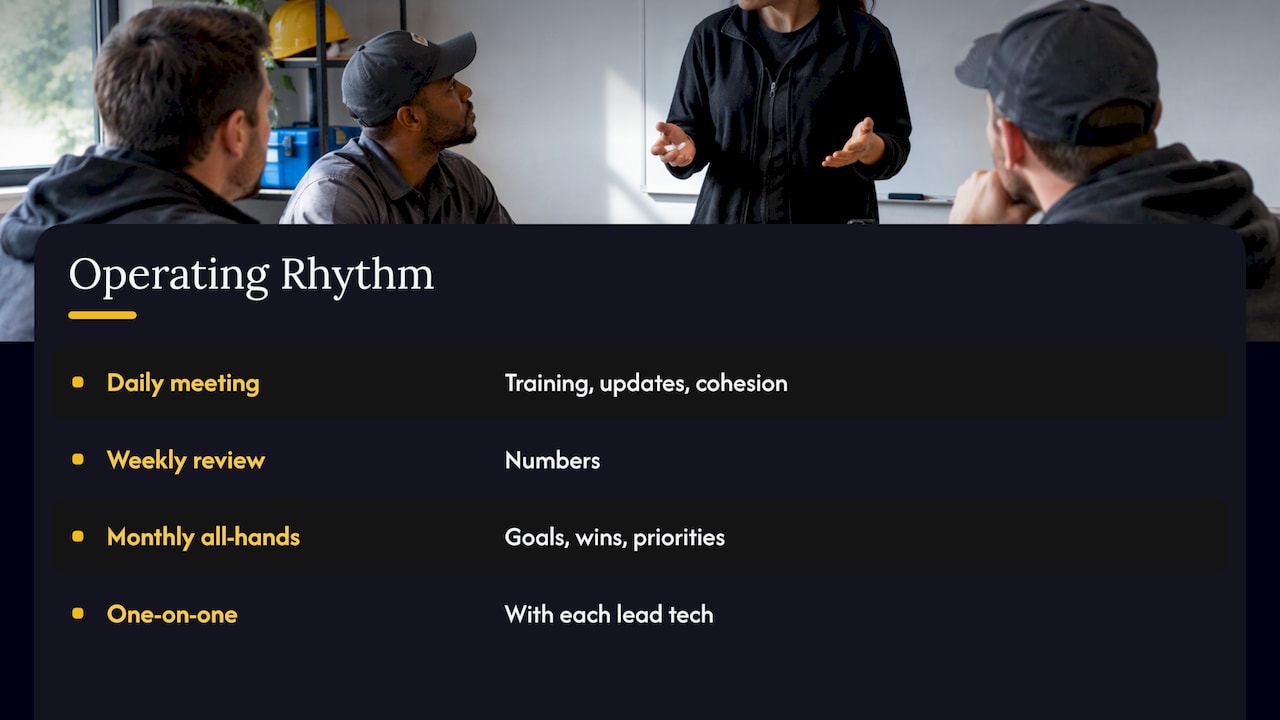
Turn fixes into habits. Daily team meetings cover training, updates and cohesion, and a monthly all-hands shares goals, wins and priorities. Add a weekly review of the numbers and a standing one-on-one with each lead tech. By day 90 the department should run on rhythm instead of on your presence.
Earn trust and set expectations
Technicians watch a new manager closely, especially one who used to be a peer. Two ideas carry most of the weight.
Make expectations explicit. The ACHR News advice is to establish what you stand for, what you will not stand for, and what you expect from each worker. A service manager quoted there adds that honesty means people know where they stand, so nothing surprises them at review time.
Be on their side. A veteran contractor describes the ideal service manager as a servant-leader, because service staff work long hours in all conditions and need someone in their corner.
In practice:
- Write down three or four standards (arrival communication, truck condition, documentation, callback ownership) and review them in the first huddle.
- Give feedback within a day, privately for corrections and publicly for wins.
- Coach instead of taking over the job. Our article on coaching versus managing lays out the difference.
- Follow through every time. One skipped consequence teaches the crew the standard is optional.
Numbers a service manager should watch
A service manager who sees results only at month-end is steering by the rearview mirror. A consultant quoted in Contracting Business says the manager should know the department’s daily goals for calls, leads and dollars and share them with everyone, because waiting for month-end is too late.
A practical starter dashboard:
| Metric | Why it matters | Cadence |
|---|---|---|
| Calls, leads, dollars vs. daily goal | Shows the day’s pace while you can still act | Daily |
| First-call completion | Fewer return trips, happier customers | Weekly |
| Callbacks | Signals quality and training gaps | Weekly |
| Gross margin | Shows whether jobs are priced to pay | Monthly |
| Service agreement count | Steadies revenue through slow months | Monthly |
On service agreements, one trade article quotes a manager calling them the life blood of the company for steady year-round revenue. For the owner side of the math, see our guides to HVAC gross margin, HVAC KPIs and contractor financial reporting.
What owners can do before the promotion
The promotion goes better when the owner handles a few things up front:
- Define the seat on paper: what the manager decides, what goes to you, and which numbers they own.
- Hand over real authority. A manager responsible for results with no say in decisions burns out.
- Plan training from day one. Our look at what real service manager training looks like breaks down the content.
- Decide who coaches the coach. The owner’s weekly one-on-one with the new manager is the accountability system that keeps the rest working.
If you are also building the next layer below, see our pieces on field supervisor training and train-the-trainer programs for contractors.
Training that fits the new manager
Our Management & Leadership Training is one of the programs inside Rebuild, our hands-on consulting for HVAC, plumbing, electrical, roofing, remodeling and siding companies. Related programs cover Call Management & Dispatch Training, Sales Training, and Financial Operations and Compliance Assistance. We focus only on the trades, so the training is built around your shop’s calls, crews and numbers instead of a generic template. You can see the full list on the Rebuild page.

If you want your new service manager to start with a structure, not a guess, that is the place to begin.
Our perspective
Most of the owners we meet did not fail at promoting a good technician. They failed at promoting without a system around the person. A new manager needs three things at once: a clear definition of the job, a way to see the numbers daily, and someone to hold them accountable the way they now hold others.
That is why we work inside the business instead of handing over a binder. We combine data-driven insight with leadership training and accountability systems, because skills alone fade when the daily pressure returns. A trained manager inside a structured department is how a shop moves from owner-dependent to scalable.
If you are about to make this promotion, do it deliberately. Set the standards, give the authority, and put the training in place first.
Dan
FAQ
Can I be a service manager with no experience?
Yes. Many trade service managers are promoted from technician roles without prior management time. Show transferable skills, such as mentoring a new hire or leading a small project, and plan to build communication, delegation and financial skills quickly.
What is the hardest part of being a first-time service manager?
Usually it is moving from doing the work to getting work done through others. Delegating, giving honest feedback to former peers and handling fear of losing control are the common struggles. Clear standards and regular one-on-ones make it manageable.
How is a service manager different from a dispatcher?
The dispatcher runs the daily schedule: assigning calls, tracking job status and adjusting as conditions change. The service manager owns coaching, standards, callbacks, escalations and department performance.
What should a new service manager do in the first week?
Meet each technician individually, ride along on calls, and gather recent numbers on callbacks, completion and margin. Hold off on big changes until you understand how the department actually runs.
Sources
- Plumbing Company Org Chart
- HVAC Managers: People, Planning, Programs | Contracting Business
- Service Manager job posting | Getro Community Job Board
- Help Your Service Manager Grow | HVACR Business
- How to Become a Manager | University of Cincinnati Online
- Defining the Perfect Service Manager | ACHR News
- What it Takes to Create The Perfect Service Manager | Contracting Business
- How to Become a Manager When You’ve Never Managed | Psychology Today
- 30-60-90 Day Plan for Operations Managers
- What Qualities Make a Great Service Manager? | Contracting Business
0 Comments