
First call completion measures the percentage of service jobs a technician finishes on the initial site visit, with no return trip needed to resolve the same issue. Below that, every repeat dispatch is quietly draining capacity, margin, and customer patience.
TL;DR:
- Most repeat visits are caused by poor intake data, parts unavailability, skills mismatches, and scheduling pressure, often occurring together.
- Implementing mandatory intake fields, parts confirmation steps, and skills-based routing can significantly improve first call completion rates.
- Focusing on operational processes and scheduling discipline, rather than just technician performance, yields more sustainable FTFR improvements.
- Parts availability accounts for about half of all repeat visits, indicating that warehouse and inventory management are critical to boosting first-time fix rates.
- Continuous review, targeted process changes, and system rebuilds are necessary to maintain and advance FTFR beyond short-term software upgrades.
Table of Contents
- What Is First Call Completion and How Do You Calculate It?
- Why Do So Many First Visits Fail?
- Five Quick Wins You Can Run This Month
- How to Build First Call Completion Into Your Operations
- Common Pitfalls That Undermine FTFR Improvement
- Training and Continuous Improvement Approaches
- What Real Improvement Looks Like on the Ground
- What the Data Actually Tells Owners
- If You Want Hands-On Help Fixing FTFR
- Sources
- FAQ
What Is First Call Completion and How Do You Calculate It?
First call completion, also called first-time fix rate (FTFR), answers one question: did the tech solve the problem before leaving? The formula is simple:
FTFR = (Jobs completed on first visit / Total dispatched jobs) × 100
A shop that dispatches 200 jobs in a month and closes 180 of them without a follow-up visit lands at 90%, matching the worked example industry guides commonly cite as the benchmark calculation.
The counting rules matter more than the math. A true first-time fix means the customer never needs another on-site visit for that specific issue, and loose data capture is the main reason FTFR numbers get inflated on paper while repeat calls keep piling up on the dispatch board.
- Exclude purely administrative follow-ups (billing calls, scheduling confirmations) from the denominator.
- Count a job as a fail if the customer calls back about the same symptom within 30 days.
- Tag every repeat visit with a reason code so you know why it failed, not just that it failed.
- Segment by job type, asset class, and technician group. A blended average hides which crews and which equipment types actually need attention.
Why Do So Many First Visits Fail?
Most repeat visits trace back to four breakdowns, and they rarely happen in isolation.
- Weak triage and intake. A dispatcher who logs “AC not cooling” without the asset model, unit age, or a photo sends the tech in blind. Vague symptom descriptions are one of the most common, most preventable causes of a wasted first trip.
- Parts invisibility. Van stock doesn’t match the job, and nobody checked before the truck rolled. Parts availability alone accounts for roughly 51% of repeat visits across field service, making it the single biggest lever you can pull.
- Skills mismatch. Dispatching by who’s free instead of who’s qualified puts a general tech on a job that needed someone certified on a specific system. Skills gaps drive close to 25% of failed first visits.
- Scheduling pressure. Overbooked routes and stacked appointments push techs to rush diagnosis just to make the next stop, and insufficient time on-site accounts for another meaningful share of failures.
These causes compound. A job with no photos and no asset ID (bad intake) often ships without the right part (parts gap), and the tech assigned wasn’t trained on that unit anyway (skills mismatch). One weak link rarely sinks a job by itself. Three weak links in the same visit almost always do.
Pro Tip: *Pull ten failed jobs from last month and map each one against these four causes.
Five Quick Wins You Can Run This Month
None of these require new software or a big budget. They require enforcing rules you probably already have on paper somewhere.
- Make intake fields mandatory. Asset model, unit age, a symptom checklist, and at least one photo before the ticket can be dispatched. This alone closes the single biggest gap identified in the 2026 field service outlook, which frames FTFR as a chain problem starting at intake, not a technician performance issue.
- Add a job-to-parts confirmation step. Require a “parts confirmed” field before the job leaves dispatch, tied to a two-minute van-stock check. Tools like Bidware’s job tracking and quoting software can formalize this check so it isn’t skipped under pressure.
- Tag technician profiles with certifications. Route by capability, not just by who’s geographically closest or next in the queue.
- Protect repair windows. Stop stacking appointments back to back on complex job types. A little slack in the schedule beats a guaranteed second trip.
- Give techs a fast escalation path. A quick-access tech-to-tech line or mobile-accessible manuals means a stuck tech calls a mentor instead of leaving and rebooking.
Pro Tip: Skills-based routing occasionally adds a few minutes to response time because the “right” tech isn’t always the nearest one. That small delay almost always nets out positive once you account for the truck roll, labor, and customer frustration a repeat visit costs you. This tradeoff is well documented in current first-time fix research.
How to Build First Call Completion Into Your Operations
A number you glance at once a month changes nothing. FTFR only drives behavior when it’s built into how you plan, staff, and review work.
- Set baselines by trade and job type. Realistic targets vary. HVAC shops often run 85 to 92%, plumbing 80 to 88%, electrical 85 to 90%, according to field service benchmark data. A general HVAC target applied to complex commercial refrigeration jobs will look artificially bad.
- Design your dashboard around flags, not just a percentage. Track repeat-visit reasons, parts-dependency rates, and FTFR broken out by tech group so a dropping number points you somewhere specific. A broader KPI dashboard that places FTFR alongside labor efficiency and callback cost gives owners the fuller picture.
- Run monthly micro-experiments. Pilot one change, like mandatory photo intake, on a single route or region, then measure the lift before rolling it company-wide.
- Verify before closing the ticket. A quick callback or text confirmation before a work order closes catches the jobs that look fixed but aren’t.
Common Pitfalls That Undermine FTFR Improvement
- Lax closing rules inflate the number without fixing anything. Run a rolling weekly audit of 30 closed jobs and check whether the same issue triggered a return visit within 30 days.
- Treating dispatch software as a fix on its own. A new platform without changed intake habits or parts workflows just moves the same bad data faster.
- Setting targets that ignore job complexity. Pushing every crew toward 95% regardless of job type damages morale and tempts techs to under-report problems just to protect the number.
- Sloppy data hygiene quietly wrecks the whole analysis. Inconsistent asset IDs and shorthand job notes make it nearly impossible to segment FTFR by equipment type later.
Training and Continuous Improvement Approaches
Fixing FTFR once isn’t the goal. Keeping it fixed as your team grows and turns over is the harder problem, and it’s mostly a training issue.
New hires need structured field mentoring, not just a truck and a route. Pairing a new technician with a senior tech on complex diagnostic calls for the first several weeks builds pattern recognition faster than any classroom session. Standardizing how field knowledge gets captured, through shared notes, searchable job histories, and photo documentation, protects that knowledge when experienced techs leave. Without it, every departure resets your diagnostic skill level back toward zero.
Run short, recurring refreshers on the specific equipment types driving your worst FTFR numbers, not generic technical training. If your data shows heat pump diagnostics are your weakest category, build a 30-minute session around exactly that, using real failed jobs from your own history as case material.
Certification tracking should feed directly into dispatch, not sit in a separate HR file. When a tech completes a manufacturer certification, that tag needs to show up in the scheduling tool the same week, so skills-based routing rules stay current. Review FTFR by tech monthly, not as a scorecard for punishment, but as a coaching input. A tech whose repeat-visit rate is climbing on one equipment category almost always has a specific, fixable skill gap, and finding it early costs far less than losing the customer.

What Real Improvement Looks Like on the Ground
Numbers on a KPI dashboard mean little without the operational changes behind them. Shops that move FTFR meaningfully tend to make the same handful of changes: tightening intake so dispatchers can’t send a tech out with incomplete information, adding a parts-confirmation checkpoint before the truck leaves the yard, and reworking scheduling so complex jobs get real time instead of getting squeezed between two other appointments.
The pattern holds across a tri-trade operational case study where scheduling discipline and dispatch training were rebuilt from the ground up rather than patched with a single software rollout. The lesson that surfaces again and again: FTFR improves when you fix the process feeding the technician, not when you lecture the technician about working faster.
Shops that treat this as a one-time software purchase tend to see a short-lived bump and then a slide back to old numbers within a quarter. Shops that treat it as an ongoing discipline, reviewing causes monthly and adjusting intake and dispatch rules as they learn, tend to hold their gains.
What the Data Actually Tells Owners
Most owners assume a low first-time fix rate is a technician problem: not fast enough, not sharp enough, not trying hard enough. The data says otherwise. Parts availability alone drives roughly half of all repeat visits, which means the fix usually sits in your warehouse and your dispatch software, not in a training manual for the field crew.
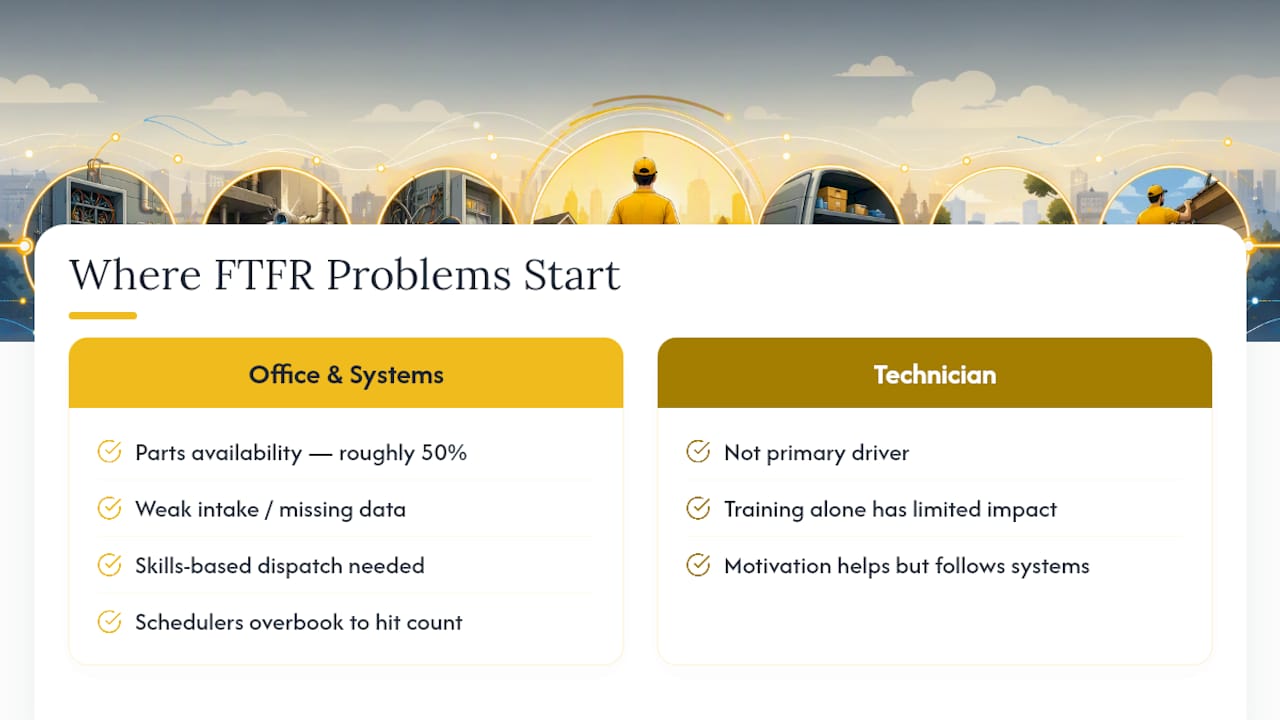
That reframe changes where leadership should spend its energy. Blended operational work, pairing better intake data with skills-based dispatch and honest accountability for scheduling discipline, moves FTFR further than any single software purchase or motivational speech to the crew. Case work with contracting businesses has shown that when leadership rebuilds the systems around the technician instead of just pressuring the technician, revenue and operational clarity follow. One tri-trade client’s operational rebuild is documented in a case study showing measurable gains tied to structural changes, not individual effort.
The uncomfortable part for a lot of owners: fixing FTFR usually means admitting the problem started at the office, not the truck. Dispatchers who don’t ask enough questions, parts managers who don’t stock proactively, and schedulers who overbook to hit a daily job count all do more damage to first-visit success than any technician’s skill level. Fix the chain, and the technician’s numbers fix themselves.
— Dan
If You Want Hands-On Help Fixing FTFR
Reading a checklist is one thing. Rebuilding the dispatch, intake, and training systems that actually move the number is another, and that’s the gap Rebuildingthetrades closes for trade contractors instead of handing them another software login. Where a generic consultant might hand you a template, Rebuildingthetrades works inside your dispatch board and your training sessions, building call management and dispatch training, install and project management training, and KPI reporting systems specific to your trade and your current numbers.

A typical engagement starts with an operational audit to find exactly where your first-visit failures are coming from, followed by a quick-win plan targeting the highest-leverage fixes first, then a pilot on one route or crew before rolling changes company-wide. That’s the same structure behind measurable gains documented in Rebuildingthetrades’ client work. If your FTFR has been stuck for more than a quarter, the fastest next step is a conversation about what’s actually breaking in your chain. Get started with Rebuildingthetrades and find out where the audit points first.
Sources
- How to improve first-time fix rate in 2026
- First-time fix rate definition — Tractian glossary
- Improve First-Time Fix Rate in Field Service | AEX Software
FAQ
What Is a Good First Call Completion Rate?
Benchmarks vary by trade: HVAC typically runs 85 to 92%, plumbing 80 to 88%, and electrical 85 to 90%.
What Causes Most Repeat Visits?
Parts unavailability causes roughly 51% of repeat visits, followed by technician skills mismatch at around 25% and insufficient time on-site at about 13%. Weak intake data often sits underneath all three, since a vague job ticket makes the wrong part and the wrong tech more likely.
How Do You Calculate First Call Completion?
Divide jobs completed on the first visit by total dispatched jobs, then multiply by 100. A shop closing 180 of 200 jobs without a callback lands at a 90% FTFR.
Can Software Alone Fix a Low FTFR?
No. Dispatch and inventory tools help, but they only work when paired with process changes like mandatory intake fields, parts confirmation before dispatch, and skills-based routing rules. Shops that skip the process changes typically see a short-term bump that fades within a quarter.
Does Rebuildingthetrades Help With First Call Completion?
Yes, through call management and dispatch training, install and project management training, and KPI reporting systems built around each shop’s actual failure points. Engagement pricing is available directly through Rebuildingthetrades.
0 Comments