
A commissioning process is the internal workflow an HVAC contractor runs on every job to verify installation quality, document results, and hand off a system with signed proof it works. The project lead or service manager owns it end to end, and the deliverables are a complete installation file, signed functional performance tests, and an O&M handover package. Done right, it cuts callbacks and gives owners a paper trail for every acceptance.
TL;DR:
- The commissioning process must be completed in five fixed phases, including preparation, start-up, functional testing, rectification, and handover, to ensure system quality and traceability.
- Each role in the process, from technician to owner, has a specific responsibility, with clear ownership assigned to avoid gaps that typically occur during handoffs.
- The installation file must include consistent, detailed documentation such as load calculations, certificates, TAB reports, wiring diagrams, and signed start-up forms, organized for quick review.
- Functional tests require preset pass/fail thresholds for airflow, temperature, and control response, with failed tests logged for correction and retesting before sign-off.
- Tracking callback costs and first-time pass rates enables proactive training and quality control, improving margins and reducing recurring failures across job fleets.
Table of Contents
- The phased workflow crews should follow on every job
- Who completes checks, who verifies, and who signs acceptance
- Build a reproducible checklist and installation file
- Running functional performance tests and recording pass or fail
- Turn commissioning results into QA metrics that protect margin
- Deliver the final acceptance package and O&M training
- Rolling out a commissioning program without slowing down revenue
- Why commissioning is a margin system, not a paperwork exercise
- How we help you build and roll out a commissioning program
- FAQ
- Sources
The phased workflow crews should follow on every job
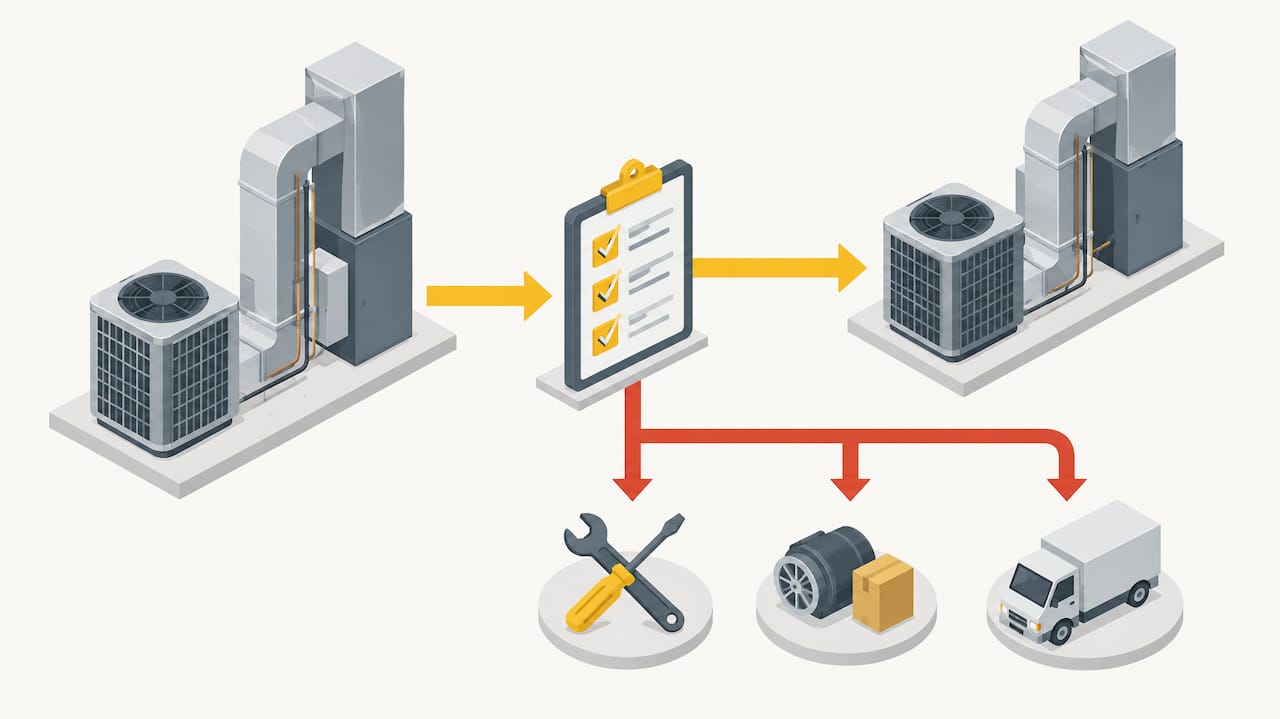
A commissioning process works best as a fixed sequence, not a judgment call made on site. Five phases cover almost every HVAC install, from a single-zone replacement to a multi-system retrofit.
- Prepare: Collect installation file items ahead of start-up: load calculations, AHRI certificates, equipment specs, and confirm test-and-balance (TAB) scheduling before the crew arrives.
- Start-up: Run manufacturer start-up checks and complete the equipment start-up form, noting voltage, refrigerant charge, and any deviations.
- Functional tests: Execute functional performance tests (FPTs) that confirm the system operates across its modes, each with a clear pass or fail threshold.
- Rectify and retest: Log any failed item on a resolution tracking form, assign a fix, and retest before moving forward.
- Handover: Compile the final job folder, then deliver O&M documentation and training to whoever operates the system.
This sequence matters because skipping a step rarely shows up immediately. It shows up three months later as a callback with no documentation trail to explain what happened. The ANSI/ACCA QI verification protocols require both a complete installation file and in-field verification before a system counts as compliant, and that same two-part logic, paper plus field proof, is what makes a contractor’s internal process defensible.
Who completes checks, who verifies, and who signs acceptance
Gaps happen at handoffs, not during the work itself. Assigning a single name to each responsibility closes most of those gaps.
- Commissioning owner (project lead or service manager): holds overall authority, schedules each phase, and has final sign-off on the job folder.
- Field technician: records every checklist value at the time of work, not from memory at the end of the day.
- Verifier or reviewer: witnesses critical start-ups and functional tests, then signs the checklist confirming what was observed.
- Owner or operator: receives the O&M package, attends training, and signs the acceptance form confirming handover.
The ACG Commissioning Guideline describes this authority role in formal building commissioning, and the same division of labor scales down cleanly for a contractor’s internal workflow: one person owns the outcome, one person does the work, and one person checks it before the file closes.
Build a reproducible checklist and installation file
A checklist only works if it is identical every time, regardless of which crew runs the job. The installation file should contain the same items whether it is a rooftop unit replacement or a full system retrofit.
Installation file items to collect:
- Load calculation and equipment sizing documentation
- AHRI certificate matching the installed equipment
- TAB report with measured airflow and static pressure
- Wiring diagrams and the sequence of operations
- Signed manufacturer start-up form
- Photos of completed connections, labeling, and clearances
Checklist structure (minimal fields per line item):
- Target value
- Measured value
- Pass or fail
- Technician initials
- Date recorded
System verification checklists (SVCs) and FPT categories to include cover airflow, duct static pressure, supply and return temperature splits, and control logic sequencing. The ENERGY STAR QI rater checklist guidebook lists the standard measurement tools for these tests, flow hoods and anemometers among them, and references AABC, NEBB, and ASHRAE procedures for airflow verification. Borrowing that same measurement discipline keeps your in-house checklist consistent across every crew.
Organize the folder so a missing item is visible at a glance: one tab per category, in the same order every time, with blank fields flagged rather than left empty. A field-service app or a basic shared drive structure both work, as long as the order never changes.
Pro Tip: Color-code checklist sections red until every field is filled, so a reviewer can spot an incomplete file from across the room.
Running functional performance tests and recording pass or fail
Functional performance tests prove the system does what it is supposed to do under real operating conditions, not just that it powers on.
- Airflow and duct static: Measure against design targets using a flow hood or anemometer, and record both target and actual values.
- Temperature splits: Confirm supply and return deltas fall within the expected range for the equipment type.
- Control sequence: Cycle the system through heating, cooling, and any staged modes to confirm each responds correctly.
- Zone balancing: Check airflow at each register against the TAB report.
Set a numeric pass or fail threshold for each test before the crew runs it, never after. Any failed item goes on a resolution tracking form with the corrective action and a retest date; the ACG Commissioning Guideline recommends attaching manufacturer-signed start-up reports whenever a manufacturer technician performs the start-up, and having the commissioning owner witness any major equipment start-up in person.
A callback often turns a job’s gross margin negative once labor, parts, and a truck roll are factored in, which is why tracking the true cost of a callback starts with catching the failure at the FPT stage instead of after handover.
Turn commissioning results into QA metrics that protect margin
Commissioning data is only useful if it feeds back into how you run the business. Callbacks belong in your job-costing system, not a separate complaint log.
- Link callback records to the originating work order, including the hours, parts, and travel cost tied to the return visit.
- Track callback cost per job as a standing metric, not an occasional spot check.
- Watch first-time pass rate on FPTs across crews to spot a training gap before it becomes a pattern.
- Review average rework hours monthly to see whether corrective action time is trending up or down.
Recurring defect types point directly at what to cover in your next KPI review and crew training session. A crew that keeps failing the same static pressure test needs a specific fix, not a general reminder to be careful.
Pro Tip: Pull your three highest-cost callback types each quarter and build a 15-minute training block around each one.
Deliver the final acceptance package and O&M training
Handover is where the commissioning process either pays off or quietly falls apart. A rushed handover leaves the owner without the documents they need the first time something goes wrong.
- Final package: signed checklists, TAB reports, wiring diagrams, a spare-parts list, a maintenance schedule, and all equipment manuals.
- Training record: an agenda, the names of everyone who attended, and a recorded or written summary of the walkthrough demo.
- Storage and sign-off: store the final file where both the office and the owner can retrieve it, and have the owner sign an acceptance form confirming receipt.
A complete handover package also protects the contractor’s own documentation trail, which matters later if installation quality ever comes under question during a sale or dispute.
Rolling out a commissioning program without slowing down revenue
The fastest way to stall a new process is to launch it shop-wide on day one. A short pilot proves the checklist works before every crew is asked to follow it.
- Pilot on two to three representative jobs, covering different system types, and collect real data on what the checklist missed.
- Set success thresholds before scaling: a target callback cost reduction and a minimum first-time pass rate.
- Assign a commissioning lead who owns the checklist and runs a short weekly review of pilot results.
- Choose paper or a simple digital tool for the checklist format, and set a date to expand to the full crew once the pilot hits its thresholds.
Estimating and bid software such as ArosBid can help standardize job scheduling around start-up and FPT windows, and a basic document control process keeps resolution tracking forms attached to the right job file instead of scattered across trucks.
Pro Tip: Run the pilot for 30 days before touching a single other process, dispatch, sales, or pricing, so you can tell which result came from which change.
Why commissioning is a margin system, not a paperwork exercise
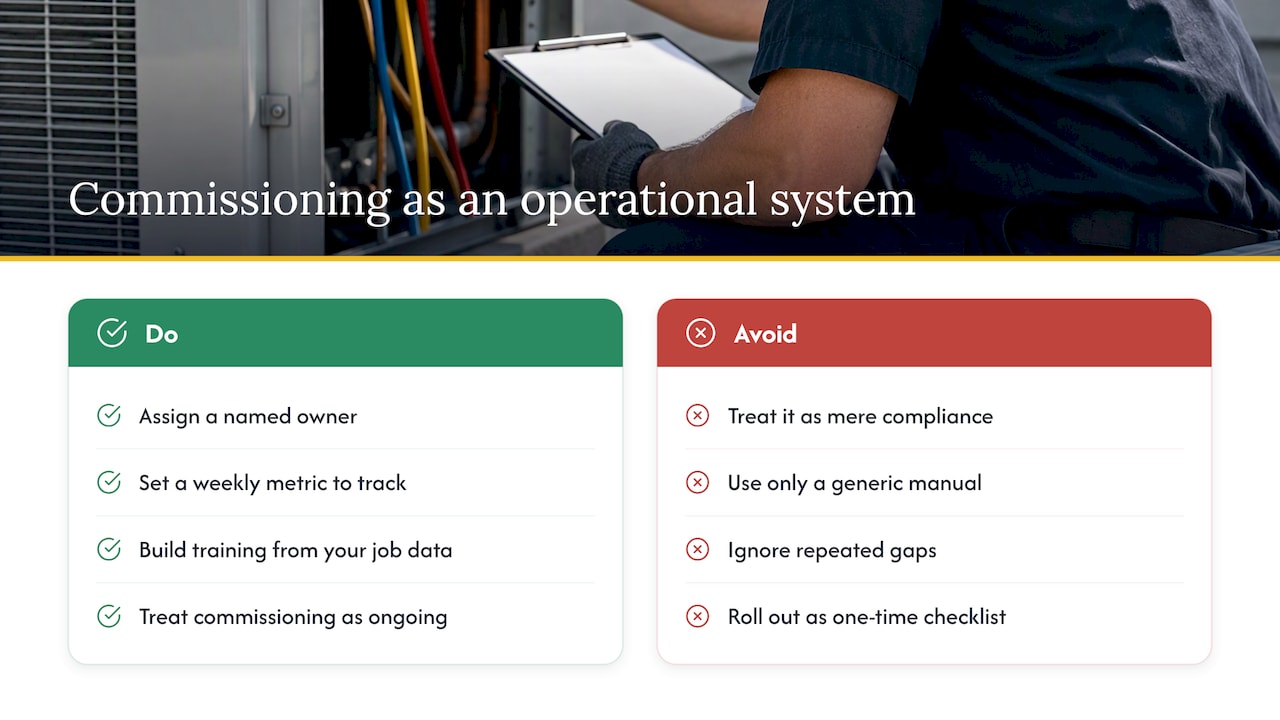
Most owners treat commissioning as compliance overhead until a callback shows up on a job that already had thin margin. By then the loss is already booked. A missed static pressure check or an unsigned start-up form rarely costs anything the day it happens, but it compounds every time that same gap repeats across a fleet of trucks.
The contractors who get the most out of this process manage it the same way they manage dispatch or sales: with a named owner, a weekly number to check, and a training loop built from their own job data instead of a generic manual. Treating commissioning as a standing operational system, rather than a one-time checklist rollout, is what separates a shop that fixes recurring failures from one that keeps paying for the same mistake.
— Dan
How we help you build and roll out a commissioning program
We provide consulting to help business owners develop a commissioning checklist into a system their crews can consistently follow. That means onsite audits of your current install and QA process, checklist design built around your specific equipment mix, staff training on FPTs and sign-off procedures, and the KPI reporting structure to track callback cost and first-time pass rate after rollout.

- Onsite operational audits that identify where your current handoffs break down
- Checklist and documentation design matched to your crew size and job types
- Staff training on functional testing, start-up forms, and resolution tracking
- KPI systems that turn commissioning data into a weekly management number
If you want a structured rollout instead of building this checklist from scratch, see our Rebuild service and schedule a conversation about your current install process.
FAQ
What is HVAC commissioning in a contractor’s own workflow?
In this context, commissioning is the contractor’s internal process for verifying, documenting, and handing off an installation, not a separate building-wide certification process. It includes checklists, functional tests, and a signed handover package owned by a project lead or service manager.
Who should own the commissioning process on a job?
The project lead or service manager typically owns it, scheduling each phase and giving final sign-off on the job folder. Field technicians record data at each step, while a verifier witnesses and signs off on critical tests.
What documents belong in a complete installation file?
A complete file includes the load calculation, AHRI certificate, TAB report, wiring diagrams, sequence of operations, and a signed manufacturer start-up form. The ANSI/ACCA QI verification protocols require both file completeness and in-field verification for a system to pass.
How do functional performance tests determine pass or fail?
Each test, such as airflow, static pressure, or temperature split, gets a numeric target set before testing begins. A measured value outside that range fails, triggers a resolution tracking form, and requires a retest before the job closes.
Why should callbacks be tracked as a margin metric?
Linking a callback to its original work order shows the real cost in labor, parts, and travel, which often turns that job’s gross margin negative. Tracking this per job helps target training at the specific failure modes costing the most.
Sources
- ACG Commissioning Guideline
- HVAC System Quality Installation Verification Protocols (ENERGY STAR / ANSI/ACCA QI)
- What’s the cost of a callback? (ACCA blog)
0 Comments