
Yes, contractors should run a transaction-triggered NPS program that ties quick customer feedback to accountable fixes. A single question, asked right after a job, gives you a referral signal and a to-do list for your team in one move. The first step takes minutes: pick a trigger moment, such as job completion, and send a short survey within a day or two.
TL;DR:
- Conduct transactional NPS surveys within 24 to 72 hours after each job to capture accurate, actionable feedback on speed and quality issues.
- Keep survey questions consistent and limited to prevent bias and survey fatigue, with follow-up driver questions to identify root causes for low scores.
- Assign specific owners to handle immediate callbacks and track common themes in responses to implement systemic improvements over time.
- Monitor response rates and follow-up times regularly to avoid skewed data from self-selected customers and maintain reliable trend analysis.
- Pair NPS with other metrics such as referral counts, repeat bookings, and response rates to validate improvements and ensure accountability for operational changes.
Table of Contents
- What NPS is and how to calculate it
- Why NPS matters for contractors and which drivers to track
- Build an NPS program tailored to your contracting business
- Timing and tactics that raise response rates
- Closing the loop: from feedback to fixed problems
- Measuring success and avoiding common pitfalls
- Where NPS fits inside a real operations turnaround
- How we help you put NPS to work
- FAQ
- Sources
What NPS is and how to calculate it
Net Promoter Score comes from one question: how likely is this customer to recommend you to a friend or colleague, on a scale of 0 to 10? Customers who answer 9 or 10 are promoters. Those at 7 or 8 are passives. Anyone from 0 to 6 is a detractor.
The score calculation is the percentage of promoters minus the percentage of detractors. Passives count toward your total respondents but never enter the formula directly, since they are neither pushing referrals your way nor actively warning people off.
Consistency matters more than most owners expect. If your HVAC techs ask the question verbally and your office asks it by text, you’re comparing two different instruments, not two time periods of the same one. Keep the wording and the 0-10 scale identical every time you survey, and the score becomes a number you can actually trust over months, not just a snapshot.
Why NPS matters for contractors and which drivers to track
A high NPS tends to track with referral volume and repeat bookings, which is exactly how most trade businesses grow their best leads. That said, the score alone doesn’t tell you what to fix. You need a second layer: follow-up questions that isolate what drove the rating.
For home service and remodeling work, two drivers show up consistently. Qualtrics data on service drivers shows customers weigh speed of response (36%) and quality or reliability of the work (32%) most heavily, with business-hour support preferences split between daytime and early evening. A separate industry satisfaction report built on GuildQuality data found that “professional and organized” conduct and perceived expertise correlate most strongly with satisfied remodeling customers.
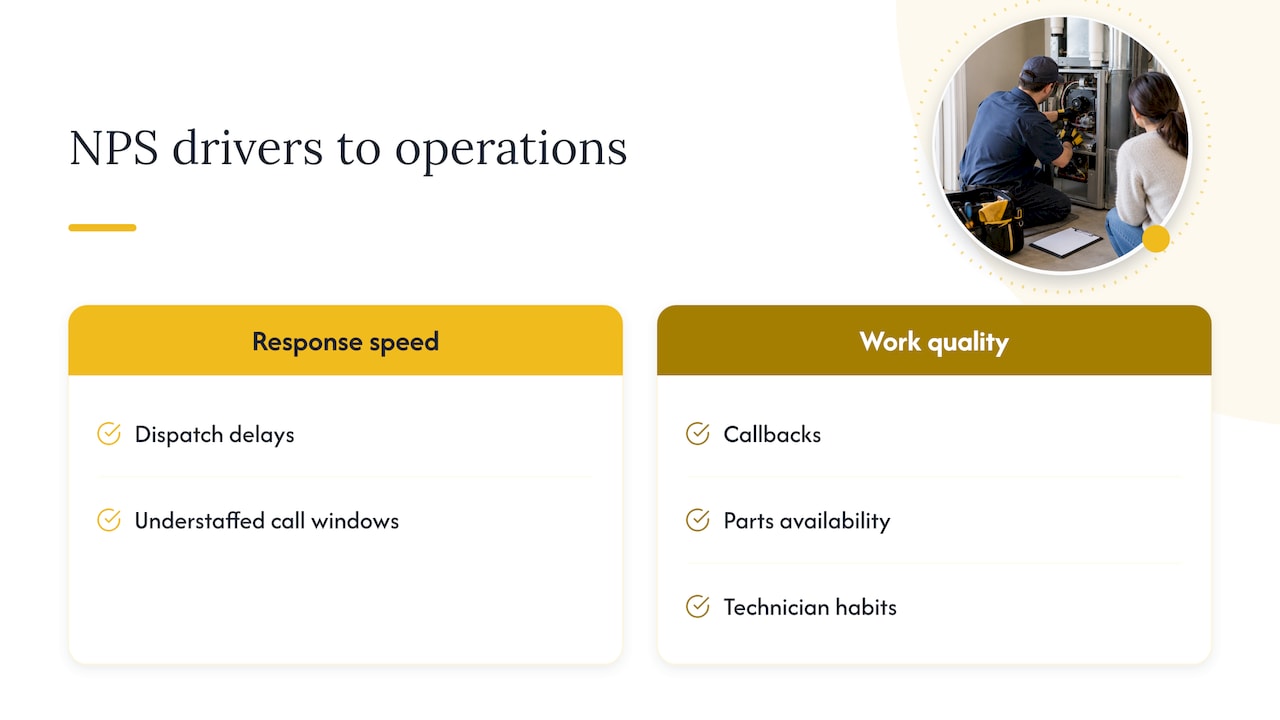
Map these to your operations directly. A low score tied to speed of response usually points to dispatch delays or understaffed call windows. A low score tied to quality points to callbacks, parts availability, or a specific technician’s habits. Asking the right second question turns a number into a work order.
Build an NPS program tailored to your contracting business
Start by deciding scope. Transactional NPS, sent after each job, catches issues while they’re fixable. Relationship NPS, sent quarterly or annually to your full customer list, tracks long-term loyalty. Most trade businesses should launch transactional first since it ties feedback to a specific crew, job, and date.
- Pick triggers and channels: job completion is the standard trigger, and SMS or short email outperforms phone calls for response speed.
- Keep the survey to one NPS question, one or two driver questions, and an optional open text field.
- Build a sampling plan: survey every job, or a rolling weekly sample, to avoid cherry-picking only the jobs that went well.
- Assign ownership before launch: someone handles immediate follow-up on low scores, someone else runs the weekly review of themes.
- Start with tools you already have. A spreadsheet and a free SMS or survey tool work fine before you need anything enterprise-grade.
Pro Tip: Attach the technician’s name and job type to every survey response so low scores route to the right manager automatically.
Your question set might look like: “How likely are you to recommend us to a friend, 0 to 10?” followed by “How would you rate our response time?” and “How would you rate the quality of the work?” Add a line for comments. That’s enough to act on without creating survey fatigue. Building out robust reporting infrastructure comes later, once the basic loop is running.
Timing and tactics that raise response rates
Send the survey within 24 to 72 hours of job completion, while the work is still fresh. Waiting a week drops recall and response rates both.
- Hand the survey off verbally before the technician leaves, so the customer expects the text or email.
- Keep it to one question on the first screen. Every added field cuts completion.
- Avoid incentives for trade work surveys. They skew your sample toward people willing to trade a discount for a high score.
- Test one variable at a time, such as SMS versus email, and compare response rates before changing your default channel.
Response rate itself is a signal worth tracking. If only your happiest or angriest customers respond, your score skews away from the average experience, which is the core bias problem in reliable NPS measurement. A steady, moderate response rate across most jobs beats a high response rate from a self-selected few.
Closing the loop: from feedback to fixed problems
A detractor score is a service recovery opportunity with a short shelf life. Call within 48 hours, acknowledge the specific issue they flagged, and document what you committed to fix.
- Triage every detractor response the same day it arrives and assign a named owner for the callback.
- Log the root cause category (dispatch delay, workmanship, communication) so patterns show up over time.
- Hold a weekly huddle to review aggregated themes across all responses, not just the worst ones.
- Prioritize systemic fixes, like parts stocking or call scripting, over one-off apologies when the same issue repeats across jobs.
Pro Tip: Read the open-text comments before you look at the score. The number tells you how upset someone is; the words tell you why.
Measuring success and avoiding common pitfalls
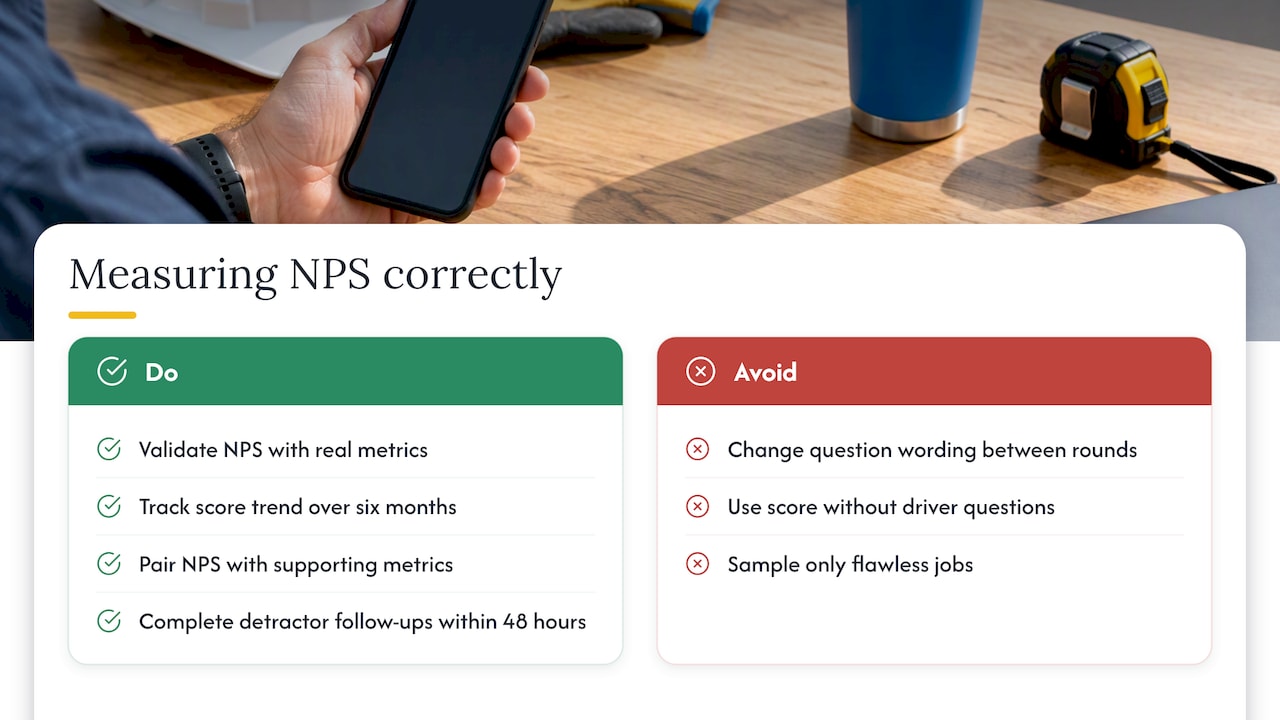
Validate your NPS by checking it against something real: referral counts, repeat booking rates, and customer retention over a quarter. If the score climbs but referrals don’t, something in your follow-through is broken.
Track the trend, not a single benchmark number. A rising score over six months tells you more than comparing your result to an industry average pulled from a different market. Watch for three common errors: inconsistent question wording between survey rounds, relying on the score without the driver questions behind it, and sampling only jobs where everything went smoothly.
Pair NPS with a short list of supporting metrics: response rate, percentage of detractor follow-ups completed within 48 hours, and the breakdown of root-cause categories behind low scores. These numbers tell you whether the program itself is working, not just whether customers are happy this month.
Where NPS fits inside a real operations turnaround
A single survey question means little without a system behind it. We build NPS into a wider structure of leadership accountability, standardized reporting, and field-level coaching, because a score that nobody acts on just becomes another dashboard tile.
Structured operational programs have produced measurable outcomes, including businesses reaching run rates in the tens of millions once reporting and accountability systems were in place. The practical starting point looks the same whether you’re adding NPS or any other metric: audit current practices, pilot a small change, then roll it out with manager huddles and KPI dashboards tracking the result. Our process follows that same audit-pilot-rollout sequence for every operational system we help install.
— Dan
How we help you put NPS to work
Running a survey is the easy part. Turning low scores into fixed dispatch windows, better parts stocking, and coached technician behavior is where most contractors stall out, and it’s where our work actually sits. Our Rebuild engagement pairs leadership and management training with install and project management coaching and KPI reporting systems, so your NPS data has somewhere to go besides a spreadsheet nobody opens.

A typical path looks like this:
| Phase | What happens |
|---|---|
| Audit | Review current feedback (or lack of it) and operational gaps |
| Pilot | Launch transactional NPS on a subset of jobs with named owners |
| Roll-out | Expand company-wide with manager huddles and KPI dashboards |
If you’re ready to connect customer feedback to real operational accountability, reach out through our site to start the conversation.
FAQ
What’s the difference between CSAT and NPS for contractors?
CSAT measures satisfaction with one specific job or interaction, while NPS measures overall likelihood to recommend your business. Contractors often use both: CSAT to catch job-level problems and NPS to track referral potential over time.
How often should a contracting business send NPS surveys?
Transactional NPS should go out within 24 to 72 hours of each completed job, or on a rolling weekly sample if survey volume gets too high to manage. Relationship NPS, sent quarterly or annually, works as a slower-moving complement rather than a replacement.
What counts as a good NPS score for a contractor?
There’s no universal “good” number, since scores vary by market, trade, and how the question is worded. Focus on whether your own score is trending up over time and whether it lines up with real referral and repeat-booking numbers rather than chasing an outside benchmark.
Who should own follow-up calls to detractors?
Assign a specific person, often a service manager or owner, to call every detractor within 48 hours and document what gets fixed. Staffing that role consistently matters more than the title attached to it, and workforce planning resources can help if you’re building out a dedicated customer experience position.
Can small contracting businesses run NPS without expensive software?
Yes. A spreadsheet paired with a basic SMS or survey tool is enough to launch a transactional NPS program, and most firms should start there before evaluating software integrations for scaling the workflow later.
Sources
- Measuring Your Net Promoter Score℠ | Bain & Company
- Net Promoter Score — Qualtrics
- The 2026 customer satisfaction report | Qualified Remodeler (GuildQuality data)
0 Comments