
Use a clearly defined, auditable fuel surcharge tied to a public diesel index when fuel is a real cost driver, or build fuel into your flat rates when simplicity matters more than precision. Either way, your policy needs five things decided before you touch an invoice: a named index, a base index and date, a formula or banded scale, a review cadence, and a distinct invoice line item.
TL;DR:
- Use a separate surcharge for fleet operations, long routes, and recurring maintenance; embed fuel in occasional small jobs where another line complicates a sale.
- For fleets with route exposure, a $4.60 diesel index against a $4.00 base yields a 12% surcharge on labor or service at 2% per $0.10.
- Monthly reviews track costs more closely but change bills more often; quarterly reviews reduce churn while lagging fuel swings, so document one cadence.
- Show the charge on written estimates before work begins, itemize it on invoices with the index date, and archive that period’s index snapshot.
- Recover only added fuel costs, use a deadband and caps, and lower the charge when prices fall; it should never add unrelated costs or margin.
Table of Contents
- When to use a separate surcharge and when to embed fuel in your price
- Practical calculation methods: percentage, banded table, and per-activity
- Design the clause: required variables, cadence, and guardrails
- Operational steps: quoting, invoicing, and internal audit trail
- Communicating the change and handling already-priced jobs
- Transparency and compliance benchmarks (adapt to your jurisdiction)
- How this policy sits inside better pricing and financial controls for trades
- Get help building and rolling out your surcharge policy
- FAQ
- Sources
When to use a separate surcharge and when to embed fuel in your price
The right structure depends on how exposed your business is to fuel swings and how much friction your customers will tolerate.
A separate surcharge gives you visibility into real costs, lets you adjust quickly when diesel prices move, and recovers money fairly instead of guessing at a margin cushion. It also creates more administrative work and occasionally irritates customers who feel nickeled and dimed.
Embedding fuel into your flat price keeps quoting simple and avoids a line item that invites questions, but you absorb volatility until your next price update, which can erode margin for months at a time.
- Choose a surcharge for fleet-heavy operations, long service routes, and recurring maintenance agreements where fuel cost is a known, trackable input.
- Choose embedded pricing for small, one-off service calls where a separate line item would complicate an otherwise simple sale.
- Hybrid models exist too: embed fuel for small jobs under a dollar threshold, surcharge everything above it.
Practical calculation methods: percentage, banded table, and per-activity
Three models cover almost every trade business, and industry guidance on clause mechanics recommends picking the one that matches how your crews actually burn fuel.
- Percentage-based index: the surcharge equals a scale factor multiplied by the difference between the current index and a base index, written as S x (Current Index minus Base Index). Say your base diesel price is $4.00 a gallon and the current published price is $4.60: a scale factor of 2% per $0.10 move yields a 12% surcharge on the labor or service portion of the invoice. This model works well for route-heavy HVAC and plumbing fleets.
- Banded table model: instead of recalculating every invoice, you set ranges. Diesel between $3.80 and $4.19 might carry a flat 4% surcharge, $4.20 to $4.59 carries 6%, and so on. This reduces invoice noise and customer questions because the number only changes when fuel crosses a band.
- Per-activity or per-mile model: a fixed cents-per-mile or cents-per-call add-on tied to index deltas, useful when your exposure is local and mileage-driven rather than tied to a national average.
Pro Tip: Match the index to your actual exposure: a national on-highway diesel figure suits a regional fleet, while a per-call flat fee suits a business running short, local routes.
Design the clause: required variables, cadence, and guardrails
Industry guidance on clause mechanics suggests writing the clause so it reads like a math problem rather than a vague promise to “adjust for fuel costs.”
Name these variables explicitly: the fuel index and its source and unit, the base index with its date and value, the eligible charges the surcharge applies to, the formula or band table, and the multiplier or scale factor.
- Pick a cadence: monthly with a one-month lag, a rolling average, or quarterly. Monthly tracks real costs closer but creates more billing changes; quarterly is calmer for customers but lags actual fuel swings.
- Add a deadband so tiny index moves do not trigger a change, since nobody wants to reissue invoices over a one-cent shift.
- Set a floor, often zero, and a ceiling to cap extreme moves, and make the policy symmetric so the surcharge drops when fuel drops, not just when it rises.
- Build in an extraordinary review trigger if the index moves beyond a stated threshold between scheduled reviews.
- Predefine a replacement index and a review process in case your chosen publication is discontinued.
Pro Tip: Write the formula into the contract exactly as you’d calculate it on a spreadsheet. If a customer can’t reproduce your number from the clause, the clause isn’t finished.
Operational steps: quoting, invoicing, and internal audit trail
Business Tasmania’s guidance recommends showing the surcharge as its own invoice item rather than folding it into labor or parts, paired with a short note explaining how it was calculated.
- Disclose the surcharge on written estimates before work begins, and get sign-off the same way you would for any other price term.
- List the surcharge as a distinct invoice line with a one-sentence calculation note, such as the index value used and the date it was published.
- Attach or archive a snapshot of the index source for that billing period. GAO audit findings show that undisclosed surcharge components limit a customer’s ability to verify a bill, and itemized invoices with supporting documentation solve that directly.
- Reconcile monthly: compare surcharge revenue recovered against actual fuel spend, track dispute counts, and measure time-to-resolution on any customer questions.
Communicating the change and handling already-priced jobs
Notify customers before the surcharge takes effect and give them real options rather than a surprise line item.
- Offer three paths on pending estimates: accept the surcharge, amend the estimate, or cancel with a refund if work hasn’t started.
- Keep customer-facing language plain: “A fuel surcharge of X% applies to this invoice, based on the [named index] published on [date].”
- Add a short line to your website and estimate footers explaining the policy exists and why.
- Honor prices on signed contracts and maintenance agreements unless the contract language allows adjustment or the customer agrees to the change. For recurring service agreements, a partner resource on managing maintenance contracts covers how to handle terms when conditions shift mid-contract.
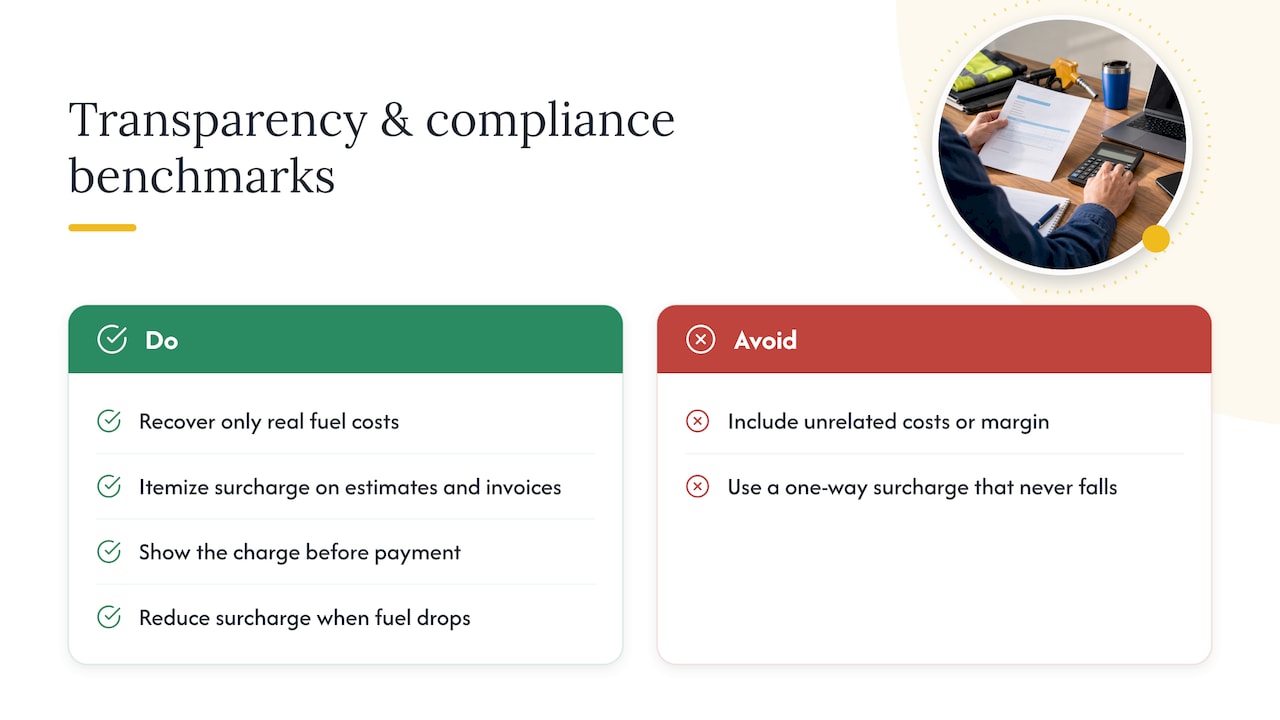
Transparency and compliance benchmarks (adapt to your jurisdiction)
The New Zealand Commerce Commission’s guidance states that a fuel surcharge should recover real, current additional fuel costs only, never unrelated expenses or margin, and customers need to see and understand the charge before they pay.
Keep the charge itemized on every estimate and invoice, and apply the same logic in both directions: if fuel drops, the surcharge drops too, which avoids the perception of a one-way fee. Treat these as general principles and check them against the consumer protection and procurement rules in your own jurisdiction before finalizing your clause.
How this policy sits inside better pricing and financial controls for trades
A fuel surcharge works as cost recovery, not hidden margin. Paired with a clear price book and ongoing KPI tracking, it protects margin without drifting into markup. Documented, symmetric surcharges cut dispute volume and make cash flow easier to predict month to month.
— Dan
Get help building and rolling out your surcharge policy
Designing a clause is one afternoon of work. Getting it into your price book, your invoicing software, and your technicians’ scripts without confusing customers is where most owners stall. Our Financial Operations and Compliance Assistance work is built for exactly that gap, and we pair it with the pricing and sales training that keeps the rollout consistent across every crew.

- We audit your current pricing and billing flow to find where a surcharge clause fits without adding friction.
- We help draft the clause, index, and guardrails, then map it into your invoicing and price book.
- We train dispatch and field staff on the exact language to use when a customer asks about the charge.
If you want a structured hand on this, start with our pricing services overview to see how an engagement is scoped.
FAQ
What is a fuel surcharge policy for a trade contractor?
It is a defined set of rules a service business uses to add a fuel-related charge to invoices when vehicle fuel costs rise, built around a named index, a base value, a formula or band table, and a review schedule. The goal is recovering real added fuel cost, not increasing margin, as outlined in Commerce Commission guidance.
How often should I review or update my fuel surcharge?
Monthly reviews track fuel costs closely but create more frequent invoice changes, while quarterly reviews are steadier for customers but lag real price swings. Business Tasmania’s guidance recommends picking one cadence and sticking to a documented review process rather than adjusting ad hoc.
Do I need to disclose the surcharge before the customer pays?
Yes. Regulatory guidance is consistent that customers must see and understand a fuel surcharge before payment, with the charge itemized separately rather than buried in a labor or materials line. Disclosing it on the written estimate, before work starts, avoids most disputes entirely.
What happens to jobs I already quoted before adding a surcharge?
Honor the price on any signed estimate or contract unless the agreement itself allows for adjustment or the customer agrees to a change. For recurring agreements, offer the customer a choice: accept the new surcharge going forward, amend the agreement, or cancel with a refund if no work has started.
Can Rebuilding the Trades help me set up this policy?
Our Financial Operations and Compliance Assistance service covers designing the clause itself along with mapping it into your invoicing system and training your staff on customer-facing language.
Sources
For clause templates and jurisdictional detail, consult the Commerce Commission, Business Tasmania, Cleverence, and GAO sources linked above.
- Guidance: businesses applying fuel surcharges | Commerce Commission
- Understanding fuel surcharges | Business Tasmania
- How to incorporate fuel surcharges and indexing in client contracts | Cleverence
- GAO inspector-general reports on federal service invoicing
0 Comments