
Say it plainly: tell customers prices are increasing in the first line, give one factual reason tied to costs or protected service, and state a clear effective date. We treat price increase communication as a short operational program, not a one-off email, with a pilot, a rollout sequence, and a 30-day scorecard. Include a quick FAQ link and a direct contact option so nobody has to guess what changed.
TL;DR:
- Before setting a date, calculate the cost or margin impact, review contract limits and renewal dates, and decide which customers qualify for exceptions.
- Allow 30 to 90 days’ notice, using the longer window for annual contracts or strict budget cycles, and align changes with renewal dates.
- The announcement should state the increase and effective date upfront, give one factual reason, show the dollar change, and provide an FAQ and contact.
- Brief frontline teams before outreach with matching scripts, approved concessions, and escalation rules; inconsistent promises during the first 72 hours can drive churn.
- Pilot the message with one customer segment, then use a 30 day scorecard to track weekly churn, downgrades, and support tickets about pricing.
Table of Contents
- Is now the right time to raise prices?
- What to say: the one-screen announcement blueprint
- Who hears first, and how much notice is enough
- The six-week sequence that keeps the message consistent
- Arming the frontline before the phones ring
- Templates you can copy and edit today
- What to watch in the first 30 days
- What makes trade businesses different
- The one mistake that sinks most price increases
- How we help trade businesses run this well
- FAQ
- Sources
Is now the right time to raise prices?
Before any announcement goes out, we run a readiness check that covers money, contracts, and people. A price increase that looks fine on a spreadsheet can still backfire if contracts block it or if frontline teams are not ready to field questions. Material markup and labor burden are the two most common hard costs that justify a trade business raising prices, and tying the increase to one of them gives the message a factual backbone.
Work through these questions before setting a date:
- Calculate the actual margin or cost impact driving the change, and decide the churn rate you can tolerate if some customers leave.
- Segment customers by price sensitivity and lifetime value so high-value accounts get a different approach than mass-market ones.
- Review contract terms, renewal dates, and any clauses that limit how or when you can raise prices.
- Decide now which customers qualify for grandfathering or temporary exceptions, before anyone asks.
Skipping this step is what turns a routine service pricing strategy update into a scramble. Decide the rules first, then write the message.
What to say: the one-screen announcement blueprint
A good price increase announcement fits on one screen. Customers should not have to scroll, calculate, or guess. We build every announcement around four elements, in this order:
- State it first. The subject line or opening sentence says prices are increasing and gives the effective date, with no euphemism.
- Give one honest reason. Tie the change to a specific input, such as rising material or labor costs, or to a protected service level customers already value.
- Show the math. Include a concrete dollar example or a before/after invoice line so customers see the real impact instead of doing arithmetic.
- Close with a path forward. Link to a short FAQ, offer a direct contact for questions, and thank the customer for their business.
Plain-language reasons tied to concrete inputs and visible notice windows reduce the perception that a company is simply grabbing margin, which in turn lowers churn risk, according to practitioner research summarized by the FTC’s enforcement actions on pricing transparency.
A short, plain announcement that shows a dollar change rather than only a percentage can lower the number of support tickets a price increase generates, because customers do not need to calculate what the new total means for them. Avoid stacking multiple reasons or hedging the message with marketing language. One clear why, one clear number, one clear date.
Who hears first, and how much notice is enough
Timing determines whether customers feel informed or ambushed. Most pricing playbooks recommend a notice window of 30 to 90 days, with the longer end reserved for annual contracts, regulated services, or customers with strict budget cycles. Shorter windows work for month-to-month service agreements where the next invoice is the natural trigger point.
Sequence the outreach by segment:
- Give enterprise or high-value accounts personal outreach from an account manager, not a mass email.
- Send a broadcast announcement to standard or mass-market customers once personal outreach to top accounts is complete.
- Time the announcement so it never lands within days of a customer’s renewal; align it with the renewal cycle instead of fighting it.
- Run a pilot with one segment first, track a 30-day scorecard, then roll the adjusted message to everyone else.
The pilot step matters most for trade businesses with recurring maintenance agreements, where a poorly timed notice can collide with a renewal invoice and trigger confusion the service team then has to untangle, as explained in how to manage plumbing maintenance contracts like a pro.
The six-week sequence that keeps the message consistent
A price increase fails when departments hear about it at different times and improvise different explanations. We run every rollout on a six-week internal sequence so the public message is the last thing customers see, not the first thing staff scramble to explain.
- Week minus six: Align leadership on the number, the reason, and the exceptions. Finance, sales, and customer service sign off on the same message.
- Week minus four: Brief customer service and account managers privately, with scripts and a list of pre-approved concessions.
- Week minus two: Account managers reach out personally to high-value and at-risk accounts before anyone else hears the news.
- Announcement week: Send the public email, post the in-app banner, and update the billing page on the same day.
- Week plus one: Monitor support volume and account manager feedback, and adjust scripts based on the first wave of questions.
Private outreach can include more context and negotiation room; public copy should stay short, factual, and free of promotional language. A routine pricing adjustment rarely needs a press release or social media post. Treat it as an operational update, not a marketing moment.
Arming the frontline before the phones ring
The 72 hours after a public announcement are the riskiest window in the entire process. Internal sequencing failures, especially a gap between what customer service says and what sales promises, are a common operational cause of churn when teams are not aligned before the message goes out. Give frontline staff scripts and authority before customers start calling, not after.
Equip the team with:
- Three short scripts covering the most common objections: fairness of the increase, billing or invoice questions, and contract term questions.
- A defined list of pre-approved concessions, such as a one-time credit or a short grandfathering extension, and exactly who can authorize each one.
- A one-page leadership brief distributed before the announcement and discussed in a live question-and-answer session, not just emailed and forgotten.
- A short role-play session so reps practice the scripts out loud, plus a documented escalation path for anything outside their authority.
Pro Tip: Give every frontline rep the exact dollar example from the customer announcement, not just the percentage, so they can answer “why is my bill higher” without doing math on the call.
Templates you can copy and edit today
Having the structure in place from the message blueprint, the fastest path to execution is a set of ready templates. Use these as starting points and adjust the specifics to your business.
- Broad customer email: Subject line states the increase and date directly, such as “Your service rate is changing on [date].” The body opens with the one-sentence reason, shows a before/after dollar example, and closes with a FAQ link and contact information.
- Key account email: Personalized version sent by the account manager before the broad email, referencing the customer’s specific plan or service history and inviting a direct conversation about the change.
- In-app banner: A single line placed on the billing or account settings page, stating the new rate and effective date, with a link to the full announcement.
- Billing notice: Shows the current total, the new total, and the effective date side by side, pulled directly from the price book or invoice system so the numbers match what customers actually see.
- CS script with before/after example: A short script that walks a customer through their specific invoice change, using the same dollar figures as the billing notice so nothing conflicts.
For contractors who document scope and price changes through a formal process, the same discipline used in a change order process applies here: write down what changed, when, and why, so every customer-facing document tells the same story.
What to watch in the first 30 days
Once the announcement is live, track a short scorecard rather than waiting for a quarterly review. Early signals tell you whether to proceed, adjust, or offer targeted retention support.
- Watch churn and downgrade rate weekly, with a named owner responsible for flagging spikes.
- Track support ticket volume tied to pricing questions to catch confusion early.
- Monitor NPS or CSAT scores for a dip that signals broader dissatisfaction, not just vocal complaints.
- Set a trigger point, such as a churn rate above your pre-set threshold, that activates targeted retention offers before the issue spreads.
| Metric | Cadence | Owner |
|---|---|---|
| Churn and downgrade rate | Weekly | Customer success lead |
| Support ticket volume (pricing-related) | Weekly | Support manager |
| NPS or CSAT | Every 30 days | Customer success lead |
| Revenue delta vs. forecast | Every 30 days | Finance |
Collect direct customer feedback through support tickets and account manager notes, then feed the recurring questions back into the FAQ and scripts so the message gets clearer with each wave of outreach.
What makes trade businesses different
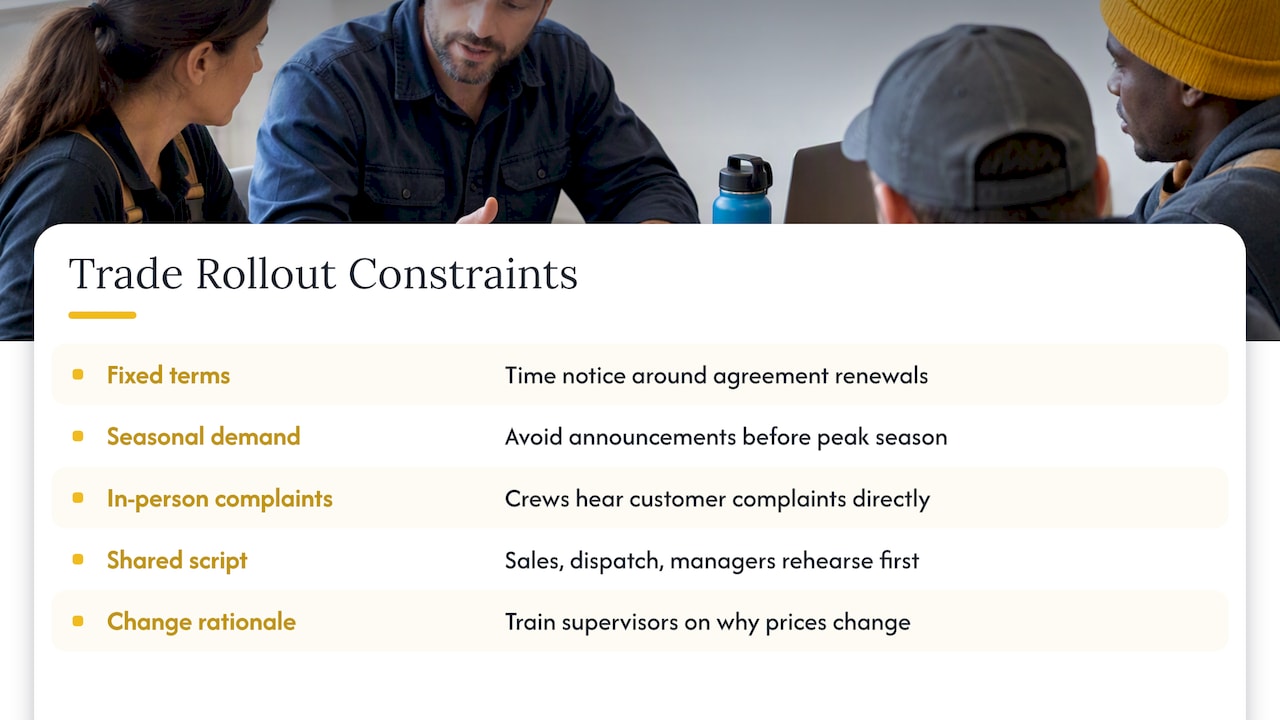
Trade businesses carry constraints that software companies do not: maintenance agreements with fixed terms, seasonal demand swings, and crews who hear customer complaints in person, not through a support ticket. That changes both timing and tone. A price increase announced right before peak season can collide with renewal cycles on existing maintenance agreements, so notice windows need to account for when agreements actually renew, not just a calendar date.
In our work with trade businesses, the rollouts that go smoothest are the ones where sales, dispatch, and service managers rehearse the same script before the announcement goes out, not after the first angry call comes in. Training field supervisors and service managers on the reasoning behind a price change, not just the new number, cuts down on the mixed messages that erode trust fastest. That alignment work is often the difference between a quiet rollout and a wave of escalations in week one.
The one mistake that sinks most price increases
The biggest failure is not the number itself. It is the vacuum between announcement and frontline readiness, when sales promises one thing and support says another, and customers get caught in the gap. Fix it by locking a CEO, CFO, and customer success alignment checklist before any customer hears the news: agree on the number, the reason, the exceptions, and who owns each piece of outreach.
Print the one-page checklist, walk it with every department lead, and treat the six-week sequence as non-negotiable scaffolding, not a suggestion. Most execution failures trace back to skipping that alignment step because the number felt urgent.
— Dan
How we help trade businesses run this well
Planning the number is the easy part. Running the rollout without losing customers is where most trade businesses need a hand, and that is the work we do every day. Our Rebuild engagement pairs operational audits with sales training and management coaching, so your pricing change lands with a team that already knows the script, the escalation path, and the exceptions before the first email goes out.

Engagements run as short, hands-on projects built around your actual rollout timeline, not a generic template. If you want help structuring the sequence, training frontline teams, or building the scorecard that tells you whether the increase is working, visit our pricing page to see how an engagement is structured, or reach out through Rebuilding the Trades to start the conversation.
FAQ
How do I announce a rate increase?
Lead with a plain statement that the rate is increasing and the effective date, followed by one factual reason tied to costs or protected service. Add a concrete dollar example so the customer does not have to calculate the impact, then close with a FAQ link and contact option.
What is a good message to send to clients about a price increase?
A good message states the change in the first line, gives one honest reason tied to a specific cost driver, and shows a before and after dollar figure. Keep it short enough to read on one screen and end with an easy way to ask questions.
Do you need to notify clients of a price increase?
Yes, and giving clear notice before the new rate takes effect is standard practice across most service industries, with 30 to 90 days being a common window depending on contract terms. Clear disclosure also reduces legal risk, as recent FTC enforcement actions on hidden pricing and renewal terms show.
How do I tell a customer there is a price increase?
Tell them directly and early, ideally through a personal outreach for high-value accounts and a clear email or billing notice for everyone else. State the new amount, the effective date, and one reason, and give them a way to ask questions before the change hits their invoice.
How much does a price increase typically affect customer retention?
The outcome depends far more on execution than on the size of the increase itself. Research on international B2B buyers shows that cultural context and the size of the increase both shape how customers react, with larger increases consistently creating more resistance regardless of market.
0 Comments