
Most service businesses should run a tiered, value-anchored pricing model backed by locked scope agreements, not a flat hourly rate. A service pricing strategy is the set of decisions that determines what you charge, why, and how you defend it against scope creep. Before you touch a price list, calculate your fully loaded cost floor. Everything else builds from that number.
TL;DR:
- Most service businesses should use tiered, value-based pricing models backed by locked scope agreements rather than flat hourly rates to protect margins.
- Calculating a fully loaded cost floor and setting prices between that and a measurable value ceiling is essential to ensure profitability and avoid underpricing by 20 to 40 percent.
- Matching the pricing model to the engagement’s repeatability, measurability, client preference, and risk level improves profitability and reduces negotiation friction.
- Operational controls like signed scope documents, change-order processes, and geospatial routing are critical to safeguarding margins and enforcing pricing strategies.
- Regular pricing audits, market position awareness, and disciplined discounting and promotion policies prevent margin erosion and maintain strategic price integrity.
Table of Contents
- What Is a Service Pricing Strategy, and Why Does It Matter?
- Common Pricing Models for Services and When to Use Each
- Pricing Math: How to Set Your Floor, Market Rate, and Ceiling
- How to Choose the Right Pricing Model for a Client or Engagement
- Building Good/Better/Best Packages That Actually Convert
- Operational Controls That Protect Your Margin
- Monitoring and Experiments: Your Pricing Audit Cadence
- A Trade-Specific Playbook: The $21 Million Maintenance Agreement Case
- Psychological Pricing Techniques Built for Services
- How to Communicate and Justify Prices to Clients
- Competitor Pricing Analysis and Market Positioning
- Legal and Ethical Considerations in Service Pricing
- Handling Discounts, Promotions, and Negotiations
- Adjusting Pricing Across the Service Lifecycle
- The Mistake I See Constantly: Pricing Without Systems
- How Rebuildingthetrades Helps You Build Pricing That Holds
- Further Reading and Primary Sources
- Sources
What Is a Service Pricing Strategy, and Why Does It Matter?
A pricing strategy is the intent behind your numbers. A pricing model is the mechanism that delivers on that intent. Confusing the two is why so many owners tinker with hourly rates and wonder why margins never move. Strategy answers “what are we trying to signal and capture?” Model answers “how do we bill for it?” You need both, in that order.
Price does five commercial jobs whether you plan for them or not. It signals quality and positioning to the market. It filters out clients who don’t fit your operation. It captures the value you actually create, not just the hours you spend. It funds growth by producing margin you can reinvest. And it protects the business when things go wrong on a job.
Here’s what most owners get backwards: price alone can’t do any of this without operational backup. A service business pricing strategy is fundamentally an operational system, built on locked scope, signed contracts, sane routing, and accurate quoting. Raise your rates without those systems and you’ll just lose bids faster.
The five jobs price has to do:
- Signal your positioning in the market (premium, mid-market, budget)
- Filter clients toward the ones who fit your delivery capacity
- Capture the value created, not just hours logged
- Fund growth through retained margin
- Protect the business from scope creep and bad-fit jobs
Common Pricing Models for Services and When to Use Each
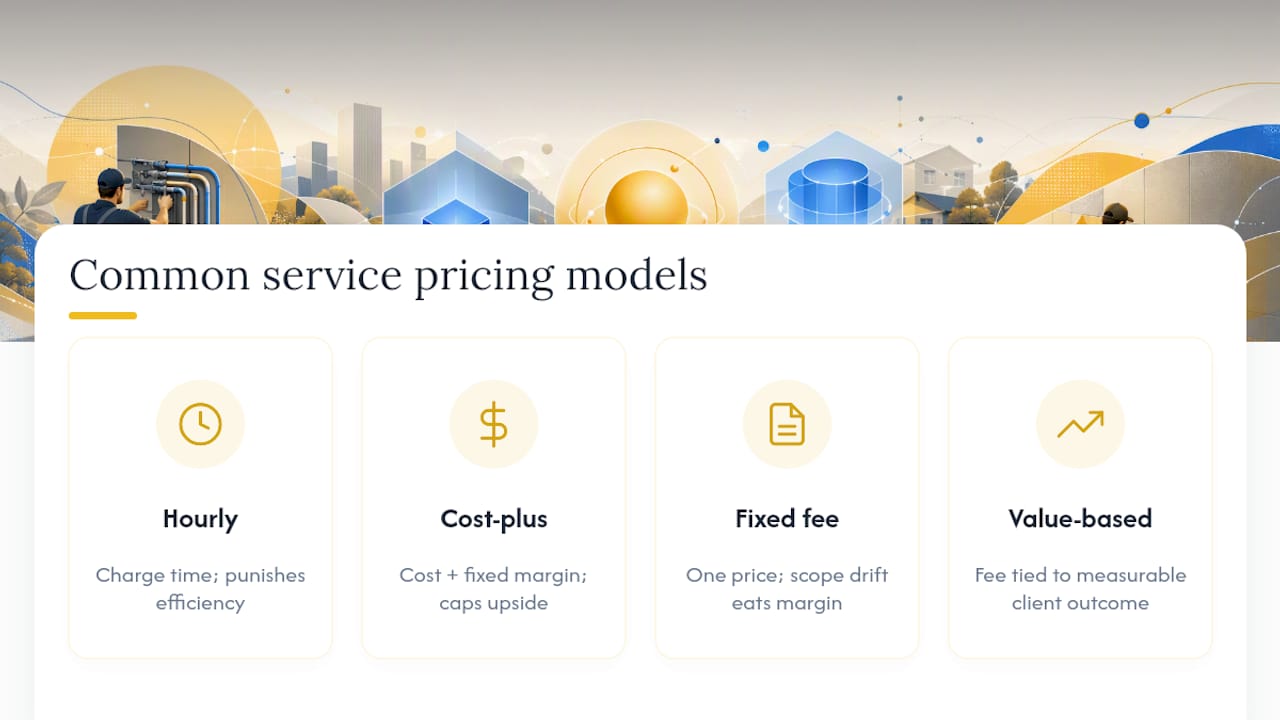
Eight models cover almost every service business scenario. Pick based on how predictable delivery is, how measurable the outcome is, and what your client actually wants to buy.
Hourly billing. You charge for time spent, tracked and invoiced. It fits early-stage consultants, legal work, and anything where scope genuinely can’t be defined upfront. The pro: it’s simple to explain and hard to underquote. The con: it punishes efficiency. The faster you work, the less you earn, and clients hate open-ended invoices.
Cost-plus pricing. You calculate your delivery cost, then add a fixed margin percentage. It works well for materials-heavy trade work like HVAC installs or roofing where component costs vary job to job. The pro: it’s defensible and easy to justify to a client who asks for an itemized breakdown. The con: it caps your upside. You never get paid more for solving a harder problem faster.
Fixed fee. One price for a defined deliverable, agreed before work starts. It fits projects with a clear, scopeable outcome: a website build, a bathroom remodel, a compliance audit. The pro: clients love price certainty, and it forces you to scope tightly. The con: any scope drift eats your margin unless you enforce a change-order process. Rebuildingthetrades built a flat rate pricing rollout guide for exactly this reason.
Retainer. A recurring fee for ongoing access or a defined bundle of monthly work. It fits maintenance contracts, fractional leadership, and agencies doing continuous marketing work. The pro: predictable revenue that smooths cash flow. The con: scope tends to balloon unless the retainer spells out exactly what’s included.
Tiered pricing. Three (or more) packaged options at different price and feature points. It fits almost any repeatable service, from IT support to HVAC maintenance plans. The pro: it shifts the buyer’s decision from “should I buy?” to “which tier fits me?” which reduces negotiation friction. The con: poorly differentiated tiers just confuse buyers and collapse into one default choice.
Value-based or outcome-based pricing. Fees tied to the measurable result you produce rather than the hours or materials involved. It fits situations where you can quantify client benefit: a sales consultant tied to revenue lift, a marketing agency tied to lead volume. Consulting firms commonly use value-based pricing alongside fixed and retainer models, and it often produces higher margins when outcomes are measurable. The con: it requires real data and a client willing to share it, which not every buyer will do.
Usage-based pricing. You charge per unit consumed: per ticket resolved, per device monitored, per transaction processed. It fits software-adjacent services and platforms with variable usage patterns. The pro: it scales naturally with client size. The con: revenue becomes unpredictable if usage swings hard month to month.
Dynamic pricing. Rates that shift with demand, timing, or capacity, common in emergency trade calls (after-hours plumbing) and seasonal service work. The pro: it captures peak-demand value that flat pricing leaves on the table. The con: clients resent it if it feels arbitrary, so the trigger for a price change needs to be transparent.
Most service firms default to one model for every job regardless of fit, and that habit is a real source of margin leakage across professional services firms. Matching the model to the delivery method, not just picking your favorite, is where the actual money is.
Pricing Math: How to Set Your Floor, Market Rate, and Ceiling
You need three numbers before you set a single price: your cost floor, a market reference point, and a value-based ceiling. Skip the floor and you’re guessing at profitability. Skip the ceiling and you’re leaving money on the table.
- Calculate your fully loaded cost floor. Add every annual business cost (labor, overhead, insurance, vehicles, software) plus your target owner compensation, then divide by your realistic billable hours for the year. A shop with $480,000 in annual costs and owner salary target, divided by 1,600 billable hours, lands at a $300 fully loaded hourly floor. Price below that and you’re subsidizing the client.
- Run the effective hourly rate sanity check. Take any quoted job price and divide it by the hours it actually takes to deliver. If that number sits below your floor, you underquoted it, even if the invoice looked healthy on paper.
- Estimate your value ceiling. If your service demonstrably saves or earns a client $50,000, a fee in the 10 to 20 percent range of that benefit is a common ceiling reference point in value-based engagements. That puts your ceiling somewhere between $5,000 and $10,000 for that job, regardless of how many hours it took.
- Position your price between floor and ceiling, weighted toward the ceiling when the outcome is measurable and toward the floor when it isn’t.
Pricing Reality Check: Many service founders are running 20 to 40 percent underpriced before they ever do this math. The floor calculation alone catches most of that gap.
A useful gut check on where you’re sitting: if more than 80 percent of prospects accept your price with zero negotiation, you’re underpriced. A healthy target close rate on full-price proposals sits around 30 to 50 percent. Too high a close rate is a pricing signal, not a sales win.
How to Choose the Right Pricing Model for a Client or Engagement
Pick the model by scoring the engagement against four criteria, then mapping the score to a model type.
- Score repeatability (0 to 3). Is this a one-off or a job you’ll do fifty more times this year? Higher repeatability points toward fixed fee or tiered pricing. Lower repeatability points toward hourly.
- Score measurability (0 to 3). Can you attach a dollar figure or clear metric to the outcome? High measurability opens the door to value-based or outcome-based pricing. Low measurability rules it out entirely, no matter how much you want the margin.
- Score client preference (0 to 3). Some buyers, especially procurement-driven ones, want hourly transparency. Others want a single number. Ask directly during scoping rather than guessing.
- Score delivery risk (0 to 3). How much could go wrong that’s outside your control? High-risk jobs (unknown site conditions, dependent third parties) push you toward cost-plus or hourly with a cap, not fixed fee.
Add the four scores. A total above 9 usually points toward fixed fee, tiered, or value-based pricing. A total below 6 points toward hourly or cost-plus, where flexibility protects you.
During scoping calls, ask questions that reveal what the client actually values: “What does solving this problem save or earn you?” and “What’s happened on past projects like this that went sideways?” The first question surfaces a value ceiling. The second surfaces the risk you’re pricing into a fixed number.
Pro Tip: Treat any client who refuses to define success metrics as a hard no for value-based pricing. Without a metric, you have no ceiling and no defense if they later claim you overcharged.
Watch for two red flags. On fixed-price offers, a client who keeps saying “well, while you’re here” during scoping is telling you the scope will drift. On value-based offers, a client who won’t share baseline data (current revenue, current costs) is telling you they’ll dispute the outcome later. Walk into both with eyes open, or walk away.
Building Good/Better/Best Packages That Actually Convert
Three tiers work better than one price because they turn a yes/no decision into a menu decision. Tiered packaging shifts the conversation from “what should this cost?” to “which tier fits me?”, and that shift alone reduces the friction that kills deals.
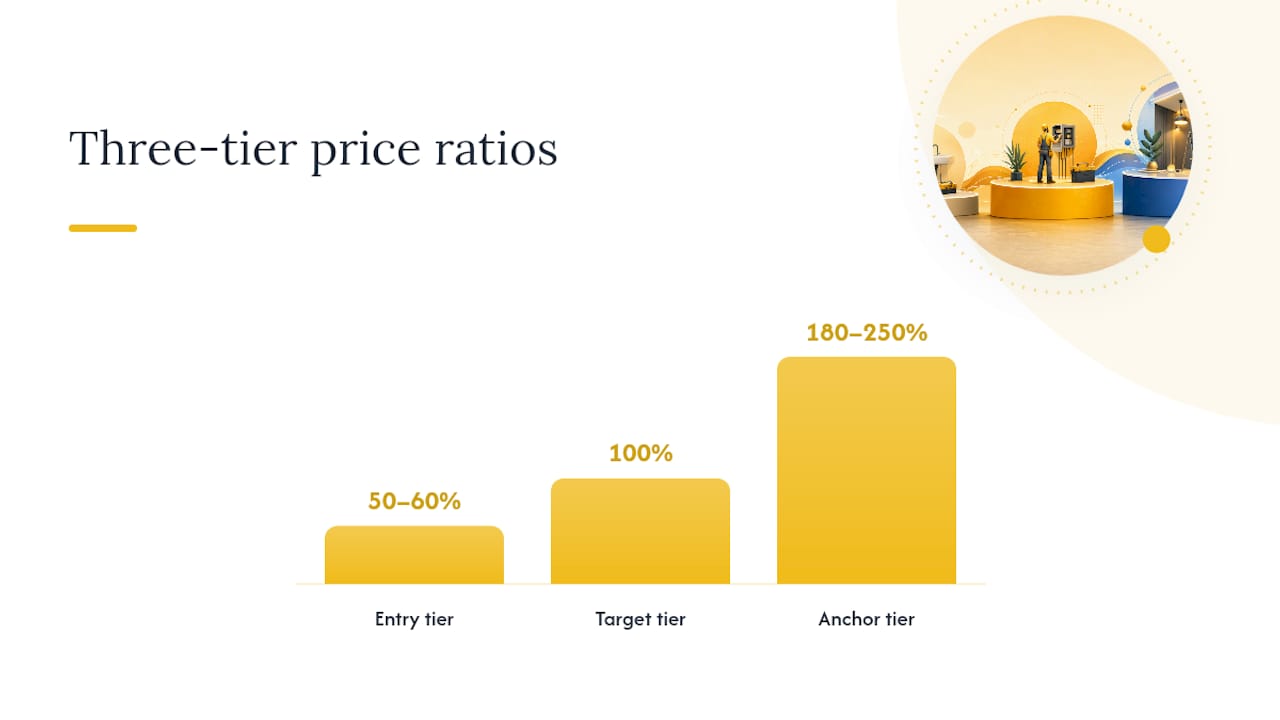
The pricing ratio matters more than most owners think. A workable structure for a trade maintenance offer runs the entry tier around 50 to 60 percent of your target tier’s price, the target tier at 100 percent, and the anchor tier at 180 to 250 percent, based on the three-tier maintenance model that scaled one HVAC operation to a $21 million run rate. The anchor tier rarely sells in volume. Its job is to make the target tier look reasonable.
Define deliverables per tier with zero ambiguity. If the entry tier includes “seasonal tune-up,” name the exact checklist items. If the target tier adds “priority scheduling,” define the response-time window in writing. Vague tier descriptions collapse into disputes the first time a client expects more than you scoped.
Price your middle tier first, not last. It’s the one most buyers pick, so it needs to reflect a genuinely attractive price-to-value ratio. The entry tier exists to make the middle tier look substantial; the anchor tier exists to make it look like a bargain.
Use add-ons for upsell instead of quietly expanding what a tier includes:
- Offer emergency response as a paid add-on, not a folded-in perk
- Sell equipment upgrades separately from the maintenance plan itself
- Bundle a discounted second service only after the core tier is signed
This keeps your tiers stable and enforceable instead of drifting into custom deals every time a salesperson wants to close faster.
Operational Controls That Protect Your Margin
Pricing strategy fails without operational backup. You can set a brilliant price and still bleed margin if scope, contracts, and routing aren’t locked down.
Attach a signed scope of work to every estimate, no exceptions. A scope document that lists exactly what’s included, and explicitly what’s excluded, is your first line of defense against “well, while you’re here” requests mid-job.
Define and enforce a change-order process before you need it, not during a dispute. The script is simple: “That’s outside our original scope. Here’s what it adds to the price and timeline. Do you want to proceed?” Rebuildingthetrades built a field guide for structuring change orders specifically because this single habit recovers more margin than most price increases do.
Route density matters more than most owners price for. A technician running four jobs in one zip code costs less per job than one running four jobs across a metro area, even at identical labor rates. Build routing rules that cluster work geographically and price standalone, far-flung jobs at a premium to cover the windshield time.
Quote templates should state assumptions explicitly, in writing, every time:
- List the exact materials, brands, or specs assumed in the price
- State site-access assumptions (parking, permits, working hours)
- Note what triggers a change order before work begins, not after
Operational fixes like scope lockdown, signed contracts, and route density often recover more margin than a single across-the-board price increase, and they cost nothing to implement beyond discipline.
Monitoring and Experiments: Your Pricing Audit Cadence
Pricing isn’t a set-it-and-forget-it decision. Build a quarterly check and an annual audit into your calendar the same way you’d schedule equipment maintenance.
- Run a quarterly dashboard review. Track close rate on proposals, gross margin by job type, and average revenue per sale. A close rate creeping toward 80 percent or higher is your signal to test a price increase.
- Conduct a 90-minute annual pricing audit. Recalculate your cost floor with current labor and material costs. Compare your actual effective hourly rate on last year’s jobs against your target. Review which tier sold most and why.
- A/B test price points or tier messaging on a subset of quotes rather than changing everything at once. Test one variable, like anchor tier pricing or a renamed middle tier, and measure the close rate difference over a full quarter.
- Communicate a planned price increase with a defined notice window, typically 30 to 60 days for existing retainer or maintenance clients, framed around added value rather than rising costs.
Audit Reality Check: Running an annual pricing audit alongside quarterly close-rate and margin checks is the mechanism that catches margin drift before it compounds across a full year of underpriced jobs.
A Trade-Specific Playbook: The $21 Million Maintenance Agreement Case
A three-tier maintenance agreement strategy took one HVAC operation to a $21 million run rate by applying almost exactly the framework above: a clear cost floor, tiered packaging anchored around a target middle tier, and enforced scope controls on every agreement sold.
Building a trade price book starts with floor math for each recurring task. If a seasonal HVAC tune-up costs $85 fully loaded (labor, drive time, materials), price the entry tier around $110 to $130, the target tier around $180 to $220 with added services bundled in, and the anchor tier at $300 plus with priority scheduling and parts discounts folded in. Rebuildingthetrades documented a full working example in its HVAC price book guide, and partner resources like HVAC Prime’s maintenance offering breakdowns are useful for benchmarking typical scope inclusions.
The operational rollout that made the pricing stick came down to four moves:
- Attach a scoped statement of work to every maintenance agreement sold
- Collect an electronic signature at point of sale, not after the fact
- Route every scope change through a documented change-order workflow
- Run the annual pricing audit on a fixed calendar date, not “when we get to it”
None of the pricing math matters if the operational discipline behind it doesn’t hold.
Psychological Pricing Techniques Built for Services
Charm pricing (ending a number in .99 or .95) works differently in services than in retail. A $499 diagnostic fee reads as under $500 the same way a $19.99 product does, but services carry a credibility risk that products don’t: round numbers like $500 or $1,000 can actually signal more confidence and less “trying to trick you” than a charm-priced figure. Reserve charm pricing for entry-tier or transactional services (a one-time inspection, a basic tune-up) and use clean round numbers for premium or relationship-based engagements.
Anchoring does more work in services than almost any other tactic. Showing your anchor tier first, even if almost nobody buys it, resets the client’s mental reference point before they see your target tier’s price. A $2,400 target-tier retainer looks reasonable next to a $4,500 anchor tier and expensive next to a bare $800 entry tier. Sequence matters: present high, then land on your target.
Decoy pricing works inside tiered structures when the middle tier is deliberately positioned to look like the obvious rational choice. If your entry tier gives 40 percent of the value at 55 percent of the price, and your target tier gives 100 percent of the value at 100 percent of the price, the math itself steers most buyers toward the target tier without you saying a word.
Bundling changes how clients perceive individual line items. A $150 line item feels expensive in isolation, but the same $150 disappears when it’s one component of a $2,000 bundled package. This is part of why productized, bundled offers tend to outperform itemized invoices on both close rate and perceived value.
How to Communicate and Justify Prices to Clients
Lead with outcomes, not hours. “This plan prevents the average $4,000 emergency repair bill” lands harder than “this plan covers four visits a year,” even when the second sentence is technically more informative. Clients buy avoided pain and gained results, not labor units.
Give the price before the client asks for it, framed around the tier structure rather than a single number. Presenting three options at once, with the target tier visually emphasized, moves the conversation to comparison shopping between your own offers instead of comparison shopping against competitors.
When a client pushes back on price, resist the instinct to discount immediately. Ask what specifically feels out of range: the total number, the payment structure, or the scope itself. Often the objection is really about cash flow timing, which a payment plan solves without touching your margin at all.
Written proposals should state the value delivered in the client’s own terms wherever possible. If a commercial client mentioned downtime costs during scoping, reference that number back in the proposal: “This maintenance plan is designed to prevent the kind of downtime that cost your operation $12,000 last quarter.” That’s not manipulation. It’s translating your price into the currency the client already cares about.
Never apologize for your price in tone or wording. Phrases like “I know this seems like a lot, but…” plant doubt before the client has even reacted. State the number, pause, and let the value case you’ve already built do the work.
Competitor Pricing Analysis and Market Positioning
Checking competitor rates tells you where the market sits, not where you should price. Too many service owners treat a competitor’s rate sheet as a ceiling rather than one data point among several.
Gather competitor pricing the same way a client would: request quotes, review published rate cards, and talk to recent switchers about what they paid elsewhere. Then place your own number relative to your actual positioning, not the market average. A premium operator with better response times, cleaner trucks, and warrantied work has no obligation to match a budget competitor’s rate, and matching it usually signals the wrong thing to buyers who were never going to choose on price alone.
Positioning determines how much competitor pricing should influence you at all. If you’re competing on speed and reliability, your price should sit at or above the market median, and your marketing should say why. If you’re competing on volume and efficiency (a high-density route model, standardized service), pricing near or slightly below the median while protecting margin through tight operations makes more sense.
The trap is reactive pricing: cutting your rate every time a competitor undercuts you. That’s a race with no floor, and your fully loaded cost number is the only thing stopping the bottom from falling out. Track competitor moves quarterly alongside your own close-rate and margin dashboard, but let your cost floor and value ceiling set the boundaries, not the loudest competitor’s latest promotion.
Legal and Ethical Considerations in Service Pricing
Pricing decisions carry legal exposure that many service owners don’t consider until a dispute lands on their desk. Written estimates and quotes should state clearly whether the number is a binding fixed price or a good-faith estimate subject to change, because the distinction has real contractual weight if a client later disputes a final invoice.
Discriminatory pricing, charging different customers different rates for identical work based on protected characteristics rather than legitimate business factors (volume, risk, location, timing), creates legal exposure in many jurisdictions and is simply bad practice regardless of the legal risk. Price differences should always trace back to a documented, defensible factor: job complexity, travel distance, rush timing, or contract volume.
Bait-and-quote practices, advertising an artificially low rate with no intention of honoring it for most jobs, invite consumer protection complaints and damage referral reputation faster than almost any other pricing mistake. If your advertised rate only applies to a narrow set of circumstances, state those conditions plainly in the advertisement itself, not buried in fine print.
Dynamic and surge pricing require particular care in service industries, especially in emergency trades. A documented, transparent trigger for after-hours or peak-demand pricing (published rate sheet, clear time windows) protects you from accusations of price gouging during a client’s moment of genuine need. When state or local regulations govern emergency service pricing, check the specific rules that apply in your operating area rather than assuming general practice is compliant everywhere you work.
Handling Discounts, Promotions, and Negotiations
Discounting without a rule set is how margin quietly disappears. Before you ever offer a discount, decide the conditions that justify one: multi-service bundling, off-season timing, referral volume, or upfront annual payment. A discount tied to a specific, repeatable trigger protects your price integrity. A discount handed out because a client pushed back hard does the opposite, and word travels fast that your prices are negotiable for anyone willing to ask.
Promotions work best when they create urgency around timing rather than permanently eroding your price point. A seasonal maintenance promotion tied to a specific month, with a clear end date, drives volume without training your client base to wait for the next discount cycle.
Negotiation should happen on terms, not just price. If a client wants a lower number, offer to adjust scope, payment timing, or service level instead of simply cutting the fee. “I can hit that number if we move to a 12-month contract instead of month-to-month” preserves your effective rate while giving the client a concession that costs you less than a flat discount would.
Set a documented floor below which no one on your team, including sales reps, can discount without owner approval. This single rule prevents the slow, invisible margin erosion that happens when five different people each grant a small discount over the course of a year, none of which alone seems significant, but which compound into a meaningfully lower average close price.
Adjusting Pricing Across the Service Lifecycle
Pricing isn’t static across the life of a service line, and treating it as fixed is one of the most common strategic errors owners make.
At launch, price closer to your floor than your ceiling. You’re building case studies, testimonials, and delivery confidence, and a slightly aggressive price buys the volume needed to prove the model works. Resist launching at your dream price before you’ve validated delivery cost and time.
During growth, raise prices as demand outpaces capacity. If your close rate on full-price proposals climbs above the healthy 30 to 50 percent range and starts approaching 70 or 80 percent, that’s your signal the market will bear more. This is also the stage to introduce tiered packaging if you launched with a single flat price, since productized, tiered offers are what let revenue scale without proportional owner time.
At maturity, shift focus from acquisition pricing to retention and expansion pricing. Existing clients on retainers or maintenance agreements should see modest, well-communicated annual increases tied to added value, not just inflation. This is also when add-on and upsell revenue matters more than winning new logos.
During decline or when a service line is being phased out, pricing often rises rather than falls, deliberately. Raising the price on a sunsetting service line filters remaining demand toward clients who value it most, while freeing capacity to reinvest in the next offering. Dropping the price to chase volume on a dying service line usually just delays the inevitable while eating margin on the way down.
The Mistake I See Constantly: Pricing Without Systems
Here’s the honest admission: most pricing conversations I’ve been part of in the trades start with “what should we charge?” when the real question is “can we actually defend what we’re already charging?” Owners will spend weeks debating a rate increase while their change-order process is a verbal conversation on a job site that nobody documents. That gap is where the real money leaks out, not in the rate card.
If you take one action from this entire guide this week, make it this: pull your last ten invoices and check how many jobs went over the original quoted scope without a signed change order. If it’s more than two or three, you don’t have a pricing problem. You have an operational control problem wearing a pricing costume. Fix the change-order workflow before you touch a single rate.
The framework in this guide works. The floor, market reference, and ceiling numbers are real tools. But no pricing strategy survives contact with an operation that can’t enforce its own scope. Systems first, then price.
— Dan
How Rebuildingthetrades Helps You Build Pricing That Holds
Rebuildingthetrades works exclusively with trade businesses, HVAC, plumbing, electrical, roofing, remodeling, and siding companies, on the operational systems that make a pricing strategy actually stick. Where a generalist consultant hands you a rate spreadsheet and moves on, Rebuildingthetrades stays hands-on through the rollout: locking down scope documents, building change-order workflows, mapping the processes that let a price increase survive first contact with a real job site.

If you’ve read this far and recognized your own business in the change-order gap or the tiered-packaging section, that recognition is the useful part. The three-tier maintenance agreement case study shows what that work looks like at full scale, a $21 million run rate built on exactly the pricing and operational controls covered above. Review the current engagement structure and pricing to see how a hands-on operational consulting engagement is built, and book a conversation to map your own cost floor, tier structure, and change-order process before your next quarter’s audit is due.
Further Reading and Primary Sources
The following sources informed the pricing math, model definitions, and operational guidance throughout this guide:
- How to price services for profit — Northern Star Business Consult: The source for the fully loaded cost floor method, the 20 to 40 percent underpricing figure, and the annual audit cadence.
- Professional services pricing models — Productive: Covers the margin risk of defaulting to one pricing model across every project type.
- Packaging and bundling strategy — Umbrex: The reference for tiered packaging’s effect on buyer conversion and negotiation friction.
- Consulting pricing models — Deltek: Background on fixed, retainer, and value-based models common in consulting engagements.
- The pricing strategy guide — Paddle: Detail on the customer research and experimentation required to adopt value-based pricing.
- How to price a service business for growth — Castlane: Supports the growth-stage argument for productized, tiered pricing architecture.
Sources
- How to price services for profit — Northern Star Business Consult
- Professional services pricing models — Productive
- Packaging and bundling strategy — Umbrex
- Consulting pricing models — Deltek
0 Comments