
A service department structure is the set of roles, reporting lines, and decision rights that decides who owns the phone, the schedule, the truck, the customer, and the numbers. In an HVAC, plumbing, or electrical company, a good one turns service from a filler task between installs into a predictable, measurable division. A bad one leaves the owner answering every question at 7 p.m.
This guide is for owners of small and mid-sized trade businesses. It covers the roles a service department needs, how to draw reporting lines, how the structure should change as you grow, and how to roll out a new chart without breaking the crews you have.
TL;DR
- A service department structure assigns clear ownership for four things: call intake, dispatch, field work, and financial performance.
- Small shops can run with multi-hat roles, but should name one champion for service and standardize processes before adding headcount.
- Grow in stages: multi-hat roles, then specialized managers, then consolidated reporting under executive leadership.
- Build the chart for where you will be in 12 to 24 months, write role descriptions, and treat the chart as a live document.
- Structure only helps if it shows up in the numbers: track service as its own business unit.
Table of Contents
- What a service department structure actually defines
- The roles a service department needs
- Reporting lines: who answers to whom
- Three stages of structure as you grow
- Making the structure visible in the numbers
- How to build or revise your structure, step by step
- Common mistakes
- Our perspective: structure is where the owner gets their time back
- Where we can help
- FAQ
- Sources
What a service department structure actually defines
Most owners picture an org chart with boxes. The boxes are the least important part. A structure defines three things:
- Roles: what each position is responsible for, in plain language.
- Reporting lines: who each person answers to, and who they go to when something breaks.
- Decision rights: who can discount a job, reschedule a tech, authorize overtime, approve a callback, or turn down a call.
According to ELECTRI International’s guide on service and maintenance work, a structure like this is what moves service from an ad-hoc side task to an integrated, predictable revenue division. The same guide says the structure typically sets accountability for core functions such as dispatch, field operations, customer intake, and financial performance.
That list is a useful test. Pick any one of those four and ask: whose name goes next to it? If the answer is “the owner” for all four, you have a job, not a department.
The roles a service department needs
No single chart fits every company. Titles differ by shop, and one person may hold two of these jobs for years. What matters is that each function has an owner, even when that owner has other duties. Here are the functions we see in healthy trade service departments.
Call intake and customer service
The person who answers the phone sets the tone for the whole job. This function books calls, captures the right information (symptom, equipment, access, urgency), and sells the appointment, including maintenance agreements where they fit. It usually reports to the dispatch or service lead, not directly to the owner. If your booking rate is a mystery, intake is the first place to look.
Dispatch and scheduling
Dispatch matches the right technician to the right call at the right time. It owns the board: routing, capacity, emergency overrides, and keeping customers informed when things slip. In a small shop the dispatcher often doubles as the intake person. As call volume grows, split the roles so the person building the day is not also fighting the phone.
Service manager
The service manager owns the field outcome: technician productivity, quality, callbacks, safety, and the daily rhythm. This is the role most owners promote too early from the best tech, and then lose both a great technician and a manager. The skills are different. Managing people, reading a dashboard, and holding a hard conversation can all be taught, but they need to be taught on purpose. Our leadership pipeline guide covers how to test a field pilot for 90 days before you commit someone to the job.
Lead technicians and field supervisors
Lead techs ride along, check work, mentor newer technicians, and absorb the escalations that would otherwise go to the manager. They are a bridge, not a layer for its own sake. You add them when one manager can no longer see the work.
Technicians and installers
Technicians report to a lead or to the service manager, and should know exactly who approves what. Clear decision rights for technicians (what they can quote, what they can discount, when they call for backup) prevent most of the friction that reaches the owner.
Administration and financial operations
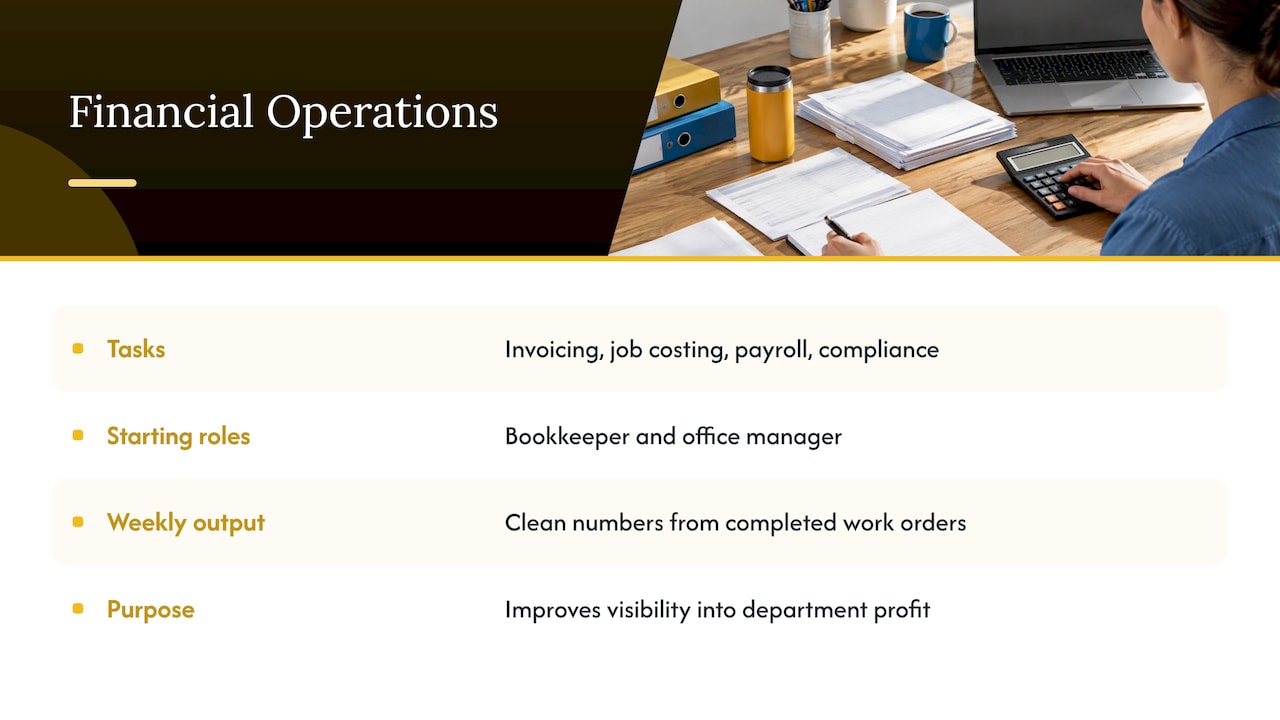
Invoicing, job costing, payroll inputs, and compliance paperwork need an owner too. Someone has to turn completed work orders into clean numbers every week. That function often starts with a bookkeeper and an office manager, and it ties directly to how well you can see the department’s profit. More on that below.
Reporting lines: who answers to whom
A simple, workable service department for a mid-sized shop looks like this:
| Role | Reports to | Owns |
|---|---|---|
| Owner or GM | Board, partners, or self | Strategy, culture, hiring of managers |
| Service manager | Owner or GM | Field results, callbacks, technician performance, safety |
| Dispatch lead | Service manager | Schedule, capacity, customer communication on timing |
| Call intake / CSRs | Dispatch lead | Booking, call quality, agreement offers |
| Lead technicians | Service manager | Quality checks, mentoring, escalations |
| Technicians | Lead technician or service manager | Diagnosis, repair, customer experience on site |
| Office / finance | Owner or GM | Invoicing, job costing, weekly service numbers |
Two rules keep this table honest:
- One boss per person. If a technician takes direction from the dispatcher, the service manager, and the owner, none of them is accountable.
- Decision rights follow the chart. If the dispatcher cannot move a job without asking the owner, the chart is decoration.
How many people should report to one manager
Span of control is where many contractors go wrong, usually by leaving the owner as the manager of everyone. Terry Nicholson of Praxis S-10 says in a Housecall Pro guide for owners that an owner can generally manage about five direct reports, covering pillars such as operations, administration, sales, marketing, and training. Past that, things slip. We go deeper on this in span of control for contractors, including how the number moves with the kind of work your people do.
Three stages of structure as you grow
The ELECTRI guide describes a progression that matches what we see in the field. Think of it in three stages.
Stage 1: Everyone wears multiple hats
This is the owner, a few technicians, and an office person who does everything from answering phones to invoicing. Small contractors often work this way, and it works fine until volume rises. At this stage the goal is not more boxes. It is two moves:
- Appoint a champion for service, one named person who owns the initiative, even part-time.
- Standardize the manual processes (call script, dispatch rules, job close-out, invoicing) before scaling them.
Standardizing matters because a process that lives in one person’s head cannot be handed off. Higher-risk work in particular benefits from a written sign-off step, such as a permit to work system, so nobody on the crew is guessing who approved what.
Stage 2: Specialized managers
As the business grows, the multi-hat roles give way to specialized management positions: a dedicated service manager, a dispatch lead, an office manager. The owner stops being the escalation point for everything. The typical sign you are here: the owner is still answering technician questions at night, yet the company has twenty or more trucks’ worth of work.
This is also where training gets real. Managers need a playbook for how to run a morning huddle, review a callback, and coach a technician. Our training playbook for contractors shows how to build one that people actually use.
Stage 3: Maturity and consolidated reporting
At maturity, reporting lines consolidate under executive leadership to reduce operational friction. The Housecall Pro guide notes that this often produces roles such as a Chief Operations Officer or Chief Finance Officer. The owner moves from running the days to running the company. Not every shop needs these titles, but every shop at this size needs someone who owns operations and someone who owns the numbers.
Making the structure visible in the numbers
A structure with no measurement behind it drifts back to habit. ELECTRI’s guidance for owners is to departmentalize financial statements, track performance through dedicated business units, and review metrics such as revenue, first-time fix rate, and contract renewal rate on a regular schedule.
In practice that means:
- Service is its own business unit. Separate revenue and cost from installs so you can see whether service makes money on its own.
- Each role has a number. Intake: booking rate. Dispatch: jobs per tech per day and on-time arrival. Service manager: first-time fix, callbacks, revenue per technician. Office: days from job completion to invoice.
- Technology mirrors the chart. The same guide says integrated field service management software helps mirror the organizational structure, with real-time cost tracking, accurate billing, and better technician workflow. If your software lets everyone see and change everything, your decision rights exist only on paper.
For what to put on the weekly report, see contractor financial reporting. If callbacks are your biggest leak, HVAC callback reduction shows where ownership usually breaks down.
How to build or revise your structure, step by step
The June 2026 ELECTRI guide to organizational charts lays out a sequence that works for service departments. Here is how we would run it in a trade business.
- Define the core functions. Write down what the department must do: intake, dispatch, field work, quality, billing, customer retention. Function first, people second.
- Map the as-is structure. Draw what actually happens today, not what you wish happened. Who really approves a discount? Who really calls the unhappy customer? Include the informal power, like the tech everyone asks before they ask the manager.
- Identify the gaps. Look for functions with no owner, people with three bosses, and owners with more than five direct reports.
- Design the target state for 12 to 24 months out. Build for the company you will be, based on your labor forecast, not today’s headcount. Our guide to labor forecasting for contractors helps with the hiring side of that number.
- Write the role descriptions. One page each: purpose, decisions they own, who they report to, the two or three numbers they are measured on.
- Keep the chart alive. Review it at least yearly and whenever you add a truck, a location, or a manager.
The same Housecall Pro guide makes a point worth borrowing: draw the chart early, even before the positions are filled. It lets people see a career path and prepares you for milestones like a second location.
A worked example
Take a hypothetical residential HVAC and plumbing company with 14 technicians, one office person, and an owner who still dispatches at 6 a.m. The as-is map shows the owner handling dispatch overrides, pricing exceptions, callbacks, and payroll questions. That is four functions and no clear owner for any of them.
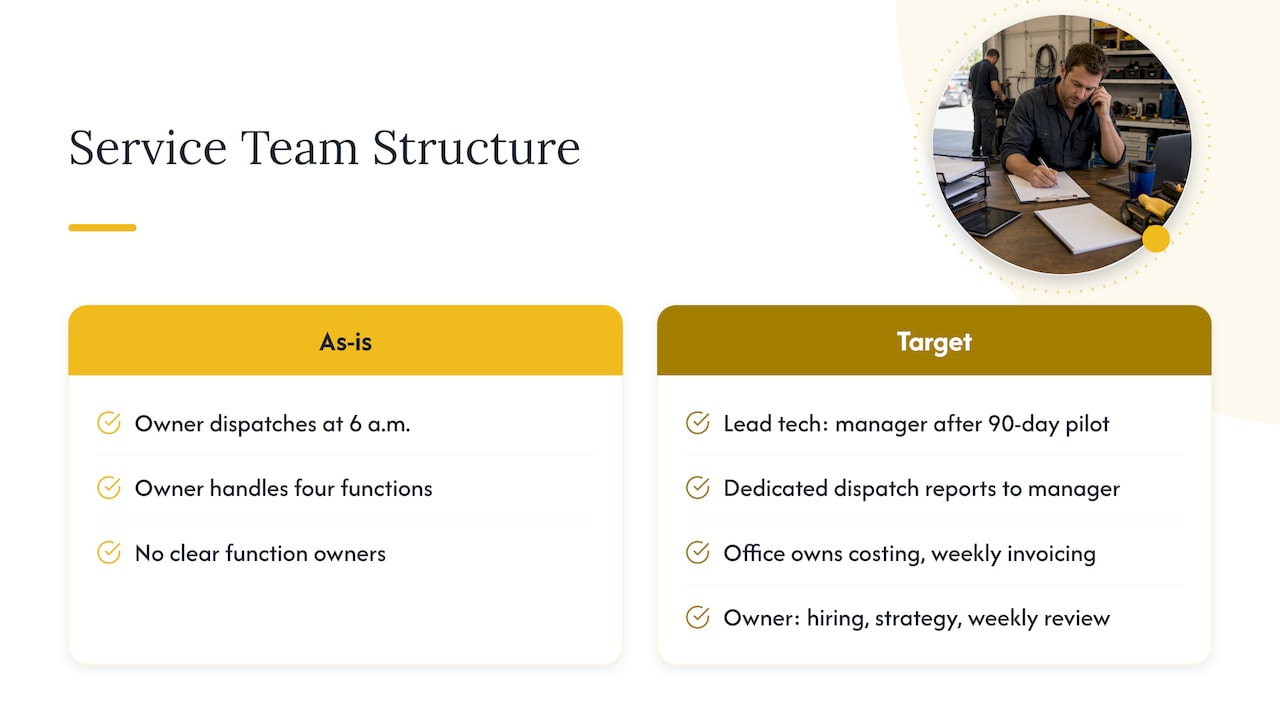
The target state: promote one proven lead tech into a service manager role, after a 90-day pilot. Move dispatch to a dedicated person who reports to the service manager. Give the office person job costing and weekly invoicing ownership. The owner keeps hiring, strategy, and the weekly numbers review. Direct reports for the owner drop to three. Nothing about the trucks changed, but the owner gets the evenings back, and every function has a name next to it.
Common mistakes
- Promoting the best technician without training. You lose output and gain a stressed manager. Train first, pilot second, promote third.
- Building the chart around people instead of functions. When Mike leaves, the chart collapses. Roles outlast employees.
- Adding layers before standardizing. A manager cannot manage a process that nobody has written down.
- Ignoring retention. Structure includes how you hear from your people. Stay interviews catch problems before a technician resigns.
- Never revisiting the chart. A chart that has not changed in two years describes a company you no longer are.
Our perspective: structure is where the owner gets their time back
We work only with trade businesses, and one pattern repeats. The owner built the company on being the best problem solver, so every problem still lands on them. The crews are good, the demand is there, and the business still feels fragile because it runs through one person.
We do not believe the fix is software or a template chart. Generic templates fail in the trades because the work is different: weather swings, emergency calls, techs who are paid to solve problems in someone’s basement, and families who sometimes sit on both sides of the org chart. A structure has to reflect how your shop really moves, and then it has to be backed by training, accountability, and financial visibility, or it fades in a quarter.
So we start with what is happening on site. We audit the board, the phones, the close-out, and the numbers, then build the roles and the routines that make them stick. The goal is simple: every function has an owner, every owner has a number, and the owner of the company is no longer the only one holding it together.
— Dan
Where we can help
If you have read this far and recognized your own shop, you probably need hands-on help rather than another chart. Our Rebuild engagement is built for trade owners who want a working service structure: onsite audits, management and leadership training, call management and dispatch training, and financial operations support, all designed specifically for HVAC, plumbing, electrical, and related trades.

See how Rebuild and our training programs work, or start from our home page to learn how we work with owners.
FAQ
What is the best service department structure for a small contractor?
For a small shop, the best structure is the simplest one that gives each core function an owner: intake, dispatch, field work, and billing. People can hold more than one function, but name one champion for service and write down the key processes. Add specialized roles as call volume and headcount make the multi-hat model break.
When should I hire a service manager?
Hire or promote one when you are the bottleneck for daily field decisions and you cannot review the work of every technician. A common trigger is when your direct reports exceed about five. Pilot the person in the role for a set period and give them management training before the title becomes permanent.
Should dispatch and customer intake be separate roles?
In a small company, one person can do both. As call volume rises, separate them, because building the day and answering new calls compete for the same attention. When you split them, make the dispatch lead the owner of the schedule and let intake report to that lead.
How often should I update my service department org chart?
Review it at least once a year and any time you add a manager, a truck, a service line, or a location. Treat it as a live tool rather than a one-time project. Design it for 12 to 24 months out so each update is a small adjustment.
Sources
- ELECTRI International, Electrical Service and Maintenance Guide to NFPA 70B and E
- ELECTRI International, Organizational Charts guide
- Housecall Pro, Hanging Up Your Boots and Hiring Leadership
0 Comments