
Span of control is the number of people who report directly to one manager. For a contractor, that means how many technicians a lead can run, how many leads a service manager can coach, and how many managers you, the owner, can hold accountable. There is no single right number. Most healthy trade businesses land on a range, then adjust it for crew experience, job complexity and how scattered the work is.
This guide gives you the ranges that research and practitioners point to, the factors that move them, the signs that a manager is stretched or smothering, and a way to set spans as an HVAC, plumbing or electrical company grows.
TL;DR
- Span of control is direct reports per manager. For most office and management roles, four to seven is a workable starting range. Field crews and complex work shift it either way.
- Newer leaders, junior crews, scattered job sites and managers who still do production work all call for smaller spans.
- Too wide shows up as long days, skipped one-on-ones and no time to think. Too narrow shows up as a manager hovering over every decision.
- Add a layer of management when the span stops working, not when someone asks for a title.
- Check each manager against one test: can they hold a short, regular check-in with every direct report without the operation falling apart?
Table of Contents
- What span of control means in a contractor business
- Why the number matters
- What ranges do people actually use?
- The factors that move the number
- Signs the span is too wide
- Signs the span is too narrow
- A simple test: the ten-minute check-in
- How span should change as you grow
- Worked example: a service department that outgrew its manager
- Our perspective
- Getting help setting spans and building leaders
- FAQ
- Sources
What span of control means in a contractor business
The plain definition is headcount: the number of direct reports a manager is responsible for, sometimes written as a ratio such as 1:6. In a trade company, you can see it at every level:
- A lead installer with two helpers has a span of two.
- A service manager with twelve technicians and a dispatcher has a span of thirteen.
- An owner who has the operations manager, sales manager, office manager, install manager and bookkeeper reporting to them has a span of five.
It is worth knowing that researchers define it more broadly than headcount. A Harvard Business School study describes span as the total resources under a manager’s direct control, including assets and information systems, not just people. For a contractor, that is a useful reminder that a manager who also owns a fleet, a parts room and a warranty process has a heavier span than the headcount suggests.
Why the number matters
Span of control is a trade-off, and both ends cost money.
Economist Valerie Smeets notes that a wider span lets talented leaders influence more workers, but returns diminish because a manager’s time is scarce and each person gets less individual attention. She also points out that more experienced managers are often given larger spans so their expertise reaches further.
That maps neatly onto a trade business. Your best service manager can probably coach more people than a newly promoted lead tech can. Give both the same span and one of them will fail.
A narrow span is not free either. Facilities-management guidance from APPA notes that flattening layers can lower management salary costs and bring managers closer to customers, though it requires trust and employee empowerment to work. If you have a manager supervising two people, you are paying for a layer that may not be earning its keep.
What ranges do people actually use?
You will hear famous numbers. The APPA article quotes Jack Welch as preferring ten reports per manager at GE, and as saying that organizations with more than five layers carry built-in management inefficiency. A large manufacturer with standardized work is not a twelve-truck plumbing shop, so treat that as a ceiling for simple, repeatable roles, not a target.
Closer to construction, a 2026 talent-industry analysis says a construction operations leader overseeing complex work such as heavy civil self-perform projects is effective with three to four project managers, while a leader running repeatable commercial building projects can handle five to six.
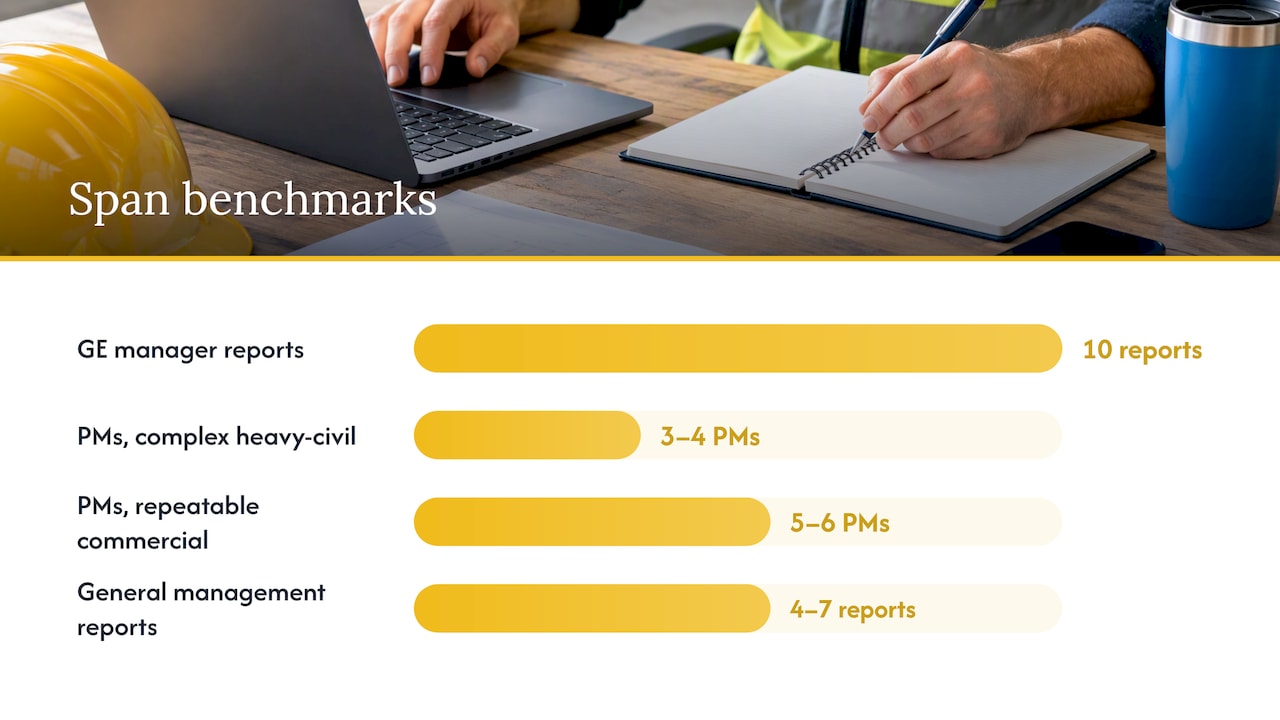
For general management, Worklytics reported in 2024 that its data suggest four to seven direct reports is often optimal, with adjustments for collaboration intensity, seniority, remote work and whether the manager also does individual work. Newer managers and junior teams generally need smaller spans.
Here is how those ranges translate into a working guide for trades. These are starting points drawn from the sources above plus common sense, not published standards for HVAC, plumbing or electrical.
| Role | Starting range | Move toward fewer when | Move toward more when |
|---|---|---|---|
| Owner or GM | 4 to 6 managers | You still sell, estimate or dispatch yourself | Managers are proven and reports are clear |
| Operations or service manager | 4 to 7 leads or dispatchers | Techs are junior or spread across a big territory | Leads handle most coaching |
| Field lead or foreman | 3 to 6 crew members | The lead also runs jobs, with complex or high-risk work | Crew is experienced and jobs repeat |
| Project or install manager | 3 to 6 active crews or projects | Jobs are custom or the PM is new | Work is repeatable and plans are clean |
If your number sits outside these bands, that is not automatically wrong. It is a prompt to check why.
The factors that move the number
A foreman study by researchers publishing through the International Association for Automation and Robotics in Construction identified nine factors affecting supervisory span: worker motivation, training, experience, the foreman’s own management training and experience, management style, availability of an assistant, quality and timeliness of plans and information, work complexity, and how physically spread out the crew is. The same study defines maximum span as the point beyond which a foreman’s effectiveness drops, and argues that it should be worked out systematically rather than by intuition.
Earlier foundational work in the same vein, a 1991 situational analysis of construction foremen in the Journal of Construction Engineering and Management, examined how crew size and managerial assistance change how a foreman spends the day, and what that does to crew performance.
For managers above the crew level, the 2026 construction talent analysis lists delivery method, level of self-perform work, project-manager tenure, time spent on direct estimating and geographic spread as the limits on span.
Turning that into questions you can ask about each manager:
- How experienced are the people reporting to them? Seasoned technicians need a weekly conversation. Apprentices need daily direction.
- How experienced is the manager? A first-year lead needs a smaller span while learning to coach.
- Is the manager also producing? A lead who runs calls all day has far less time for supervising than a full-time manager.
- How scattered is the work? Eight techs in one warehouse and eight techs across three counties are different spans.
- How good are the plans, schedules and information? When dispatch or job packets are sloppy, managers spend their day patching, which shrinks the span they can handle.
- Is there help? An assistant, a dispatcher or a strong second-in-command lets the same manager carry more.
- How complex is the work? Service changeouts are repeatable. Custom commercial installs and remodels are not.
Signs the span is too wide
Worklytics found that managers with more than seven reports were more likely to work ten to thirteen hour days. In a trade business, you will recognize the pattern in other ways:
- One-on-ones get skipped, then stop happening.
- Reviews, ride-alongs and call audits slip.
- The manager answers questions all day and does the paperwork at night.
- Small problems reach you because the manager had no time to solve them.
- Turnover or unresolved conflict rises in that team.
For an owner, an encyclopedia entry on the topic describes the hallmark sign: losing the ability to focus on long-term strategy because day-to-day employee issues take over. If you have not worked on the business in weeks, your span is probably too wide, whatever the org chart says.
It often happens by accident. The 2026 construction analysis notes that span is rarely a deliberate choice. It tends to be an accumulation of project assignments, and the seat slowly degrades into an administrative role until forecast accuracy and job-site visibility suffer. Anyone who has watched a service manager slowly turn into a full-time dispatcher knows how that goes.
Signs the span is too narrow
The opposite problem is quieter. The same Worklytics research found managers with fewer than four reports were more likely to over-manage, for example attending about 60% or more of team meetings or commenting on about 75% or more of collaboration documents. Those are knowledge-work measures, but the trade version is easy to spot:
- A manager rides along on every call a tech runs.
- Every quote, change order or purchase needs the manager’s sign-off.
- Leads wait for permission instead of deciding.
- The manager’s calendar is open but the team still feels micromanaged.
A narrow span is sometimes right, for example while a new leader learns. It becomes a problem when it is permanent and there is no plan to widen it.
A simple test: the ten-minute check-in
A practical test, suggested in a 2026 contractor org chart guide, is whether a leader can consistently hold a ten-minute weekly one-on-one with each direct report without the operation collapsing.
Run it this way:
- Count each manager’s direct reports.
- Multiply by ten minutes, and add travel or setup time if the check-ins happen in the field.
- Ask the manager whether they have really held those check-ins for the last four weeks.
- If not, find out why before changing anything. The problem may be the span, or it may be that the manager is doing work someone else should own.
The test works because it is about behavior, not the org chart. A manager with nine reports who has real weekly conversations is in better shape than a manager with five who has not talked to anyone in a month.
How span should change as you grow
Trade companies usually get this wrong in one of two ways. The owner holds everything until the business breaks, or the owner hands out titles to keep people happy and ends up with more managers than work.
A guide from the electrical contracting research foundation ELECTRI recommends building the chart around business functions such as estimating, field operations and administration before assigning people, which avoids the risk of one person wearing four hats. The same logic applies to HVAC and plumbing. Define the functions first: sales, dispatch, service operations, install, accounting. Then decide who owns each one.
A practical sequence:
- Owner stage. You supervise everybody. Keep it to what you can truly manage, and write down the check-in rhythm so it survives busy season.
- First layer. When your span stops passing the check-in test, promote or hire one manager for the function causing the pain, usually service or install operations.
- Lead layer. When the manager’s span grows past what they can coach, build field leads. A lead needs training before the title, not after.
- Specialist roles. Add dispatch, a call-center lead or a finance manager when the work is spread across too many hats.
A contractor org chart guide makes a sensible point about the trigger: add layers when a supervisor’s span exceeds effective limits, not because an employee asks for a title, or you only move the bottleneck. That is also why leadership development should come before the promotion. If you are thinking through who the next leaders are, our piece on building a leadership pipeline for contractors walks through a 90-day field pilot.
Worked example: a service department that outgrew its manager
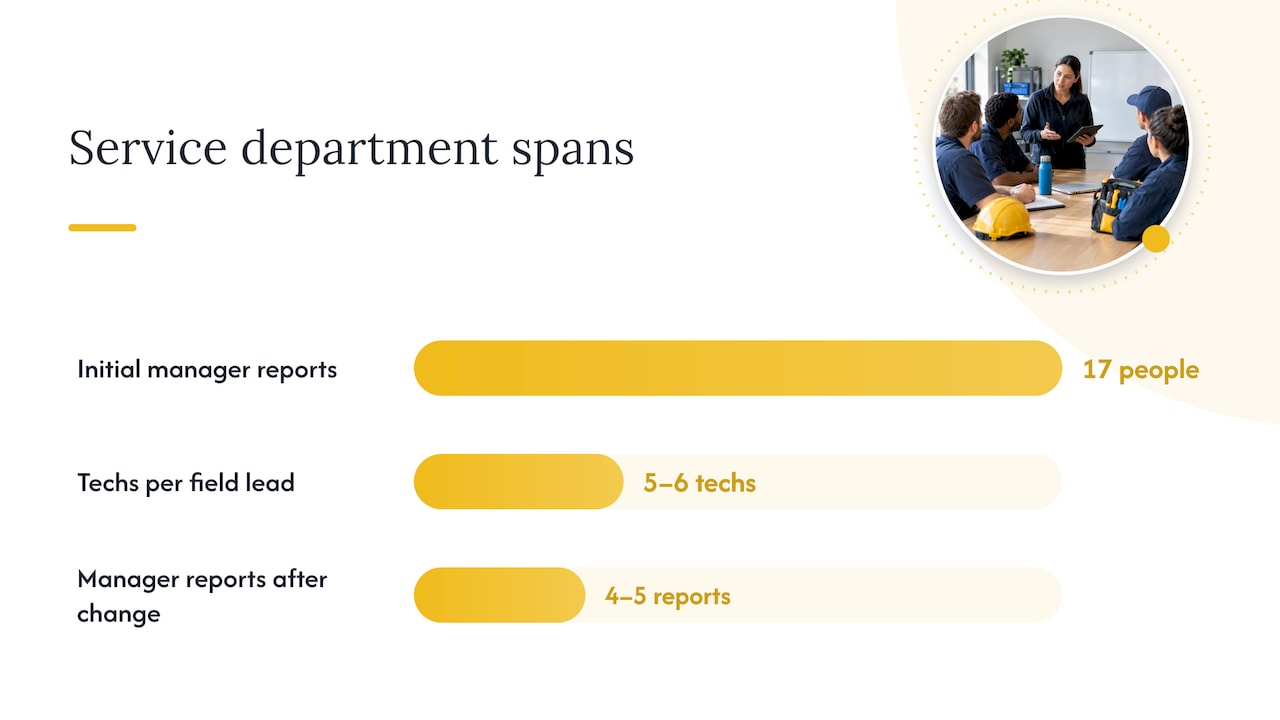
This is an illustrative scenario, not a client case. A residential HVAC company has a service manager with fourteen technicians, a dispatcher and two installers’ leads reporting in. That is seventeen people. The manager also takes escalated customer calls and approves every callback.
Run the check-in test: seventeen times ten minutes is nearly three hours a week with no travel, and the manager admits it has not happened in a month. That is a span problem and a role problem.
A reasonable fix:
- Promote two experienced technicians to field leads, each with five or six techs.
- Send the leads through coaching training before they start.
- Move callback approval to the dispatcher with clear rules.
- Reduce the service manager’s span to the two leads, dispatcher and install lead, which is four to five reports.
The manager now has time for ride-alongs, call reviews and numbers. The company paid for two lead stipends and got back the one person who could improve the department.
The same exercise is easier if you can see your labor needs in advance. Our guide to labor forecasting for contractors helps you decide when headcount growth justifies a new layer.
Our perspective
We work only with trade businesses, and the span problem is rarely about the chart. It is about the owner who is the real manager of everyone, and about leads who were promoted for being great technicians and never taught to lead.
When we step into a company, we want to see how managers spend a week, who they actually talk to and what falls through the cracks. The number of direct reports is a symptom. The cause is usually missing systems: no scheduled check-ins, no scorecard, no clear decisions a lead can make alone. Fix those first and the same manager can often carry more. Skip them and adding a layer just creates another person waiting on you.
So our advice is to set a range for each role, write down the weekly rhythm, train before you promote, and review spans when you hire or lose a manager. Retention matters here too: a stretched manager is often the reason good people leave, and stay interviews are a cheap way to find out.
— Dan
Getting help setting spans and building leaders
If you see the warning signs above and want someone in the business with you, our Rebuild program covers management and leadership training, call management and dispatch training, install and project management training and financial operations support for HVAC, plumbing, electrical and other trades. Pricing is not published, so the way to find out what fits is to reach out through the page.
FAQ
What is a good span of control for a contractor?
For managers, four to seven direct reports is a reasonable starting range, based on research on team size. For complex project work, a leader may do better with three or four project managers, and with five or six on repeatable work. Adjust for experience, complexity and travel.
How many technicians can one service manager supervise?
There is no official figure for HVAC, plumbing or electrical. Test it instead: if the manager cannot hold a short weekly check-in with each person, the span is too wide. Add field leads before the manager’s days stretch past ten hours.
Should the owner be a manager of managers?
Yes, as early as you can afford it. When daily employee issues crowd out strategy, the owner’s span is too wide. Build a small team of function leaders, such as service, install, sales and office, and keep your own span to a number you can really hold accountable.
When should I add a layer of management?
Add one when a manager’s span fails the check-in test and training or delegation has not solved it. Do not add a layer simply because an employee wants a title. Train the person first, give them a defined span and review it after a quarter.
Sources
- What is span of control, and why is it important (Randstad)
- The Entrepreneurial Gap: How Managers Adjust Span of Control (Harvard Business School)
- Can firms oversee more workers with fewer managers? (IZA World of Labor)
- Span of Control for Facilities Management (APPA)
- Construction Operations Leader Span of Control (Selah Talent Partners)
- Using ONA to Find Optimal Team Size (Worklytics)
- Development of an expert system for the determination of the span of control of the construction foreman (IAARC)
- Span of Control of Construction Foreman: Situational Analysis (ASCE)
- Span Of Control (Encyclopedia.com)
- Organizational Charts for Contractors (ELECTRI)
- Contractor Org Chart: The Seats You Need at Each Size (Contractor Lane)
0 Comments