
Build an internal train-the-trainer academy that blends classroom instruction, hands-on lab work, and supervised field coaching. This standardizes how technicians diagnose problems, talk to customers, and follow safety protocol, and it cuts turnover because trainees who go through structured programs stay longer than those who don’t. Start now by naming one internal trainer and writing the first module’s learning objectives.
TL;DR:
- Companies with structured internal training report significantly lower turnover rates, saving on costly technician replacements and increasing retention over time.
- Selecting internal trainers requires assessing their teaching skills, not just technical expertise, through demo lessons and multiple explanation methods.
- Effective curricula should focus on specific, testable skills with modules on fundamentals, diagnostics, soft skills, and field work, balanced across theory and practice.
- Objective assessments such as weekly report cards, gate exams, and badge systems are essential to measure training success and justify ongoing investment.
- Using real or used equipment in labs helps prepare trainees for field variability, reducing the shock of real job conditions and costly mistakes early in their careers.
Table of Contents
- Why Train the Trainer Trades Programs Pay Off
- How Do You Choose the Right Internal Trainers?
- What Should the Curriculum Actually Look Like?
- How Do You Measure Whether Training Is Working?
- How Do You Set Up Labs That Mirror Real Field Conditions?
- What Does It Cost, and How Fast Does It Pay Back?
- Rollout Checklist and a 90-Day Starter Plan
- What Building These Programs Actually Teaches You
- How Rebuildingthetrades Helps You Build This Faster
- Sources
- FAQ
Why Train the Trainer Trades Programs Pay Off
Technicians who go through structured internal training turn over at 2.5 times lower rates than those who don’t. That single number should reframe how you budget for training. It’s not overhead. It’s retention insurance.
Beyond retention, a well-run academy tightens callback rates because every tech learns the same diagnostic sequence instead of improvising. It also builds a hiring pipeline: candidates who might not qualify for a lead-tech role today become viable after dedicated training over several weeks. Industry data backs the shift. Roughly 41% of firms report increasing their training spend, and more contractors are aligning internal curricula with credentials like NCCER and formal apprenticeship frameworks rather than building everything from scratch.
The number that matters: Companies with structured internal training report 2.5 times lower turnover among trainees. If your average tech costs $8,000 to $12,000 to replace, that ratio alone can fund an entire training academy.
How Do You Choose the Right Internal Trainers?
The instinct is to hand training to your best technician. That’s a mistake if it stops there. Trade competence is table stakes. Teaching ability is a separate skill, and plenty of your top performers have never had to explain why they do something, only that it works.
Look for a profile that combines four traits: deep trade knowledge, clear communication, patience with repetition, and alignment with how you actually want the company run. A gifted diagnostician who cuts corners on documentation will train a room full of corner cutters.
Vet candidates the way you’d vet a hire for any critical role:
- Have them deliver a 15 minute demo lesson to a small panel of managers or peers, then critique it openly.
- Require a written lesson plan before the demo, not after. It reveals whether they think in sequences or just wing it.
- Run a basic adult learning check: can they explain a concept three different ways when the first explanation doesn’t land?
Pro Tip: Don’t skip the demo lesson step even for your most senior tech. Trade mastery and instructional design are different muscles, and the panel critique surfaces gaps before they show up in a $40,000 cohort.
What Should the Curriculum Actually Look Like?
Good trade curriculum is built on SWBAT objectives (students will be able to) rather than vague topic lists. Every lesson should end with a specific, testable skill, not a general impression that “we covered electrical basics.”
Structure modules in this general sequence:
- Foundations module: trade math, basic electrical theory, tool identification, and safety fundamentals.
- Diagnostics labs: scenario-based troubleshooting using company equipment, both new and pulled from retired jobs.
- Soft skills and customer interaction: how to explain a repair, present pricing, and handle a frustrated homeowner.
- Field integration: supervised ride-alongs with a mentor sign-off after each shift.
The mix matters more than the order. Aim for a balanced mix of classroom theory, hands-on lab time, and supervised field work with mentor verification. Trainees who only sit in a classroom are unprepared for the complexity of real jobs. Trainees who go straight to the field without foundational theory may develop bad habits that are costly to correct later.
How Do You Measure Whether Training Is Working?
Subjective feedback (“he’s coming along”) doesn’t hold up when you’re trying to justify a training budget to a partner or a bank. You need graded, objective checkpoints.
Build assessment around a few concrete tools:
- Weekly report cards scoring specific competencies, not overall impressions.
- Graded lab work with pass/fail thresholds tied to real job standards.
- Gate exams before a trainee advances to unsupervised field work.
- Internal badges tied to your specific SOPs, supplemented by external credentials like NCCER, EPA certification, or NATE where the trade calls for it.
Each dollar invested in structured craft training returns an estimated $1.30 to $3.00 in benefits according to research summarized by NCCER, which makes the case for tracking KPIs the same way you’d track any capital investment.
Track four numbers monthly: time to first billable hour, trainee pass rate, one-year retention of graduates, and callback rate for trained versus untrained techs. If those numbers don’t move within two cohorts, the curriculum needs revision, not more budget.
How Do You Set Up Labs That Mirror Real Field Conditions?
A lab full of pristine new equipment teaches trainees to fix things that work like the manual says they should. Real jobs rarely cooperate that cleanly. The strongest programs mix in used or retired equipment pulled straight from operations, so trainees encounter the corrosion, wiring quirks, and prior owner “fixes” they’ll actually face in the field.
A few setup principles worth following:
- Stock the lab with both new units and decommissioned equipment from real service calls to build in field variability.
- Design scenario-based troubleshooting exercises modeled on your most common ticket types, not generic textbook faults.
- Structure supervised field shifts with a written mentor checklist and a required sign-off before the trainee moves to the next skill tier.
This approach also reduces the shock of the first solo call. A trainee who has only diagnosed clean lab units freezes when a real system throws three overlapping symptoms at once.
What Does It Cost, and How Fast Does It Pay Back?
Budget key cost categories before you launch, such as instructor hours (including opportunity costs), lab equipment and materials, curriculum development time, and trainee wages during training periods.
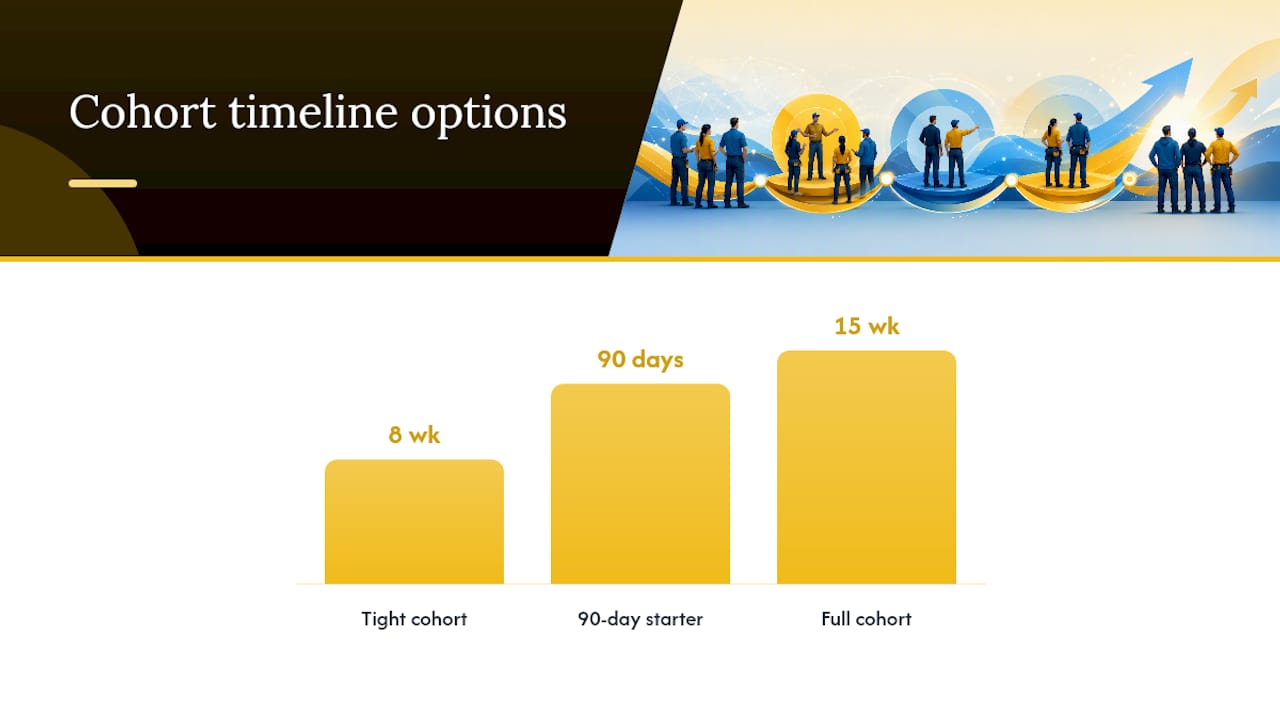
Timeline shapes cost directly. Contractors running 8 to 15 week cohort models with rigorous candidate screening report strong pass and retention rates, and that timeline range gives you two workable templates: a tight 8 week intensive for narrow skill gaps, or a fuller 15 week cohort for ground-up technician development. A 90-day starter cohort sits comfortably in between and works well for a first attempt.
On the payback side, model three inputs against your cost buckets:
- Reduced hiring and recruiting cost per filled position.
- Retention savings, using the 2.5x turnover differential as your baseline assumption.
- Callback reduction, valued at your average cost per truck roll.
Most owners find the math works in favor of training within the first two cohorts, once the retention effect compounds.
Rollout Checklist and a 90-Day Starter Plan
Before you launch anything, lock four things: budget sign-off, your selected internal trainer, written module objectives, and the KPI tracking system you’ll use from day one.
- Pre-launch (weeks 0 to 1): finalize budget, confirm trainer, publish the module map, and set up your data tracking sheet or system.
- Weeks 1 through 6: run classroom and lab sessions on a fixed weekly schedule, with a mid-course skills check around week 3 to catch trainees falling behind early.
- Weeks 7 through 12: move to supervised field integration, run the final gate assessment, and finalize placement decisions and any retention agreements tied to the training investment.
Pro Tip: Keep your first cohort’s scope narrow. One trade discipline, one module set, no more than four or five trainees. A small, well-run pilot builds internal credibility for a much bigger academy next year.
What Building These Programs Actually Teaches You
The biggest failure mode isn’t a bad curriculum. It’s underbudgeting the instructor’s time and treating assessment as an afterthought, which lets informal shortcuts calcify into “how we’ve always done it” long before anyone catches them.
The fastest wins are almost embarrassingly simple: pay trainees a real wage so they take the program seriously, keep the first module narrow enough to actually finish, and lean on equipment suppliers for donated or discounted lab units instead of buying everything new. Programs like the maintenance agreement strategy case study that contributed to a documented $21 million run rate didn’t start with a perfect system. They started with disciplined execution of a narrow plan and got better every cohort.
— Dan
How Rebuildingthetrades Helps You Build This Faster
If you’d rather not build a train-the-trainer academy from a blank page while running daily operations, Rebuildingthetrades gives you a shortcut most consultants in this space don’t: hands-on involvement in the build itself, not just a slide deck telling you what to do. The engagement typically covers an operational audit, trainer development, curriculum design specific to your trade, and the KPI systems to prove it’s working.

Owners who’ve worked through similar operational overhauls point to clearer reporting, better trained cohorts, and documented run-rate improvements like the three-tier maintenance agreement case study. If you want a related look at how trainer and leadership development connects to management structure, the guide on service manager training is worth reading first. When you’re ready to talk specifics, check current pricing and book a discovery call.
Sources
For deeper reading on program design and outcomes, start with the NCCER whitepaper on the value of training for ROI framing and credentialing guidance. Contracting Business has covered why contractors are training their own next generation, and HVACR Business offers a practical walkthrough on setting up an in-house training program, lab equipment and all.
- If We Want the Next Generation in the Trades, We Have to Train Them Ourselves | Contracting Business
- Value of Training — NCCER whitepaper
- Set up your own in-house training program — HVACR Business
- Build your own training academy — ACHR News
FAQ
How long does it take to build a train-the-trainer program?
Most contractors need 4 to 6 weeks to design curriculum and select a trainer, then run cohorts on an 8 to 15 week timeline depending on scope.
What’s the biggest reason trade training programs fail?
Underbudgeting instructor time and skipping objective assessment are the two most common failure points, letting informal shortcuts go uncorrected instead of being caught by graded lab work.
Do I need external credentials like NCCER for internal training?
No, but aligning select modules with NCCER, EPA, or NATE credentials adds portability and consistent competency standards without requiring you to import an entire outside curriculum.
How much does an in-house training academy cost?
Costs vary by trade and cohort size, covering instructor hours, lab equipment, materials, and trainee wages. Rebuildingthetrades lists current program design pricing on its pricing page.
What KPIs prove a training program is working?
Track time to first billable hour, trainee pass rate, one-year retention of graduates, and callback rate, comparing trained technicians against those who came up without the program.
0 Comments