
Set your material markup by working backward from the gross margin your business needs, then adding up three specific cost buckets: waste, sourcing overhead, and supply-chain risk. Skip the forum averages. Most standard materials support a 7% to 25% markup, but that range means nothing until you know what it has to cover on your jobs. The formulas, the audit, and the pricing rules below will get you there.
TL;DR:
- Contractors should set their markup based on actual waste, sourcing overhead, and supply chain risks, not just industry averages or simple percentages.
- A proper markup requires converting desired profit margins into a percentage that accounts for the difference between markup and margin, often around 54% for targeted margins.
- Small orders under $250 in material cost should include a minimum charge or higher tiered markup to cover fixed sourcing and delivery costs effectively.
- Separately tracking waste, sourcing, and risk costs enables more accurate pricing adjustments and prevents underfunding key expense buckets.
- Conducting regular markup audits using recent invoices helps identify hidden underfunding or lost margins that might be as high as 5% to 10%.
Table of Contents
- How Do Contractors Calculate Material Markup?
- What Should a Material Markup Actually Pay For?
- Why Does a Flat Markup Percentage Fail on Small Jobs?
- How Should Your Contract Type Shape Your Markup?
- How Do You Run a One-Week Markup Audit?
- How One Trade Business Fixed an Underpriced Markup
- Dan’s Three Rules for Pricing Materials
- Get Hands-On Help Pricing Materials Correctly
- Sources
- FAQ
How Do Contractors Calculate Material Markup?
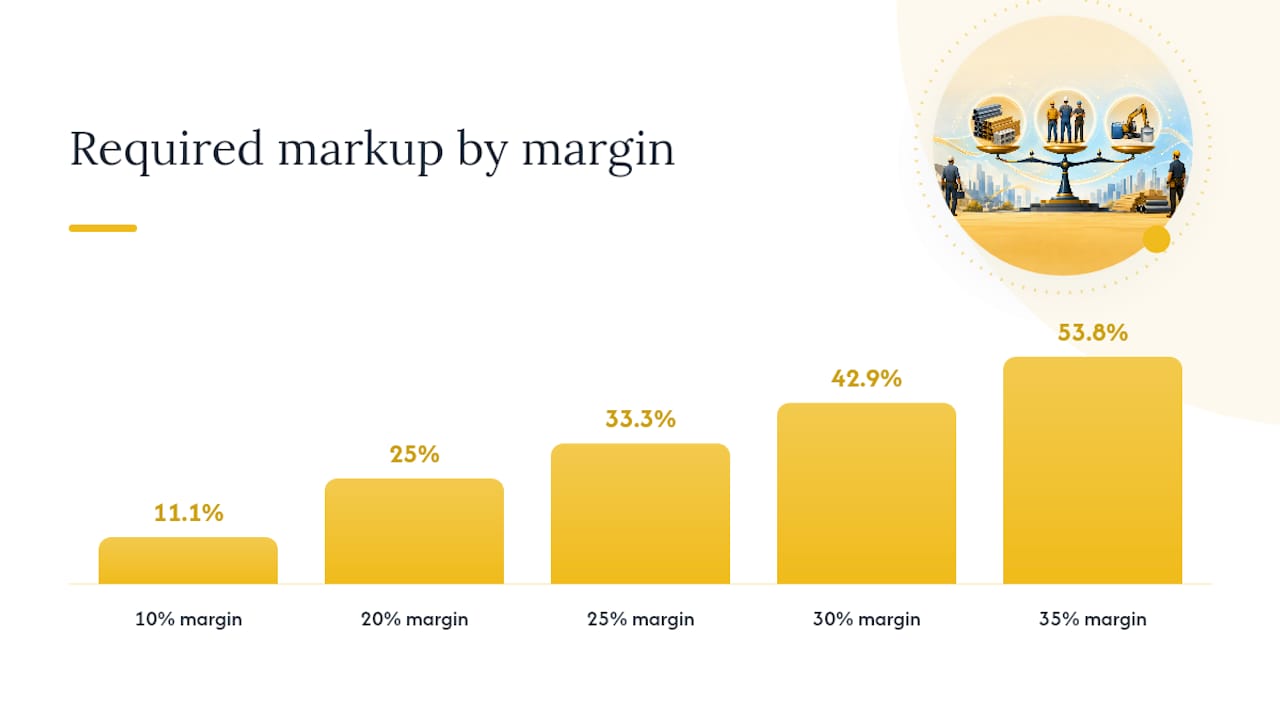
Markup and margin are not the same number, and mixing them up is how contractors quietly lose money on every job. Markup is what you add to your cost. Margin is what’s left as profit after the sale. A $100 item marked up 25% sells for $125, but that $25 is only 20% of the $125 sale price, not 25%. The gap between those two numbers grows fast as your target margin climbs.
The conversion formula every contractor should have taped to their monitor:
Markup = Margin / (1 − Margin)
You need roughly a 54% markup, not 35%. That single miscalculation is probably costing more contractors money than any pricing mistake on this list.
Here’s how that plays out across three job sizes:
- Small service part (a $40 capacitor). Target a 30% margin, so markup runs about 43%. Sell it for $57.20. On a single part, most contractors round up rather than nickel-and-dime a $17 gap.
- Medium remodel materials ($3,000 in cabinetry and trim). Target a 25% margin means a 33% markup, putting your sell price near $4,000. At this volume, the difference between guessing and calculating is real money.
- Large project materials ($40,000 in HVAC equipment and ductwork for a commercial job). Even a 20% margin target, common on large-ticket work where volume offsets thinner percentages, requires a 25% markup, landing your sell price at $50,000.
| Target Margin | Required Markup |
|---|---|
| 10% | 11.1% |
| 20% | 25% |
| 25% | 33.3% |
| 30% | 42.9% |
| 35% | 53.8% |
| 40% | 66.7% |
When you present pricing to the client, quote the installed price, not a broken-out “cost plus markup” line. Exposing the raw markup invites price-shopping and disputes over a number the client has no context to evaluate. Bundling it into one installed figure keeps the conversation on the value delivered, which is standard practice among contractors who protect their margins.
What Should a Material Markup Actually Pay For?
A material markup isn’t profit padding. It’s the mechanism that funds specific, recurring costs that show up whether or not you remember to price for them. Lumping everything into one flat percentage is the fastest way to underfund at least one of these buckets without noticing.
The core components:
- Waste and overage. Tile, drywall, and flooring routinely run 8% to 12% waste from cuts, breakage, and pattern matching. Rough lumber can run higher on custom framing.
- Sourcing and procurement overhead. The labor of calling suppliers, comparing quotes, and managing delivery timing typically adds 1% to 4% depending on how manual your purchasing process is.
- Transport and handling. Fuel, vehicle wear, and the time spent picking up materials that didn’t arrive on the truck.
- Storage. Job-site trailers, warehouse space, and the inventory risk of materials sitting unused between phases.
- Returns and restocking. Suppliers routinely charge restocking fees on returned special-order items, a cost that lands on you if it’s not priced in upfront.
- Warranty and liability. Contractors carry implied warranty responsibility on installed materials, even when the manufacturer’s warranty technically covers the product.
- Administrative handling. Invoicing, tracking, and reconciling material costs against the job budget.
Separating these buckets matters because each one moves independently. A supplier price hike changes your sourcing risk. A run of humid weather changes your waste rate on lumber. If you’re carrying one blended percentage, you can’t tell which piece broke when your margin slips, and you end up adjusting the whole number based on a guess. Contractors who track waste and sourcing costs separately can raise the one bucket that’s underfunded instead of overcorrecting across the board.
Why Does a Flat Markup Percentage Fail on Small Jobs?
Run the math on a $150 material order at a 20% markup, and you make $30. That $30 has to cover the drive to the supply house, the time spent sourcing an oddball part, and the invoicing labor. It usually doesn’t come close. The same percentage that works fine on a $30,000 remodel actively loses money on a $150 service call, because the fixed costs of sourcing and delivering materials don’t shrink with the order size.
Three ways contractors fix this:
- Add a trip fee or minimum parts charge. A flat $35 to $75 fee on any order under a set dollar threshold covers the fixed cost of the run regardless of markup percentage.
- Use a tiered markup that rises as order size drops. Orders under $200 might carry a 50% markup while orders over $2,000 sit at 20%, reflecting that fixed costs matter more on small tickets.
- Fold materials into a flat installed service rate for routine repairs, so the customer never sees a materials line at all and you’re not exposed on parts pricing that barely moves the needle either way.
A workable threshold rule: anything under $250 in material cost gets either a minimum charge or a markup at least double your standard rate. Anything under a full truck run gets a trip fee if it’s the only reason for the visit. Small orders and specialty items commonly justify higher markups or separate fees precisely because the flat percentage math breaks down at low volume.
Pro Tip: Pull your last 20 invoices under $500 and calculate your actual margin on each one at your current markup. Most contractors find at least a third of those jobs were priced at a loss once labor for sourcing is factored in.

How Should Your Contract Type Shape Your Markup?
Markup behaves differently depending on how you’ve structured the deal. In a fixed-price contract, you’re carrying all the material-price risk between the quote date and the purchase date, so your markup needs a bigger risk buffer or a shorter quote window. In cost-plus contracts, the client absorbs actual material cost and you charge an agreed percentage on top, which shifts price-volatility risk off your books but requires clean, transparent documentation.
Allowances split the difference: you quote a placeholder dollar amount for a category the client hasn’t finalized (tile selection, light fixtures) and true it up once they choose. Document the allowance amount and the markup rate that applies to any overage in writing before work starts.
To manage volatility inside either model:
- Shorten your quote validity window, especially on materials with recent price swings.
- Add an escalation clause tied to a named supplier price list or index.
- Include a contingency line, typically 5% to 10% of material cost, instead of quietly inflating your base markup to cover uncertainty you can’t quantify.
Escalation clauses and shorter windows are easier to defend to a client than a padded markup they can’t see, and they hold up better if a dispute ever lands in front of a third party.
How Do You Run a One-Week Markup Audit?
Most contractors are pricing off a number they picked years ago and never revisited. A one-week audit fixes that with data you already have sitting in your accounting software and supplier invoices.
Data to pull, days one through three:
- 12 to 18 months of material purchase invoices, sorted by job.
- Actual waste or loss on each job (ordered quantity versus installed quantity).
- Hours spent on procurement calls, quote comparisons, and delivery coordination.
- Any shortage costs: emergency runs, rush shipping, or restocking fees paid.
Calculations, days four and five:
- Waste % = total wasted material cost ÷ total material cost across the sample.
- Sourcing % = annualized procurement labor cost ÷ annual material spend. Timing your procurement activity for four weeks and annualizing it turns this from a guess into a number you can defend.
- Risk % = a buffer sized to your supplier volatility and job mix, usually 2% to 5%.
- Base markup = waste % + sourcing % + risk %.
- If you’re targeting a specific gross margin instead, run that base markup through the conversion formula to check it clears your margin target.
Deliverables to keep on file:
- A spreadsheet with columns for job number, material cost, waste amount, sourcing hours, and calculated markup.
- A validation pass against 3 to 6 recent jobs to confirm the new markup would have produced the margin you actually wanted.
Contractors who run this kind of audit routinely discover they’ve been underfunding material costs by 5% to 10% without realizing it, simply because nobody had measured waste against a real baseline before.
How One Trade Business Fixed an Underpriced Markup
A mid-size remodeling contractor had margins that looked fine on paper but kept shrinking in the bank account. The diagnosis: a single blended markup percentage that hadn’t been recalculated in years, with no separate tracking for waste, and small material orders quietly losing money on every trip.
The fix wasn’t a bigger markup number. It was breaking the one percentage into three measurable pieces, then adding a minimum charge on small orders that had been absorbing sourcing costs the old flat rate never covered.
After separating waste, sourcing, and risk into their own tracked figures and changing quoting rules for orders under a set threshold, the business saw clearer margins on installed pricing and fewer disputes over material line items on client invoices.
Dan’s Three Rules for Pricing Materials
Separate your buckets, or you’ll never know which one is starving. Protect small jobs with a minimum charge, because a flat percentage lies to you at low volume. And quote installed pricing wherever you can. Run the audit above, then put a quarterly review on your calendar. Markup that made sense last year rarely still does.
— Dan
Get Hands-On Help Pricing Materials Correctly
Reading the formulas is one thing. Rebuilding your pricing system while running jobs every day is another. Some consulting services work directly inside trade businesses to build financial visibility and pricing structures that make a defensible material markup possible, rather than just providing a spreadsheet exercise you run once and forget.

That means real support on the pieces that make markup decisions stick: financial operations and compliance assistance to get your cost data accurate enough to trust, and install and project management training so your team applies the new pricing rules consistently on every job, not just the ones the owner is watching. If your last markup review happened by accident rather than on purpose, schedule a pricing review with Rebuildingthetrades and get a system built around your actual numbers instead of a number someone quoted you at a trade show.
Sources
The formulas and ranges in this guide draw from EosLog’s contractor pricing guide, Truitt & White’s breakdown of markup components, LegalClarity’s explanation of what markup legally covers, and ABC Supply’s contract strategies for material price volatility. For a quick field reference, Housecall Pro’s markup calculator handles the arithmetic, though pair it with your own audit for a company-level number. For pricing templates built for trade businesses, see Rebuildingthetrades’s pricing resources.
- How Much Should Contractors Mark Up Materials? A 2026 Pricing Guide · EosLog
- Why do contractors mark up materials? What it covers · LegalClarity
- Truitt & White — Contractor markup on materials
- ABC Supply — Contract strategies to protect contractors from material price volatility
FAQ
How much do contractors mark up material costs?
Most contractors mark up standard materials between 7% and 25%, with specialty items and small orders often running higher. The right number for your business comes from adding your actual waste, sourcing, and risk percentages rather than copying an industry average.
Why do contractors charge markup on materials?
Markup funds real costs beyond the sticker price: sourcing time, delivery, storage, restocking fees, and the warranty and liability responsibility contractors carry on installed materials. It is not simply added profit; it is priced coverage for work the client doesn’t see.
Is 30% markup the same as 30% margin?
No. A 30% markup on a $100 cost yields a sale price calculated by adding 30% of the cost. The formula margin ÷ (1 − margin) helps you find the markup you actually need to hit a specific margin target.
What should a contractor avoid telling a client about materials?
Avoid exposing your raw cost alongside your markup as separate line items, since that invites price-shopping on individual materials rather than evaluating the installed job. Quoting one installed price keeps the conversation focused on the finished result instead of your supplier invoice.
What does Rebuildingthetrades charge for pricing help?
Pricing for Rebuildingthetrades’s consulting services, including financial operations support and pricing template work, is available directly through Rebuildingthetrades’s service page rather than listed publicly, since engagements are scoped to each business’s needs.
0 Comments