
The most reliable policy rollout plan runs on five phases: assess, design, pilot, scale, and sustain. Skipping straight to a company-wide launch is the single biggest reason rollouts stall. Prioritize governance first, then manager briefings, then SMART objectives, then training, then monitoring. Expect to produce several important deliverables along the way: a pilot plan, a manager FAQ, and a documented acknowledgment process.
TL;DR:
- A phased approach with assess, design, pilot, scale, and sustain phases reduces the risk of rollout failure and promotes sustainable adoption.
- Effective rollouts require early, thorough briefing of managers with written FAQs and functional walkthroughs, not just polished announcements.
- A well-defined ownership structure with a clear escalation path and responsible roles ensures accountability and smooth decision-making.
- Monitoring key performance indicators during and after rollout, including compliance and outcome metrics, helps identify issues before they become resistance.
- Large-scale projects benefit from multiple strategies bundled together, while simple changes may succeed with a quick, single-department pilot and follow-up.
Table of Contents
- The 5-Step Rollout Plan: Assess, Design, Pilot, Scale, Sustain
- Who Owns the Rollout: Governance and Roles
- Communications and Training That Actually Land
- Phased Rollout vs. Big-Bang Launch
- Monitoring, Evaluation, and the Feedback Loop
- What a Rollout Actually Costs to Staff and Run
- What Real Rollouts Look Like in the Trades
- Editorial Take: Why Most Rollout Advice Skips the Hard Part
- Get Hands-On Help Running Your Rollout
- Templates and Frameworks Worth Bookmarking
- Sources
- FAQ
The 5-Step Rollout Plan: Assess, Design, Pilot, Scale, Sustain
A policy rollout plan works when it treats implementation as a sequence of gated phases rather than a single announcement day. The CDC’s implementation framework describes this as operationalizing an adopted policy through stakeholder education, administrative updates, enforcement, and ongoing monitoring against SMART goals. Here’s how that translates into an actual sequence you can run.
- Readiness assessment. Build a stakeholder map, run a gap analysis against current workflows, check legal or fiscal exposure, and capture baseline metrics before anything changes. Skip this step and you’ll be guessing at your own starting line.
- Design. Finalize the policy text, write SMART objectives, draft a RACI chart, define pilot success criteria, and build the training plan. This is where most of the real thinking happens.
- Pilot. Run the policy with a controlled group, whether that’s one branch, one crew, or one region. Collect feedback continuously and measure it against the gates you set in the design phase.
- Scale. Brief managers, run team walkthroughs, deliver full training, and collect signed acknowledgments from everyone affected.
- Sustain. Audit compliance, review KPIs on a set cadence, and schedule a formal review cycle so the policy keeps improving instead of quietly rotting.
This sequence matters because implementation science research consistently shows that rollouts succeeding on a single tactic, like an email announcement, underperform ones that combine strategies. A 2024 systematic review of implementation strategies found that education, structured meetings, audit-and-feedback, and training work better bundled together than any one deployed alone.
Two things trip up otherwise solid rollout strategy steps. First, teams design the policy in isolation from the people who’ll actually execute it, then wonder why adoption stalls. Implementation mapping research makes the case that rollout has to adapt repeatedly to the real workflows of frontline adopters, not the org chart version of how work happens. Second, teams treat the pilot as a formality instead of a real gate, greenlighting scale-up regardless of what the data says.
Pro Tip: Run your pilot long enough to catch a full operational cycle, not just a good week. A two-week pilot during a slow season will lie to you about adoption rates.
Who Owns the Rollout: Governance and Roles
Every policy implementation guide worth following starts with one question: who actually owns this? Assign a single implementation lead, backed by a small steering committee with the authority to make calls without escalating every decision.
- Implementation lead: owns the timeline, chairs check-ins, and is the one name everyone calls when something breaks.
- Steering committee: three to five people from operations, HR, and finance who approve major changes and unblock resource conflicts.
- Operational owners: department or branch managers who adapt the policy to their team’s daily workflow.
- Local champions: frontline staff who model compliance and answer peer questions before they escalate.
- Escalation path: a documented route from technician or field staff, up through the manager, to the steering committee, with a response time attached.
A one-line RACI works better than a twelve-tab spreadsheet nobody opens: lead is Accountable, steering committee is Consulted, operational owners are Responsible, and everyone else is Informed.
Communications and Training That Actually Land
Sequence matters more than content here. Brief managers several days before launch and hand them a written manager FAQ so they’re not improvising answers in front of their teams. That lead time, drawn from practical AI policy rollout guidance but applicable to any workplace policy change, gives managers room to actually digest the change before defending it.
- Brief managers first, always, with a FAQ document they can reference live.
- Run 15 to 20 minute team walkthroughs tailored to each function. Dispatch needs different examples than the field crew.
- Collect signed acknowledgments within a short period through your HRIS or an e-sign flow.
- Run a 30-day feedback pulse to catch confusion before it becomes resistance.
The 30-60-90 onboarding structure many managers already use maps cleanly onto this same rhythm: brief, walk through, check back.
Pro Tip: If the policy restricts a behavior, pair the announcement with an approved alternative. Telling staff what they can’t do without offering a substitute is what turns compliance into workaround.
Phased Rollout vs. Big-Bang Launch
Choose phased rollout when the change is complex, touches multiple departments, or carries regulatory risk. Choose a big-bang launch only for simple, low-risk changes affecting a single team.
Set clear gates before moving from pilot to full scale:
- Adoption rate hits your target threshold (commonly 80% or higher).
- Zero critical incidents during the pilot window.
- Every major feedback theme has a documented resolution, not just an acknowledgment.
Two timeline templates cover most cases: an 8 to 12 week quick pilot for a single-department policy, and a 6 to 12 month enterprise rollout for company-wide changes spanning multiple locations or job functions. Complex regulatory rollouts often split into pre-implementation and execution modules, similar to how international tax implementation toolkits structure legal, IT, and compliance work into separate tracks before go-live.
Monitoring, Evaluation, and the Feedback Loop
Set three to five KPIs tied to SMART objectives: acknowledgment rate, compliance incident count, time-to-resolution on flagged issues, and at least one outcome metric tied to why the policy exists in the first place; for guidance on how to monitor and measure these effectively, see the Sättningsmätning för byggprojekt: teknisk guide för projektledare.
- Pull data from audits, system usage logs, staff surveys, and manager reports, not just one source.
- Review at 30 days post-launch, then quarterly after that.
- Document lessons learned in a shared log and publish a short summary to managers each cycle.
The CDC’s own implementation framework treats monitoring against SMART goals as a core requirement, not an afterthought bolted onto the end of rollout. If you’re already tracking operational KPIs elsewhere in the business, add policy metrics to that same dashboard instead of building a parallel system nobody checks.
What a Rollout Actually Costs to Staff and Run
Budget for training hours, a point person for notifications and support questions, IT time to update forms and permissions, and possibly outside consultant hours for complex compliance work.
- Estimate cost by multiplying affected headcount by training hours, then add IT and admin time.
- Reprioritize existing training or admin budget lines before requesting new spend.
- Update forms, approval workflows, system permissions, and reporting templates before launch day, not after.
What Real Rollouts Look Like in the Trades
An operational turnaround, detailed in the Tri-Trade case study, paired a phased rollout of new dispatch and accountability systems with manager-level training, contributing to a documented climb toward a $21 million run rate. The lesson generalizes: pilot with one crew, fix what breaks, then scale with data instead of hope.
Editorial Take: Why Most Rollout Advice Skips the Hard Part
Most rollout guidance obsesses over the announcement. Slide decks, all-hands meetings, a well-worded email. That’s the easy 10%. The part that actually determines whether a policy sticks is the unglamorous middle: whether managers were briefed early enough to answer questions without guessing, and whether anyone bothered to check adoption data 30 days later instead of assuming compliance because nobody complained.
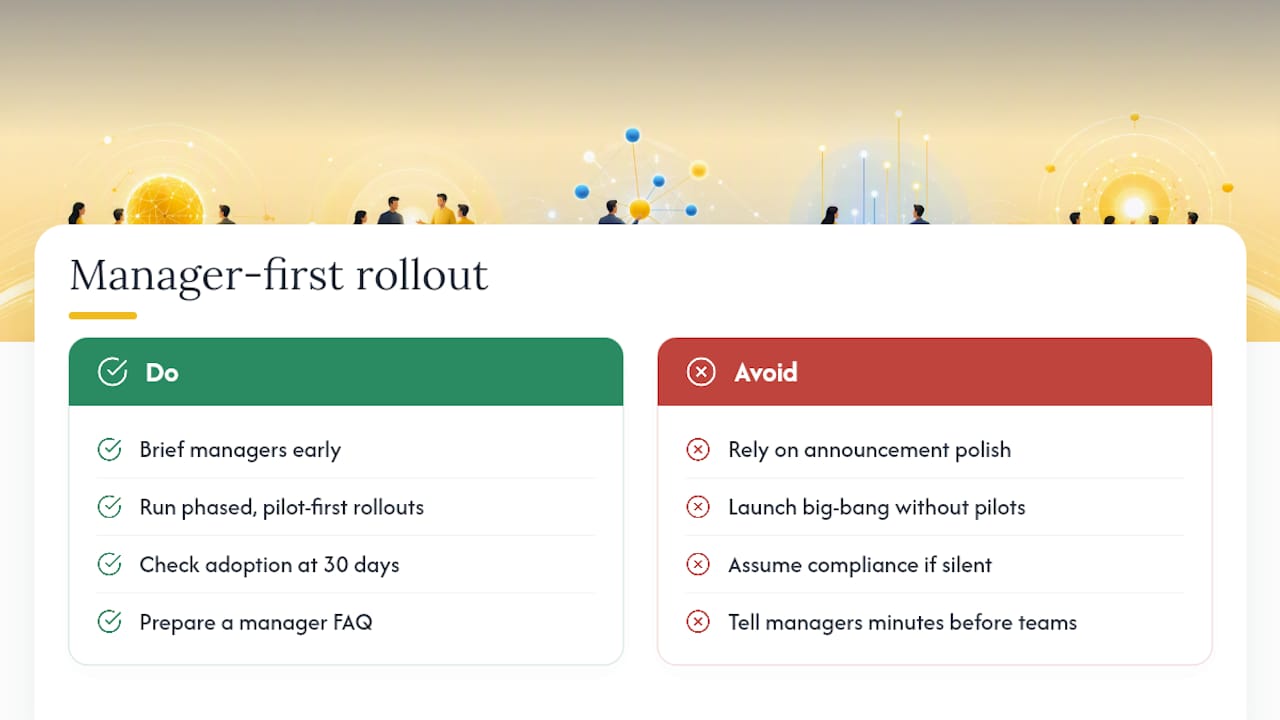
Conventional wisdom treats big-bang launches as efficient. They’re not. They’re just faster to plan, which is a different thing entirely. A phased, pilot-first approach costs more calendar time up front and saves far more in rework and morale damage later. Every failed rollout I’ve seen traces back to the same root cause: the policy was designed for how leadership imagined work happens, not how work actually happens on the floor.
If you take one thing from this, prioritize the manager briefing sequence over the polish of your announcement. A confident manager with a rough FAQ beats a beautiful all-hands deck delivered to managers who found out five minutes before their team did.
— Dan
Get Hands-On Help Running Your Rollout
A written plan is one thing. Getting fifteen crews to actually follow it under real operational pressure is another. Rebuildingthetrades runs onsite audits, builds the training programs your managers need to brief teams with confidence, redesigns the operational workflows a new policy touches, and sets up the KPI tracking that turns your monitoring phase from guesswork into a real dashboard.

That hands-on involvement is the difference between a policy that lives in a binder and one that changes how work actually happens on the floor. Trade businesses don’t need another generic template. They need someone who has already redesigned dispatch systems, trained service managers, and tracked the KPIs that prove a rollout worked. Explore the Rebuild program to see exactly what a hands-on implementation partnership covers, and start the conversation about your next rollout.
Templates and Frameworks Worth Bookmarking
Check the CDC’s policy implementation framework, the 2024 implementation strategies review, and government implementation toolkits for sector-specific templates.
Sources
- Policy Implementation | POLARIS | CDC
- Systematic review on implementation strategies (2024)
- Implementation mapping and adopter-focused strategies (2019)
- How to Roll Out an AI Policy Without Getting Everyone Mad at You | Shadow AI Policy
FAQ
What Are the Stages of the Policy Cycle?
Most frameworks describe the policy cycle as problem identification, agenda setting, policy formulation, adoption, implementation, evaluation, and either maintenance or termination. Rollout planning sits squarely in the implementation and evaluation stages, where the CDC’s framework focuses on stakeholder education and monitoring.
What Is a Rollout Plan?
A rollout plan is the documented sequence of actions, owners, and timelines used to move a new or updated policy from approval to full adoption. It typically covers governance, communications, training, timeline, and monitoring, structured as phases rather than a single launch event.
Can You Give an Example of a Policy Initiative?
A trade business updating its dispatch and accountability procedures is a real-world policy initiative. In the Tri-Trade case study, phased operational and training changes helped drive measurable growth toward a $21 million run rate.
How Do I Announce a New Policy to Employees?
Brief managers three to five days before the announcement and give them a written FAQ so they can field questions confidently. Follow with short team walkthroughs by function, then collect signed acknowledgments within a short period and run a 30-day feedback pulse to catch confusion early.
How Much Does Rebuildingthetrades Charge for Rollout Support?
Pricing depends on the scope of the engagement, from a single training module to a full operational turnaround. Current pricing details are available directly on the Rebuildingthetrades site.
0 Comments