
The single highest-leverage move a contractor can make is to install a weekly 13-week rolling cash forecast and pair it with disciplined WIP and retainage reviews. Four reports drive that discipline: the cash flow statement, AR aging, job cost/WIP, and AP aging, each illuminating a crucial aspect of cash management. Software helps later, but the habit of running these reports weekly is what closes cash gaps before they close the business. Specialized consulting firms build these systems directly into trade businesses that need them.
TL;DR:
- Running a weekly 13-week cash forecast helps identify cash shortages with enough warning to take corrective action, especially when modeling retainage release dates separately.
- The four core reports—cash flow statement, AR aging, job cost/WIP, and AP aging—each reveal different cash flow blind spots that can cause sudden financial distress if ignored.
- Regular WIP reviews should focus on underbilled jobs, margin fade, and unpaid change orders to prevent cash gaps and margin erosion before they impact cash flow.
- Effective AR and collection tactics include milestone billing, automated reminders, and escalation procedures for accounts over 90 days past due to recover outstanding receivables.
- Using vendor ranking, early communication, and negotiated payment terms helps manage payables without jeopardizing construction progress or liquidity.
Table of Contents
- Why the four core reports matter
- Building and running a 13-week rolling cash flow forecast
- WIP and job-level forecasting: catching margin fade early
- AR and collections: tactics that actually accelerate receipts
- AP and vendor sequencing: protect liquidity while keeping suppliers
- Retainage and contract terms worth negotiating
- Tools and tech: spreadsheets versus CPM and ERP integration
- A 90-day plan to stabilize contractor cash flow
- How Rebuilding the Trades installs these systems
- Tax implications and planning related to contractor cash flow
- Best practices for negotiating payment terms with clients and subcontractors
- Financing options and credit management for contractor cash flow
- Why owners keep ignoring their own books
- Get hands-on help installing these systems
- Sources
- FAQ
Why the four core reports matter
Each report answers a different cash question, and skipping one leaves a blind spot that catches up with you at the worst time.
- Cash flow statement: shows what actually moved in and out of the bank, separate from what you invoiced or billed.
- AR aging: shows which clients are sitting on your money and for how long, with anything past 60 days a warning sign.
- Job cost/WIP report: compares billed-to-date against cost-to-complete, and rising underbillings signal cash trapped in jobs you have already done work on.
- AP aging: shows what you owe and when, and a pile of bills concentrated at month-end usually means a timing problem, not a profitability one.
If you only have time to run one report this week, run WIP. It tends to expose the biggest cash gaps first, because underbilled work is cash you earned but haven’t billed for, sitting invisible until someone checks.
Building and running a 13-week rolling cash flow forecast
A 13-week rolling cash flow forecast gives you roughly 6 to 11 weeks of warning before a cash trough hits, which is enough time to act instead of react. The forecast must model contractor-specific flows, not generic business income and expenses.
- Inflows: progress billings net of retainage, scheduled retainage releases, pending change orders, and any deposits due.
- Outflows: payroll, subcontractor draws, equipment payments, insurance, and tax deposits, all mapped to the week they actually clear.
- Weekly cash meeting: reconcile last week’s actuals against the forecast, roll the model forward one week, flag any week that dips below your minimum cash threshold, and assign exactly one owner and one action per flagged week.
When a week shows a dip, you have two levers: raise cash (push a collection call, ask for a deposit on an upcoming job, draw on a line of credit) or conserve it (delay a discretionary purchase, stagger a vendor payment, hold a non-critical hire). CivilCFO’s forecast guidance is explicit that the forecast’s value comes from the actions it triggers, not from the spreadsheet itself.
Pro Tip: Model retainage releases as separate line items tied to specific dates, not as a flat percentage subtracted from every invoice.
WIP and job-level forecasting: catching margin fade early
Job cost reporting only matters if you use it to forecast forward, not just record what already happened. CFMA’s guidance on forecasting and WIP describes forecast-to-complete and forecast-at-complete methods that expose underbilling and margin fade before they eat your cash position.
- Forecast to complete: estimates remaining cost on a job, useful for spotting cost overruns mid-project.
- Forecast at complete: projects total job profitability, useful for catching margin fade across a portfolio of jobs.
- Buy-out review: compares actual subcontractor and material costs against your original bid, useful for finding where estimating assumptions broke down.
A monthly WIP review should hunt for three things: underbilled jobs (cash you’ve earned but not invoiced), margin fade (a job trending toward lower profit than bid), and unpaid change orders. Once you find them, the fix is mechanical: invoice the change order, log the retainage amount and release date in your tracker, and reassign whoever owns billing on that job if the gap kept slipping past them. Rebuilding the Trades’ field guide on the change order process walks through documenting and invoicing change orders so they stop sitting unbilled.
AR and collections: tactics that actually accelerate receipts
Sort your AR aging by dollar amount and days outstanding, then assign a named owner to each bucket with a specific weekly target, not a vague “follow up when you can.”
- Milestone-tied billing: invoice at defined project stages instead of waiting for full completion.
- Deposits: require a deposit before mobilization on new contracts.
- Certified invoicing and automated reminders: reduce the excuse gap that lets invoices drift past 30 days.
- Partial lien waiver releases: tie partial payment releases to partial lien waivers instead of holding everything for the final release.
- A dispute timeline: set a firm number of days to resolve a billing dispute before it escalates.
When an account passes 90 days with no resolution, escalate to the owner directly, involve your bonding company if the job is bonded, or move toward formal collection or lien processes rather than letting it drift another month.
AP and vendor sequencing: protect liquidity while keeping suppliers
Map every payable by due date and by how critical that vendor is to keeping jobs moving. Not every bill deserves the same urgency.
- Rank by criticality: pay the supplier who can stop a job cold before the one who can wait a week.
- Negotiate terms: ask long-standing vendors for extended terms or partial deliveries instead of full upfront payment.
- Use vendor financing selectively: some suppliers offer short-term financing that’s cheaper than pulling from your line of credit.
- Communicate early: a heads-up call two weeks before a payment is due preserves the relationship far better than a missed payment with no warning.
Retainage and contract terms worth negotiating
Retainage is often the single biggest chunk of cash trapped outside a contractor’s control, and RICS guidance on retentions notes it creates real working-capital strain across the industry. Model each retainage release as its own event tied to a specific milestone or date, never as a blanket percentage you assume will show up eventually.
- Retention bonds: let you receive full payment upfront in exchange for a bond guaranteeing performance.
- Escrow accounts: hold retainage in a neutral account, sometimes earning interest, instead of the client’s general funds.
- Project bank accounts (PBAs): route payments through a ring-fenced account that protects subcontractors and primes further down the chain.
Retainage drag is a known industry problem, and alternatives exist: RICS points to retention bonds and PBAs as credible ways to reduce the cash strain retainage causes, though adoption and cost vary by market. On new bids, ask for mobilization payments, explicit retainage release dates written into the contract, and a faster approval cadence on progress billings.
Tools and tech: spreadsheets versus CPM and ERP integration
Most mid-market contractors can run this entire system in Excel or Google Sheets before spending a dollar on software. Discipline, not tooling, is what recovers cash in the first 90 days.
- Require retainage modeling: any tool you adopt should track retainage by job and release date, not as a lump aggregate.
- Require job-level inflows and outflows: a forecast that isn’t tied to individual jobs hides exactly the problems you’re trying to catch.
- Require scenario planning: CFMA notes that CPM platforms integrating ERP, CRM, and project data enable what-if modeling that a static spreadsheet can’t.
Pilot any new tool on one division or job type before rolling it out company-wide, and only invest once the weekly discipline itself, not the spreadsheet’s limits, becomes the bottleneck.
Pro Tip: Buy software to speed up a habit you already have, never to install a habit you don’t.
A 90-day plan to stabilize contractor cash flow
Turning this into a plan means assigning owners and dates, not just intentions.
- Weeks 1 to 2: reconcile actual cash against your bank statements and build your first 13-week forecast draft.
- Weeks 3 to 4: install the weekly cash meeting rhythm and assign an owner to each report.
- Weeks 5 to 8: run a full WIP deep dive across every open job and build your retainage tracker with release dates.
- Weeks 9 to 12: pilot a forecasting or job-cost tool on one job type if spreadsheets are becoming the bottleneck.
| Milestone | Owner | Metric to track |
|---|---|---|
| Forecast installed | Controller or owner | Weeks of cash on hand |
| Collections cadence running | AR lead | AR balances over 60 days |
| WIP tracker live | Project manager | Underbilled dollar amount |
By day 90, expect clearer visibility into upcoming cash troughs and some trapped cash recovered from unbilled change orders and overdue retainage, not a full turnaround.
How Rebuilding the Trades installs these systems
Specialized consultants work inside trade businesses to install the operational systems this article describes, rather than handing owners a template and leaving. Their engagements typically start with a financial visibility audit, move into building the reporting cadence, and layer in the accountability structure to keep it running after the consultants leave.
- Financial Operations and Compliance Assistance targets the exact reporting gaps covered in the cash flow statement and AR sections above.
- KPI and reporting systems development builds the weekly review habit into daily operations, similar to the guidance in their HVAC KPI resource.
- Reported case work includes a business reaching a multi-million dollar run rate after operational cleanup, as part of broader case study material.
Tax implications and planning related to contractor cash flow
Cash flow and tax timing collide in ways that catch contractors off guard, especially around estimated tax payments and job-costing methods. Many jurisdictions require contractors to use percentage-of-completion accounting for tax purposes on longer contracts, which means you may owe tax on income you’ve recognized but haven’t actually collected yet, particularly when retainage is holding back the cash. That mismatch between recognized revenue and collected cash is exactly why the WIP report and the tax return need to be reviewed together, not separately.
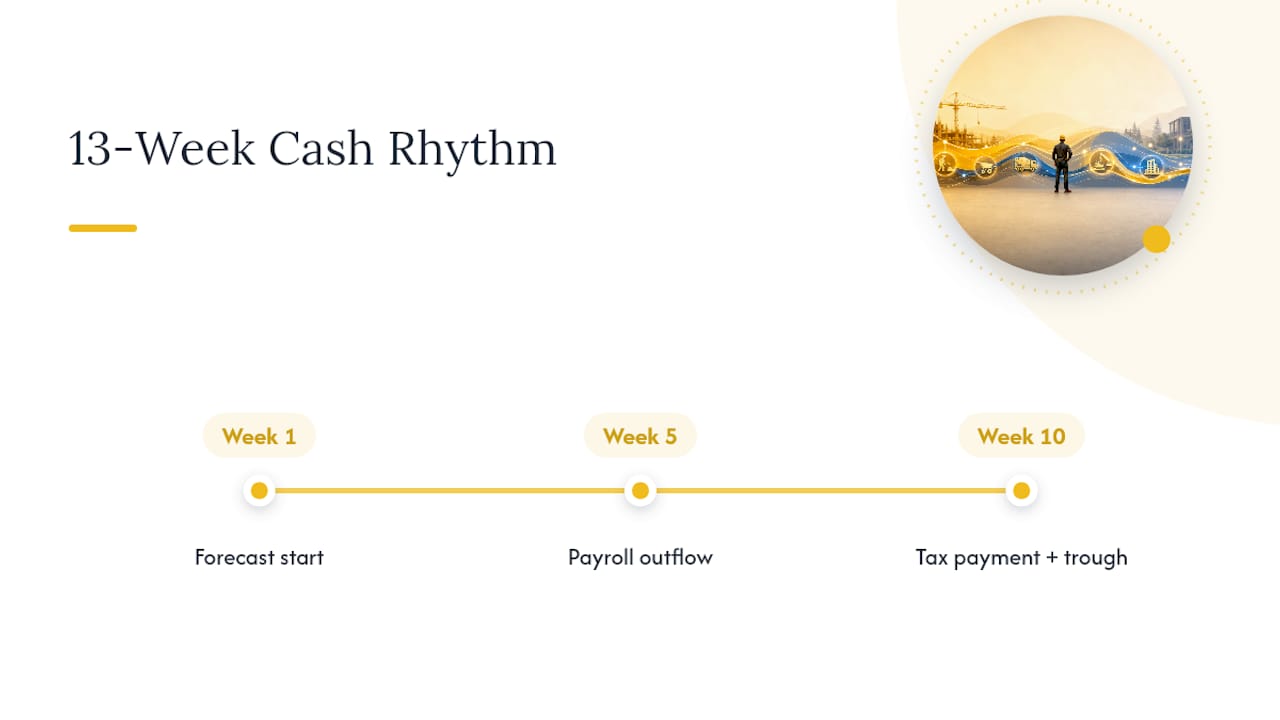
Quarterly estimated tax payments are another place cash flow planning matters. If your 13-week forecast shows a trough in the same week a tax payment is due, that’s not a coincidence you want to discover the week it happens. Build known tax dates directly into the forecast as fixed outflows, the same way you’d treat payroll.
Depreciation timing on equipment purchases can also shift your taxable income independent of your actual cash position, so a year with heavy equipment investment may show lower profit on paper while cash is tighter than the return suggests, or vice versa. None of this replaces guidance from a tax professional familiar with your jurisdiction’s rules for contractors, but the forecast should at minimum flag every known tax obligation as a scheduled outflow so it never arrives as a surprise.
Best practices for negotiating payment terms with clients and subcontractors
Payment terms are negotiated at the moment you have the most leverage: before you sign, not after the job starts. On new client contracts, push for a mobilization payment upfront, milestone billing tied to defined project stages, and a short, specific window for progress payment approval, ideally 15 to 30 days rather than open-ended language.
With subcontractors, the terms you negotiate downstream should mirror what you negotiated upstream, not lag behind it. If your client owes you retainage for 60 days after substantial completion, don’t hold your subcontractors to a 30-day retainage release when you won’t have the cash to pay them until your own release comes through. Matching your payable terms to your receivable terms is one of the simplest ways to avoid becoming the bank for everyone else on the job.
Put retainage release dates, change order approval timelines, and dispute resolution windows in writing on every contract, not as a verbal understanding. Contracts with vague payment language are the ones that end up stuck in AR aging past 90 days.
Financing options and credit management for contractor cash flow
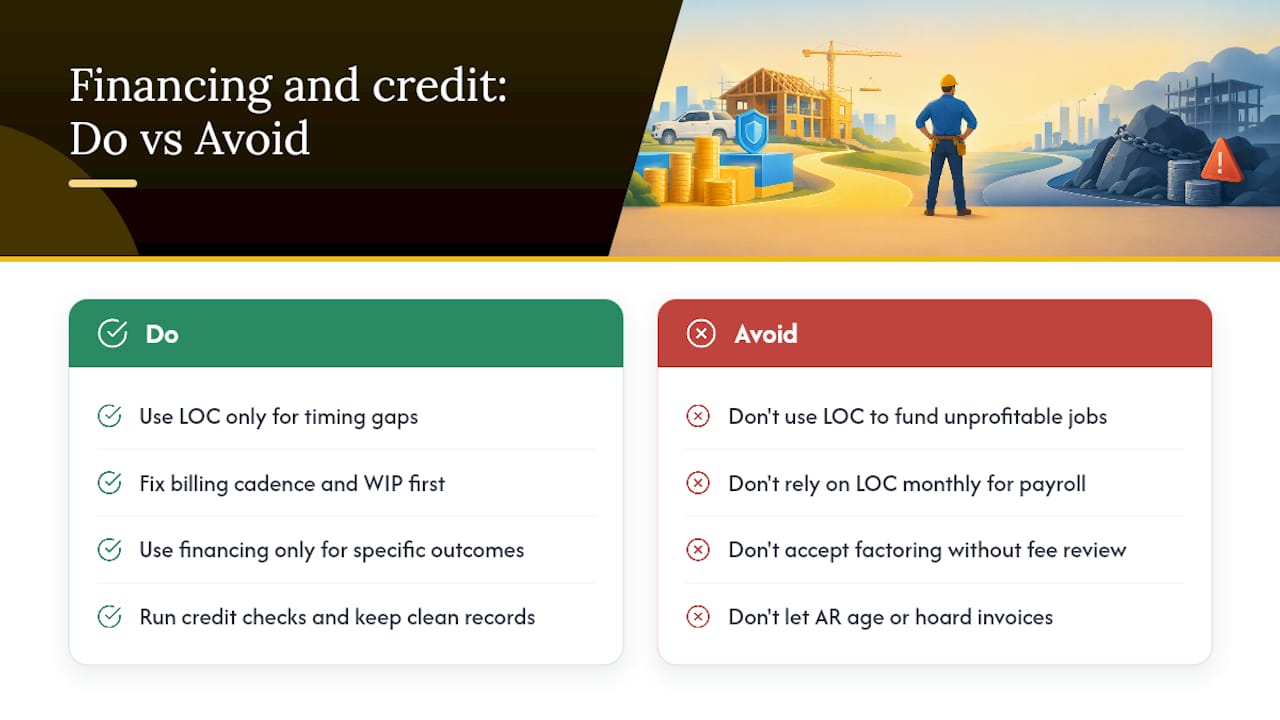
A line of credit exists to smooth timing gaps, not to fund a structurally unprofitable job, and the difference matters more than most owners treat it. If you’re drawing on your line every month just to make payroll, that’s a signal your billing cadence or WIP discipline needs fixing, not that you need a bigger credit line.
Equipment financing and invoice factoring both convert future cash into present cash at a cost, and that cost only makes sense when it buys you a specific, calculable outcome, like keeping a crew staffed through a slow season or bridging a known retainage release. Understand the fee structure before you commit; factoring in particular can erode margin quickly on thin-margin contract work.
Credit management on the receivable side matters just as much. Running a basic credit check on new commercial clients before signing a large contract catches payment risk before it becomes an AR aging problem. A contractor’s own credit standing with vendors and lenders also depends on the same discipline covered throughout this article: a lender or bonding company reviewing your books wants to see a clean cash flow statement and current WIP report, not a shoebox of invoices at year end.
Why owners keep ignoring their own books
Most owners can read a bank balance. Few can read a WIP report, and that gap is where cash problems hide. A controller manages the weekly cadence: reconciling, chasing AR, updating the forecast. A CFO-level view means deciding when to draw on credit, renegotiate a bonding line, or walk away from a job with fading margin. Growth is the trigger to make that shift, not crisis.
— Dan
Get hands-on help installing these systems
Reading about a 13-week forecast and actually running one every week for a year are different problems, and most owners underestimate the gap. These systems are installed directly inside businesses rather than simply handing over templates.

- Financial Operations and Compliance Assistance builds the reporting cadence covered in this article into your weekly operations.
- Management & Leadership Training gets your team to actually own the cash meeting instead of letting it lapse after month one.
- Rebuild addresses the broader operational gaps, staffing, dispatch, and sales process, that often sit upstream of cash problems.
If you’re ready to see what hands-on implementation looks like for your business, visit the Rebuild services page to start a conversation.
Sources
Further reading behind the systems in this article:
- 13-Week Cash Flow Forecast for Construction Companies – CivilCFO
- Retentions and contractual alternatives – RICS
- Improving financial success: forecasting, WIP & S curves – CFMA
FAQ
Is it true that most small businesses fail due to cash flow problems?
Cash flow issues are widely cited as a leading cause of small business failure, though the specific figure often quoted online varies by source and study year. Rather than relying on one number, focus on the practical fix: a weekly rolling forecast catches the trough before it becomes a failure point.
What is the CFO formula for cash flow?
There is no single standardized “CFO formula” that applies across every business type, and contractors should be cautious of definitions that claim otherwise. The core CFO-level habit is comparing operating cash flow against fixed obligations and forecasted troughs, then deciding when to draw credit or adjust job pacing.
Is cash flow lending or invoice factoring legit for contractors?
Invoice factoring and cash flow lending are legitimate, widely used financing tools, but they come at a real cost that can erode margin on thin-margin contract work. They make the most sense as a bridge for a known, calculable gap, such as a retainage release date already on your 13-week forecast, not as a permanent fix for a structurally unprofitable job.
How often should contractors update their cash flow forecast?
Contractors should update their cash flow forecast weekly rather than monthly, since CFMA guidance recommends more frequent monitoring to catch timing issues like job borrow and margin fade before they compound. A monthly cadence is too slow to catch a cash trough in time to act on it.
What is the fastest way to find cash trapped in current jobs?
Run a WIP review across every open job to find underbilled work, which is cash you’ve earned but haven’t invoiced yet. CFMA’s forecasting and WIP guidance points to this as one of the quickest ways to surface cash that’s already earned but sitting unbilled.
0 Comments