
The most reliable field supervisor training combines a quick needs analysis, a short trade-specific curriculum, mandatory field mentoring, and tracked KPIs. Owners who follow this sequence typically see early signs of change within 30 to 90 days: better safety behaviors on site, cleaner scheduling, and fewer callbacks. Skip any one piece and the gains rarely stick.
TL;DR:
- Field supervisor training is most effective when it starts with a needs analysis, focusing on interpersonal skills, safety, and management, with modules lasting 2 to 3 hours.
- Most improvements appear within 30 to 90 days, including safer site behaviors, better scheduling, and lower callback rates, especially when training includes field mentoring and KPI tracking.
- Training should be repeated regularly with field coaching and reinforcement through microlearning, as one-time classroom sessions rarely lead to sustained behavior change.
- Use basic technology like mobile checklists, microlearning apps, and field reporting tools tailored to your crew size to support ongoing reinforcement without high costs.
- Customizing training around actual dispatch workflows and site-specific scenarios enhances relevance, and building a system that includes mentoring and assessment yields better results than generic courses.
Table of Contents
- Core components every field supervisor training program must include
- Designing a program for trade businesses: needs analysis, curriculum length, and customization
- Delivery and on-the-job reinforcement: coaching, mentoring, and technology that work in the field
- Rollout, measurement, and what success looks like (KPIs and 30/60/90 checklist)
- Practical perspective from Rebuilding the Trades: how we run supervisory training for trade firms
- Legal and regulatory compliance training relevant to field supervisors
- Handling conflict resolution and employee relations in the field
- Crisis management and emergency response training
- Use of technology and tools specific to field supervision
- Cultural competency and diversity training for field teams
- What most owners get wrong about supervisor training
- How Rebuilding the Trades can help
- FAQ
- Sources
Core components every field supervisor training program must include
Most field supervisors get promoted because they are good at the trade, not because anyone taught them to manage people. That gap shows up fast: missed handoffs, safety shortcuts, and crews that drift without direction. A working training program closes it with five components.
Leadership and safety leadership come first. The Foundations for Safety Leadership module, built by CPWR and used as an elective in OSHA’s 30-hour construction course, is a useful model: a short session teaching five specific safety leadership skills rather than a vague lecture on “being a good leader.” A published evaluation found that supervisors who completed FSL-style training showed statistically significant gains in understanding and self-reported use of leadership and safety practices shortly after training. The evaluation of FSL training shows the strongest improvement among supervisors from small and medium-sized companies, where baseline leadership habits tend to be weaker.
Communication is the second module, built around three-way briefings: the supervisor states the task, the crew member repeats it back, and both confirm understanding before work starts. This single habit cuts down on the “I thought you meant” conversations that cause rework and safety incidents.
The remaining three components round out a working curriculum:
- Planning and daily sequencing, tailored to whether the crew runs service calls or multi-day installs.
- Productivity and job-cost awareness, so supervisors understand how schedule slips and material waste hit the bottom line.
- Built-in assessment, including short knowledge checks, scenario practice, and a field observation rubric a manager can use during a site visit.
None of these modules needs to run long. The value comes from repetition and field practice, not classroom hours.
Designing a program for trade businesses: needs analysis, curriculum length, and customization
Before building anything, find out what your supervisors actually lack. A leadership development evidence review from CIPD found that training works best when it starts with a real needs analysis, focuses on interpersonal and general management skills, uses several instructional methods, and gets repeated over time rather than delivered once.
A practical needs analysis for a trade business takes three steps:
- Run a short survey asking supervisors and their crews to rate communication, scheduling, and safety follow-through.
- Hold brief one-on-one conversations with each supervisor to surface specific incidents where something went wrong.
- Review recent critical incidents, callbacks, or near-misses to find patterns the survey missed.
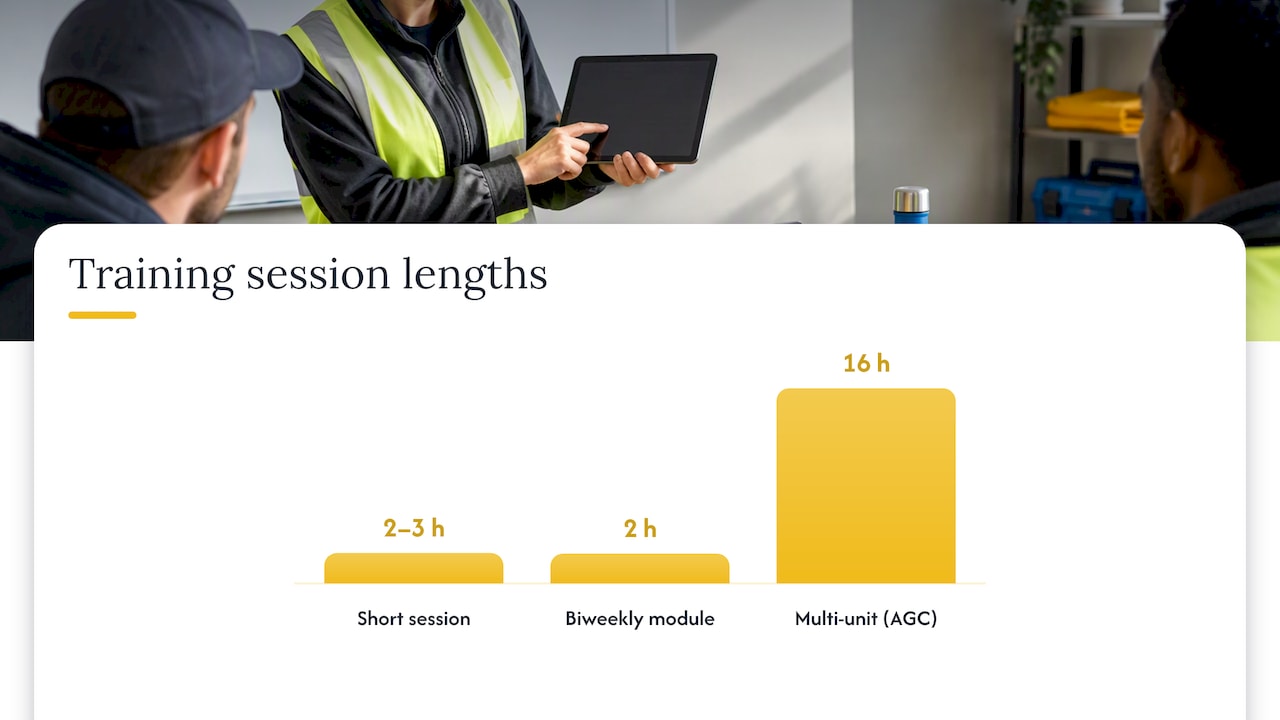
Once you have the gaps, match them to module length. Short, focused sessions in the 2 to 3 hour range work well for a single skill like safety leadership or briefings. For broader coverage, a multi-unit structure modeled on the AGC Supervisory Training Program, commonly built in 16-hour units covering leadership, communication, planning and scheduling, productivity, contract documents, and risk management, gives you a scalable framework you can deliver in classroom, hybrid, or online formats depending on crew availability.
Whatever the length, build in company-specific scenarios: your actual dispatch workflow, your SOPs, and bilingual materials if your crews need them. Generic case studies from an outside industry do not transfer the same way.
Pro Tip: Run the same two-hour module twice a month instead of one long annual seminar. Spaced repetition beats a single workshop every time supervisors have to apply the skill on a live jobsite.
Delivery and on-the-job reinforcement: coaching, mentoring, and technology that work in the field
Training that stays in the classroom does not change behavior on a jobsite. A 2026 frontline safety report from Oregon State recommends mixing classroom instruction with field-based mentoring and practical problem solving, and linking both to ongoing assessment rather than treating training as a one-time event.
A workable delivery blend for a trade contractor looks like this:
- Short classroom or virtual sessions for new concepts, kept under three hours.
- Weekly field mentoring, where an experienced supervisor or manager shadows the trainee on real calls.
- Toolbox talks that reinforce one safety or communication point at the start of a shift.
- Microlearning refreshers sent by text or app a few weeks after the initial session.
Field mentoring needs structure to work. Pick mentors for their coaching ability, not just seniority, give them a short observation checklist, and schedule a feedback conversation after each shadow session. Our piece on coaching versus managing breaks down how to keep that feedback constructive rather than corrective.
On the technology side, you do not need a large budget. Mobile checklists, a shared microlearning app, and simple video review for coaching sessions cover most needs. Platforms like CivroBuild support scheduling and field reporting in one place, which helps when you are trying to track checklist completion without adding paperwork. VR or AR simulations can add value for complex or hazardous scenarios, but they are optional additions, not a starting requirement.
Assessment should run on both ends: a pre- and post-test around each module, and a field observation rubric tied to the KPIs you are tracking.
Rollout, measurement, and what success looks like (KPIs and 30/60/90 checklist)
A training program without measurement is a guess. Set a 30/60/90 day pilot before rolling anything out company-wide.
- Days 1 to 30: pick one or two pilot crews, schedule the first training sessions, assign mentors, and collect baseline numbers on safety incidents, schedule adherence, and callback rates.
- Days 31 to 60: run weekly field mentoring sessions, deliver microlearning refreshers, and log observed behavior changes using your rubric.
- Days 61 to 90: compare post-training KPIs against baseline and decide whether to expand the program to additional crews.
Track a small set of KPIs rather than a long list: observed safety leadership behaviors, incident and near-miss reporting rates, schedule adherence, rework rate, first-time fix rate, and crew turnover. A published evaluation of FSL-style training found statistically significant improvement in supervisors’ understanding and use of leadership and safety practices shortly after training. The strongest gains were among supervisors from smaller companies, according to the evaluation of FSL training. For a small or mid-size contractor, that means training investment tends to pay back faster than larger firms often assume.
For a rough ROI signal, track hours saved from fewer reworks, reduced callback trips, and any drop in incident-related costs. Set a formal review at the 90-day mark and use whatever gaps show up in the KPI data to adjust the next round of curriculum, rather than redesigning the whole program from scratch.
Practical perspective from Rebuilding the Trades: how we run supervisory training for trade firms
We start with a short diagnostic of supervisory gaps, followed by a curriculum built around actual dispatch workflows, SOPs, and job types rather than a generic course. From there, onsite coaching reinforces the material on live jobs, and a KPI dashboard tracks whether behavior is actually changing.
The difference from a packaged course is the fieldwork: coaching happens on jobsites, tied to scheduling and financial systems. Our Tri-Trade case study outlines one example of what that operational work can produce.
Legal and regulatory compliance training relevant to field supervisors
Field supervisors sit closest to the decisions that create legal exposure: who works which hours, how an incident gets documented, and whether a jobsite follows the safety rules that apply to it. Training needs to cover the basics of recordkeeping, incident reporting timelines, and the supervisor’s role when a regulator or inspector shows up on site, even in a program that is not primarily about compliance.
Supervisors also need a working understanding of how safety credentials fit into their role. The STSC certification from BCSP requires a minimum of 30 hours of safety training along with supervisory experience, which gives owners a benchmark for how much formal safety instruction a credentialed supervisor is expected to carry. Even without pursuing certification, using that threshold as a reference point helps set realistic expectations for how much compliance training belongs in a supervisor’s first year.
Because rules on hours, licensing, and jobsite safety requirements vary significantly by location and trade, a generic compliance module is not enough. Build the legal and regulatory section around what applies in your own jurisdiction and trade, and update it when rules change rather than treating it as a one-time addition to the curriculum.
Handling conflict resolution and employee relations in the field
Most new supervisors have never been trained to handle a disagreement between two crew members or a complaint from a client standing in their driveway. Left untrained, they tend to either avoid the conflict entirely or escalate it, both of which cost time and morale.
A useful module teaches a simple process: let both sides state their view without interruption, identify the actual point of disagreement rather than the surface complaint, and agree on one next step before ending the conversation. Supervisors who skip technical competence and move straight into a leadership role often need explicit instruction here, since the construction foreman certificate program notes that the shift from skilled tradesperson to supervisor requires direct training in delegation and conflict handling, not just technical mastery.
Employee relations issues, like attendance problems or performance concerns, also land on the supervisor’s desk first. Pair this training with a clear process for when to document an issue versus when to escalate it, so supervisors are not making that call alone the first time it comes up.
Crisis management and emergency response training
A field supervisor is often the first person on site when something goes wrong, whether that is a safety incident, a gas leak, a vehicle accident, or a weather emergency on a roofing job. Training needs to give them a clear, memorized sequence: secure the area, account for every crew member, contact emergency services if needed, and notify the office.
This is one area where practice matters more than lecture. A short tabletop drill, walking through a specific scenario like a fall on a roofing job or a flooded basement on a plumbing call, gives supervisors a chance to rehearse the decision-making before it happens for real. Keep the scenarios specific to your trade: an HVAC crew and a roofing crew face different emergency types, and generic crisis training tends to miss the details that matter on an actual call.
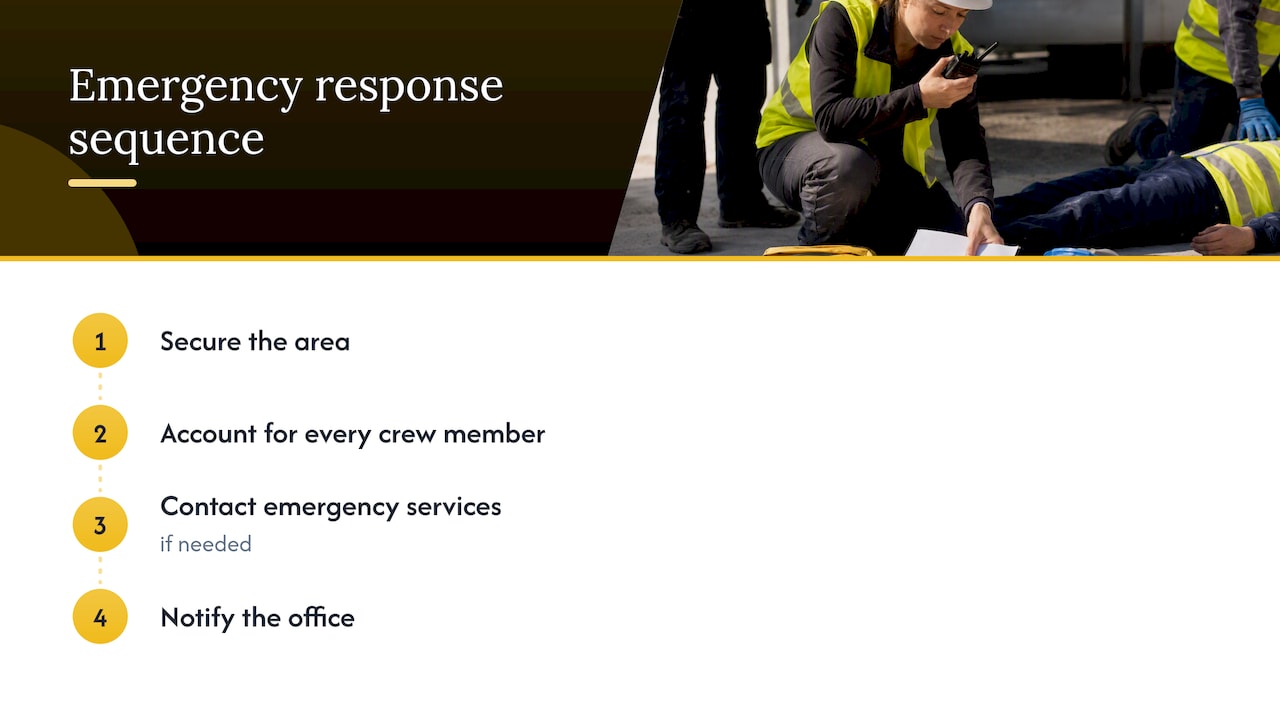
Document the response plan in simple terms your supervisors can reference quickly, not a long policy manual. The goal is a one-page sequence they can recall under pressure.
Use of technology and tools specific to field supervision
Supervisors juggle scheduling, safety checks, and crew communication, often from a truck between job sites. The right tools reduce that load instead of adding another system to manage.
Mobile checklist apps let supervisors complete safety walkthroughs and job-start verifications from a phone, with the data flowing straight into a shared record instead of a paper form that gets lost. Field reporting software, including platforms like CivroBuild, consolidates scheduling, checklists, and job notes in one place, which matters most for contractors running crews across multiple sites at once. For geographically spread jobs, resources like JRP’s construction progress services illustrate how tracking tools support supervisors managing work across distant locations.
Microlearning platforms that push a short video or quiz to a supervisor’s phone a few weeks after initial training reinforce the material without pulling anyone off a job site for a refresher session. None of this requires an enterprise software budget. A contractor can start with a basic mobile checklist tool and a shared messaging channel, then add more structured field reporting software as the crew count grows.
Cultural competency and diversity training for field teams
Trade crews are often made up of workers from different language backgrounds, generations, and cultural norms around communication and authority. A supervisor who does not account for that can misread a quiet crew member as disengaged or create friction without realizing why.
Training here does not need to be elaborate. Cover the basics: how to communicate clearly with crew members who speak English as a second language, how directness is perceived differently across cultures, and how to make sure safety briefings land regardless of language barriers. If your crew includes non-English speakers, bilingual training materials and translated safety signage are not optional extras, they are part of making sure the training actually works on site.
The goal is a crew where every member understands instructions the same way and feels comfortable raising a safety concern, regardless of background. That consistency shows up directly in incident reporting rates and first-time fix quality.
What most owners get wrong about supervisor training
The biggest mistake is treating training as a one-time event instead of a system. Owners send a supervisor to a single workshop, check the box, and wonder six months later why nothing changed. The evidence on this is consistent: training sticks when it is repeated, tied to field practice, and reinforced by a mentor who is actually watching the work happen.
The second mistake is over-investing in curriculum length before running a needs analysis. A long, generic program covering everything is less useful than a short one built around your actual gaps. Most small and mid-size trade contractors do not need a 120-hour certification track to start. They need two or three sharp modules, a mentor checking in weekly, and a handful of KPIs tracked consistently.
If you take one thing from this, make it mandatory field coaching. Classroom content without a mentor watching the behavior on a real job rarely survives contact with a busy week.
— Dan
How Rebuilding the Trades can help
We build supervisor training around crews, dispatch workflow, and financial systems instead of a generic course, through services covering management and leadership training, install and project management training, and call management and dispatch training.

- Start with a short diagnostic to find your actual supervisor skill gaps.
- Get a curriculum and coaching plan built for your trade and crew size.
- Review the Rebuild service page to see the full scope of the engagement.
If you are ready to see how this works for your business, reach out to schedule a pilot diagnostic and review timeline options for getting started.
FAQ
What is field supervisor training?
Field supervisor training teaches foremen, crew leaders, and service supervisors in trades like HVAC, plumbing, electrical, and roofing how to manage people, schedules, and safety on the job, not just the technical work itself. It typically covers leadership, communication, planning, and safety leadership skills.
How long does field supervisor training take?
Short modules focused on one skill, like safety leadership, often run 2 to 3 hours, while broader multi-unit programs modeled on the AGC Supervisory Training Program are commonly built in 16-hour units. Most trade contractors see better results from several short sessions spaced over weeks than one long seminar.
What results should I expect from supervisor training?
Owners typically start seeing early signs of change within 30 to 90 days, including improved safety behaviors and clearer scheduling. A published evaluation found that FSL-style training produced statistically significant gains in supervisors’ leadership knowledge and safety practice use. The strongest improvement was among supervisors from small and medium-sized companies, per the evaluation of FSL training.
Do I need expensive technology to train field supervisors?
No. A mobile checklist app, a shared messaging channel, and simple microlearning refreshers cover most needs for small and mid-size trade contractors. More advanced field reporting software, like CivroBuild, becomes worth adding once you are managing multiple crews across several job sites.
What does Rebuilding the Trades offer for supervisor training?
We provide hands-on management and leadership training built around dispatch, scheduling, and financial systems rather than a generic course. Pricing is available on request through the Rebuild service page.
Sources
- Evaluation of FSL training (PMC/NLM)
- AGC Supervisory Training Program brochure
- Frontline safety report (Oregon State, 2026)
- CIPD leadership development evidence review
0 Comments