
A weekly ops review is a recurring, cross-functional meeting where teams examine performance data, surface anomalies, and leave with assigned actions rather than a list of numbers everyone already saw on a dashboard. Most run 30 to 60 minutes on a weekly cadence. Done well, it ties technical measures like SLOs and error budgets to business outcomes, the same discipline Rebuilding the Trades applies when it builds accountability systems for trade businesses.
TL;DR:
- Only metrics related to reliability, customer impact, throughput, quality, cost, capacity, safety, and field performance should be discussed, with a focus on anomalies, not raw numbers.
- Incident reviews should summarize impact, cause, and actions in the weekly meeting, while full postmortems are handled separately to avoid lengthy discussions.
- Meetings require specific roles, strict time-boxing, and a visible action tracker to maintain focus on decisions and accountability.
- Preparation involves updating dashboards and pre-reads, while follow-up ensures actions are tracked and resolved into subsequent meetings.
- Trade businesses can implement these practices by pairing dashboards with leadership training and accountability systems, transforming meetings into decision-making forums.
Table of Contents
- What a weekly ops review is and why it matters
- A sample agenda that fits in 30 to 60 minutes
- Which metrics and dashboards belong in the room
- Handling incidents and postmortems without redoing the investigation
- Roles and facilitation that keep the meeting honest
- A practical runbook: prepare, run, follow up
- How Rebuilding the Trades applies this inside trade businesses
- Why weekly reviews must be decision forums, not status rituals
- Setting up a weekly ops review that holds
- Primary sources worth bookmarking
- Sources
- FAQ
What a weekly ops review is and why it matters
A weekly ops review sits between two other meetings people often confuse it with. Daily standups track immediate blockers. Operational readiness reviews are checklist-based gates teams run before a launch, not recurring performance forums, a distinction AWS Well-Architected draws explicitly. The weekly review fills the gap: a regular look back at trends, incidents, and risk, with enough authority in the room to make calls.
That means the right people need to show up with the right mandate.
- A facilitator who runs the clock and keeps the conversation on decisions.
- A representative from operations or engineering who owns the metrics being shown.
- A product or program voice who can weigh business tradeoffs.
- Someone with authority to approve resourcing or priority changes on the spot.
AWS Well-Architected frames this kind of review as a feedback loop, a place to capture improvement opportunities across development, testing, and production rather than only reacting to what broke in the last seven days.
A sample agenda that fits in 30 to 60 minutes
A tight agenda is what keeps a weekly ops review from turning into a status reading. The structure below scales down to 30 minutes for a small team or stretches to 60 for a group handling multiple product lines.
- Open with a BLUF statement on overall health, roughly 3 minutes, covering safety or team mood where relevant.
- Review top metrics and flag anomalies only, 10 to 15 minutes, skipping anything tracking normally.
- Walk through incident status and any requested deep dives, 10 to 20 minutes.
- Make decisions and assign actions with owners and dates, 10 minutes.
- Close with a quick commitments recap, under 5 minutes.
Pre-reads matter as much as the meeting itself: dashboards need to be current before anyone walks in, and the action tracker from last week should be visible, not rebuilt from memory. Larger organizations often split into breakout reviews by function, with a rotating presenter each week so the habit of keeping data current does not rest on one person.
Which metrics and dashboards belong in the room
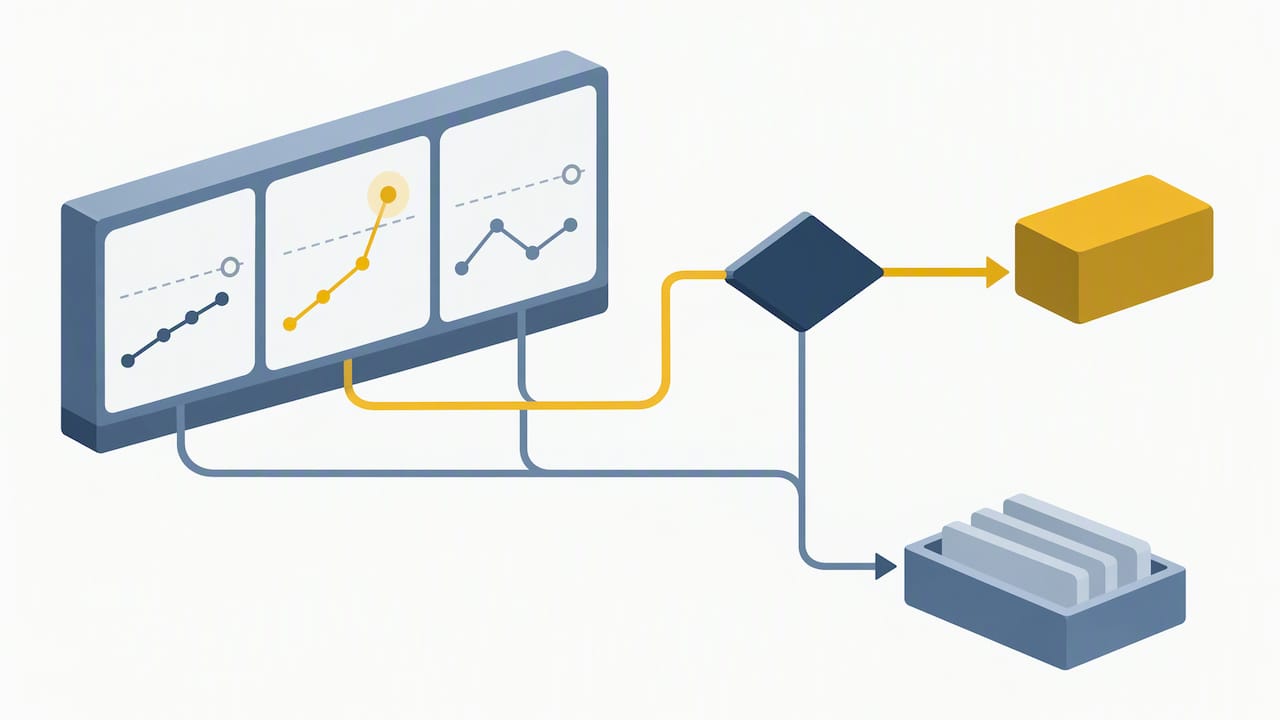
Not every number deserves airtime. A weekly ops review works best when the dashboard groups metrics into a handful of categories and shows only what moved.
- Reliability and customer impact: uptime, error rates, support ticket volume.
- Throughput: jobs completed, cycle time, backlog size.
- Quality: rework rate, defect escape rate, callback rate for field service.
- Cost and capacity: spend against budget, crew or server utilization.
- Safety and field performance: incident rate, first-time fix rate, on-time arrival.
The pairing that makes a review decision-capable is SLIs tied to explicit SLOs with an error budget attached. Google Cloud’s SRE guidance frames the error budget as the mechanism that lets a team trade reliability against cost or delivery speed instead of arguing from gut feel.
A dashboard that only displays numbers, with no target or trend attached, cannot support a decision, which is why AWS guidance ties operations metrics reviews to identifying improvement opportunities, not reciting figures. Build the dashboard around anomalies, pre-flagged decisions, and an action status column, and skip reading every line item aloud.
Handling incidents and postmortems without redoing the investigation
Incidents belong in the weekly review as a status check, not a reinvestigation. Google Cloud’s operational excellence guidance recommends summarizing each incident briefly and running the full postmortem separately.
For each incident on the agenda, capture:
- Impact and timeline, in a sentence or two.
- Immediate cause and any systemic contributors.
- Actions assigned, their owners, and current status.
Atlassian’s postmortem guidance backs the same separation: the weekly meeting tracks whether postmortem actions are closing, while the deep analysis happens in its own session. Escalate to a dedicated postmortem meeting when an incident caused significant customer impact, when the root cause is still unclear after initial triage, or when more than one team needs to coordinate a fix. Trying to solve the problem live in the weekly review is usually what makes these meetings run long and lose focus.
Roles and facilitation that keep the meeting honest
A weekly ops review needs defined roles: a meeting lead who owns the agenda, a facilitator who manages time, a data owner responsible for each dashboard, an action owner for each commitment, and a timekeeper if the lead is also presenting.
Facilitation technique matters more than the agenda template itself.
- Open with the bottom line, then back into detail only if someone asks.
- Time-box every section and enforce it, even mid-sentence.
- Rotate or randomly select presenters, a practice AWS documents at Amazon specifically to keep dashboards current and teams ready to present without warning.
- Use blameless language when discussing what went wrong, focused on systems and conditions, not individuals.
Pro Tip: Keep a visible, shared action tracker in the room during the meeting itself, not just in the minutes afterward. It discourages vague commitments.
A practical runbook: prepare, run, follow up
Running an effective weekly ops review comes down to three phases, each with its own short checklist.
- Before the meeting: confirm presenters, update every dashboard, circulate pre-reads, and pull last week’s open actions into the agenda.
- During the meeting: open with a one-line health statement, review flagged anomalies, make the decisions that are actually on the table, and assign each action to a named owner with a date.
- After the meeting: update the shared tracker immediately, fold new actions into each owner’s regular work queue, and review closure rates the following week.
| Phase | Core task | Owner |
|---|---|---|
| Prepare | Update dashboards and pre-reads | Data owner |
| Run | Assign actions with owners and dates | Facilitator |
| Follow up | Track closure into next week’s review | Action owner |
Teams that skip the follow-up phase tend to see the same unresolved issue reappear for months. The DMAIC-style continuous improvement cycle AWS describes only works if actions from one week actually show up as closed or in progress the next.
For readers building out the metrics side of this process, a deeper look at HVAC KPIs tied to profit and growth shows how to pick measures that connect directly to business outcomes rather than vanity numbers. Construction project managers adapting the agenda structure can also borrow timing patterns from a preconstruction meeting agenda template built for a similar cross-functional format.
How Rebuilding the Trades applies this inside trade businesses
Rebuilding the Trades pairs operational dashboards with hands-on leadership training and accountability systems, the same combination this article describes, adapted for HVAC, plumbing, electrical, and similar trade businesses. One client case the firm cites involves reaching a multi-million dollar run rate alongside clearer operational visibility, an outcome the company attributes to its own engagement rather than an independent benchmark. Two adjustments matter most for trades specifically:
- Pairing dispatch and scheduling data directly into the weekly metrics set, not as a separate report.
- Using field-ready KPIs like first-time fix rate and callback rate instead of software-industry equivalents.
Readers can see how this fits into a broader operating rhythm in the org health assessment framework.
Why weekly reviews must be decision forums, not status rituals
The failure mode in most weekly ops reviews is not bad data, it is a room full of people narrating numbers nobody acts on. A review earns its hour when it closes a small number of real decisions and pushes actions into next week’s work, not when every metric gets a mention. Protect psychological safety enough that people volunteer bad news early, and measure the meeting itself by decisions closed, not minutes filled.
— Dan
Setting up a weekly ops review that holds
Most trade businesses already have the data to run a strong weekly ops review. What they lack is the dashboard structure, the trained facilitators, and the accountability habits that turn a meeting into a decision forum instead of a status update nobody remembers by Friday.

This is achieved through Management & Leadership Training and accountability systems tailored for trade businesses. A typical engagement starts with an onsite audit, moves into a pilot review cycle, and rolls out across the organization once the format proves out. If you are ready to build a weekly review your team actually uses, see the full range of services and start the conversation.
Primary sources worth bookmarking
- AWS Well-Architected operational metrics reviews for dashboard and feedback loop design.
- Google Cloud SRE guidance on SLOs and error budgets.
- Atlassian’s postmortem handbook for blameless incident tracking.
Sources
- OPS11-BP07 Perform operations metrics reviews (AWS Well-Architected)
- Manage incidents and problems (Google Cloud operational excellence guidance)
- How SREs analyze risks to evaluate SLOs (Google Cloud Blog)
- Postmortem guidance (Atlassian)
FAQ
What is an ops review?
An ops review is a recurring meeting where a team examines operational data, like performance metrics, incidents, and trends, to make decisions and assign follow-up actions. It differs from a readiness review, which is a one-time checklist gate before a launch.
What is a weekly operations meeting?
A weekly operations meeting, often called a weekly ops review, brings cross-functional stakeholders together on a set cadence, typically 30 to 60 minutes, to review anomalies in key metrics and close open actions. AWS Well-Architected frames it as a feedback loop for continuous improvement rather than a status report.
What is an ops meeting?
An ops meeting is a general term for any gathering focused on operational performance, ranging from daily standups to weekly or monthly reviews. The weekly version is the one most teams use to connect technical metrics to business decisions.
What is the purpose of a review meeting?
The purpose is to surface what changed, decide what to do about it, and assign that work to a named owner with a deadline. A review meeting that only reports numbers without producing decisions or actions has missed its point.
How does Rebuilding the Trades help set up a weekly ops review?
Rebuilding the Trades builds the dashboard systems and trains the leadership team needed to run an effective weekly ops review inside trade businesses. The work falls under its Management & Leadership Training and accountability system offerings, detailed on its services page.
0 Comments