
HVAC gross margin is the share of each sales dollar left after you pay the direct cost of the job: burdened technician labor, equipment, parts, subcontractors and permits. The formula is (revenue − direct job costs) ÷ revenue × 100. Published targets for contractors range widely by work type, roughly 25–35% on installs and 35–50% or more on service, and the number you report is only as good as the labor and material costs you load into it.
TL;DR
- Gross margin = (revenue − direct job costs) ÷ revenue × 100. Overhead is not in it. Net margin is what is left after overhead.
- Margin and markup are different. A 50% markup is only a 33% margin. Price from the margin you need, not from a markup you like.
- Targets differ by work: installs and replacements sit lower than service, repair and maintenance agreements. One blended number hides problems.
- Most reported margins are inflated by using base payroll instead of fully loaded labor. Fix the cost capture first, then chase the percentage.
- Review margin per job and per technician every week, not once a quarter from the P&L.
Table of Contents
- What HVAC gross margin actually measures
- How to calculate it, step by step
- Gross margin vs. markup: the conversion that costs money
- What gross margin should an HVAC company target?
- What pulls gross margin down
- A weekly routine to measure and protect margin
- Our perspective
- Get help turning margin into a managed number
- FAQ
- Sources
What HVAC gross margin actually measures
Gross margin answers one question: when we sell and deliver a job, how much of the price is left to pay for the business itself? Everything the job consumes directly comes out first. Everything the company consumes just by existing (office wages, rent, insurance, marketing, software) comes out after.
Simpro’s margin guide gives a clean example. A job with $12,000 in revenue and $6,000 in direct costs has a 50% gross margin. Take out $4,500 of overhead and $1,500 is left, a 12.5% net margin.
That split matters because the two numbers do different work. Gross margin tells you whether a job, a department or a technician is priced and run well. Net margin tells you whether the whole company is healthy. Gross margin is the better lens for managing departments such as install, service and maintenance, while net margin is the better lens for the entire business, as ServiceTitan’s profit margin article frames it.
A government small business guide from Australia’s Victorian state puts the relationship simply: net margin is gross margin less overhead, and it is your profit before tax. The arithmetic is the same in any country.

What counts as a direct job cost
A direct cost is anything you would not have spent if you had not sold the job. For an HVAC company that means:
- Equipment: condensers, furnaces, air handlers, coils.
- Parts and materials: line sets, fittings, refrigerant, duct, electrical supplies.
- Technician or installer labor at the fully loaded rate, meaning wages plus payroll taxes, workers’ comp, benefits and other burden.
- Subcontractors, such as electrical or sheet metal work.
- Permits, disposal and financing fees tied to that job.
FieldCamp lists the same core buckets: materials and equipment, technician labor including burden, and subcontractor fees. TaxSteady’s chart of accounts guide adds a useful bookkeeping rule: keep major equipment in its own account, separate from parts, so install margin stays honest.
How to calculate it, step by step
Here is the job-level calculation, using the $18,000 invoice example from Zevonix.
- Take the invoiced revenue: $18,000.
- Add every direct cost: equipment, materials, loaded labor, subcontracted work. In the example that totals $13,000.
- Subtract: $18,000 − $13,000 = $5,000 gross profit.
- Divide by revenue: $5,000 ÷ $18,000 = 27.8% gross margin.
Run the same math for the month by adding up revenue and direct costs for all jobs in a department. Do it for install, service and maintenance separately before you blend them.
The labor mistake that inflates your number
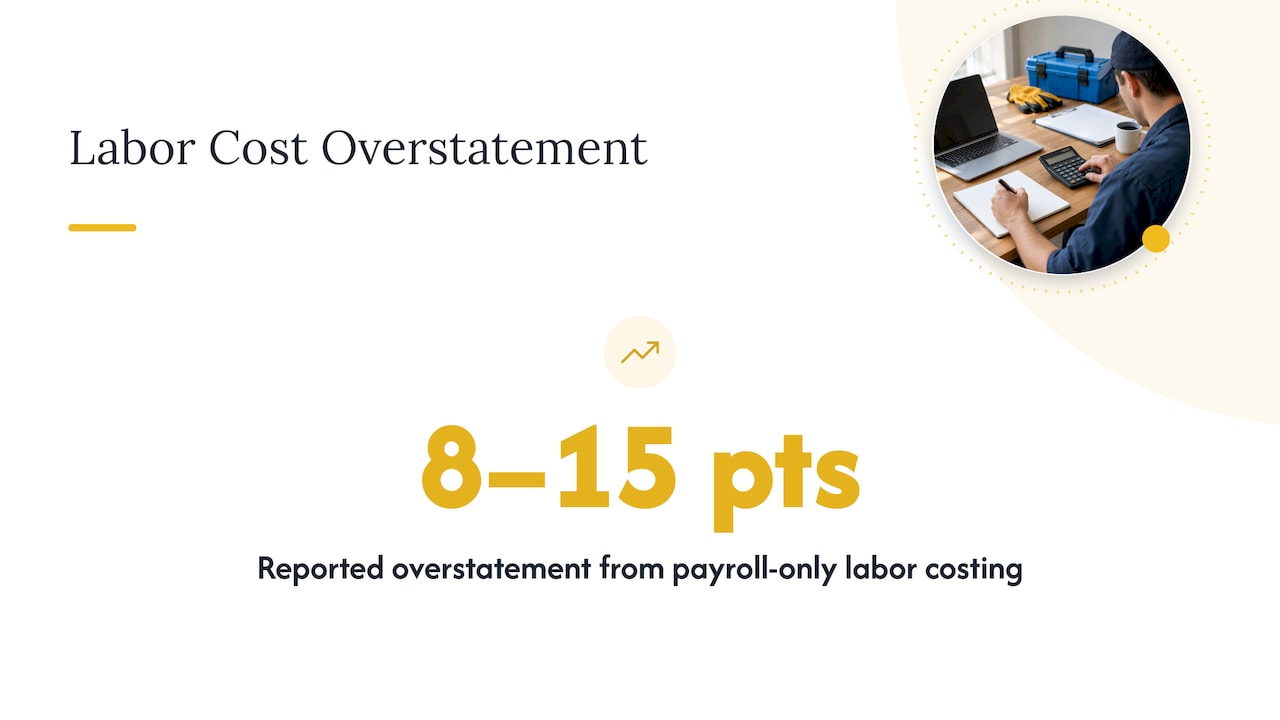
The most common error is costing labor at the hourly wage instead of the fully loaded rate. One benchmark guide from Marginplug says owners who use payroll rather than fully loaded labor overstate gross margin by 8 to 15 points. Treat that as a company-reported estimate, but the direction is certain: if burden is missing, margin looks better than it is.
Take a technician paid $30 an hour. If taxes, insurance and benefits add a meaningful percentage, the real cost of an hour on a job is well above $30. Multiply that gap by thousands of hours a year and you see why a shop can show a healthy gross margin and still run out of cash. We walk through the full calculation in our guide to labor burden for contractors.
Costs that quietly disappear
Simpro names several leaks that pull costs off the job and into overhead, or off the books entirely: field labor not tracked to a work order, materials pulled from van stock and never logged, scope changes never billed as change orders, and callback costs. Pipelineon’s job costing guide describes the same problem with indirect time: drive time, shop time, callback time and warranty work get buried in general overhead unless you handle them on purpose.
The same discipline applies to specialty work you subcontract or price by the unit. Estimators in neighboring trades think in unit costs, for example cabling cost per drop in low-voltage work. An HVAC contractor can borrow the habit: define each cost category once, cost every job the same way, and your margins become comparable job to job. When excavation or trenching is part of an install, the same logic applies to utility daylighting and hole count costs, which belong on the job rather than in overhead.
Gross margin vs. markup: the conversion that costs money
Markup is calculated on cost. Margin is calculated on price. They never match, and mixing them up is the fastest way to underprice a job.
- Markup = (price − cost) ÷ cost
- Margin = (price − cost) ÷ price
Simpro’s example: a 50% markup on a $400 part brings the price to $600, but the gross margin is only 33%. Tradeswork gives the reverse: a 50% margin requires a 100% markup.
The conversion formulas, as HVACPrice states them, are margin = markup ÷ (1 + markup) and markup = margin ÷ (1 − margin). To price for a target margin, divide cost by (1 − margin).
| Markup on cost | Resulting gross margin | Price on a $1,000 cost |
|---|---|---|
| 25% | 20.0% | $1,250 |
| 30% | 23.1% | $1,300 |
| 40% | 28.6% | $1,400 |
| 50% | 33.3% | $1,500 |
| 65% | 39.4% | $1,650 |
| 100% | 50.0% | $2,000 |
| Target margin | Markup you need | Price on a $1,000 cost |
|---|---|---|
| 30% | 42.9% | $1,429 |
| 35% | 53.8% | $1,538 |
| 40% | 66.7% | $1,667 |
| 50% | 100% | $2,000 |
One contractor-oriented estimate guide from Projul says many profitable residential replacement companies mark up equipment 40 to 65% over distributor cost, with commercial equipment lower at 25 to 40%. Run those through the first table: 40% to 65% markup is roughly a 29% to 39% margin on the equipment line, before labor is considered. If you want a method for setting markups by material type, see our piece on converting margin to exact markup.
What gross margin should an HVAC company target?
There is no single correct number, and any article that gives you one is hiding the mix. Published figures are self-reported and come mostly from software and industry vendors, so treat them as ranges to test against your own books.
| Work type | Typical target gross margin |
|---|---|
| Residential installs (AC, furnace, heat pump) | 25–35% |
| Full system replacement | 20–30% |
| Service and repair calls | 35–50% |
| Emergency after-hours calls | 45–65% |
| Duct cleaning | 40–55% |
| Annual maintenance agreements | 50–70% |
These ranges come from ServiceAgent’s pricing guide, which also says net after overhead should land at 10 to 20%. The trade publication ACHR News reports a similar split: service and maintenance work at 50 to 60% gross margin, installation at 25 to 35%.
Other sources aim higher. ServiceTitan suggests an average gross margin of 50 to 55% across services, which it says generally supports a 17 to 20% net margin. The spread between sources tells you something: definitions differ, especially on labor burden and what lands in cost of goods sold.
Net margin reality check
Gross margin targets only matter because of what they fund. Reported net margins are far lower than the aspirational figures. The 2025 ACCA Contractor of the Future Study, as summarized by a Canadian contractor, found a median net profit margin of about 5.8% among more than 1,000 contractors, with the top quartile above 13.2%. Your gross margin has to be high enough to carry your overhead and still leave you in that top group.
Why you should blend nothing
A shop doing 70% installs and a shop doing 70% service can post the same blended gross margin and be completely different businesses. Service-weighted revenue is steadier and tends to carry higher margin, a point ACHR News makes about earnings quality. Set a target for each line and track it separately. If you are deciding where to raise prices first, our guide to a service rate increase covers how much and when, and an up-to-date HVAC price book keeps every tech quoting the same margin.
What pulls gross margin down
When a shop’s margin sits below target, the cause is rarely one big mistake. It is usually several small leaks:
- Underpriced labor. Rates built on wages instead of loaded cost.
- Untracked time. Hours on a job that never reach the work order, including waiting for parts and unnecessary driving.
- Unlogged materials. Van stock used and never invoiced.
- Unbilled scope changes. Extra work done on a handshake.
- Callbacks. Every return trip is a cost with no revenue. Benchmarks cite a callback rate below 5% as a quality marker; our callback reduction guide shows how owners cut them.
- Weak closing on installs. Discounting to win the job erases the margin you planned.
- Poor dispatch. Low first-call completion adds truck rolls to the same ticket.
Two of these, discounting and truck rolls, are operations problems, not accounting problems. That is why raising your close rate through an operations-first sales process and improving first call completion often move margin more than a price increase does.
A weekly routine to measure and protect margin
Gross margin from your year-end P&L is a post-mortem. Use a weekly review instead. Simpro recommends a routine along these lines:
- Review jobs closed in the last seven days and flag any more than 10% under estimate.
- Review open jobs where actual labor has run more than 20% over the estimate.
- Check materials issued to jobs but not invoiced.
- Audit jobs closed more than 48 hours ago that have not been invoiced.
Then go one level deeper. ServiceAgent’s tracking guide stresses margin by job and by technician rather than aggregate averages, and keeping consistent job and technician records is the foundation. If one tech’s installs consistently land at 22% while the crew average is 30%, you have a coaching conversation, not a pricing problem.
Keep the books structured to match
Separate direct job costs from overhead in your chart of accounts so the report you pull each month shows the real picture. Our guides on contractor financial reporting and the HVAC KPIs owners should track lay out which numbers belong on the weekly page and which on the monthly one.
Our perspective
Most owners we meet do not have a margin problem first. They have a visibility problem. The number on the report is wrong because labor burden, van stock and callbacks never reach the job, so pricing decisions get made on fiction.
We start in the field. We look at how calls are booked, how jobs are dispatched, how techs are paid and how the office closes out tickets, because those habits decide what the margin report says. Then we build the reporting and accountability around it so owners and managers see job-level margin every week.
A target percentage is useful. A team that knows who owns each number, and a manager who coaches against it, is what actually moves it. That is the work we do for trade businesses, and only trade businesses.
Dan
Get help turning margin into a managed number
If your gross margin is below target, or you are not sure the number you see is real, our Rebuild engagement works inside your company: financial operations and compliance assistance, sales training, call management and dispatch training, and leadership training for the managers who own the numbers. We design it around trade businesses, not generic templates or software.

See how it works on our Rebuild page, or start from our homepage to read the case studies.
FAQ
What is a good gross margin for an HVAC company?
It depends on the mix. Published ranges put installs around 25–35% and service, repair and maintenance work at 35–70% depending on the line. Blended company targets cited by vendors run from the mid-30s to 50–55%. Set targets by work type and check them against your own fully loaded costs.
What is the markup on an HVAC unit?
One contractor guide reports that profitable residential replacement companies mark up equipment 40 to 65% over distributor cost. That is a 29% to 39% gross margin on the equipment alone. Convert with margin = markup ÷ (1 + markup) before you compare it to a margin target.
Is gross margin the same as profit?
No. Gross margin only subtracts direct job costs. Net profit also subtracts overhead such as office staff, rent, insurance and marketing. A job can have a strong gross margin and the company can still lose money if overhead is too heavy.
Why does my gross margin look high but cash is tight?
Usually because costs are missing from the job. Unloaded labor, untracked van stock, uninvoiced work and callbacks all inflate gross margin on paper. Fix the cost capture, then compare your corrected margin to your targets.
Sources
- Simpro: Master HVAC Profit Margins
- Business Victoria: Calculate your breakeven point, margin and markup
- ServiceTitan: Understanding HVAC Profit Margins
- FieldCamp: HVAC Profit Margins in 2026
- TaxSteady: HVAC Chart of Accounts
- Zevonix: How to Calculate Job Gross Margin
- Marginplug: HVAC Business Benchmarks 2026
- Pipelineon: Understanding HVAC Job Costing
- Tradeswork: What Is Gross Margin?
- HVACPrice: HVAC markup vs. margin
- Projul: Free HVAC Estimate Templates
- ServiceAgent: HVAC Pricing Guide
- ServiceAgent: How to Track HVAC Job and Technician Profitability
- ACHR News: The Gap Between 4.0× and 10.93×
- Moe Heating & Cooling: Divisor vs Multiplier
- Low Voltage Corp: Commercial Cabling Cost per Drop
- Rocky Mountain Underground: Utility Daylighting Costs
0 Comments